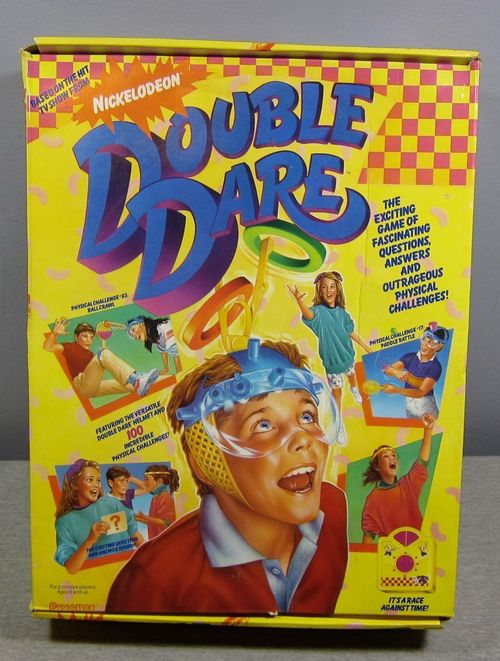
Nickelodeon Double Dare
Nickelodeon Double Dare Rulebook
Table of Contents
Table of Contents
Object
To be the team or player with the most Double Dare Dollars at the end of the game. Players earn dollars by correctly answering questions, by performing Physical Challenges within the time limits and when the opposing team fails to answer a DARE correctly or complete a Physical Challenge. Dollars are also earned by successfully completing the final Obstacle Course round.
Contents
- Stunt Helmet with connecting Goggles, Basket, Squeezers, Paddle, 3 Foam Discs, 3 Foam Rings, 3 Foam Balls, Foam Swing Ball, Swing Ball Plug, "Double Dare" Disc with strap and buckle, 3 "A" Plugs, 2 "B" Plugs, Double Dare Timer, Double Dare Dollars, 50 Question and Answer Game Cards, Answer Reveal Slide, 50 Physical Challenge Cards with 100 Challenges.
Assembling Your Helmet
Put the top part of the helmet together by pushing the B Tab into the A Slot (see illustration). Attach the Ear Flaps to the sides of the helmet by pushing the five posts on the Flaps, from behind, into the five holes.
Attach the Goggles to the helmet by pushing the three holes at the top of the Goggles onto the front three Plugs. Then, press the Goggle Caps over the Plugs to secure the Goggles in place.
Once you've assembled the helmet, it stays assembled. The only parts you'll have to adjust for each player is the Head Strap (at the back of the helmet) and the chin strap.
Note: For your safety, you must wear the Goggles while performing Physical Challenges, also remove blue protective film from Goggles before using.
Illustration callouts (Double Dare Helmet): Push "A" tabs into "B" slots; "B" slots; "A" tabs; Adjustable Head Strap; Plug 5 posts in from the back; Ear Flaps; Adjustable chin strap threads through the Buckle.
Illustration callouts (Goggle detail): Goggle Caps keep GOGGLES attached to HELMET. Goggles. Goggle Plug: Push Goggle Holes around Plugs and push Caps onto Plugs sandwiching Goggles in Place.
Set Up
The Double Dare Helmet/System has been developed as a construction system. That means that most of the parts can be plugged together, with or without using the "A" and "B" plugs. This construction allows you to create an incredible variety of Physical Challenges! The following drawings will help you see how some of the basic pieces should be assembled. The Physical Challenge cards will show you how each individual Challenge should be put together.
Double Dare Basket
Attach two parts of BASKET as shown, by pushing "A" tabs into "B" slots. These two parts stay together as one piece once assembled.
Illustration callouts: "A" tabs; "B" slots.
Double Dare Paddle
Back of BASKET can be plugged directly into PADDLE and DD DISC.
This end of PADDLE can plug directly onto HELMET. Using "A" and "B" plugs, the PADDLE can be plugged into the DD DISC.
Double Dare Squeezers
Top end can plug directly into the HELMET or, using an "A" Plug, can be attached to the Double Dare DISC. (See illustration, page 5.)
These ends of the Squeezers can be attached to the CUP, BASKET or HELMET.
Swing Ball
You'll need to tie the string through the loop of the Plug and knot. The Plug and SWING BALL stay together as one piece once assembled.
Double Dare Disc / Elastic Strap and Buckle
Before attaching the DD's to the Disc be sure to thread the elastic strap through the loops on the back of the Disc, as shown. Once threaded, double back into the buckle to keep in place.
Then, attach the DD's to the Disc by inserting the "A" tabs into the "B" slots.
The DD's, Disc and elastic strap stay together as one piece once assembled.
Illustration callouts: "A" tabs; "B" slots.
"A" Plug, "B" Plug and Cup
Choose 1 of the A plugs to fit into 1 of the B plugs, and put together. This one unit can stay together and need not be taken apart.
The illustrations on the Physical Challenge cards will show you how to assemble the parts for each individual Challenge.
Here are some examples of how things can fit together to give you a basic idea!
Illustration callouts: "B" Plug; "A" Plug. Note: When removing "A" plug twist and pull.
Team Names
Have each team make up a fun name: "Pickleheads," "Daredevils," "Panthers," The Triple Threats" are all examples.
Hosting the Game
On TV, there is a DOUBLE DARE host. You don't need a host to play at home. But if someone wants to play "host" then let the person ask all the questions, set up the Physical Challenges and hand out the money. (Bad jokes are optional.)
Playing Double Dare
There are 3 different rounds in Double Dare: Round 1 and Round 2 feature 10 questions each and Physical Challenges. Round 3 is the Obstacle Course Round where all players compete in a final attempt to win the game.
Starting the Game
Divide into 2 teams of equal numbers. Choose a banker; this player will hand out the dollars as they are won.
Flip a coin. The team that wins the toss gets "control," which means they have the right to answer the first question. This is Team A.
Round One
The team asking the question selects a Question and Answer Game Card and reads aloud the first question on the side marked "Round One." After reading the question, insert the question card into the Answer Reveal Slide (see illustration). Then gently pull the card up until the first question passes the window and shows through the top. Be careful not to slide strip past the word "ANSWER" which appears below each question.
Illustration callout: "Don't reveal the ANSWER until someone ANSWERS a Question!"
Game Options
I. Options
Team A won the coin toss. Therefore Team A was asked the first question. Now Team A has 3 options. Team A can...
-
Answer the question correctly and win $10. or they might...
-
Answer the question wrong and lose control of the game (so that the Team B would be asked the next question first. If there is no DARE at stake, Team B does not get any money—just control.) Or they can...
-
DARE Team B to answer the question.
II. Playing out Option #3 "DARE"
If Team A DARES Team B to answer the question, Team B has 3 options. Team B may...
A) Answer the question correctly and win double the dollars ($20). They then get control of the game (so they would be asked the next question first). Or Team B may...
B) Answer the question wrong. A wrong answer on a DARE gets Team A $20. Team A then gets control of the game (so they are asked the next question first). Or Team B might...
C) DOUBLE DARE Team A to answer the question.
III. Playing Out Option #IIC "DOUBLE DARE"
(Printed as "#IIC" in the source.)
If Team B DOUBLE DARES Team A, then Team A has three options. Team A can...
-
Answer the question correctly and win four times the original dollar value, or $40. Or Team A might...
-
Answer the question wrong, then Team B gets the $40. A wrong answer on a DOUBLE DARE also forces Team A to give up control. (Team B gets to answer the next question.)
-
Or they might choose to take a Physical Challenge. If Team A successfully completes the Challenge in time, they collect $40. If they don't, Team B gets the $40 and control of the game.
Dollar Amounts
In Round One, answering the question correctly the first time it's asked gives you $10. Answering a question correctly on a DARE gives you $20, and answering correctly on a DOUBLE DARE gives you $40. Successfully completing the Challenge in time gives you $40.
Strategy Note
The DARE and DOUBLE DARE bonuses are designed to make each team try and outwit the other. For example, if you knew the answer to a question, then you might DARE your opponents to answer, hoping that they would DOUBLE DARE you and give you the chance to get four times the original value of the question.
Physical Challenges
Start with Physical Challenge #1 and work your way through them!
Illustration callouts (sample card #14, "Dear Dare," 1 or 2 Players): Materials: Helmet, Squeezers, Ring, Basket, Swing Ball. Set Up: Attach BASKET to end of SQUEEZERS. Connect SQUEEZERS to front of HELMET. Objective: Hold the Swing Ball by the plug. With your arm extended, swing the BALL and catch it inside the BASKET. Time Limit: 2 Do-its! to catch the SWING BALL in the BASKET 1 time. "2 Player": TAKE TURNS! You each have 2 Do-its! to do the Physical Challenge. Cartoon captions: "Arm must stay extended when swinging Ball!" and "Some Physical Challenges can only be done by 2 PEOPLE! If you're on your own—move to the NEXT card!"
Illustration callouts (card layout): Objects needed for Challenge; How to put the Challenge together; How to beat the Challenge; How much time you have; How to do the Challenge with different number of players.
Note: If you have one player per team, then only use Physical Challenge cards that have 1 player variations. If you have two players per team, then use the 2 player variations on the Physical Challenge cards. If you have more than two players on a team, use the 2 player variations and alternate taking turns doing the Physical Challenges so that everyone on your team has a chance to try them during the game. (Example: If you have three players—X, Y and Z—on your Team, let X and Y do the first challenge your team takes, then let Y and Z do the next challenge, and so forth.)
Gather all the materials listed—then measure your SQUEEZITS (refer to illustration before setting up). One SQUEEZIT measures approximately one foot.
What's a "Squeezit"?
The length of the SQUEEZERS equals 1 Squeezit! Measure the Squeezits before putting the Challenge together! (Illustration shows 3 Squeezits.)
Timer
Each Physical Challenge must be completed before the timer stops ticking in order to win the dollars. Set the timer to the number of Do-its! listed on the card and GO FOR IT! For your information: 1 Do-it! is approximately 15 seconds.
Practice Makes Perfect
It's OK to take a practice swing of a ball or toss of a ring before you set the Timer!
Younger Players
If some players have too much difficulty doing the Physical Challenges agree between your teams to set the timer to the next Do-it! for more time.
Round Two
After the 10 questions for Round One have been used it's time for Round Two.
The team with the least amount of money gets control of the game so they will be asked the first question of Round Two.
The team that is asking the question turns the question and answer card over to the side marked Round Two and reads aloud the first question on the card (to the team with the least amount of money). They then insert the question card into the answer reveal slide and gently pull up the card until the first question passes the window.
Round Two is played the same as Round One, with the same GAME OPTIONS except that now all dollar values are DOUBLED. Therefore, answering the question correctly the first time it's asked gives you $20, answering a question correctly on a DARE gives you $40 and answering correctly on a DOUBLE DARE gives you $80. Successfully completing the Challenge in time gives you $80.
After all 10 questions for Round Two have been used, it's time for Round Three—The Obstacle Course!
Round Three—The Obstacle Course!
Both teams compete in the Obstacle Course. The team with the least amount of money goes first.
Each Obstacle Course is made up of 3 different Physical Challenges. At the end of the Round Two side of the Game Card there are 3 numbers. These numbers correspond with numbers on the Physical Challenge cards. Pull out those 3 cards from the game. Gather all the necessary materials for each challenge, then measure the SQUEEZITS for each challenge as noted on the card. (Note: Keeping the Physical Challenge cards in order will make putting together your Obstacle Course easier!)
The section heading above the next illustrations is not legible in the scan; the captions that follow are transcribed as printed.
Plan ahead what you'll need! You might need to re-use some materials.
Remember, measure the SQUEEZITS before putting together the Physical Challenges for the Obstacle Course!
Here's how the Obstacle Course works:
- On a 1 player team—use the 1 player variations on the cards and do all 3 Challenges yourself.
- On a 2 player teams—Use the 1 player variations on the cards and alternate between the 3 Challenges so that one player does the first and third Challenge and the other player does the second Challenge.
- If you have more than 2 players on a team—use the 2 Player variations on the Physical Challenges. Decide which two players will do the Physical Challenges and keep switching so everyone on your team gets a chance to try Physical Challenges during the Obstacle Course.
Illustration caption: "Turn the Timer all the way around!"
Disregard the time limits on the Cards and set the timer for the most amount of time by winding the dial knob all the way around—until you can't wind it anymore (see illustration). Once you start the Obstacle Course, the timer keeps ticking. Losing time by proceeding from 1 obstacle to another is part of the challenge.
Teams must complete the 3 challenges and stop the timer before the timer stops ticking. Write down where the timer stopped. This is the time the other team must beat to win the Obstacle Course and get the bonus dollars.
All teams that complete the Obstacle Course get $100. The team that completes the Obstacle Course in the BEST TIME not only gets $100, but also gets to DOUBLE their score!
Example
Team A has $340 at the end of Round Two and completes the Obstacle Course faster than Team B. Both teams get $100 added to their score. Team A then gets to DOUBLE their score! $340 + $100 = $440, $440 x 2 = $880.
No dollars are awarded to a team that does not complete the Obstacle Course before the timer stops ticking.
Winning the Game
After the Obstacle Course is completed, add up your team's winnings. The team with the most money wins the game!
In Case of a Tie
If both teams have the same amount of dollars after the Obstacle Course Round has been completed, then choose another Obstacle Course from one of the Question/Answer cards. Both teams should run the course and the team who runs it faster wins.