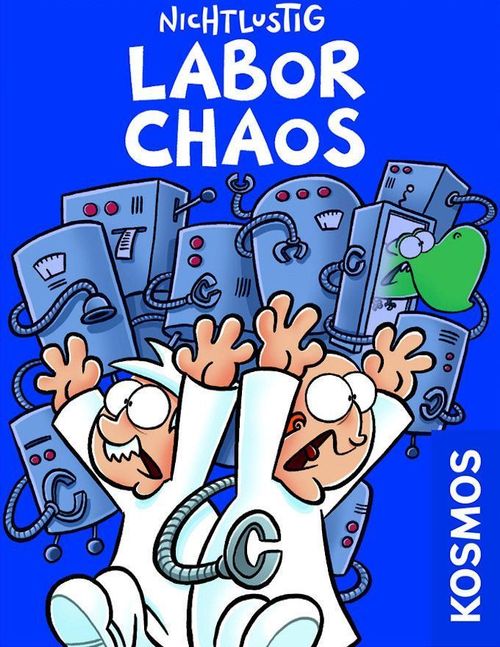
Nichtlustig: Labor Chaos
Nichtlustig: Labor Chaos Rulebook
Table of Contents
Table of Contents
Goal
Get rid of the cards in your hand as quickly as possible. However, if one of the cards changes this goal, you must fulfil the new win conditions. Sounds simple, doesn't it?
Setup
Any player shuffles the cards and deals 7 to each player (including themselves). The remaining cards form a draw pile, placed face down in the middle of the table. The player to the left of the dealer starts the game.
Playing a Turn
On your turn, choose one card from your hand. Place it in front of you and read its text aloud. Then carry out what it says. In most cases, the card then goes to the discard pile face up. Some cards (robo-cards) can only be played if the conditions described on them are met. If a card describes a condition that cannot be fulfilled, that card cannot be played.
Important: cards are placed on the discard pile on top of each other, so the effect of the previous card stops applying.
The next player clockwise then takes a turn. They also play a card, reading and carrying out its instruction, and then put it on the discard pile, unless the card's text says otherwise.
When a player gets rid of their last card in hand, they win immediately, even if the played card's text says to draw another card afterwards. A player also wins if the played card's text says to discard a card from hand and the discarded card is their last one.
To win, a player must themselves fulfil the win conditions. That is, a player does not win if they help someone else get rid of cards in their hand.
That is all for now. You can already start the game, but some further information may still be useful.
Cards
Each card has four features:
- Text: the most important part of the game, as it explains what the player must do when the card is played.
- Symbol: in the upper left corner, one of four characters (symbols) is shown. Sometimes the text of a played card refers to a specific symbol on another card.
- Number: some cards show a number. Sometimes the text of a played card refers to a specific number on another card.
- Picture: simply illustrates the card's text and has no effect on play.
There are three types of cards:
- scientists;
- dino-cards;
- robo-cards.
Whenever a card's text refers to a "scientist", a "dino-card" or a "robo-card", the card means the symbol in the upper left corner of the card.
Note: two different scientists are shown on the cards. When a card's text refers to a "scientist", it does not matter which one is pictured - bald or with hair. When a card's text refers to a "symbol", it must match a specific symbol on the card, so which scientist is pictured does matter.
You do not need to know the following to play, but you may find it interesting:
- Scientists mostly make players discard cards, but some tell a player to take new cards into hand.
- Dino-cards are cards that can affect the course of the game.
- Robo-cards are cards that can only be played once their conditions are met, and they also add specific humour to the game.
"Impossible" Cards
Every game will contain "impossible" robo-cards, that is, cards a player cannot play because the conditions for playing them cannot be met at that moment. For example, if a player does not have a dog in their home, they cannot play that robo-card. Different cards are possible for some players and impossible for others. For example, one player has keys in their pocket and another does not.
Do not despair! Many cards allow you to discard cards from hand in other ways. One way or another, a player can get rid of any card, even if they cannot play it.
Important: if a player cannot play any card from their hand, they must draw a card from the draw pile. Their turn then ends.
Terms Used on Cards
The designers aimed to be as precise as possible in terminology. But in a game called "UNFUNNY CHAOS IN THE LABORATORY", this is a delicate matter. Players should always understand the card text as literally as possible. If a player misunderstands the meaning of a text, let them have their way this time, and never argue. Above all, this game is for fun and entertainment.
-
Player: all participants in the game, including the one playing a card.
-
Other players: players other than the one playing the card.
-
Card vs. card in hand: there is a difference between "Card" and "Card in hand". A "card in hand" is a card the player is holding. A "card" is a card that has just been played, other played cards, cards in the discard pile, and cards in the draw pile.
Note: some cards, such as robo-cards, may refer to both "Cards" and "Cards in hand" - but writing "robo-card-in-hand" would be simply silly.
-
Instant: some cards (except robo-cards) instruct you to do something immediately. These are reaction cards that you may play outside your own turn, whenever the situation described on the card occurs. Conversely, cards without the "instant" mark may only be played on your own turn.
-
End: cards whose text begins with the word "End" change the win conditions of the game. These cards stay on the table separately from the discard pile until another card with the word "End" is played. Only one "End" card can be active at any time. If a new "End" card is played, the previous one goes to the discard pile.
-
Card lying on the table: these cards have a lasting effect. They stay on the table until either the action described on the card is carried out, or until such a card is replaced by another. For example, an "End" card can only be replaced by another "End" card, while cards with other conditions replace each other.
Robo-Card Conditions
Some robo-cards relate directly to the play session. Once the game has started, players may not change anything to gain an advantage. For example, you may not take off a ring or bring a dog into the house just to make a described condition become fulfillable. Of course, you are allowed to switch on the light, but would you really sit down to play in pitch darkness?
End of the Game
Chaos ends when, on their turn, a player fulfils the current win condition. Either they have got rid of all the cards in their hand, or they have fulfilled the condition of an "End" card.
Multiple Games and Scoring
If you want to play several games in a row, you need to record points to determine the winner. The player who finishes a game scores 0 penalty points. All other players receive a number of penalty points equal to the sum of the numbers on the cards in their hand. If that is too much work, simply count the number of cards remaining in hand and write that number down as penalty points. The player who scores the fewest penalty points over several games (decide the number of games yourselves) wins the whole game!
Note on the Promo Cards
In addition to the 76 main game cards, the box contains 2 promotional cards. They are not part of the main deck, but you may use them if you wish. Until all participants own the advertised games, their owners must give the corresponding card to a player who does not yet have the advertised game. Isn't that fun?