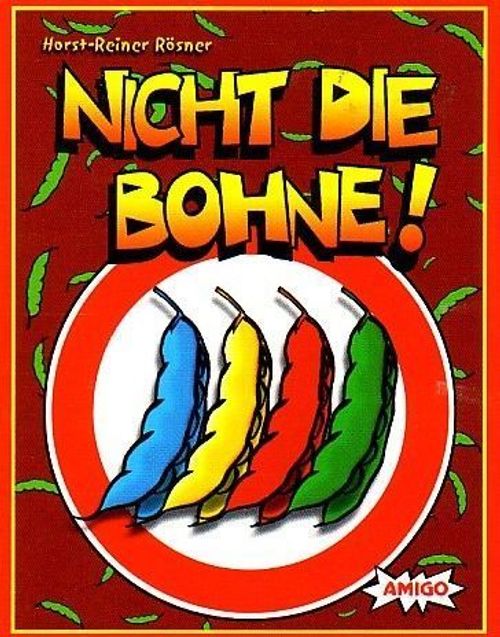
Nicht die Bohne!
Nicht die Bohne! Rulebook
Table of Contents
Table of Contents
Overview
3 – 6 players, Age 10+, Approx. 30 mins.
Contents
- 60 cards in 4 colors (from 1 to 10 and 5 special cards)
- 1 Bean chip
- 1 Game rule
- Score sheets
The Cards
There are 4 colors: blue, red, green, and yellow. There are bean cards from 1 to 10 and three kinds of special cards in each color.
- Nullifier card: This card nullifies all bean cards and specials of this color. The bean cards of this give 0 points.
- Doubler card: This card doubles the score of this color, no matter positive or negative.
- Plus/Minus card: The number of this card decides whether the score of this color is positive or negative. The 1st one gives negative; the 2nd one positive and the 3rd one negative again.
There are beans in 4 colors with value from 1 to 10.
Preparation
Find a pencil to write down scores on the score sheets. The oldest player receives pencil and score sheets and shuffles all cards.
- 3 players, deals 20 cards to each player
- 4 players, deals 15 cards to each player
- 5 players, deals 12 cards to each player
- 6 players, deals 10 cards to each player
All players take their cards and sort them by colors. Sort the cards into colors. The player left to the deal takes the Bean chip.
Game Play
1. Play a Card
The player with the Bean chip starts playing a card. He selects one card from his hand and places it face-up in front of him on the table with the Bean chip. Only the player with the Bean chip places his card face-up. Afterwards, all other players place likewise one card face-down in front of them. The cards are revealed after all players have played a card.
2. Take One Card
Each player must take a card on the table. Players cannot take their own card. The selection of cards follows this sequence:
- The player, with the Bean chip, selects first. He takes a card of fellow players, except the one with the Bean chip. No player may take his own card.
- The player, whose card is selected, selects next. He selects the rest cards, except the one with the Bean chip.
- The last player takes the card with the Bean chip. The card with the Bean chip is selected last.
- The round ends when each player takes a card.
Example: Alex has the Bean chip. He places the red "Plus/Minus" card face-up with the Bean chip. Beate places a yellow-5 face-down, Claudia blue-3 face-down, and Dirk blue-8 face-down.
All cards are revealed. Alex selects the first card. He picks blue-8 from Dirk. Dirk now selects and he picks yellow-5 from Beate. Beate must pick blue-3 because it's the only card available – red "Plus/Minus" is covered by the Bean chip. Finally, Claudia picks the red "Plus/Minus" and the Bean chip.
3. Place Cards
After players select a card, they put it sorted by colors face-up in front of them. All collected cards must be always visible for each player. The special cards are always put at the top end of the color. They are resolved at game end (see "Game End – Scoring"). Whether the player takes the special card as the first, last or middle one of a round, the special card only affects its color.
4. New Round
The player who takes the Bean chip begins the next card play, in the same way as described in "1. Play a Card". A round ends when all players have no more cards in hand.
Game End
The round ends when the last card is played, each player takes their last card and places the selected card in front of them according to colors. The player calculates the score of their individual color. The totals of positive and negative points are written on the score sheets under their names. Afterwards, a new round starts. All cards are shuffled and dealt. The player who takes the Bean chip the very last of the previous round starts the new round.
After three rounds, whoever has the most points is the winner.
Scoring
Each player adds the value of individual colors. Note: the special cards modify the value of the color.
- If there is no special card, only add the value of all cards in that color.
- If the color has "Nicht die Bohne" (the Nullifier), its score is 0.
- If the color has no or two "Plus/Minus" cards, its total is positive.
- If the color has one or three "Plus/Minus" cards, its total is negative.
- Finally, if the color has a "Double" card, its value is doubled, no matter if it is positive or negative.
Players first sum all positive points of each color; then all negative points of each color. Write these two sums on the score sheet.
Example of scoring:
- Red color is 3 + 6 = 9 points.
- Blue color is positive due to two "Plus/Minus" cards. With the double card, the value is (4 + 2 + 8) x 2 = 28 points.
- Green card is 0 points due to the "Nicht die Bohne" card.
- Yellow card is negative points due to the single "Plus/Minus" card. The value is -4 + -9 = -13 points.
Finally, 28 + 9 = 37 positive points. 13 negative points. So, in total, the score of the first round is 37 – 13 = 24 positive points.