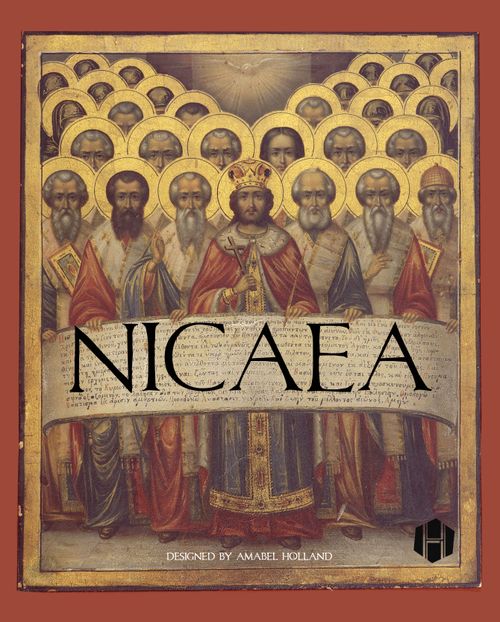
Nicaea
Nicaea Rulebook
Table of Contents
Table of Contents
Components
The game is played with 75 cards in two decks, one sheet of counters, and two display sheets.
Cards
There is one deck of 35 Doctrine Cards, and one of 40 Action Cards.
Doctrine Cards are color-coded and numbered I through V, with each representing a dispute that threatens to rip the newly-legitimized church asunder. Each dispute has seven cards:
- Three cards marked "A" denote what ultimately became the orthodox position adopted by the council.
- Three cards marked "B" denote what ultimately became the heterodox, heretical position condemned by the council.
- The final card has "A" on one side and "B" on the other; when obtained by a player, the dispute is decided.
Note that these disputes are distinct; you can have the "A" position in dispute I and the "B" position in dispute II.
Action cards come in two flavors: Bishops and Canons.
Bishop cards have a cost, in Influence, which usually must be paid in order to play the card in front of them (into their tableau). Played cards may be flipped face-down to expend Influence equal to their cost.
- There are two cards for each historical figure. If a player has both of those cards in their tableau, those cards can generate bonus Influence (about which, more later).
- The bottom of each Bishop card indicates one or two disputes. At the end of the game, if you hold Doctrine cards on the correct side of that dispute, you earn an additional Victory Point for each such icon in your tableau.
Canons are minor points of Canon Law which can be played into your tableau. Like Bishops, they have a cost in Influence. Canons do not generate Influence, but do generate Victory Points (equal to their cost) at the end of the game, and do allow you to carry over Temporary Influence after a Debate Round.
Action cards of both types are sorted into one of five Suits. Suits can allow you to play certain cards of the same Suit without paying their cost; see Playing a Card below.
Counters
There is a sheet of circular counters:
- 30 Victory Points, equally divided between values "4", "5", and "6". These are kept face-down until the end of the game, their values only known to the players who possess them.
- 36 Temporary Influence, each with a value of "1". This is probably way more Influence than you will ever actually use in the game. If the supply is exhausted, use proxies, but also send me a picture because I wanna know what the heck happened.
- One Constantine marker, which forbids certain actions and confers certain benefits.
- Five Dispute tokens, used on the Dispute Track, each corresponding to one of the five disputes.
Display Sheets
There are two canvas Display Sheets: the Doctrine Display and the Action Display.
The Doctrine Display is home to the Dispute Track, which charts the intensity of debate for each of our five disputes.
- The number on the space the dispute's token occupies indicates the current cost in Influence to buy a Doctrine card.
- The number between spaces indicates the number of face-down Action Cards in a player's tableau that can be refreshed (flipped face-up) for each Doctrine card they hold for a dispute whose current space is adjacent to it (round fractions up).
The Doctrine Display also houses the four Pass Pools, where players will place expended Temporary Influence.
The Action Display has spaces for seven Action cards. Each space has an associated cost, in Influence, which must be paid in order to first take the associated action, and secondly, the associated Action card. We'll cover the actions in detail in the Taking Actions section.
Setting Up the Game
Place the two display sheets at the center of the table. Shuffle the Action Cards deck and deal one card face-up into each of the seven spaces on the Action Display.
Place the VP markers in a face-down pool or opaque container.
Place the five dispute tokens on the first space ("2") of the Dispute Track.
Randomly choose a starting player and give them the Constantine marker. Give their right neighbor 1 Temporary Influence.
Some of the Doctrine cards have a hidden back. If playing with five or six players, shuffle all of these cards and deal one face-up to each player. If playing with four, use only the I, II, and III cards with a hidden back.
- If two cards for a dispute are now in player hands, advance its disc to the "4" space. Give those players 2 Temporary Influence.
- If one card for a dispute is now in player hands, advance its disc to the "3" space. Give those players 3 Temporary Influence.
All remaining Doctrine cards, including those that were in the shuffle but not dealt, are placed face-up beside the Doctrine Display, in easy view and within reach of all players, separated in "A" and "B" piles with the double-sided "4" card between them.
Play begins with the player that holds the Constantine marker, and passes clockwise.
Flow of Play
On your turn, you can do exactly one of the following three things:
- Take an Action.
- Play a card.
- Pass.
If all players pass consecutively, normal play is interrupted for a Debate Round, in which players gain bonus Influence, refresh cards in their Tableau, and buy a single Doctrine card. If this settles a Dispute, hidden Victory Points are awarded. The Action Display is then refreshed and play resumes.
Influence
Taking actions, playing cards, and buying Doctrine cards usually require the expenditure of Influence. You can expend Influence in one of two ways:
- Flipping a face-up Bishop in your Tableau face-down. You choose which card to flip.
- Paying Temporary Influence into the Pass Pools.
When paying Temporary Influence, place the first expended Influence in the topmost pool, the second in the second pool, and so-on, only looping back to the first if you need to expend more than four Influence.
Taking Actions
If you choose to take an Action, you must:
- Select a space on the Action Display which has a card on it.
- Pay the cost in Influence for that Action (0, 1, 2, 3, or 4).
- Resolve the Action.
- Take the card into your hand.
If you possess the Constantine marker, then you must place it on that space after resolving the Action. The Constantine marker will stay in place until the next Debate Round.
Note that taking an Action only brings the card into your hand; it does not place it in your Tableau. When taking the Action, you only pay the cost for that Action, not the cost of the card.
The Actions are:
- 0: Pay nothing and do nothing (but take the card into your hand).
- 1 or 2: Refresh leftmost. The leftmost face-down card in that player's tableau is turned face-up.
- 2: Debate Doctrine. Buy one Doctrine Card. Note that this is distinct from the Debate Round, as only the player taking the action may buy a Doctrine Card.
- 3: New Offer Cards. First, choose one of the other Actions (do nothing, refresh leftmost, debate doctrine, or play free card) and perform it without taking the card associated with that space, if any. You cannot take the Action associated with a space occupied by the Constantine marker (even if there is another space with that Action). Then, draw a new card from the deck for each empty card space, except the space occupied by Constantine. Note again that Actions are resolved before taking the associated card, so this space itself will not be refilled by this Action.
- 3 or 4: Play Free Card. Play a card from your hand into the rightmost space of your tableau without paying any Influence for it.
Playing a Card
If you choose to play a card, you must:
- Choose an Action Card from your hand.
- Place it in the rightmost space of a tableau. This will usually be your own tableau, but you can (and sometimes should!) play a card to a rival's tableau. Gonna say it again, and bold it: you can totally play cards to another player's tableau!
- Pay its cost in Influence (but see Suits below).
If you do not have a card in your hand, you can't play one!
Suits
Before playing a card, determine which Suit (or Suits) have the most face-up cards in the chosen tableau. Only count face-up cards, never face-down. If your chosen card matches one of those Suits, you can play it without paying its cost. At least one face-up card of a Suit must be in the Tableau to qualify.
Passing
A player who passes takes all the Influence from the Pass Pool that:
- Has at least one Influence in it, and
- Is the first such Pass Pool, checking in descending order from the topmost to the bottom.
If all Pass Pools are empty when you pass, you get nothing.
Debate Round
When all players pass consecutively, a Debate Round occurs. Follow these steps in the order given:
- The first player to pass takes the Constantine marker into their possession.
- Bonus Influence is generated.
- Cards are refreshed.
- Beginning with the last player to pass and moving clockwise, each player may purchase one Doctrine card. If a player's purchase settles a dispute, resolve it.
- The Action Display is refilled.
- Influence markers are adjusted.
- If the game has not ended, play resumes with the player holding the Constantine marker.
Bonus Influence
If both cards for the same Bishop are face-up in the same player's tableau, that player earns the Bonus Influence indicated on each of those cards, taking them as Temporary Influence from the supply.
Refresh
Consult the Refresh Number for each Doctrine card in your possession. Add them, rounding fractions up; this is the number of Action cards in your tableau that can be refreshed. You must refresh face-down cards from left to right within your tableau.
Buying Doctrine Cards
Each player has an opportunity to buy one unsettled Doctrine card of their choice.
- If they do not have a Doctrine card for that dispute in their possession, they must choose whether to purchase an "A" card or a "B" card, and pay its cost. Then, the relevant disc is advanced one space. This is called making an argument.
- If they already have a Doctrine card for that dispute, then they must conform to their previous theological position; i.e., if they have an "A" card for that dispute, they must buy an "A" card, and if they have a "B" card, they must buy a "B". They pay twice the cost, and advance the relevant disc two spaces. This is called doubling down.
- A player cannot buy more than two Doctrine cards for a dispute.
- The larger number for a space represents the base cost of making an argument. The smaller number represents the cost of taking a contrarian position: the side of the dispute that has fewer cards in player hands. For example, if there are two red A cards in player hands, and one red B card, B is the contrarian position. A player taking the B position would pay the lower of the two costs (or double the lower cost if doubling down). As ever, contrarianism is cheap!
Settling a Dispute
When one side of a dispute has four cards in player hands, the dispute is settled:
- The side with fewer cards returns their Doctrine Cards to the game box.
- The doctrine's marker is returned to the box. Note that it will no longer contribute towards Refresh.
- For each Doctrine card, its owner draws one Victory Point marker, keeping its value hidden.
- Note that a Dispute can also be settled when a player buys the fourth card via a Debate Doctrine action.
Refilling the Action Display
Move the leftmost card in the Action Display to the leftmost empty card space. Repeat this until the only empty spaces in the Action Display are to the right of all cards. Then, draw a new card for each empty space.
Adjusting Influence Markers
Each player counts the number (not value) of Canon cards in their tableau. This is the number of Temporary Influence markers that they hold that they are allowed to keep; any in excess of that are returned to the supply.
Then, divide the Temporary Influence in any Pass Pools equally among the players. If there is a remainder, place it into the Pass Pools from top to bottom, as you would if you were paying for something.
Check for Game End
If during this step, all five disputes have been settled, or if the Action Deck is empty, the game ends. Proceed to scoring. Otherwise, play resumes.
If the game is ended by exhaustion of the Action Deck, the player who holds the Constantine marker decides how each remaining dispute is resolved. Resolve them before proceeding to scoring.
Scoring
Each player flips all face-down cards in their tableau face-up. Then, each player reveals their face-down Victory Points. To this total they add:
- 2 or 3 points for each Canon in their tableau, as printed.
- 1 point for each dispute icon in their tableau for which they still hold Doctrine cards. (Remember, "bad" Doctrine cards are removed from the game when the issue is settled.) Note that the number of Doctrine cards you have is irrelevant: you do not get two points for having doubled down on an issue for which you have a dispute icon.
The player with the most VP wins… unless there is a schism!
Schism
If the player with the lowest score has the most Influence (Temporary plus Influence on Bishops), they win instead! If players are tied for the lowest score, a schism is impossible; ditto if players are tied for the most influence.
If there isn't a schism, but there is a tie for the most VP, the tied player with the most Influence wins. If a tie persists, victory is shared.
Apologia
With this game, I sought to center the church – and its first ecumenical council – as a political and temporal phenomenon, rather than as a theological and holy one. This isn't to say that the theological questions which the game treats as largely fungible and esoteric weren't incredibly important to its participants: they absolutely were. The Arian position was attractive because it conformed to our understanding of how the actual world works: sons are born after their fathers, time is linear, etc. And the opposition to it was so fierce because, perhaps unintentionally, it subtly undermined the divinity of the Christ. For the Nicene Fathers, this was a life-and-death struggle.
But for Constantine, the precise outcome of Nicaea wasn't as important as the fact that there was an outcome – that there was a single, united, unanimous doctrine that could bind his empire together. But churches, like empires, are inherently fractious. The Council of Nicaea did not result in a united church, but in a church that pretended to be united, and those are two very different things. Arianism continued, sometimes favored by future emperors reared in that flavor of the faith. The council's decision regarding the date of Pascha (Easter) was openly disregarded, and would be a sticking point for centuries to come. And the idea that the Bishop of Rome had authority over the entirety of the church was laughable.
Nicaea did not so much prevent an open schism as it delayed it. This game posits that this perhaps had less to do with the "rightness" of the decisions or the fervor with which they were argued for, and more to do with political pressure – coming both internally within the church and externally from the emperor that only recently gave it his protection. The persecutions of the preceding decades were still fresh, and the church's position was tenuous, vulnerable. Pretty much everyone went into Nicaea with the expectation that they would go along with what was decided; otherwise, the church might not survive. Heck, even Arius, who the Nicene Fathers exiled, tried to make good, and was literally on his way to recant when he suddenly shit out his intestines, liver, and spleen in broad daylight, dying immediately, unsaved.
Or so we're told by the sources – sources written by men with a vested interest in demonizing heterodoxy, and to present the fiction of a united church made up of perfect people. This myth is inherently nostalgic – yearning for an age where men were noble and pious, wise and incorruptible, unyielding and unfaltering: an age that never was. People, in the end, are people, and throughout history, people have always been the same – profound and ridiculous, sacred and profane. The same can be said of politics – it's the story of convictions that are deeply held, and also cynical ambitions, of bitter rivalries and strange alliances. This is a game about people and politics.