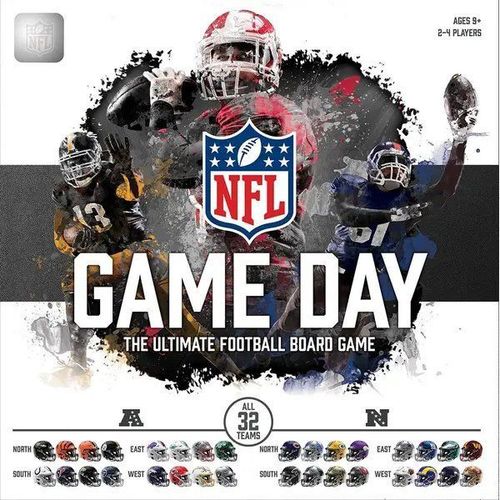
NFL Game Day
NFL Game Day Rulebook
Table of Contents
Table of Contents
Game Contents
32 Magnetic NFL Team End Zones, 60 Offense Cards, 60 Defense Cards, 20 Special Teams Cards, 1 Game Board, 5 Clear Discs, 6 Time Out Cards, 1 Magnetic Ball, 1 Magnetic Yard Marker & Sticker, 1 Die.
Getting Started
- Each player/team can customize his end zone with any of the 32 NFL teams.
- Shuffle the Offense, Defense, and Special Teams cards into their own piles.
- Each player gets 3 time out cards.
- The game starts with a roll of the die. The player with the higher number chooses whether to start on offense or defense.
- The player on offense draws a Special Teams card and starts on the yard line indicated.
- Set the down counter to 1st down using a clear disc.
- The player on offense draws 5 Offense cards. The player on defense draws 5 Defense cards.
The Turn
The player on offense and the player on defense each plays a card face down. Both players then flip their cards over at the same time revealing the selected plays. The player on offense gets as many yards as is listed on the card, but yardage can be changed by the card selected by the defense. For example, if the offense plays a Pass, and the defense plays a Run, the offense gains the yards indicated on the Offense card. But if the player on offense chooses a Pass card and the player on defense chooses a Pass Defense card, there is no gain on the play. Once a card is played, it is discarded in a separate pile which becomes the discard pile.
After each play advance the down counter to the next down unless there is a first down conversion, a scoring play, or a turnover.
Offense/Defense Cards
Interception and Fumble Cards: Playing an Interception and Fumble card will either get back the ball for the defense or help the offense advance depending on the play called by the offense. See Change of Possession for further rules.
Blitz Cards: Push an offense farther back to make it more difficult to achieve a 1st down. There are 2 types of Blitz cards: All-Out Blitz and Zone Blitz. All-Out Blitz primarily defends against all run plays as well as play-action pass plays. Zone Blitz defends against all pass plays. Calling the right kind of blitz at the right time is important because if the defense guesses wrong it could mean extra yardage for the offense.
Penalty Cards: Push an offense farther back to make it more difficult to achieve a 1st down. If the offense calls a Play-Action Pass, or a Screen Pass then the penalty goes against the defense and the offense gains the yards indicated on the card.
Time Outs
A Time Out card is used when a player doesn't like the mix of plays in his hand and wants to draw new cards. Each player gets 3 time outs per half. Whenever a Time Out card is used, both players must discard their respective hands. These cards should be shuffled back in to the active draw piles. Then each player draws from the draw pile until he has 5 cards in his hand. Once a player calls a time out, he must call another play before using another time out.
1st Down Conversion
If the offense advances the ball 10 yards or more, the offense gets a 1st Down conversion. Reset the down counter to 1st down, move the 1st down marker 10 yards ahead of the new location of the ball, and each player draws until he has 5 cards. 1st downs can also happen whenever there is a turnover. If a penalty occurs on 1st down, players must draw a card so their hand totals 5 cards.
4th Down
4th Down is the last chance for the offense to make a play! If the offense does not get a 1st Down Conversion or score a point there is a change of possession.
Instead of a normal play on 4th Down, the offense can choose one of these two options:
- Field Goal: A field goal may only be attempted when the offense is within 40 yards of the end zone. Consult the Field Goal Rules on the board when deciding to go for a field goal. When a player attempts a field goal he rolls the die. The result of the play depends on where the ball is on the field and the roll. The closer the field goal the higher probability of a good result. Score 3 points for a success; a missed field goal results in a change of possession at the point of the field goal attempt. A field goal cannot be attempted once all the Offense cards have been used.
- Punt: When punting, the player on offense draws a card from the Special Teams deck. The opposing player starts his possession according to the card drawn. If the punt indicates starting at the goal line or past the goal line, the result is a touchback and the offense starts on the 20 yard line.
Scoring Points
Touchdown
If the offense makes a play that goes into the end zone (goal line or beyond), it is a touchdown. Score 6 points immediately, then another point if he can complete an extra point kick.
Extra Point
An extra point is kicked by rolling the die. If the player rolls 1-5 the kick is good. If he rolls a 6 the kick is no good.
2-Point Conversion
A player can attempt a 2-point conversion by stating so before the roll. The player rolls the die as he would for the extra point. If he rolls a 3 or 6 the 2-point conversion is good. If any other number is rolled the 2-point conversion is no good.
Safety
If a player is forced backwards into his own end zone, a safety occurs. The defending player gets 2 points, then draws a Special Teams card and starts on offense as indicated by kickoff position on the card.
Keeping Score
The enclosed clear discs will be used to keep the score. For a single digit score use the top numbers. For a double digit score use the appropriate combination of top and bottom numbers. For example, 17 points would be a disc on #1 from the top row and a disc on #7 from the bottom row.
Kick Offs
After a scoring play there is a change of possession: The defending player then goes on offense. He then draws a Special Teams card and starts as directed, typically on his own side of the field. He begins with a 1st down. (Reset the down counter to 1st down, move the first down marker 10 yards from the new location of the ball, and each player draws until he has 5 cards.) Note: Special Teams Cards never get discarded. They go back into the Special Teams deck and get reshuffled.
Switching Between Offense and Defense
When a change of possession occurs, the defense places his current hand face down in front of him and switches to using Offense cards and the player going on defense places his Offense cards face down in front of him and switches to using Defense cards.
If the player going on offense does not have 5 Offense cards, he must then draw until he has 5 cards from the Offense deck. The same applies to the player going on defense. Each player should have no more than 5 cards in his hand at any one time.
Change of Possession
Whenever a turnover happens, whether from a failed fourth down attempt, a punt, a kick off (after a scoring play), fumble, or interception, do the following:
- The player on defense gains possession of the ball at the new location and switches to using Offense cards. The other player switches to using Defense cards. (Leftover cards should be kept by each player and set aside facedown for use on the next change of possession.)
- Reset the down counter to 1st down, move the first down marker 10 yards from the new location of the ball, and each player draws until he has 5 cards.
Game Length
The game is played in two "halves". A half is over when there are no more cards available and neither player has a card in his hand. A half will take from 30 to 45 minutes.
When the half is over, shuffle all the Offense, Defense, and Special Teams decks. Each player draws 5 cards to start the second half. Each player gets 3 time outs. The player who started the game on defense is now on offense and draws a special teams card.
The Game is over at the end of the second half. The player with the most points wins. For a shorter game, play 1 half.
Overtime
If the game is tied at the end of the second half the game goes into Overtime. Overtime starts with a roll of the die. The player with the highest number chooses whether to start on offense or defense. The first person to score wins the game!