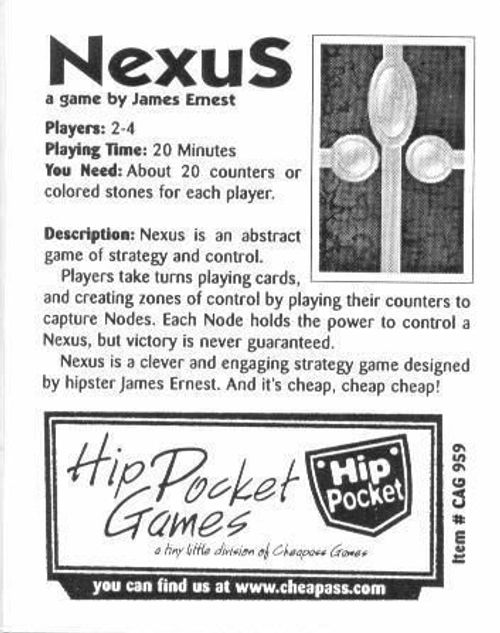
Nexus
Nexus Rulebook
Table of Contents
Table of Contents
Setup
Give each player about 20 stones or counters of a different color. There is no limit to the number of stones a player may use, but 20 is usually enough.
Shuffle the deck and place it face down. Place one card face up in the middle of the table. This card is the beginning of the board.
Decide randomly who will go first. After that, play proceeds to the left.
On Your Turn
You will play a card from the top of the deck. If this results in any closed Nexuses, you will score them. Then you will place one counter on the board.
1: Playing a Card
Take the top card of the deck and play it face up onto the board. The rules for playing a card are as follows:
- Cards must be played in a "basketweave" pattern, with short edges always touching long edges, like the cards in Figure 1.
- New cards much touch existing cards.
- There is no limit to the playing space, so if you reach the edge of the table you must extend the table top with nails and glue before you can proceed.
- If you close a Nexus, score it.
2: Scoring a Nexus
"Nodes" are the round bits at the intersections and the ends of the rods, which are called "Connectors." A "Nexus" is a set of contiguous Nodes and Connectors. When every Connector in a Nexus leads to a Node, the Nexus is "closed." Until then, it is "open." There is one closed Nexus in Figure 1.
The "Power Value" of each Node is equal to the number of Connectors attached to it. These Values range between 1 and 4. The Power Values of various Nodes are marked in Figure 1.
To capture a Nexus, you must have more Power Points than any other player in that Nexus, based on the Power Values of the Nodes you control. For example, if Player 1 owns Nodes totaling 5 points, and Player 2 owns Nodes totaling 4 points, Player 1 scores the points for the Nexus. If the strongest players are tied when the Nexus closes, or if the Nexus is empty, no one scores it.
The point value of a Nexus is equal to the total Power Values of the unoccupied Nodes in that Nexus. This means that the more Nodes you cover, the fewer points the Nexus will be worth.
Once you have closed and scored a Nexus, take all the counters out of it. It will remain empty for the rest of the game.
If you close two Nexuses at once, you score your own first, then proceed to the left. This only matters if two players might win.
3: Placing a Stone
After you have played your card and scored any closed Nexuses, place one counter on an unoccupied Node. You may never play a counter in a closed Nexus.
Winning
To win, you must score at least 10 points.
Variations
We tried all of these in playtest before settling on the final rules: let each Node be worth only one Power Point; make it illegal to create a tie by any means; or, allow players to place cards anywhere on the table as long as they match the existing grid.
Notes
Nexus is the first in a series of small abstract strategy games from Hip Pocket Games, a division of Cheapass Games. Yes, "Nexuses" really is the plural of Nexus.