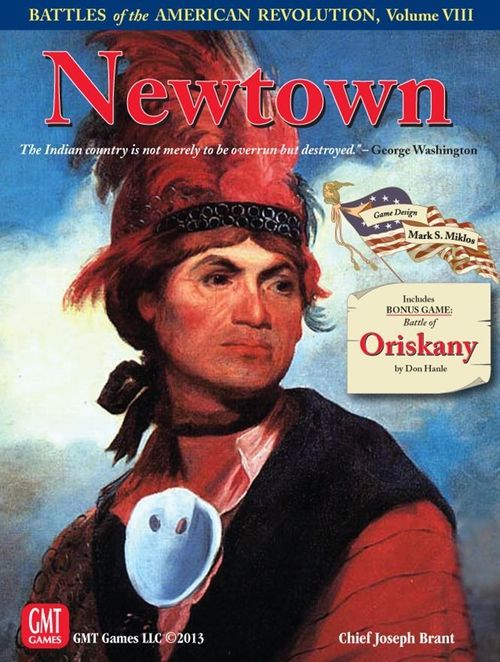
Newtown
Newtown Rulebook
Table of Contents
Table of Contents
- Newtown Combat Units
- Shared Markers
- Replacement Counters
- Newtown Exclusive Rules
- I. Prepare for Play
- II. How to Win
- III. Series Rules Variations
- IV. Special Rules
- V. Indian Rules
- VI. Special Units
- Newtown Historical Scenario
- Newtown Historical Essay: The Battle of Newtown (by Mark S. Miklos)
- Newtown Order of Battle
Newtown Combat Units
INDIAN Player
- Tan with no stripe: Indians
- Tan with red stripe: British Regulars
- Tan with yellow stripe: Provincials
- Tan with brown stripe: Tory Militia
AMERICAN Player
- Blue with no stripe: Continentals
- Blue with light blue stripe: Patriot Militia
(Oriskany units are marked with a thin white horizontal stripe.)
Shared Markers
In order to conserve counter mix space, many markers are shared between both games (Newtown and Oriskany). In addition, the Ambush markers (front-side) are used in Oriskany while the Failed Resolve markers (back-side) are used in Newtown. Shared markers shown in the booklet include Momentum Destroyed, Withdrawal and Disrupted.
Replacement Counters
The counter sheet includes 10 replacement combat units and 5 markers for previous games in the Battles of the American Revolution series.
- Saratoga ("Next Day" scenario): MacKay's Corp (new unit); Queen's Loyal Rangers (new unit); British HQ (new marker)
- Brandywine Creek: 2nd N.J. Volunteer Artillery (new unit)
- Eutaw Springs: Palmetto Foot (Strength Points have been increased from 1 to 2 and the unit now has a reduced side); 2nd Royal Highland Emigrants (new unit)
- Savannah: Georgia Volunteers (Unit Morale has been degraded from 0 to –1); Volunteers of Ireland (new unit; Design Note: This ad-hoc unit also includes Maryland Loyalists, the 4th N.J. Volunteers and infantry from Tarleton's British Legion); Georgia Lt. Dragoons (new unit)
- Pensacola: Fijo de Luisiana (new unit)
- Germantown: 2nd N.J. Volunteer Artillery (new unit); Friendly Fire/Panic (four additional markers)
Newtown Exclusive Rules
Design Note: Despite our efforts to maintain accurate period names for all map features, three locations have post-battle nomenclature due to inconclusive research into their pre-battle identification: Newtown: "Sullivan's Hill" and "Butler's Creek"; Oriskany: "Bloody Creek".
I. Prepare for Play
1.1 Game Length
The game begins at 8:00 AM (Turn 1) and ends at 7:00 PM (Turn 12) unless either a Decisive or Substantial Victory is achieved prior to the final turn (see Section II).
1.2 Player Order
Only the American player moves on Game Turn 1, thereafter the player order is determined randomly per Series Rule 6.0.
1.3 At-Start Army Morale
American: 14, Indian: 13
1.4 Momentum
The Americans begin the game with one Momentum Chit.
1.5 Deployment
Both sides deploy their units either by the at-start hex or turn of entry indicated on the counters.
1.6 Optional Unit Selection
Both players must agree on the use/disuse of the Optional Seven Nations Indian player combat unit (Rule 6.2) before rolling for Indian Honor (Rule 1.7) or Pre-game Indian Enhancement (Rule 1.8).
1.7 Indian Honor
The Indian player rolls on the Indian Honor Table to determine which combat unit begins the game with honor (Rule 5.1).
1.8 Pre-game Indian Enhancement
- Set the following markers and Random Event combat units (labeled RE) aside for use with the Pre-game Indian Enhancement Table: War Dance, French Margaret, Visions, Big Medicine, Wampum Belt, Tiahogwando, Capt. Montour, 8th Foot, and Mohawk Valley.
- The Indian player rolls on the Pre-game Indian Enhancement Table and applies the result.
- The Table will indicate which marker or RE combat unit, if any, is required and how it is to be applied.
1.9 Activation Markers
1.9.1 Pre-Game Marker Placement – Indian Player Only
- Place Activation-Movement markers for each Indian tribe/clan in an opaque container.
- If the Seven Nations unit is in play (Rule 1.6), add its marker to the container (Rule 6.2).
- If the Onondaga unit is in play (Rule 1.8), add its marker to the container (Rule 6.3).
1.9.2 Marker Additions During Play
- The moment that American player and Indian player combat units become adjacent to one another, the Combat marker is immediately added to the container.
- As soon as Indian Resolve is triggered (Rule 5.4), the Indian Resolve marker is added to the container during the End Phase of the Indian Player Turn.
1.10 Opportunity Cards (Rule 4.2)
Each player draws one card from his or her respective deck.
II. How to Win
2.1 Indian Decisive Victory
Eliminate 7 SPs of American combat units (except artillery).
2.2 American Decisive Victory
Destroy every Newtown hex (Rule 4.1).
2.3 Substantial Victory
Either side can achieve a Substantial Victory as indicated in Series Rule 16.3.
2.4 Marginal Victory
If neither player achieves a decisive or Substantial Victory by the end of the game, the American player must have at least 9 more VPs than the Indian player to earn an American Marginal Victory. Any other result is an Indian Marginal Victory.
2.5 Victory Point Schedule
2.5.1 Leader Casualties: See the Leader Loss Table.
2.5.2 Indian Player Only: 2 VPs are awarded if the Cattle Herd is captured (see Rule 6.5.3).
2.5.3 American Player Only: VPs are awarded if there are no Indian player combat units in any breastwork hexes at the end of the Indian Final Movement Phase on Turns 5-8 (based on a sliding scale shown on the Game Turn Track). Place the Breastwork Abandoned marker on the Turn Track as a reminder. If the Indian player subsequently occupies at least one breastwork hex there is no further VP adjustment.
III. Series Rules Variations
3.1 Leaders
3.1.1 Indian Seniority: The Indian player has three Leader units: Old Smoke, Colonel John Butler and Cornplanter. The following rules apply to these leaders:
- Old Smoke & Cornplanter can command any Indian units.
- John Butler can command Butler's Rangers, the 8th Foot [Platoon or Battalion] and the Mohawk Valley Militia.
- If Indian and non-Indian units are stacked together with John Butler and Cornplanter, the Indian player may designate either of these leaders to command the entire stack. Old Smoke cannot command a mixed stack.
- If Butler has the Wampum Belt, he may command Indian units alone.
- Joseph Brant is a demi-leader for himself, the Mohawk Valley Militia and any Indian units with whom he is stacked.
3.1.2 American Seniority: The American player also has three Leader units: Major General Sullivan, Brigadier General Clinton and Brigadier General Poor. All American leaders can command any American-controlled units.
3.2 Retreat Priorities
3.2.1 Indian Player: The Indian player retreats toward Newtown or hex 1408 if possible.
3.2.2 American Player: The American player retreats toward hex 6020 if possible.
3.3 Stacking Exception – The Cattle Herd
The Cattle Herd may freely pass through friendly units during the movement phase but McLane's Delaware Horse is the only American combat unit that can end the movement phase stacked with the cattle herd. If the Cattle Herd is alone in a hex, Indian player combat units may enter its hex to capture it (Rule 6.5.1).
3.4 Limited American Intelligence
The American player may not examine Indian player stacks. If he does, a penalty of –1 Army Morale will be imposed on him each time.
- Once a target hex is identified for Artillery or Rifle fire, the American player is free to examine all units in that specific hex in order to pick the specific target.
- One unit in a reviewed hex must be fired upon in that very same Fire Phase before any other targets are identified.
3.5 Strategic Movement
3.5.1 Cattle Herd: The Cattle Herd cannot use Strategic Movement.
3.5.2 At-Start American Units: American units deployed on the map at the beginning of the game cannot use Strategic Movement on Game Turn 1.
3.5.3 The Seven Nations Unit: The optional Seven Nations unit cannot use Strategic Movement on Game Turn 1.
3.6 Combat Considerations
3.6.1 Retreat and Stacking: In certain situations, Indian player units (Indians, British Regulars, Provincials and Tory Militia) can retreat prior to combat (5.7) and Indian units have special rules regarding retreats (5.9).
3.6.2 Advance after Combat: A victorious Indian player Lead Unit is not required to Advance After Combat when occupying breastworks. This is an exception to series rule 12.2.
Note: This rule applies only if all defending units were attacked across breastwork hexsides.
3.6.3 Indian Combat Quality: In this game, Indians are treated as Regulars for Close Combat DRM purposes.
IV. Special Rules
4.1 Destroying Newtown Hexes
- Newtown hexes are automatically destroyed whenever an American combat unit begins a friendly Movement Phase in the hex.
- The unit may not move.
- Place a destroyed marker on the hex.
4.2 Opportunity Cards
4.2.1 Setting Up: Each player possesses a deck of 12 Opportunity Cards. Shuffle the decks and place them facedown before play.
4.2.2 Obtaining Cards
- Each player draws one card prior to beginning Turn 1.
- During each friendly Rally Phase, prior to making rally rolls, the American player may spend one momentum chit to draw a new card from his deck.
- The Indian player may add only one additional card to his hand during the entire game. He does so immediately when any Indian combat unit crosses to the eastern side of the creek running between hex rows 45xx & 46xx. Therefore, the Indian player may hold a maximum of just two cards in his hand during the game.
- The American player has no hand-size limit.
4.2.3 Card Usage
- The cards are self-explanatory—follow the directions as indicated.
- Cards may be played by either player at any moment and during any phase, unless specifically disallowed by card text.
- Once a card is played it is discarded permanently.
4.2.4 Card Notes
- Fathers, Sons and Brothers: Note that an ignored result also prevents units stacked with the identified unit to be impacted as well. Example: A unit avoids a 1 Step loss result. Therefore any units stacked with that unit are unaffected since the step loss never occurred.
- They Were as Ghosts, Chaos and Parley: These cards can be played at any time, including immediately prior to the Close Combat resolution die roll.
V. Indian Rules
5.1 Indian Honor
At the start of the game the Indian player rolls on the Indian Honor Table to determine which tribe/clan begins the game "with Honor".
5.1.1 Assignment of Honor One combat unit in the designated tribe/clan (Indian player's choice) is assigned the Honor marker, which is placed under the selected unit.
5.1.2 Effects of Honor
- The unit "with Honor" receives +1 to its Unit Morale for all purposes.
- The unit with Honor must be the Lead Unit if involved in Close Combat, or Honor is lost and the marker is immediately removed and set aside for reassignment in the End Phase (see 5.1.4).
5.1.3 Loss of Honor
- The Honor marker is removed as in rule 5.1.2 above.
- The Honor marker is removed if the owning unit fails an Indian Resolve Morale Check (see 5.4.2).
- The Honor marker is removed if the owning unit is the Lead Unit in a Close Combat that produces any adverse results impacting that Lead Unit: NC, R, D, PIN, R/R, 1, 2, C.
Design Note: Although "NC" is not specifically an adverse result, if an Indian unit with Honor entered combat and was not able to bring the enemy to bear and produce a victorious result, the detrimental effects to that unit's Honor among the tribes would be much the same.
Clarification: Honor is not lost by choosing Indian Withdrawal, which is not a combat result.
5.1.4 Honor Reassignment
- During the End Phase of the current Indian Player Turn, roll on the Indian Honor Table to determine the next tribe/clan from which the Indian player will choose the combat unit that will receive the Honor marker.
- If Honor was not lost during the current Game Turn, no roll is made.
- To receive Honor a unit must be in Parade Order. In addition, Honor cannot be assigned to a unit marked with Failed Resolve, nor to the unit that just lost the Honor marker in the current Player Turn.
- If the die roll does not result in an eligible combat unit for Honor marker placement, then Honor is not assigned and the marker should be placed on the next turn of the Game Turn Track. Honor will then be rolled for again during the next Indian player End Phase.
- The Tuscarora, Seven Nations (optional) and Onondaga (possible pre-game enhancement result) units can never own the Honor marker.
5.2 Indian Player Movement Phases
The Indian Player Turn has three distinct Movement Phases (see the Sequence of Play).
5.2.1 Standard Movement Phase The Indian player may move his non-Indian combat units: British Regulars, Butler's Rangers, and the Mohawk Valley Militia.
5.2.2 Activation Movement Phase
Design Note: Newtown introduces a chit-pull mechanic that controls the movement of Indian combat units (only) in the Indian player Movement Phase.
- The Indian player draws Activation markers one at a time from the container and moves only those units corresponding to the Activation marker drawn.
Note: The Mohawk Valley Militia can move in the Standard Movement Phase or in the Activation Movement Phase with the Mohawk tribe when their marker is drawn (not both).
Note: The counter mix includes two activation markers for the Mohawk and Mohawk Valley Militia. Both markers go in the cup, but only the first marker drawn is used—the second is ignored.
Design Note: This mechanic demonstrates these units' mobility in a tempered fashion by increasing the chance of their markers being drawn, rather than allowing them to move twice outright.
Note: The Seneca tribe consists of the Wolf Clan and the Turtle Clan. The counter mix includes two Seneca Activation Markers; one each showing a wolf's paw print and a turtle. Likewise, each Seneca combat unit and leader features one or the other of these totems. Only those units in the Clan corresponding to the totem on the Activation marker drawn (wolf or turtle) can move when its Activation marker is drawn.
- When a Check Indian Resolve marker is drawn, all Indians within range and LOS of an American artillery unit must immediately perform an Indian Resolve Morale Check (Rule 5.4.2).
- The Activation Movement Phase ends immediately when the Combat marker is drawn. Proceed to the Rally Phase.
- Activation markers are returned to the container during the End Phase of each Indian Player Turn (see the Sequence of Play).
5.2.3 Final Movement Phase
- Indian units whose Activation markers have not been drawn and who are not adjacent to enemy combat units may now move.
- Units marked with Failed Resolve may not move in the Final Movement Phase.
- Units cannot move adjacent to enemy combat units in the Final Movement Phase, even if enemy ZOC is not projected into the adjacent hex.
5.3 Indian Sortie
5.3.1 Restriction
- Until released by a successful sortie die roll, Indians may only move freely on or west of hex row 34xx.
Exception: Blacksnake starts east of hex row 34xx and is not restricted.
5.3.2 Sortie Rolls
- Beginning with game turn 2 the Indian player rolls the die and checks the result against current range printed on the turn track.
- If the result falls within the range, Indian units may sortie east of hex row 34xx.
5.3.3 One and Done Once a sortie roll is successful, it applies for the remainder of the game and no future die rolls are attempted. Place the Successful Sortie marker on the turn track as a reminder.
5.4 Indian Resolve
5.4.1 Check Indian Resolve Markers
- On the first turn in which at least one American defensive artillery fire achieves a hit on the To-Hit Table against a targeted Indian combat unit, one Check Indian Resolve marker is added to the opaque container during the End Phase of the current Indian Player Turn.
Note: Only a "hit" is necessary—it is not necessary to cause damage on the subsequent Damage Die Roll.
- On the first turn in which an Indian combat unit fails an Indian Resolve Morale Check, the second Check Indian Resolve marker is added to the opaque container during the End Phase of the current Indian Player Turn.
5.4.2 Indian Resolve Morale Checks
- When a Check Indian Resolve marker is drawn during the Activation-Movement Phase, all Indian units within range and LOS of American artillery units must make an Indian Resolve Morale Check.
Exception: Mohawk never check Resolve.
- Review the Indian Resolve DRM Table for modifiers to the die roll.
- Place Failed Resolve markers on any units which fail their Resolve Morale Checks.
5.4.3 Effects of Failed Resolve
- The unit is immediately retreated 4 hexes toward Newtown or hex 1408 if possible (the unit may not utilize Indian Evasion [Rule 5.9]).
- The unit is captured if it cannot retreat without moving adjacent to American player units.
- The unit may not move in a friendly Movement Phase until it recovers Resolve.
- The unit may fire in the Rifle Fire Phase.
- The unit may not attack in Close Combat and therefore may not Retreat Before Combat.
- The unit may not choose Indian Withdrawal if attacked.
- The unit is captured if pinned.
- The unit automatically loses Honor (Rule 5.1.3).
- An attacker receives a +1 Close Combat modifier when attacking a unit with a Failed Resolve marker.
5.4.4 Recovering Resolve A Failed Resolve marker is removed during the Indian player Rally Phase upon a successful morale check (in the same way Disruptions are recovered per the Series Rules).
Units that fail to recover Resolve continue to retreat four hexes per turn. Units that Retreat off the board cannot reenter play. No VPs are awarded, however reduce Indian Army Morale by –1 for every turn in which any units Retreat off the board.
5.5 Indian Ambush
Design Note: The Indian vanguard was deployed well east of the main Indian line. They were to demonstrate and lure the American column into an ambush at the masked breastwork. Historically the ambush was sprung by elements of the American Light Corps and the American army was able to approach and deploy. This rule allows for the possibility that the ambush was successful.
- The first time in the game that either player declares Close Combat the Indian player rolls on the Ambush Table.
- This roll occurs after all combats are designated, but before any are resolved.
- If the Ambush Table yields a successful result, then all Close Combats in that Combat Phase (only) are shifted 2 columns in favor of the Indian player.
5.5.1 Optional Rule For play balance treat Ambush as automatic.
5.6 Indian Ferocity
Indian Lead Units located in a woods hex receive a Close Combat DRM against enemy units.
- This DRM is gained whether attacking (+1) or defending (–1).
- Disrupted or shattered Indians or Indians with Failed Resolve never benefit from ferocity.
5.7 Indian Retreat before Combat
During the Indian player Close Combat Phase, after all Close Combats are designated, the attacking Indian player is allowed to Retreat before Combat in any or all of these designated combats.
- Each Retreat is executed one by one in any order desired by the Indian player.
- Each Retreat must be resolved before another is begun.
- The retreating units are retreated one hex according to Series Rule 13.2.
- As each retreat is resolved, the defending American player has the option to immediately advance one Parade Order combat unit into each hex vacated by the retreating Indian player's units. Artillery units may never advance.
Important: If any Indian player unit retreats away from a particular American unit/stack, then all Indian player units must retreat away from this same American player unit/stack. Note that this can impact other designated Close Combats—not just the one relating to the American unit/stack in question.
Illustrated example (diagram): If unit "B" decides to execute Retreat Before Combat instead of attacking American unit "F", then units "A", "C" and "D" must also execute a Retreat as they are adjacent to American unit "F". Note that they would be required to do so even if they were designated to attack American units "E" or "G". Note: If American unit "H" is present in the indicated location, such a move would become highly risky for units "C" and "D" unless hexes 1 or 2 are woods hexes (negating unit "H"'s ZOC). (See Rule 5.9, Indian Evasion.)
- Pinned Indian units can utilize Retreat before Combat, but must pay the standard –1 AM point.
5.7.1 Completion of Retreats Once all Retreats before Combat are completed, previously designated Close Combats where Indian player and American player units remain adjacent are now resolved per the Series Rules.
5.8 Indian Withdrawal
- If all defending units in a woods, orchard or corn hex are Parade Order Indians and none of the attacking units include Light Infantry, the defending Indians have the option to announce an Indian Withdrawal after the attacker has declared his Lead Unit but before the Close Combat is resolved.
- The defending Indians retreat three hexes to a hex not adjacent to an enemy unit.
- Mark the withdrawn Indians with an Indian Withdrawal marker.
- Defending "pinned" Indians can choose Indian Withdrawal at a cost of –1 to Army Morale.
- Indians with Failed Resolve may not choose Indian Withdrawal.
- Withdrawn units may not move or attack, but they retain their ZOC and defend normally.
- If attacked while marked with Indian Withdrawal they may not again choose it.
- The marker is automatically removed after the next Activation-Movement Phase.
5.9 Indian Evasion
- If retreating Indian units are blocked by friendly units in a way that would cause the hex to be over-stacked the retreating Indians may freely pass through to the next available hex (this is an exception to Series Rule 13.22—last bullet).
- If retreating Indian units are blocked by enemy ZOC, the Indian unit enters the ZOC hex and performs a morale check subtracting –1 from the die roll.
- Subtract an additional –1 if the ZOC is projected by a rifle unit.
- If the retreating Indian passes the morale check it continues to retreat to the next available hex.
- If it fails the morale check it takes a step loss applying normal VP and AM adjustments.
- If the retreating Indian unit has a reduced side it may now continue retreating to the next available hex.
- If it would have to pass through additional ZOCs it would perform the procedure in each such hex entered.
- Indian units cannot retreat into or through hexes containing enemy units.
VI. Special Units
6.1 8th Foot (Platoon)
Design Note: This unit represents the 15 men of the 8th Foot present at the Battle of Newtown.
6.1.1 Attachment
- The 8th Foot (Platoon) begins the game "attached" to Walter Butler's Company of Loyalist Rangers.
- To "re-attach" to another friendly combat unit—simply stack the 8th Foot (Platoon) with the new unit. This may occur as often as desired.
- The 8th Foot (Platoon) should be stacked directly under the unit it is attached to.
- Note that no unit can move more than once per turn. Therefore, if the 8th Foot (Platoon) moves to stack with an Indian player unit and attaches to it, the new "parent" unit will not be able to move that turn.
6.1.2 Stacking The 8th Foot (Platoon) never counts against stacking.
6.1.3 Movement
- When alone in a hex, the 8th Foot (Platoon) may not voluntarily move adjacent to an enemy combat unit.
- If it begins its Movement Phase alone and adjacent to an enemy combat unit it must move to a non-adjacent hex if possible. If unable to move away due to enemy units or their ZOC it is captured.
- When "attached" to another friendly combat unit it moves with that unit.
Exception: The 8th Foot (Platoon) does not receive 5 MPs while attached to an Indian combat unit. If attached to such a unit the Indian unit would be limited to a movement of 4 MPs.
6.1.4 Combat
- When alone, the 8th Foot (Platoon) defends with a provisional defense strength of 1 SP.
- When attached, the 8th Foot (Platoon) does not add its 1 SP to the strength of the stack and cannot be selected as the Lead Unit. Parentheses have been added to the counter to remind players of this rule.
- It may be targeted by enemy artillery or rifle fire.
- The 8th Foot (Platoon) adds "+1" to the unit morale of the combat unit to which it is attached for all game purposes.
6.1.5 Combat Results
- If the combat unit to which the 8th Foot (Platoon) is attached suffers a combat result of R, D, Capture or Pin, it accompanies that unit and shares its fate.
- If the combat unit to which the 8th Foot (Platoon) is attached suffers a step loss, the 8th Foot (Platoon) does not absorb that loss unless it is the last remaining step available that can satisfy the requirements of a "2" Step Loss result.
6.1.6 VPs & AM Apply normal VP and Army Morale adjustments when the 8th Foot (Platoon) is either eliminated or captured. This adjustment would be in addition to the adjustment for its parent unit.
6.1.7 "Full Measure" As a result of a die roll on the pre-game Indian Enhancement Table, the 8th Foot (Platoon) may be replaced by the 8th Foot Battalion. The Battalion is treated in every way as a standard combat unit and all special rules pertaining to the 8th Foot (Platoon) are disregarded.
6.2 Seven Nations
Design Note: These allied Canadian Indians represent Mohawk, Algonquin, Nipissing, Caughnawaga, Abenakis, Huron & Cayuga/Onondaga. They occasionally campaigned with the Iroquois people of the Mohawk Valley. This unit is optional and provided for play balance.
- If both players agree, the Seven Nations and its Activation marker can be added to the Indian player counter mix at the start of play (Rule 1.6).
- If used, the Seven Nations unit is placed in hex 1408.
- It may not use Strategic Movement during Turn 1.
6.3 Onondaga
The Onondaga may enter the game as a result of a die roll on the pre-game Indian Enhancement Table. Place the unit in any Newtown village hex.
6.4 Provisional NY Battalion & Joseph Brant's Mohawks
- These are mixed musket/rifle units with two SP values separated by a backslash. The SP values are read as Close Combat/Rifle Fire, and each value is applied in the corresponding phase.
- When either of these units receives a step loss, the Close Combat value on the back of the counter is reduced but the Rifle Fire value is not.
6.5 The Cattle Herd
6.5.1 Movement and Stacking Considerations
- The Cattle Herd may freely pass through friendly units during the movement phase but McLane's Delaware Horse is the only American combat unit that can end the movement phase stacked with the cattle herd. If the Cattle Herd is alone in a hex, Indian player combat units may enter its hex to capture it.
- The Cattle Herd may not use Strategic Movement.
- During each friendly Movement Phase the Cattle Herd must move westward as far as possible along the road.
- If the herd is stampeded off the road by the play of an Opportunity Card it must move back to the road by the quickest route possible (fewest movement points spent) paying normal terrain costs.
- The Cattle Herd is captured whenever an Indian player combat unit enters its hex. Note that this capture can occur in any Indian Movement Phase or during Advance After Combat.
6.5.2 Combat Considerations
- The Cattle Herd is not a combat unit, and therefore has no combat value.
- The Cattle Herd cannot be attacked.
- The Cattle Herd does not retreat as a result of combat.
- It remains in place even if stacked with McLane's Delaware Horse and the latter was attacked and suffered a result which forced it to vacate the hex.
- If the Cattle Herd is stacked with McLane's Delaware Horse and the latter suffers a PIN combat result, the Cattle Herd is not considered pinned.
- Upon its capture, the Indian player gains 2 VPs and the American player loses 2 points of Army Morale.
Newtown Historical Scenario
Game Length
The scenario begins on the bottom half of Turn 5 and ends at the end of Turn 10 unless either a Decisive or Substantial Victory is achieved prior to the final turn.
Player Order
The game begins on the bottom half of Turn 5. The only game function on this half-turn is American Defensive Artillery Fire.
The Americans automatically move first on Turn 6, thereafter the player order is determined randomly.
At-Start Army Morale
American: 14, Indian: 13
Momentum
The Americans begin the game with one Momentum Chit.
Deployment
Indian Player
- Hex 3119: McDonell
- Hex 3320: Joseph Brant & Mohawk Valley Militia
- Hex 3420: Little Billy & Jack Berry
- Hex 3419: Walter Butler (with 8th Foot Platoon attached)
- Hex 3418: Farmer's Brother & Red Jacket
- Hex 3417: Half Moon
- Hex 3415: Little Beard, Captain Montour (with Honor) & Fish Carrier
- Hex 3314: Sagwarithra
- Hex 2914: Handsome Lake
- Cornplanter & Blacksnake anywhere on or west of hex row 34xx, south of Butler's Creek and north of the Hog Back
- Colonel Butler (with Wampum Belt) with any Indian units at the breastwork
- Old Smoke (with Big Medicine) with any Indian units
- Not used in this scenario: Random Event and Optional combat units
American Player
- Hex 3722: 1st N.J.
- Hex 3620: Lt. Stephens Artillery, Selin's Ind. Rifle Company, Spalding's Ind. Company
- Hex 3719: Sullivan, German Battalion & Wyoming Militia
- Hex 3619: Capt. Machin Artillery & PA Brigade
- Hex 3618: Lt. Jenkins Artillery, Parr & Light Infantry
- Hex 3818: Capt. Wool Artillery & Tryon County Volunteers
- Hex 3919: N.J. Brigade & Spencer
- Hex 3715: 2nd N.H. & 3rd N.H.
- Hex 3815: Poor & N.H. Brigade
- Hex 3714: Du Bois
- Hex 3916: Clinton & N.Y. Brigade
- Hex 4016: Provisional N.Y. Battalion
- Not used in this scenario: McLane's DE Horse and the Cattle Herd
Opportunity Cards
Each player draws one card from his or her respective deck.
Victory Conditions
The victory conditions are the same as in the campaign game except that no points are awarded to the Indian player for capturing the Cattle Herd.
Variations to Campaign Game Rules
Pre-Game: The Indian player does not roll for Honor or Pre-Game Indian Enhancement. Those outcomes are already reflected in the at-start deployment.
Opportunity Cards: The Indian player may not add a second Opportunity Card to his hand in this scenario.
Indian Sortie: There are no sortie restrictions in this scenario.
Indian Ambush: Ambush is automatically unsuccessful. No die is rolled.
Newtown Historical Essay: The Battle of Newtown (by Mark S. Miklos)
“The Indian Country is not to be merely overrun, but destroyed.”
~ General George Washington
The Battle of Newtown was the decisive opening salvo in what has come to be known as the Sullivan-Clinton Campaign of 1779. This campaign, undertaken to vanquish the Iroquois, was in response to frontier conditions in New York and Pennsylvania which had grown more and more acute during 1778. Britain’s Indian allies, principally the Seneca, Cayuga, Onondaga and Mohawk, terrorized the frontier settlements. Some of their incursions that year still echo through history with names like the Wyoming and Cherry Valley massacres. Although the Sullivan-Clinton Expedition is rightly regarded as a punitive movement it was much more than that. Its immediate purpose was indeed to give protection to the frontier settlements by destroying Indian villages and sources of supply. A second objective was to interdict British supplies out of Iroquoia, known as the granary of Niagara. A third objective was to threaten the forts at Oswego and Niagara, which were bases of operation for the British in the region. But the Expedition’s arguably most important strategic objective has faded in the collective memory. By 1779 the war was deadlocked. Burgoyne had surrendered an army at Saratoga, France was an active ally and other European nations were friendly. Peace was openly discussed in the British parliament. Washington and other American leaders saw that independence with a mere fringe of land along the seacoast would scarcely be worth the cost of the struggle if the rest of the continent to the west and north remained in the hands of the British Empire and its allies. Washington knew from actual experience the potential wealth of the fertile regions of the interior. He realized that when the time came to discuss terms of peace, those rich areas could only be secured for the young nation if they were actually possessed by them. Hence, the Sullivan-Clinton Expedition was at its very core a gamble for an inland empire.
After the Cherry Valley massacre on November 11th General Washington recognized the necessity of a decisive response to crush the power of the Indian nations. His plan for the Indian Expedition was authorized by Congress on February 25th, 1779 and leadership of the campaign was first offered to General Gates because of his seniority. He curtly refused and so, in his stead, Major General John Sullivan of New Hampshire was appointed. Brigadier General James Clinton of New York was made second in command and given direct charge of the forces being raised in the Mohawk Valley. He was to march south and join with Sullivan’s forces at Tioga in northern Pennsylvania. Clinton was also directed to preempt the Onondagas. Their ancestral homelands in eastern Iroquoia threatened the right flank of the proposed line of march of the combined expedition as it travelled north from Tioga into the Finger Lakes region of western New York State. Accordingly, General Clinton ordered the invasion of the Onondaga country on April 6th, 1779. A flying column of 558 officers and men covered 180 miles in five days. They burned numerous homes, killed or captured fifty of the enemy and destroyed the livestock, food, guns and ammunition that could not be carried off as plunder. Loyalist Colonel John Butler of Butler’s Rangers advised those Onondaga who were still loyal to the King, “To come off, and bring their Council Fire with them, to some place among the Senecas and Cayugas, there to resettle and rekindle their fire.”
The Sullivan-Clinton Expedition was one of the largest offensives of the War. General Sullivan agreed with Washington’s goals, “the total destruction and devastation of the Iroquois villages so that the country may not merely be overrun but destroyed,” but he faced a major logistical undertaking. His force would operate for several weeks beyond traditional supply lines, meaning it would have to be self-sufficient. When complete, Sullivan’s command would include four brigades totaling about 4,500 men, approximately 25% of the entire Continental army. Specifically, he was given Enoch Poor’s New Hampshire Brigade, William Maxwell’s New Jersey Brigade, Edward Hand’s Pennsylvania Brigade and James Clinton’s New York Brigade. In addition Sullivan received a company of Virginia riflemen, several artillery pieces, and Pennsylvania militia. A band was also provided to cheer the weary marchers. The plan was simple. Sullivan would gather his forces near Easton, Pennsylvania and advance up the Susquehanna River Valley, first to Wyoming and then on to Tioga. Simultaneously, Clinton’s Brigade would proceed westward from the Mohawk Valley, down the upper Susquehanna and link with the main force at Tioga. From there the combined force would travel into the Iroquois country and destroy everything in its path. Getting supplies proved difficult. Equally difficult was the advance from Easton to Wyoming and beyond and Washington became concerned about the growing delays. He continually urged speed lest the enemy organize to thwart their plans. Washington, assuming that Sullivan would be on the march by early June, reached the limits of his patience in late July with Sullivan’s reluctance to begin the campaign. He had envisioned a rapid strike into Iroquois territory, not a slow methodical campaign. “I cannot but repeat my entreaties that you hasten your operations with all possible dispatch,” he wrote. As an expedient, the Commanding General ordered Colonel Daniel Broadhead to take a small force north from Fort Pitt along the Allegheny River and possibly link with Sullivan or at the very least serve as a diversion. When Washington’s message arrived, the army was finally on the move to Tioga from its advanced base at Wyoming. Tioga was a small village at the confluence of the Chemung and Susquehanna Rivers. Supplies were carried there in 120 boats while the army marched along one shore in a formation that surrounded the near twelve hundred pack horses and seven hundred beef cattle. On average the force stretched out about six miles as it marched, reaching Tioga on August 11th.
With his three brigades concentrated and his supplies up Sullivan took a more aggressive approach. He ordered a night march to the Indian village of Chemung twenty miles above Tioga. At dawn the army stormed the town only to find it deserted. The soldiers looted and burned close to forty houses and most of the surrounding fields. There was brief skirmishing with an Indian covering party during which seven Americans were killed and thirteen wounded. Following the action Sullivan returned to Tioga to await the rendezvous with Clinton and his New York Brigade which was accomplished on August 19th. After detaching 250 men, the musicians and the army’s camp followers to secure a base of supply at Tioga, Sullivan finally stepped off on August 26th, two months behind schedule. On August 28th the army reached the charred remains of Chemung where it halted to refresh on a late harvest of beans, squash, and pumpkins. While the army feasted, Loyalist Colonel John Butler and his Iroquois allies made their move. Butler, Mohawk Chief Joseph Brant and the Seneca Chiefs Old Smoke and Cornplanter selected an ambush site near the Seneca village of Newtown along the American’s line of march. They constructed a camouflaged breastwork a half mile long and perpendicular to the trail on rising ground that fronted a stream. Here they posted seven hundred warriors. The right was secured by a low ridge known as the Hog Back and by the river beyond, and was garrisoned by Butler’s Rangers and Brant’s Mohawks. The left was secured by high hills and mountains and was garrisoned by still more Iroquois warriors. They dug in and waited. Actual numbers for the Indian army vary depending upon sources but a comfortable estimate is 1,500 total warriors plus Butler’s 300 Loyalist Rangers enhanced by a fifteen-man detachment of the British 8th Foot. They hoped that a diversion would draw Sullivan across their front and the confusion generated by sudden fire from one flank, quickly followed by fire from the other flank would rout the invading army.
At 9:00 a.m. on the morning of August 29, the American army moved off. Riflemen in the vanguard moved cautiously because scouts had reported a large encampment ahead the night before. A small group of Indians appeared. Suspecting an ambush, Major Parr ordered one of his riflemen to climb a tree whereupon he discovered the enemy’s works and alerted the army. Hand’s light troops came forward in support of the riflemen and they skirmished with the Indians while the rest of the army came up. At 11:00 a.m. Sullivan arrived on the scene. He ordered Poor and Clinton to outflank the Indian left with their brigades. Hand would demonstrate in front of the enemy and Maxwell would be held in reserve. Meanwhile, the American artillery was brought forward. At 3:00 p.m. the bombardment opened. It was to have been coordinated with the attack on the enemy left but Poor’s troops had gotten bogged down crossing swampy ground and had not reached their position. Hearing the sound of the guns, Poor and Clinton quickened their march. As they scaled the heights they encountered stiff opposition. New Hampshire troops in Poor’s Brigade under Colonel Henry Dearborn charged upslope with fixed bayonets while under a heavy fire. Other Continental units unleashed a volley. Fierce fighting, some hand to hand, engulfed the ridgeline. Suddenly, Seneca defenders at the breastwork, commanded by Red Jacket, routed under the artillery barrage. Almost immediately, the whole Iroquois line broke. Warriors on the high ground on the Indian left were the last to flee, leaving the Americans in possession of the field. It is said that sometime after the Battle of Newtown, the Seneca leader Cornplanter asked Red Jacket’s wife, “Why do you stay with him? He is a coward.” The Battle of Newtown had not been costly. Sullivan reported three killed and 39 wounded and, as at Chemung, he was unaware of the number of Indian casualties because they carried off their dead and wounded as they fled. Morale soared as the victorious army entered and plundered Newtown. Detachments burned 150 acres of what one soldier called, “the best corn I ever saw.”
The Iroquois made no other attempts to impede the progress of the Sullivan-Clinton Expedition which set about fulfilling the Commander-in-Chief’s orders with zeal. Sullivan and his army marched 250 miles into hostile territory, destroyed 40 villages comprising nearly 1,200 houses, 160,000 bushels of corn and a vast quantity of vegetables of every kind. His troops put to the torch hundreds upon hundreds of acres of crops and defeated the Indians and Loyalists at Newtown in the only pitched battle of the campaign. By campaign’s end on September 24th Sullivan bragged that there was “not a single town left” in the Six Nations in exchange for a total loss of a mere forty men. Colonel Broadhead congratulated Sullivan saying, “The wolves of the forest will have sufficient cause to howl as they will be quite destitute of food.” It was a scorched earth policy the likes of which North America would not see again until Sherman’s passage through Georgia in 1864; the troops acknowledged their accomplishment with a triumphant feu de joie! General Washington was pleased. He had repeatedly stressed the necessity of pushing the Indians to the greatest practicable distance from American settlements and of throwing them “wholly on the British enemy” for subsistence. The winter of 1779-1780 proved to be the coldest in living memory and became known as the “winter of hunger.” Approximately 5,000 Indian refugees suffered in the harsh winter, which not only demoralized and destabilized the Indians but also disintegrated them. The snow lay five feet deep for months and whole families froze to death. So did most of the game. Diseases ran rampant. In spite of the campaign’s success, one American officer noted, “the nests are destroyed but the birds are still on the wing.” The Iroquois, brimming with a desire for revenge, regrouped as a fighting force the following spring; raids continued throughout the war but the power of the Iroquois Confederacy had been broken forever at Newtown. Meanwhile, America’s loyal allies, the Oneida, would lose their villages to reprisal attacks by their former Iroquois brethren, then spend the duration of the war in squalid refugee camps around Ft. Stanwix and Schenectady. And all Indians were equally ignored in the Treaty of Paris which ended the Revolutionary War in a land transfer between the Americans and their British cousins. Thus was power wrested from the Six Nations and one of North America’s most fertile regions opened to American settlement.
The Sullivan-Clinton Expedition captured the imagination of the fledgling nation, and awakened a latent interest in growth as a precursor to the idea of Manifest Destiny. Its pivotal role was validated when, one hundred years later, some 50,000 spectators gathered on the Newtown Battlefield to listen to the stirring words of the iconic former general of the Civil War, William Tecumseh Sherman who spoke the key note address at the unveiling of the Sullivan Monument. Sullivan, for his part, resigned his commission following this, his most successful campaign, citing poor health and a wish to be with his family.
Newtown Order of Battle
Battle of Newtown, August 29, 1779
Continental Army Expeditionary Force Major General John Sullivan – Commander-in-Chief
- McLane's DE Horse
- Artillery Regiment – Colonel Thomas Proctor
- 1st Brigade – Brigadier General William Maxwell: 1st N.J. Regiment – Colonel Matthias Ogden; 2nd N.J. Regiment – Colonel Israel Shreve; 3rd N.J. Regiment – Colonel Elias Dayton; Spencer's Regiment – Colonel Oliver Spencer
- Second Brigade – Brigadier General Enoch Poor: 1st N.H. Regiment – Colonel Joseph Cilley; 2nd N.H. Regiment – Lt. Colonel George Reid; 3rd N.H. Regiment – Colonel Henry Dearborn; 7th MA Regiment – Major Daniel Whiting
- Third Brigade – Brigadier General Edward Hand: 4th PA Regiment – Lt. Colonel William Butler; 11th PA Regiment – Lt. Colonel Adam Hubley; German Battalion – Major Daniel Burchardt; Light Corp – Major James Parr (Selin's Ind. Rifle Company – Captain Anthony Selin; Spalding's Ind. Company – Captain Simon Spalding); Wyoming Militia – Captain John Franklin
- Fourth Brigade – Brigadier General James Clinton: 2nd N.Y. Regiment – Colonel Philip Van Cortlandt; 3rd N.Y. Regiment – Colonel Peter Gansevoort; 4th N.Y. Regiment – Lt. Colonel Frederic Weissenfels; Du Bois Regiment – Colonel Lewis Du Bois; Provisional Battalion – Colonel John Harper; Tryon County Volunteers; N.Y. Artillery Detachment – Captain Isaih Wool
Iroquois Forces Combined Command: Sayenqueraghta (Old Smoke) of the Seneca; Koeentwahka (Cornplanter) of the Seneca; Thayendanegea (Joseph Brant) of the Mohawk; Colonel John Butler
- Butler's Rangers – Colonel John Butler
- 8th Regiment of Foot (Platoon)
- Mohawk Valley Tory Militia
- Iroquois Warriors of the Mohawk, Seneca, Cayuga & Tuscarora Nations
- Allied Warriors of the Delaware Nation