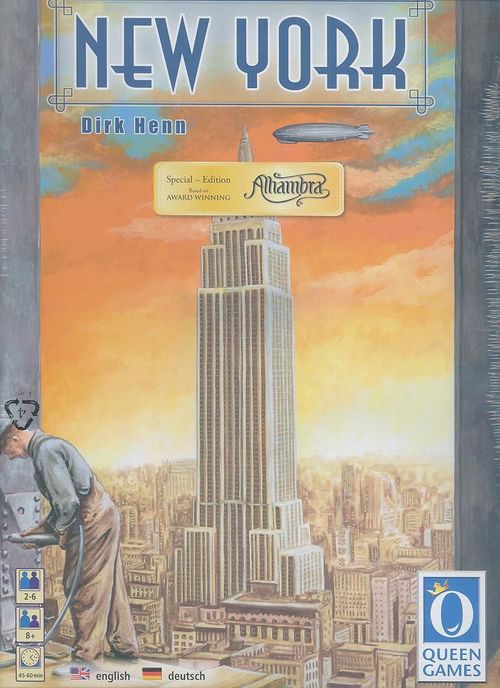
New York
New York Rulebook
Table of Contents
Table of Contents
Game Components
- 108 money cards – of four different currencies. They are used for buying building cards.
- 54 building cards – of 6 different types of buildings. Each building card shows its type of building and its price.
- 1 Construction yard – with one currency symbol for each currency.
- 2 scoring cards and 1 reference card – the "scoring A" card, the "scoring B" card and the reference card.
- 1 rules booklet
Object of the Game
The player owning the most building cards of a certain type at the right moment – that is at the moment of scoring – gains varying numbers of points, depending on the type of buildings. The number of points is increasing with each scoring. The player with the most points at the end of the game is the winner.
Setup
Place the construction yard in the center of the playing area.
Sort all cards in separate piles (building cards, money cards, scoring cards, reference card).
Shuffle the 54 building cards and place the deck face down on the table. Draw the top 4 cards and place them face up next to the construction yard, from left to right.
Put the 2 scoring cards aside for the time being.
This table shows the prices and quantities of building types:
| Price | Quantity | Type of building |
|---|---|---|
| 2 - 8 | 7x | Museum |
| 3 - 9 | 7x | Theater |
| 4 - 10 | 9x | Station |
| 5 - 11 | 9x | Church |
| 6 - 12 | 11x | Park |
| 7 - 13 | 11x | Skyscraper |
Shuffle the deck of money cards and deal each player their starting capital. For each player, deal one card after the other from the top of the deck of money cards and place the cards face up in front of the player until their total is 20 or more, disregarding the different currencies. Deal cards to the next player in the same manner etc. Place the remaining money cards as face-down deck on the table, after all players have received their starting capital. The players take their money cards in their hand and keep them secret from now on.
Note: This way it is ensured that each player's starting capital ranges from 20 to 28 total.
The player holding the least number of cards (disregarding their total) is the starting player. In case of a tie, the player with the least total (of all tied players) is the starting player. If there is still a tie, the youngest player of the tied players is the starting player.
Then draw the top 4 money cards from the deck and place them next to each other face up on the table.
Separate the remaining money cards in five piles of a similar level, then shuffle the "scoring A" card into the second pile, the "scoring B" card into the fourth. Stack the piles on top of each other; the fifth pile at the bottom, the fourth on top of it, next is the third pile etc., the first pile being on top of the complete deck. Place this deck next to the 4 face up money cards.
Note: This procedure makes sure that the scoring cards won't be drawn too early or too late in the game or are drawn in rapid succession.
Keep pen and paper and the reference card handy for scoring.
Playing the Game
The active player must decide between 2 possible actions:
- Take money
- Buy one building card
These actions are now explained in detail:
Take Money
The active player picks up any one money card of their choice from those on open display or even several ones, as long as the total value does not exceed 5 (disregarding the different currencies).
Example: The player may pick up both money cards on the left or any one of the other two.
Buy One Building Card
The active player takes one of the face up building cards. They have to pay at least the price printed on the card in the currency as shown by the construction yard. Please note there is no change!
All money paid is placed on a discard pile.
If a player is paying the required price sharp they immediately perform one more turn, again deciding between the two possible actions.
Note: The maximum number of actions a player can perform in a row is 5 (four times paying sharp and take money once).
Each player places all their bought building cards in front of themselves, so that everybody can see how many cards of which type they possess.
The open display of building cards is not replenished during a player's turn; this is done only after the player has finished their turn.
Example: Lucy urgently wants a garden. The garden on offer costs 10 of the blue currency. Lucy owns two blue money cards and opts to buy the garden. She cannot pay 10 sharp (in fact, she pays 11) and her turn is finished, she does not receive any change. If she would have paid 10 sharp, she would continue her turn, again deciding between "Take money" and "Buy one building card". Lucy now adds the card to her own display.
Replenishing
After a player has finished their turn, both the building cards (from left to right) and money cards are replenished to a total of 4 cards each. If the deck of money cards is empty, the discard pile is shuffled and used as new face down pile.
Then the next player in clockwise direction performs their turn.
Scoring
Overall there are 3 scorings during the course of the game. The first two scorings "A" and "B" take place as soon as the corresponding cards are drawn from the deck of money cards. The third and final scoring "C" takes place at the end of the game.
When a scoring card is revealed scoring takes place immediately, before the next player's turn. As reminder place the scoring card in front of the next player. The players refer to the reference card for the number of points to be awarded. Remove the scoring card from the game after all points have been awarded. Replenish the number of money cards on display to four.
Points are awarded for each type of building cards; the points for each player are noted on a piece of paper. In case of a tie, i.e. more than one player have the same number of cards of a certain building type, the points of the corresponding ranks are totaled and then divided by the number of tied players.
Reference Card — Points per Rank
| Type of building | A: 1st | B: 1st | B: 2nd | C: 1st | C: 2nd | C: 3rd |
|---|---|---|---|---|---|---|
| Museum (light blue) | 1 | 8 | 1 | 16 | 8 | 1 |
| Theater (red) | 2 | 9 | 2 | 17 | 9 | 2 |
| Station (brown) | 3 | 10 | 3 | 18 | 10 | 3 |
| Church (white) | 4 |
Scoring "A"
The 1st scoring takes place as soon as the scoring card "A" is revealed.
Only the player owning the majority of each type of building card gains victory points. The number of victory points for each 1st rank is shown on the reference card.
Example: The player owning the most white building cards gains 4 points.
Scoring "B"
The 2nd scoring takes place as soon as the scoring card "B" is revealed, and now both the player with the majority of each type of building card gains victory points and the runner-up. The number of victory points for each 1st and 2nd rank is shown in column B of the reference card.
Example: The player owning the most purple building cards gains 13 points. The player owning second most cards of this type gains 6 points.
Example: Both Tobi and Nina own 4 purple building cards. They share the points for 1st and 2nd rank. 13 + 6 = 19 points. Both players gain 9 points, rounded down.
Scoring "C"
The 3rd scoring takes place at the end of the game, as soon as the number of building cards cannot be replenished completely (see "End of the game"). Now also the player holding 3rd rank of each type of building card gains victory points, as shown on the reference card.
Example: Paul and Nina own 3 green building cards each, both Tobi and Kate have 2 green building cards. Paul and Nina gain 20 + 12 = 32 : 2 = 16 points each. Both Tobi and Kate gain 5 : 2 = 2 points (rounded down).
End of the Game
The game ends – after a player has finished their turn – as soon as the building cards can not be replenished completely up to 4 because the pile is empty.
Please note: As many building cards as possible are still replenished in order.
The remaining face up building cards are bought by the players owning the most money of the corresponding currencies (the actual price of the cards does not matter now). In case of a tie nobody buys the card in question.
Now the third and final scoring takes place.
The player with the highest total of points after the third scoring is the winner of the game. In case of a tie all tied players are sharing the victory.
Special Rules for 2 Players
Please use the rules for 3 to 6 players and apply the following changes:
Each money card exists three times; sort one of each type out. This means there are only 72 money cards.
There is an imaginary third player, let's call him Dirk. Dirk collects building cards as the two other players do. However, Dirk does not perform any turns.
At the start of the game, place the top 6 cards from the pile of building cards aside for Dirk, face up and sorted by type and in good view of both players.
When scoring also Dirk gains victory points for any majority of building cards.
Immediately after Scoring "A" 6 more building cards are drawn and added to Dirk's open display. After Scoring "B", the number of cards drawn and added to Dirk's display is not necessarily six, but a third of all remaining cards, rounded down.
There is only one actual rules change for the two players: Each time they buy a building card, they may keep it for themselves or donate it to Dirk.