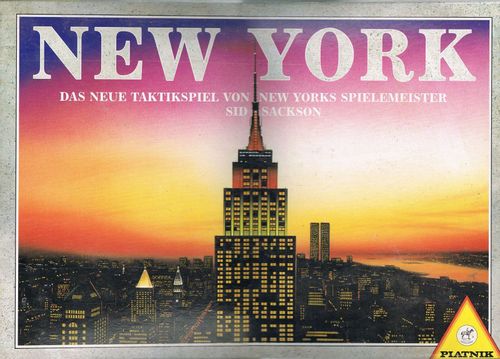
New York (1995)
New York (1995) Rulebook
Table of Contents
Table of Contents
Object of the Game
The players compete for ownership of the 49 buildings. The goal is to obtain the largest group of contiguous buildings and with it the greatest number of points. To this end it is important, during the game, to keep an eye on and hinder the growth of the other players' territories.
The Board
The board shows 7 horizontal "avenues" crossed by 7 vertical "streets". The resulting intersections give 49 spaces/buildings.
Cards Used in the Game
Some cards have a red back and others a blue back. Red refers to the horizontal "avenues"; blue refers to the vertical "streets".
Street Cards: Each "avenue" has 4 cards, for a total of 28 red street cards. Likewise, there are 28 blue street cards, 4 for each "street".
Joker: There are 5 red jokers and 5 blue jokers.
Stop Cards: There are two end-of-game cards, each bearing the word "Stop".
Action Cards: There are 12 action cards. These are not used in the basic game. There are variants of the game and the cards are used in one of these. The rules for the variants are described later.
Game Pieces
Each player is represented on the board by a colour, and the pieces of that colour are used to mark ownership of the player's buildings. The number of pieces each player owns varies according to the number of players in the game.
| Players | Pieces | Colours |
|---|---|---|
| 3 | 25 | red, blue, yellow |
| 4 | 20 | red, blue, yellow, green |
| 5 | 15 | red, blue, yellow, green, black |
Colour Cards
There are five of them and they are used to decide who plays with which colour.
Money
Money is used to buy buildings from the other players. The amount each player starts with is shown in the following table.
| Players | Money |
|---|---|
| 3 | 8 |
| 4 | 6 |
| 5 | 5 |
Setup
Place the board in the centre of the table. Count the required number of pieces to play for each colour. (See the table above for both the colours and the numbers.) Set the five colour cards to one side. Set the two end-of-game cards to one side. They will be inserted into the deck later. If you are playing the basic game, return the twelve action cards to the box. They are not needed. The remaining playing cards (street cards and jokers) are shuffled and placed face down near the board. (Red and blue cards together in one deck.)
Game Overview
The game consists of a preliminary phase and a main phase.
Preliminary Phase
Before the actual game begins, the players place some pieces on the board. The number of each colour depends on the number of players and corresponds to the number of money markers each player has at the start.
| Players | Pieces placed for each colour |
|---|---|
| 3 | 8 |
| 4 | 6 |
| 5 | 5 |
Placing the Pieces
Each player chooses a colour and takes the appropriate number of pieces (8, 6 or 5). The colour chosen is not necessarily the one the player will use in the main game; that will be determined after this preliminary phase is complete.
The youngest player places one piece on a space of their choice. The other players then follow clockwise. This continues until all the pieces of the preliminary phase have been placed.
Rules for Placement
A piece may be placed on any free space subject to one restriction: a piece may not be placed next to a piece of the same colour. "Next to" in this context means "next to on the same row" or "next to on the same column". There are no restrictions on two pieces of the same colour being diagonally adjacent. There is a diagram on page 6 of the rulebook that gives examples of what is and is not permitted. ("Beispiel" means "example" and "nicht erlaubt" means "not permitted".)
This placement restriction applies only to the preliminary phase.
Assigning Colours
Once all the pieces of the preliminary phase have been placed, the colours that each player will use in the main part of the game are assigned. This is done by taking the appropriate colour cards, shuffling them and placing them side by side, colour face down, on the table. Each player then draws one of the cards. The colour on the card is the colour they will use for the rest of the game. Each player then takes the rest of the pieces in their own colour.
Main Phase
Now the real game begins.
Drawing Cards
The player with the red pieces begins by taking the first card from the deck. The other players then follow clockwise. This drawing of cards continues until every player has at least two cards of each colour (red and blue). An individual player stops drawing cards as soon as their hand meets this condition. So at the end of the process it is possible that one player may have 6 avenue cards and 2 street cards, while another has only two of each. However, every player will have at least 4 cards in hand. The coloured backs of the cards show that everyone can see this rule is being respected.
Acquiring Buildings
From here on, the game for each player is always the same:
- Play a red card and a blue card
- Acquire or return a building
- Put the two cards on the discard pile
- Draw new cards
(1) Playing the Two Cards
Playing one red street card and one blue one determines an intersection and with it a building. With this play of two cards of different colours, the player indicates which building they wish to acquire. (The best way to describe a building is to give the avenue and the number, for example "Park Avenue 49" refers to the crossing point of Park Avenue and 49th Street.)
Jokers: By playing a joker, a player may choose an avenue (red joker) or a street (blue joker) of their choice. Example: a player who plays a red Broadway card and a blue joker may choose any one of the intersections on Broadway. A player who plays both a red joker and a blue one may name any space on the board.
(2) Acquiring the Building
Once a player has played the two cards and then chosen a building, they may acquire it.
If the chosen building is not owned (that is, the space does not contain a marker), the player places one of their pieces on the space. This costs nothing.
If the building belongs to an opponent, the player must buy the building from them. This is done using money. The cost of the building is determined by counting the number of buildings the current owner has in that street and the number they have in that avenue. The cost is the lower of these two numbers. The player hands the correct amount of money to their opponent and replaces the opponent's marker with their own. Note that the purchase is mandatory: the current owner of the building may not refuse to sell.
(There is an example on page 9 of the rules to illustrate how this works. In that example, I wish to buy Park Avenue 49. My opponent owns 4 buildings on Park Avenue but only one on 49th Street, so Park Avenue 49 will cost me 1 money marker, which I give to my opponent. Had I wished to buy Park Avenue 38, the cost would have been 4, because my opponent has 4 buildings on Park Avenue and 5 on 38th Street.)
If the building you choose is one of your own, you lose it. Remove the marker from the board and return it to your supply.
If it happens that you can neither choose a building not owned, nor choose one of your own, nor choose an opponent's building that you can afford to buy, lay your cards face up on the table so that your opponents can see the situation. Then discard all your cards and draw a new hand. This is done by drawing cards from the deck until you have at least two red cards and two blue cards. Once you have your new cards, your turn ends: you may not acquire a building in this turn.
(3) Complete Your Turn
The two cards you have just played are placed on the discard pile and you draw new cards from the deck until you again have at least two red cards and two blue cards. If the deck is exhausted, shuffle the discard pile to form a new deck.
End of Game
The final phase of the game begins when only 4 buildings remain without an owner. At this point, place the two end-of-game cards on the discard pile. The game then continues as before until one of these two cards is drawn. When one of the "Stop" cards is drawn, the game ends immediately.
Scoring
Each player now counts the number of buildings in their largest contiguous group. Each of these is worth 2 points. Connections count along avenues and streets; "diagonal connections" do not count. The player then counts the number of buildings they own outside this group. Each of these is worth 1 point. Each money marker owned is also worth 1 point. The player with the highest total score wins.
(There is an illustrative example on page 11 of the rules. It shows the final position of a 3-player game. Player A owns the buildings marked with white circles. They have a group of 8, plus 5 connected buildings outside this group, and a treasure of 10. This gives them a total of 16 + 5 + 10 = 31 points. A breakdown is also given for each of the other two players.)
Variant (1): Event Card Game
At the start of the game the twelve event cards are added to the street cards, and the whole deck is then shuffled and placed face down next to the board.
There are two types of event card: those played as single cards, and those that must be played in combination with a second card of the opposite colour. When a player plays one of the uncombined event cards, they do not draw new cards from the deck, even if they are left with fewer than two cards of each colour.
Description of the Event Cards
Sanierung / Reconstruction: (two cards in the deck, one for each colour). The "Sanierung" card is always played as a single card, that is, without an accompanying card of the opposite colour. The inner city is rebuilt. The markers on the 5 central spaces of the board are removed and returned to their respective owners. Starting with the player who played this card and proceeding clockwise, each player places one marker on one of these five spaces. This process of repositioning pieces continues until all five spaces are filled, so if there are fewer than five players, some will place more than one piece.
Ruin: (two cards in the deck, one for each colour). The "Ruin" card, like the "Sanierung" card, is played as a single card. The houses on the outskirts of the city fall into ruin. The four corner sites are wiped out. Remove the pieces and return them to their respective owners. Starting with the player who played this card and proceeding clockwise, each player places one marker on one of these four spaces. This process of placing pieces continues until all four spaces are filled, so if there are three players, the player who played the Ruin card will place two pieces, and if there are five players, one will miss out.
Spekulation / Speculation: (two cards in the deck, one for each colour). The player who plays this card names a player who has more than 8 pieces on the board. This named player then removes one of their own pieces from the board, of their choice, and replaces it with a piece belonging to the player who played the card.
Baulöwe / Property Developer: (four cards in the deck, two for each colour). This is a joker card with extra functionality. The card is always played together with a second card of the opposite colour. As with the normal joker card, the accompanying card determines an avenue or a street, and the joker allows the player to choose a building on it. The difference this time is that the building chosen must be owned by an opponent, and the player who plays the card replaces it without paying compensation. Simply remove your opponent's marker and replace it with yours.
Statik: (two cards in the deck, one for each colour). The "Statik" card is always played in combination with a second card of the opposite colour. The second card determines a street or an avenue. The player with the most buildings on this street/avenue loses one of them, of their choice, to the person who played the card.
Variant (2): Alternative Setup Procedure
The players choose the colour they will play before the start of the preliminary phase. In the preliminary phase they will then play using the pieces of their own colour.
Variant (3): Two-Player Challenge
Each player uses two colours. The setup procedure therefore works as if there were four players: twenty pieces of each colour, 12 money markers for each of the two players, and so on. When it is a player's turn, they may choose which of their two colours to use. You are not allowed to move your pieces. So when you play two cards to determine an occupied intersection and then replace the existing marker with yours, the marker that is displaced must be one belonging to your opponent. At the end of the game, count the sizes of the largest groups in each of your two colours, and add to the sum of these two numbers the number of money markers you have. This is your score. Unlike the main game, buildings outside the largest groups do not count.
Variant (4): Team Game (for 4 Players)
The partners sit opposite each other. Each player has their own colour and their own money. When you replace one of your partner's pieces you must pay compensation in the usual way. Partners may exchange cards. At the end of the game each player calculates their own score, and these are added together to determine the total score of their team.