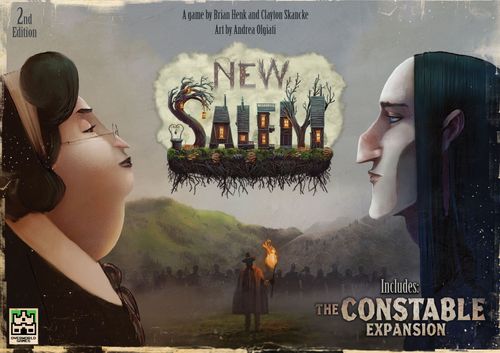
New Salem: Second Edition
Official rulebook: Pull the Pin Games (formerly Overworld Games) · PDF
New Salem: Second Edition Rulebook
Table of Contents
Table of Contents
Objective
Players will draft Buildings, scoring points for those that correspond with symbols on their Character card and scoring extra points when completing sets of Buildings. A Witch player will win if their team adds a certain amount of Despair to the town while a Puritan player will win if they keep the Despair under that amount. The player with the most points on the team that accomplishes that goal wins the game.
Components
- 144 Building cards
- 10 Character cards
- 24 Event cards
- 5 Round cards
- 35 Despair cubes
- 35 Hope cubes
- 8 Badges
- 1 Constable standee
Symbols
Despair: Despair determines whether the game is won by a Witch or a Puritan citizen. This is an unlimited resource, so if Despair cubes run out, use something else to represent Despair.
Hope: Hope is New Salem's currency and is used to initiate events. When shown on a Building card, this indicates that Hope is provided by that Building. When shown on an Event card, this indicates how much Hope must be spent to initiate the event. This is an unlimited resource, so if Hope cubes run out, use something else to represent Hope.
Remove Despair: When anyone plays a Building or triggers an event that displays this symbol, that player removes one Despair cube from a building for each symbol displayed. This cannot be saved for another round; if there is no Despair on any Building when a Building or event with this symbol is played, it does nothing.
Set Matching: These symbols appear on the edges of Building cards to indicate that another Building should appear to the right and/or left of each Building in a set. Each complete set includes one pair of half moons and one pair of triangles.
Give/Take Event: Any Event with this symbol is given to or taken by a player rather than being discarded to the bottom of the Event deck when used.
End Game Set Bonus: A complete Building set with these symbols will add or remove 3 Despair at the end of the game before determining the winner. Despair is not added or removed immediately when the set is completed, but instead when round 5 has ended.
Building Types
Although the building types are named, you may simply reference and match the symbols.
- Entertainment
- Trade
- Finance
- Education
- Death
- Justice
Setup
Character Cards
- Separate the Puritan and Witch Character cards into two separate piles. Reference the table below to determine the appropriate number of Witch and Puritan cards to be included based on the number of players.
- Randomly remove cards from each pile until you have the appropriate number based on the table below, then shuffle the remaining Character cards together.
- Deal one to each player.
- Remove all unused Character cards from the game. These may not be viewed by any player.
| Players | Witch Character Cards | Puritan Character Cards |
|---|---|---|
| 3 | 2 | 4 |
| 4 | 2 | 4 |
| 5 | 2 | 4 |
| 6 | 2 | 5 |
| 7 | 3 | 6 |
| 8 | 3 | 6 |
Example (six players): Separate the Witch and Puritan Character cards. Randomly remove two Witch Character cards and one Puritan Character card from the game. Shuffle the remaining two Witch and five Puritan Character cards together and deal one to each player. Remove the remaining Character card from the game.
Building and Event Cards
Most Building and Event cards have a number in the bottom right corner to indicate whether they will be used during this game.
- Remove any Building and/or Event cards that show a number that is greater than the number of players in the game.
- Shuffle all remaining Buildings and place them face-down to create the Building deck.
- Place the Cleansing and Trial Event cards face-up in the middle of the table.
- Shuffle all remaining Events and place them face-down to form the Event deck.
Round Cards
Place the Round cards in a face-up pile in the center of the table where they are visible to all players. Stack the cards in order with Round 1 on top and Round 5 on bottom.
Badges
Take one Badge for each player in the game and place them in a stack on the table. Place any unused Badges back in the box.
Constable
Give the Constable token and a Badge to the player who was most recently wrongfully accused. They will be the first Constable. Give them 1 free Hope to place on the first Building they play in Round 1.
Example (six players): Of the Building and Event cards, only those numbered 6 or lower are used. Those numbered 7 and 8 are removed from the game. Shown in the setup example are the Cleansing and Trial Event cards placed face-up in the middle of the table, along with the remaining Events and Buildings in their decks. The Round 1 card is placed face-up, six Badges are taken, and the Constable token and a Badge go to the first Constable.
Gameplay
Each of the game's five rounds consists of the following four phases, in this order:
- Draft Buildings
- A. Deal
- B. Draft
- C. Discard
- Draw Event
- Initiate Events
- Shuffle and End Round
1. Draft Buildings
A. Deal
The Round card for the current round indicates how many Building cards should be dealt to and played by each player each round. This is also shown in the table below.
| Round | Buildings Dealt | Buildings Played |
|---|---|---|
| 1 | 3 | 2 |
| 2 | 4 | 3 |
| 3 | 5 | 4 |
| 4 | 4 | 3 |
| 5 | 3 | 2 |
Deal example (round two): Each player is dealt four Building cards from the Building deck.
B. Draft
Each player chooses one card and places it face-down on top of their Character card, then passes the remaining cards to the player on their left. If that player is still choosing between other cards, the cards being passed should be placed near the edge of the table between the two players.
Once all players have chosen a Building card, the card they chose is flipped face-up. For any corresponding symbol on their card, each player adds a Hope cube to it, adds a Despair cube to it, or removes a Despair cube from any Building.
Players continue drafting cards in this manner until they are choosing between two cards.
Draft example (round two): Players 1 and 2 were each dealt three Building cards. Player 1 chooses one Building card to keep and places it face-down on top of his Character card (A). Player 2 is still choosing between her three cards, so Player 1 places his remaining two cards along the edge of the table between himself and Player 2 (B). Player 1 then picks up the two cards that have been passed to him (C).
When each player has chosen a Building card to keep and passed their remaining cards, each player reveals their first Building card and adds or removes Hope or Despair if appropriate.
C. Discard
When a player has two cards handed to them, they must do one of the following:
- Keep one of those cards and discard the other
OR
- Discard both cards and draw and keep a Building card from the top of the Building deck.
Discarded Building cards are placed on the bottom of the deck and may not be viewed by other players.
When all players have made this decision, each player turns their final card face-up and adds or removes a Hope or Despair cube if a corresponding symbol appears on that card.
2. Draw Event
Draw an Event card from the Event deck and place it face-up on the table. In addition to Cleansing and Trial, there should now be one face-up Event for each round played.
Discard example: When deciding between only two cards, a player may keep one and discard the other, OR discard both and draw a random card from the deck.
Draw example (round two): In addition to Trial and Cleansing, there is now one face-up Event that was added in round 1 and one that was added in round 2.
3. Initiate Events
Giving Hope
Any player other than the Constable may give any or all of their Hope to the Constable at any time during the Initiate Events phase, even after one or more Events have been triggered. The Constable must accept any Hope they are given. Players may not give Hope to a player who is not Constable.
Initiating Events
Only the Constable may initiate an Event. When you initiate an Event, follow these steps:
- Remove Hope cubes from your own Building cards equal to the Event's cost and put them back in the supply.
- Read and execute the Event card's text. If the card does not have a red border, place it face-down on the bottom of the Event deck, unless the card specifies to give it to a player. If the Event did not have a red border, draw a new Event from the top of the deck and place it face-up to replace the Event that was used.
- Choose a new player to become the Constable. You may not choose a player who has a Badge or who is on Trial. Give the Constable standee to the new Constable.
- The new Constable takes a Badge from the center of the table and puts one Hope cube from the supply on one of their Buildings. If each player now has either a Badge or is on Trial, all players except the Constable return their Badges to the center of the table. The new Constable may choose to initiate another Event or end the round.
End Round
If the Constable has enough Hope to trigger the most expensive Event, they must trigger an Event (although it doesn't have to be the most expensive one). If the Constable has less Hope than the most expensive Event, they may decide to end the phase and move play to the next round.
Initiate Events example (three players): Player 1 is the Constable and wants to put Player 2 on Trial. Player 1 only has three Hope, and Trial costs four. Player 3 gives Player 1 one Hope. Player 1 initiates the Trial event and gives it to Player 2. Player 1 gives the Constable standee to Player 3. Player 3 takes a Badge. Because each player now has a Badge or a Trial, Player 1 returns his Badge to the center of the table.
4. Shuffle and End Round
When the Constable decides that they will end the round rather than initiating another Event, shuffle the Buildings deck. Flip over the top Round card and place it face-down next to the Round card pile.
Game End
Play ends after the Initiate Events phase of the 5th round.
The amount of Despair in the game will determine whether the winner will be a Puritan or a Witch. The winner will be the player whose Buildings score them the most points.
There are four steps to determine the game's winner. These steps are covered in detail in the following sections:
- Resolve Trials
- Resolve Building Sets
- Count Despair
- Count Points
1. Resolve Trials
At the end of the game, a trial occurs. All players reveal their Character cards.
- For each Witch who has a Trial card, remove 2 Despair cubes from the town.
- For each Witch who does not have a Trial card, add 2 Despair cubes to the town.
- For each Puritan who has a Trial card, add 2 Despair cubes to the town.
2. Resolve Building Sets
All players, including those on Trial, do the following:
- For each complete set of 3 unique Death Buildings, add 3 Despair to the town.
- For each complete set of 3 unique Justice Buildings, remove 3 Despair from the town.
Resolve Trials example: There are a total of seven Despair cubes on all players' Buildings. Player 1 is a Witch and has a Trial card, so two Despair cubes are removed. Player 2 is a Witch and does not have a Trial card, so two Despair cubes are added. Player 3 is a Puritan and has a Trial card, so two more Despair cubes are added. Player 4 is a Puritan and does not have a Trial card, which causes no change.
Resolve Building Sets example: Player 1 did not complete any Death or Justice sets. Player 2 completed the Death set, and adds 3 Despair cubes to the town. Players 3 and 4 each completed a Justice set, and each remove 3 Despair cubes from the town.
3. Count Despair
If there are enough Despair cubes in the town at the end of the game, the Witch with the most Victory Points is the winner. If there are not enough Despair cubes in the town for a Witch to win, the Puritan with the most Victory Points is the winner.
If there are enough Despair cubes in the town for the Witches to win, but no player is a Witch, all players lose.
The table below shows the minimum number of Despair cubes that must be in the town at the end of the game for a Witch to win.
| Number of Players | 3 | 4 | 5 | 6 | 7 | 8 |
|---|---|---|---|---|---|---|
| Despair needed for a Witch to win | 6 | 8 | 10 | 12 | 14 | 16 |
4. Count Points
Players earn points as follows:
- 1 point for each player's Building that matches one of the types shown on their Character card.
- 2 points for each complete set of 3 unique Buildings of any type, regardless of whether that type is on the player's Character card.
In the event of a tie, the player with the most Hope cubes wins. If players are still tied after considering Hope cubes, all tied players win.
Count Despair example: There are a total of 6 Despair cubes. Since there are four players, this means that the Puritan with the most points will win the game. Players 1 and 2 are not eligible to win. Player 3 or Player 4 will win the game.
Count Points example: Player 3 gets 2 points for his Trade (green) set and 1 point for each Building in the set, because the Buildings match one of the types on his Character card. He gets 1 point for his Finance (yellow) Building, which matches the other type on his Character card. He also gets 2 points for his Death (white) set. Player 3 has 8 points. Player 4 gets 2 points for her Education (purple) set. She gets 1 point for each of her Entertainment (red) and Finance (yellow) cards, because the Buildings match the types on her Character card. She also gets 2 points for her Death (white) set. Player 4 has 7 points. Player 3 wins.
Rule Reminders
Below is a list of rules that are often overlooked and frequently asked questions.
- Any time a player receives Hope or Despair, they must place it on one of their Buildings.
- The Constable must initiate an Event if they have enough Hope to initiate the most expensive Event.
- The Constable can receive Hope, but may not give Hope. The Constable must accept any Hope they are given.
- Any time a Building is taken or given to another player, ownership of any Hope and/or Despair on that Building follows the Building to its new owner.
- Any time a Building leaves play, any Hope and/or Despair on that Building is removed and placed back in the pool.
- Neither the Building nor the Event deck has a discard pile. Any card that is discarded is placed on the bottom of its corresponding deck.
- The Death and Justice set effects only occur at the end of the game, not immediately when the set is completed.
- Table talk is allowed. You may say anything false or truthful about Character cards you have seen, but you may not show any Character card unless an Event specifies to do so.
- You may discuss (truthfully or falsely) whether your Character card is a Witch or Puritan and/or which sets you are collecting, but you may not discuss the artwork, name, profession, or physical appearance of the Character displayed on the card.
- A Constable's declared intentions when asking for Hope are not binding. For example, the Constable may ask for Hope to initiate the Cleansing Event, but choose to initiate the Trial Event instead once they have been given Hope.
First Time Witches
Below are some tips for Witches that you can share if there are new players.
- Don't add too much Despair early on in the game, as you may be found out and put on Trial.
- Don't worry too much about being found out in the later rounds. This is your chance to add a lot of Despair.
- Remember, even Puritans play Buildings with Despair on them sometimes. If you're questioned, you can always claim that there were no good cards to choose from, or that you're collecting the cards that will get you the most points.
- Accuse others. If you've accused someone, you'll take the spotlight off yourself, cause others to doubt them, and you may even get a Puritan put on Trial.
- The game isn't over if you're put on Trial. You can still take Buildings with Hope to prevent Puritans from playing them, and you can add more Despair at the end of the game if you collect a Death Building set.
Quick Reference
Character Cards and Despair
| Players | 3 | 4 | 5 | 6 | 7 | 8 |
|---|---|---|---|---|---|---|
| Witch Character cards | 2 | 2 | 2 | 2 | 3 | 3 |
| Puritan Character cards | 4 | 4 | 4 | 5 | 6 | 6 |
| Despair needed for a Witch to win | 6 | 8 | 10 | 12 | 14 | 16 |
Drafting Buildings
| Round | 1 | 2 | 3 | 4 | 5 |
|---|---|---|---|---|---|
| Buildings dealt | 3 | 4 | 5 | 4 | 3 |
| Buildings played | 2 | 3 | 4 | 3 | 2 |
Phases
Round:
- Draft Buildings (Deal, Draft, Discard)
- Draw Event
- Initiate Events
- Shuffle and End Round
Game End:
- Resolve Trials
- Resolve Building Sets
- Count Despair
- Count Points