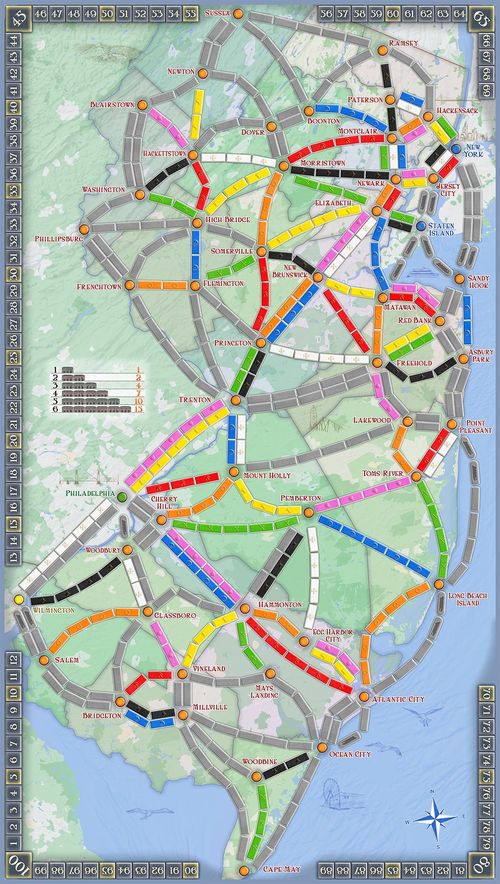
New Jersey (fan expansion for Ticket to Ride)
New Jersey (fan expansion for Ticket to Ride) Rulebook
Table of Contents
Table of Contents
New Jersey Expansion
This rules booklet describes the gameplay changes specific to the New Jersey Map, and assumes that you are familiar with the rules first introduced in the original Ticket to Ride and Ticket to Ride Europe games. This expansion is designed for 2-6 players.
To play with this expansion, you will need the following components taken from Ticket to Ride or Ticket to Ride Europe:
- 48 Trains per player (or the next highest amount from 45-48 that all players have an equal number of)
- Score markers, 1 for each player
- Deck of 110 Train Car cards
- Train Stations are recommended but optional. Give the following amount to each player depending on the number of players:
- 2 players: 1 Station
- 3-4 players: 2 Stations
- 5-6 players: 3 Stations
New Components
- 82 Destination Ticket cards
- 15 Three-Stop Destination Ticket cards
- 3 Bonus cards
- 1 Board map of New Jersey
Set Up
- Shuffle the 82 Destination Ticket cards and deal 5 to each player.
- Shuffle the 15 Three-Stop Destination Ticket cards and deal 2 to each player.
Each player must keep at least 3 cards (in any combination between the regular and three-stop destination cards).
Discarded Destination Tickets are returned to the bottom of their respective decks.
- Shuffle the 110 Train Car cards, and deal 4 to each player.
Special Rules
On your turn, you must perform one (and only one) of the following five actions:
Draw Train Car Cards
The card draw action follows the exact same rules as the base game. As usual, if at any time, three of the five faceup Train Car cards are Locomotives, all five cards are immediately discarded, and five new cards turned faceup to replace them.
Claim a Route
The route claim action follows the exact same rules as the base game. Locomotives can always act as a stand-in for any given color.
Ferry Routes
Ferries are special Gray routes linking two adjacent cities across a body of water. They are easily identified by the Locomotive icon(s) featured on at least one of the spaces comprising the route.
To claim a Ferry Route, a player must play a Locomotive card for each Locomotive symbol on the route, and the usual set of cards of the proper color for the remaining spaces of that Ferry Route.
Double and Triple Routes
One player can never claim more than one route between the same cities during the course of the game.
Important Note: In 2 and 3 player games, only one route of the Double or Triple Routes can be claimed. Once a player has claimed one of these, the other route(s) forming the Double or Triple Route are locked and unavailable to other players.
The Atlantic City-Ocean City Case
There are 3 routes between Atlantic City and Ocean City, but one is a Ferry Route. While the two parallel gray routes count as a Double Route, the Ferry Route is treated as a separate route. This means the Ferry Route may be claimed without regard to the other two routes, and vice versa. One player still may not claim more than one of these.
The Atlantic City-Long Beach Island Case
Similarly, there are 2 routes between Atlantic City and Long Beach Island, but one is a Ferry Route. The Ferry Route is treated as a separate route. This means the Ferry Route may be claimed without regard to the orange route, and vice versa. One player still may not claim more than one of these.
Draw Regular Destination Tickets
A player draws 4 Destination Tickets from the top of the deck. They must keep at least one of them, but they may keep two, three, or all four if they choose. Any returned cards are placed at the bottom of the deck.
Draw Three-Stop Destination Tickets
Important Note: This action is dependent on the number of Three-Stop Tickets a player has already kept. If a player has already kept 2 Three-Stop Tickets, they cannot perform this action.
A player draws 2 Three-Stop Destination Tickets from the top of the deck. They must keep at least one of them, but they cannot keep an amount of cards that exceeds the limit of 2 Three-Stop Tickets per player. Any returned cards are placed at the bottom of the deck.
(For example, a player has kept 1 Three-Stop Ticket previously. When taking this action, they examine 2 new cards, but must keep only one.)
Build a Train Station
The station-building action follows the exact same rules as in the original game where it was introduced.
A Train Station allows its owner to use one, and only one, of the routes belonging to another player, into (or out of) that city to help them connect the cities on their Destination Tickets.
Stations may be built on any unoccupied city, even if it currently has no claimed routes into it. Two Stations may never be built in the same city. Each player may build a maximum of one Station per turn.
To build their first Station, a player discards one Train card from their hand and places a Station of their color on the chosen city. To build their second Station, the player must discard a set of two cards of any one color; and to build their third, a set of three Train cards of any one color. As usual, any number of cards can be replaced by Locomotives.
If a player uses the same Station to help connect cities on several different Tickets, they must use the same Route into (or out of) the city with the Station for all of those Tickets. The Station owner does not need to decide which Route they will use until the end of the game.
A player is never required to build any Stations. For each Station a player does not use, four points are added to their score at the end of the game.
Note to the transcription: the Calculating Scores summary graphic on page 2 labels this bonus "+4 Points Per Station Kept", while the text above says four points are added for each Station a player does not use. The text is transcribed as printed.
Game End
When any player's stock of colored plastic Train Cars is reduced to 0, 1, or 2, each player including that player, gets one final turn. The game then ends and players calculate their final scores.
Calculating Scores
Players should have already accounted for the points they earned as they claimed various Routes. To make sure no mistakes were made, they may want to recount the points for each player's Routes.
Players then reveal all of their Destination Tickets. At this point, each player chooses the Routes to use for their built Stations. Each Station allows the player to use one (and only one) Route belonging to an opponent into or out of that city for the purpose of completing Destination Tickets.
Each built Station should be placed on top of one of the Train Cars on the chosen Routes. These Routes now behave like they are owned by both the player who owns the Train Car and the player who owns the Station. If two players have chosen the same Route for their Stations, the Route is owned by three players.
Final score is calculated as: Current Score, plus Destination Ticket Bonus/Penalty, plus Three-Stop Ticket Bonus/Penalty, plus 4 Points Per Station Kept, plus End of Game Bonuses.
Scoring Three-Stop Destination Tickets
Partial Credit
If a player completes a path comprising only the "A-B" segment, the small number shown in the "A-B" row is added to their score. Then, the "B-C" number is subtracted from their score.
Likewise, if a player completes only the "B-C" segment, the small number shown in the "B-C" row is added to their score. Then, the "A-B" number is subtracted from their score.
Note: This may result in the value of a partially completed ticket being a negative number or zero.
Full Credit
If a player completes a path between all three cities, they add points equal to the largest value "A-B-C" shown in the bottom-right corner of the card.
Note: A complete path in a different order (such as A-C-B) still satisfies the requirement for full credit.
No Credit
If the player fails to complete any part of the ticket, they lose points equal to the largest value "A-B-C" shown in the bottom-right corner of the card.
Special Case: A to C but not B
If a player completes a path between the "A" and "C" cities without connecting "B," the ticket is worth ±0 (zero) points.
End of Game Bonuses
There are three bonuses awarded at the end of the game:
- The player who has the Longest Continuous Path of Routes receives the New Jersey Express bonus card and adds 10 points to their score.
- Note: Opponents' Routes with Stations may not be counted when computing the Longest Continuous Path of Routes.
- The player who has completed the most Destination Tickets receives the Globetrotter bonus card and adds 15 points to their score.
- Note: Only Full Credit Three-Stop Tickets may be counted towards the Globetrotter Bonus. Partial Credit Three-Stop Tickets do not count towards the Globetrotter Bonus.
- The player who has completed the most "Short" Destination Tickets (worth 9 points or fewer) receives the Local Network bonus card and adds 10 points to their score.
- Note: Three-Stop Tickets are not counted towards the Local Network bonus.
In case of a tie when attributing these bonuses, all tied players score them.
If two or more players are tied with the most points, the player who has fully completed the most Destination Tickets is the winner.
House Rules
These optional house rules can alter the feel of the game to create more unique gameplay experiences. They are taken from the designer's separate House Rules card.
Merciful Three-Stop Tickets
Partial Credit is calculated by adding just the completed segment's value; either the "A-B," or "B-C" number.
Then, the incomplete segment becomes 0 points. All other cases are scored in the same way as usual.
No Three-Stop Tickets
Take these out of play for a more vanilla-friendly experience. At the beginning of play, players are still dealt 5 regular destination tickets, and must keep at least 3.
Blind Bonus
At the beginning of play, shuffle the three bonus cards face down. Pick one at random and remove the other two from play, but do not reveal what they are yet.
As final scores are being calculated, reveal the remaining bonus card and attribute it appropriately.
Train Car Substitution
A set of four unrelated train car cards of various colors may be discarded in the place of one space of any color.
However, the locomotive symbol(s) within a Ferry Route may not be substituted in this way.
This house rule is recommended in 5- or 6-player games to encourage players to return undesired train car cards to the deck.