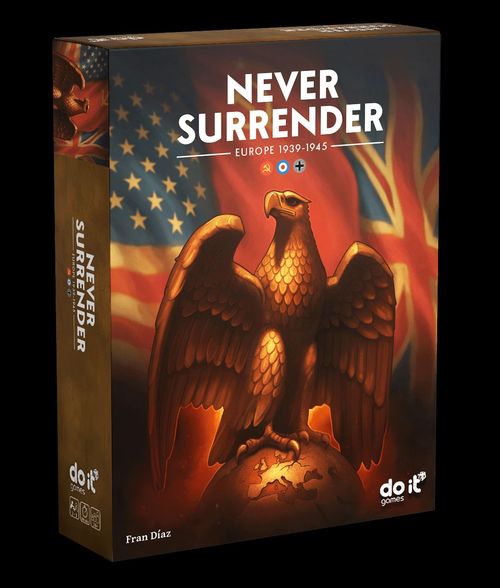
Never Surrender
Never Surrender Rulebook
Table of Contents
Table of Contents
- Introduction
- Game Components
- Cards
- Individual Decks and Common Deck
- Hand-Size Cards
- General Board
- Locations
- Communications
- Areas
- Individual Board
- Markers
- Convoys
- Pieces
- Discs
- Development of the Game
- End of the Game
- Actions
- Scenario: Full Campaign 1939-45 (3 Players, 3 Bienniums)
- Card Event List
Introduction
Never Surrender is a game for two or three players in which the struggle for mastery over Europe is played out over six years, from mid-1939 to mid-1945.
In a three-player game, the sides represented by each player are the Western Allies, Nazi Germany and the Soviet Union. For a two-player game, one of the players simultaneously represents the Allies and the Soviet Union. During the game other countries and locations may join one of the sides.
The sides are represented in the game components by different colours: blue for the Allies, grey for Nazi Germany and red for the Soviet Union, and by their own symbols: a roundel in the blue, white and red colours for the Allies, a black Balkenkreuz (the historic "Balkenkreuz" cross of bars) on a grey background for Nazi Germany, and the yellow hammer and sickle on a red background for the Soviet Union.
In a three-player game each player plays the fate of one of the sides; when the game is two-player, one of them represents two of the sides.
Depending on the maximum game length desired, and whether two or three players take part, a suitable scenario of Never Surrender is chosen.
For this rulebook the full campaign for three players (each of them representing one of the sides) covering the period from mid-1939 to mid-1945 is used, because it includes all the rules and all the cards of the common deck appear in it.
The objective of the players is to achieve predominance over Europe. To do so they must make the most of both their military strength and their political influence, knowing when to use armed conflict and when to promote peaceful relations to their benefit in order to win.
The game may end at any moment if one of the following conditions occurs: if one of the players extends their control across the map sufficiently; when a capital falls into enemy hands; if a side sinks into internal revolts; or after the activation of one of the two special events that appear in the final stretch of the game: the fall of the Nazi regime when it is driven towards a military disaster, or the detonation of the atomic bomb by one side.
If the game has not ended immediately before the last biennium finishes, the winner of the game will be the side whose military technology leaves it best prepared to face a later period of war with several superpowers during the Cold War.
Game Components
The players will have available for use in the game the components that they have on the map and in the area where they place their individual board, both those that lie directly on it and those nearby.
Another area of the table, apart from the individual boards, will be set aside as the reserve, and in it will be placed the components that are not available for play, whether temporarily or permanently.
The game components are limited, cannot be replaced by other items, and if a player does not have enough pieces to carry out an action, they cannot carry it out.
Never Surrender includes:
- Rulebook
- Events and scenarios book
- 129 cards (NOTE: In reality there are 130, adding the special hand-size card, still to be defined, for the player who represents the Allied side and the Soviet side in a two-player game)
- One common general board for the players
- 3 individual boards, corresponding to the Western Allies, Nazi Germany and the Soviet Union
- 60 circular markers (20 for the Allied player, 30 for the German and 10 for the Soviet) with two different faces indicating the type of control exercised over a location, bearing the identifying symbols of the side to which they belong
- 4 circular markers with two faces (peace or war relationship) indicating the relationship between the 3 sides and between the United States and Japan
- 5 square markers representing the Allied convoys
- 95 cubes of 8 mm in 3 colours (30 for the Allied player, 35 for the German and 30 for the Soviet) representing their national will (when placed on the individual board) or their troops (when placed on the map)
- 12 white cubes of 10 mm representing the resistance of a location to control exercised by a side
- 5 rectangular prisms in 3 colours (two each for the Allied and German sides and one for the Soviet) representing naval superiority
- 6 octagonal prisms in 3 colours (two per side) representing air superiority
- 32 discs of 15 mm in 2 colours (16 for the Allied player and 16 for the German) representing influence over the political alignment of a country, the degree of friendship in the relationship between the sides, or the belligerence of the United States and Japan
- 45 barrels representing the resources available to the sides
- 3 blocks in 3 colours (one for each side) indicating glory on their individual boards
- 3 pawns in 3 colours (one for each side) indicating the number of cards in hand with which each player ends their turn
Cards
The game contains 129 cards:
- 54 cards that make up the three individual decks of 18 cards (one for each side: Western Allies, Nazi Germany and the Soviet Union). They are distinguished from the other cards because the black band at their top occupies almost the whole width and is visible beneath the largest number in the left corner. Next to that number appears the identifying symbol that determines to which side's deck the card belongs.
- 71 cards of the common deck, divided into two types:
- 63 non-special cards that make up most of the common deck, divided into three groups called "A", "B" and "C" according to the biennium in which the event depicted falls. The group to which each card belongs appears in the letter that forms part of the reference code located in its upper right corner.
- 8 special cards which likewise belong to one of the three groups ("A", "B" or "C") of the common deck. To distinguish them from the 63 cards mentioned above, these have a white background under their title in black.
- 4 hand-size cards, which indicate the number of cards with which each player ends their turn. The Allied and Soviet sides each have one card, while the German side has two (one to be used in the first two bienniums and the other for the last).
Individual Decks and Common Deck
The 125 cards that make up the individual decks and the common deck share a similar structure with three main parts that players must take into account depending on the action executed:
- The column on the left side of the card records the information on the unit models available to the player who holds it in their deck. In order, from top to bottom, appear: the battle value of the card next to the symbol of the side to which it belongs; beneath them, its individual factors; the symbol (tank, fighter, ship or submarine) and the name of the unit model represented; and finally, at the bottom edge of the column, only in the case of non-special cards of the common deck, resource symbols (one or two) which serve to calculate the cost of executing the action of "Developing" the card.
- At the top of the cards of the common deck appear the data corresponding to the action "Resources". In the case of the 54 cards making up the individual decks and of the 8 special cards of the common deck, this information is not present, as these cards cannot be used to obtain resources. Within this space there also appears the reference code of the card, with a unique number for each card and, where it belongs to the common deck, the letter corresponding to its card group ("A", "B" or "C").
- Occupying most of the card, beneath the space reserved for resources, appears the information corresponding to the action "Event". In order, from top to bottom, appear: the title of the event, its representative picture, and the possible effects the event produces, each enclosed in a rectangle with a black border, indicating which side is able to carry out those effects (by the symbol on black background at the left) and the possible requirements needed to do so (also with a black background at the top of the effect). The events of the common deck become available for execution according to the historical period of the card group in which they appear (first those of "A", then those of "B", and lastly those of "C"), while those of the individual decks can be executed at any moment of the game by means of the action "Developing".
Hand-Size Cards
Depending on the side they represent, players will place their hand-size cards next to their individual board, with the pawn placed on the circles on the left according to the hand size they must have at the end of their turns.
The different hand sizes of the Allied side, as can be seen on its card, are:
- 4 cards if it does not meet the following conditions, which allow it a larger hand.
- 5 cards if it retains control of Paris only.
- 6 cards if Japan and the United States are in a state of war.
- 7 cards if it retains control of Paris and Japan and the United States are in a state of war.
For the German side there are two cards, one of which corresponds to the first two bienniums, its possible hand sizes being:
- 4 cards if the player is in a state of peace with the other two sides.
- 6 cards if it is in a state of war with only one of the other two sides.
- 7 cards if it is in a state of war with both of the other two sides.
The other hand-size card of the German player must replace the previous one at the moment the last biennium begins; its hand sizes are:
- 5 cards if the player is in a state of war with both of the other two sides.
- 6 cards if it is in a state of war with only one of the other two sides.
- 7 cards if it is in a state of peace with both of the other two sides.
The Soviet player places the pawn at the start of the first biennium on the circle indicating that its hand size is 4 cards. It may be 5 and up to 6 cards through the execution of the events of the special cards "Gosplan", "Five-Year Plan '38-'42" and "Urals Factories", each of which is at the disposal of the Soviet player at the start of each biennium.
General Board
Occupying the full width of the upper part of the general board are the card displays which, corresponding to the biennium being played, are available to the players.
The display of non-special cards of the common deck contains 6 spaces (one for each card that can be placed). At its bottom are shown the three actions with which the players can interact with the cards placed in this display: "Resources", "Events" and "Developing"; next to them are shown the values ("4", "3" or "2") that apply in calculating the cost in resources or in cards needed to carry out those actions.
To the right of the previous display is the one for the special cards, made up of 3 spaces (one for each card) in which, by means of the titles of the corresponding event, it is indicated which cards are placed in each space.
Beneath both displays (on the right) are placed the markers of relations between the sides and between Japan and the United States.
In the lower right part appear the columns that indicate the belligerence of Japan and of the United States, and between them the space for the available convoy markers that can be used by the Allied side.
In the lower left corner appear the title of the game and, above it, a summary box with the battle values that the cards of the common deck have according to the biennium to which they belong.
The centre of the general board contains the map that represents Europe, North Africa and the Near East with the geographic and political features they presented in mid-1939 (the start of the first biennium).
On this map 67 circular spaces are represented, which in the game are called LOCATIONS. They are linked to each other by continuous and dashed black lines which are called COMMUNICATIONS. These two elements, locations and communications, are respectively the vertices and edges that create the spaces called AREAS in the game.
The CONVOY routes are the blue dashed lines that converge on the location of Liverpool. Along them move the convoys that carry resources for the Allied player.
Locations
The circular spaces on the map called locations represent cities, regions or countries. They may be independent, or controlled by the players when control markers are placed on them, or because the symbol of their side is printed directly on the map without a control marker being present.
A location considered NOT CONTROLLED by any player is called an independent location; it is one whose circular space keeps its white fill and has no control marker.
If a flag appears beneath the name (toponym) shown on the map, that location belongs to the country that flag corresponds to, and it will have certain links in political reactions with the other locations of that country. The game contains 5 such countries: Italy, Spain, Turkey, Romania and Yugoslavia. The remaining independent locations without a flag do not correspond to any country represented in the game and have no links with other locations.
When a location is CONTROLLED by a side, it is distinguished according to the type of control exercised:
- A home location is one in whose circular space the symbol of the side that directly controls it is printed on the map.
- A location under military control is one that has a control marker of one of the sides on its circular space, showing its military control face.
- A location under political control is one that has a control marker of one of the sides on its circular space, showing its political control face.
On the locations (directly on the map or on the control marker if there is one) may be placed cubes of troops, resistance cubes (only on military control markers) or discs of diplomatic influence (in the case of the capitals of one of the countries). Throughout the game two of these types of piece cannot coincide in the same location.
Communications
The lines of continuous or dashed stroke that join the locations to each other are called communications and represent the routes along which troops move. Two types are distinguished:
- Land communication is the one represented with a continuous line.
- Landing communication is the one represented with a dashed line. If a player executes an action of "Operation" moving troops through a communication of this type, they will need to play cards from their hand bearing ship models, as will be seen in the section detailing the action "Operation".
Areas
The spaces enclosed by locations and communications are called areas, and in them are placed the players' naval or air superiorities.
A single area can only have one type of superiority: naval or air.
A naval superiority area is one in which there appears a box with text in white on a blue background, in which the players may place the pieces (rectangular prisms) they have beside their individual board to represent that type of superiority.
The remaining areas without such boxes correspond to an air superiority area, in which the players may place the pieces (octagonal prisms) they have beside their individual board to represent that type of superiority.
There are two areas with naval superiority which, besides being bounded by locations and communications, are also bounded by the edge of the map. Both are located on the left part of the map: the one whose text is "Cape Farewell", and another situated just below it, whose boxes contain the texts "North Atlantic" and "Western Approaches". This latter area is also the only one that can hold up to two naval superiorities, one for each box, which are contested individually regardless of the situation of the other superiority with which it shares the area.
Individual Board
The game contains three individual boards, one for each of the three sides available, which each player places in front of themselves.
They have two distinct parts: an upper part with the summary of the "Government" actions (explained in the corresponding section) that the corresponding player may execute, together with the requirements they have to start an "Operation"; beneath both, there is a grid of 5 rows by 3 columns forming a set of 15 numbered spaces.
In that grid each player places their control markers, their barrels of resources, their national will cubes and their block to indicate glory.
During the game, whenever through the action of one player, another who is not executing their turn must lose some component of their individual board and does not have it, they will lose another in its place: if they must lose a resource and have none, they lose one point of national will; and if they must lose will and have none left, they lose one point of glory.
Markers
Control
Control markers are distinguished by the symbols of the side to which they belong and may be on a player's individual board or on the map.
Placed in the numbered spaces of the individual board they are available to the corresponding player, whereas when they are in a location of the map that is not part of their home, they indicate that the corresponding player is exercising control over the location.
On a player's individual board, a control marker cannot share the same numbered space as a national will piece or a resource piece.
The limit of possible markers that a single space of the grid may hold varies according to the individual board: on the Allied player's board there may be up to 2 in each space, on the German one up to 3, and on the Soviet one only 1.
When a player moves a control marker from their individual board to the map, they move one placed in the space with the lowest number of those occupied. If it is the last marker remaining on the individual board, that player immediately wins the game, fulfilling the victory condition called "Territorial expansion".
When a player removes a control marker from the map, they return it to their individual board and place it in the space with the highest number in which the limit of possible markers has not yet been reached (which, as explained, varies by player). If, on being returned, the marker must be placed on a space occupied by a national will and/or a resource, those present must be removed to the reserve and are lost by the player (remember that they cannot share the same numbered space).
On the map, control markers may show one of their two different faces, the military control face or the political control face.
The military control face contains the symbol of each side occupying its whole surface and surrounded by a black border. It is the type of control exercised by a player who has taken a location with their troops through an "Operation". It has the following characteristics:
- It does not defend itself (as a home location does).
- Up to 3 troops of the player exercising control may be placed on it (as on a home location).
- It is not possible to recruit troops on it.
- It is susceptible to resistance confronting the player exercising control.
The political control face has the background in the colour of each side and the symbol in reduced size. It is a type of control that can be achieved through other actions that do not involve the use of military force by the player. Its characteristics are different from those of military control, being:
- It does defend itself (with cards of the common deck).
- Only 1 troop of the player exercising control may be on it.
- It is possible to recruit troops on it (as on a home location).
- It is not affected by resistance (as a home location is not).
Convoys
Convoys are a unique way for the Allied side to obtain resources, by transporting them for three rounds along the convoy routes to the location of Liverpool.
The convoy markers that represent the transport of resources are 5, all different from each other, and they grant the resources indicated by their face showing on arrival at Liverpool.
Every convoy marker has two faces, the normal one and the damaged one (which grants a smaller quantity of resources).
They may be in the convoy column (in the lower right part of the board) available to the Allied player through the action "Resources", or be on a convoy route of the map on the way to Liverpool.
The convoy routes are the blue dashed lines along which the Allied convoy markers travel. These are always placed in the spaces called "C1", "C2" and "C3" that lie just before the boxes of the naval superiorities that each convoy route crosses.
As will be seen in the section explaining the action "Resources", two convoy routes on the map are distinguished depending on the origin of the resources: the Atlantic and the Mediterranean. To start each of these routes, the convoy markers the Allied player may choose depend on the belligerence of Japan and the United States and on the number of Allied troops stationed in Iraq & Iran.
Pieces
Troops
Every cube belonging to a player that is placed on one of the locations they control on the map is a troop.
Troop cubes are distinguished by their identifying colours (blue, grey or red) according to the side to which they belong, and they move between different locations through the communications.
In a single location there may only be troops of one player. The maximum number varies according to the type of control the player exercises in the location:
- On the player's home they may place up to 3 of their troops.
- On a location under military control they may also place up to 3 troops.
- On a location under political control they may place at most 1 troop.
- On the remaining locations, that is, the uncontrolled ones, no player may have troops.
When troops are added to the map through the action "Recruit", the cubes move from the individual board to the general board, the pieces representing national will becoming troops. If troops are received in any other way (by executing an "Event" action or by increasing the belligerence of the United States), the cubes are taken to the map directly from the reserve.
When any player loses troops from the map, the cubes are returned to the reserve.
Resistance
A white cube (larger than the one corresponding to a troop), placed only on a location over which a player exercises military control, represents active resistance. There cannot be active resistance in locations that form part of the players' homes, nor on the political controls that are exercised, nor in independent locations.
By executing certain actions, the players may start an operation on the part of the resistance as the attacker, rebelling against the player who exercises military control over it.
An operation on the part of the resistance cannot be started in a location where no military control is exercised; and if at any moment of the game a location with active resistance ceases to have military control, the resistance cube is returned to the reserve.
For game purposes the resistance is not a troop (it cannot move); there may be only one cube in a single location; it does not belong to any player (it lacks an identifying colour); and in every operation it attacks or defends by means of a card of the common deck.
Active resistance causes two restrictions in the location:
- No player may dispose of the resources that the location grants.
- No player may move their troops through the location. In order to do so they must first carry out an action of "Operation" successfully in it.
The German player (see card no. 26 "Dr. Fritz Grobba") and the Soviet player (see cards nos. 49 to 52 "Socialist Republic") may manage to exercise political control when there is active resistance in a location not controlled by them, by means of the action "Developing". As a consequence of that action, the military control of another side is removed, and its player loses one point of national will.
Superiorities
The rectangular prisms of naval superiority and the octagonal ones of air superiority are distinguished by their identifying colours (blue, grey or red) according to the side to which they belong.
The pieces may be in the corresponding areas, representing a player's current air superiority; be available to be placed in the areas of the map (those near a player's individual board); or be unavailable at that moment of the game.
Superiorities that are unavailable at a moment of the game may become available. These are the second superiority pieces of the Allied and Soviet sides, which are placed on the general board in the spaces marked "8th Air Force" and "Urals Factories" and which become available to the players respectively if Japan and the United States enter a state of war (by turning over the corresponding marker), and if the Soviet player manages to execute the third option of the event of the special card "Urals Factories".
The dispute over superiorities in the areas will be explained in the section on the action "Superiority".
Resources
The barrels placed on a player's individual board represent the resources available to them, as a simplification of all the types of raw material used by the war industry of the time.
Each numbered space of the individual board may hold only one resource barrel, and these must be placed on spaces without control markers. Compliance with this rule must be checked when the quantity of resources increases or when markers are returned from the map to the individual board.
When by any action a player receives resources, they take the corresponding barrels from the reserve or from another player's individual board (after certain types of "Operation") and place them in the spaces with the lowest numbers not occupied by other resource barrels. If they do not fit because there are not enough free spaces free of control markers, the player does not receive the corresponding resources.
Players may obtain resources by discarding cards from their hand, either to execute an action of "Strategic reserve" or to dispose of the resources of a card in the display of the common deck. Both ways will be explained in their sections of the rules, "Resources" and "Strategic reserve".
When resources are spent, the barrels are returned to the reserve from the spaces with the highest numbers that are occupied; and if the player has no resources left, they must reduce their national will (by as many as resource barrels they have not been able to return). This loss of national will as a substitute for resources cannot be voluntary (for example, to execute the action "Operation").
National Will
Every cube belonging to a player that is placed on a numbered space of their individual board represents one point of national will.
It is considered the popular support for the players' performance in the game and largely determines their situation in it, favourably or unfavourably. Indeed, the loss of all points of national will is one of the causes of immediate defeat for the corresponding player.
National will cubes are distinguished by their identifying colours (blue, grey or red) according to the side to which they belong, and they may be converted into troops by means of the action "Recruit".
As with resources, each numbered space of the individual board may hold only one national will cube, and these must be placed on spaces without control markers. Compliance with this rule must be checked when the quantity of national will increases or when markers are returned from the map to the individual board.
When by any action a player receives national will, they take the corresponding cubes from the reserve and place them in the spaces with the lowest numbers not occupied by other national will pieces. If they do not fit because there are no free spaces free of control markers, the player does not receive the corresponding national will.
When will is lost, the cubes are returned to the reserve from the spaces with the highest numbers that are occupied; and if the player has no national will left, they must reduce their glory (by as many as will cubes they have not been able to return). This loss of glory as a substitute for national will cannot be voluntary (for example, to execute the action "Recruit").
Glory
The glory block belonging to a player, placed on a numbered space of their individual board, indicates the maximum value of national will that the player has reached during the game.
The piece is placed lying down, hiding the value it corresponds to. It may share a numbered space on a player's individual board with all the other types of piece (control markers, resources and national will).
If the numbered space on which it sits fills up with pieces, any other piece that helps optimise the space may be placed on top of the glory block.
It moves to a higher value only when national will increases to an amount greater than that indicated by glory, the block then moving to the new last space occupied by national will and thus equalling that value.
It moves to a lower value for two reasons: when a player declares war on another (as many spaces as the degree of friendship in the peace relationship between them), and when obliged to lose national will while the corresponding player has none left (losing as much glory as will cubes they have not been able to remove).
Discs
In the game there are three types of relations:
- External relations (the sides with the five countries): while the capital of a country is independent, its relation with all the sides is one of peace.
- Relations between the sides: these may be peace or war.
- Relation between Japan and the United States: this may be peace or war.
The influence discs (whether Allied or German) serve to represent different degrees according to the type of relation. Following the order above:
- The alignment of an independent country: pro-Allied or pro-German.
- The degree of friendship: only when the two sides are at peace.
- The belligerence of Japan and of the United States.
Influence discs are distinguished by their identifying colours (blue or grey) according to whether they belong to the Allies or to Nazi Germany. The Soviet Union has no influence discs and can only modify, through certain actions, those already placed by the other players.
Discs - External Relations
The alignment of independent countries is represented by the influence discs of a single player stacked on their capitals.
The relations of all the sides with a country are always peace while its capital retains independence (no control exercised). Through an increase of influence by one side, or by executing an operation against a location of that country, the country may lose its independence and its capital comes under the control of one of the sides.
If during the game a player manages to increase their influence in a country where there are discs of the other side, they must first remove one for each point of influence they gain in the country before they can add their own discs. That is, if a player gains 2 points of influence in a country and the other player has 1 influence disc there, they remove it with the first point and place one of their own with the second.
At the moment one of the players, when placing influence discs in the independent capital of a country, reaches the indicated amount (that is, manages to place a 5th disc in Rome, a 4th in Madrid, Ankara or Bucharest, or a 3rd in Belgrade), all the locations belonging to that same country that are not controlled by any player pass to the player's political control, and then all the influence discs of the capital are returned next to the corresponding individual board. In the case of the Allied player, for each location in which they place political control in this way they receive 1 point of national will.
As will be seen in the action "Resources", a country's favourable alignment towards a player allows them to take part of those resources when another player has them.
Discs - Relations Between the Sides
Each side has a relation of this type with each of the other two sides, resulting in a total of three relations that form a circle in the upper right part of the board, with the one existing between Japan and the United States appearing beneath them, which will be explained in the following section.
The three relation markers have two faces, one to represent that two of them are at peace, and the other that they are at war.
When the relation marker between two sides shows its peace face, influence discs representing the degree of friendship between them may be stacked on it. There cannot be discs on a marker showing its war face.
A degree of friendship (the number of discs) may vary between a minimum of 0 and a maximum of 5. When the maximum of 5 has been reached and an action requires placing another disc, it is not placed.
A player's influence discs may be placed on their two relations with the other sides; therefore, on the relation between the Allied player and Nazi Germany, discs of both sides may coexist.
The relations of the German player with the other sides determine the size of its hand at the end of its turn, so sometimes it will be necessary to adjust the corresponding pawn.
If two sides are at peace, one of the players representing those sides may voluntarily DECLARE WAR on the other, turning the marker of their mutual relation to the face showing that they are at war. To do so they must spend as many points of national will and of glory as the degree of friendship they have (discs on the marker). After turning the relation marker, the discs it had are returned next to the corresponding player's individual board, and the German player will adjust, if necessary, the pawn indicating the size of its hand at the end of its turn.
When there are no influence discs (the degree of friendship has a value of 0), declaring war costs nothing for both players; and if an action during the game requires removing an influence from the mutual degree of friendship, war between the two sides is declared mandatorily by turning their relation marker over, and the German player adjusting, if necessary, the pawn of its hand-size card.
Two sides that are at war may voluntarily AGREE TO PEACE. The relation marker between them is turned over, showing that they are now at peace, and then two influence discs are placed on that marker from the corresponding reserve: in the case of the relation between the Allied and German sides, one from each player (in this order); and in the case of the relation between the Soviet side and another player, the two discs will be of that other side. After agreeing peace, if necessary, the German player adjusts the pawn of its hand-size card.
In a three-player game, when two of the players are at war they may not talk about common strategies nor about the situation of the third player's game. In this respect, it is the players who must set the limits they consider logical for their conduct in the game, depending on the relations that the sides they represent have with each other.
Discs - Relation Between Japan and the United States
The marker for the relation between Japan and the United States is placed directly beneath the three showing the relations between the sides.
No influence disc may be placed on this marker, and the face it shows depends solely on the BELLIGERENCE of the two countries, which is indicated in the columns in the lower right part of the general board.
Both belligerences increase and decrease in opposite directions to each other across the grid: that of Japan grows if discs of influence are added in the spaces above those already occupied, while in the case of the United States the increase of belligerence occurs when discs are added in the spaces below those already occupied. The directions of the increase in belligerence are indicated by the arrows with the flag of the corresponding country shown at the two ends of the columns.
Each of the columns may hold only influence discs of one player: those of Nazi Germany in Japan's and those of the Allied player in the United States', regardless of which player is the one causing the increase in belligerence.
At no time may there be gaps in either column between spaces occupied by influence discs.
If an action requires removing a disc from one of the belligerence columns while it is empty, that part of the action is not executed.
At the moment both belligerences cross, that is, as soon as discs from both columns coincide on the same horizontal row, WAR IS DECLARED between Japan and the United States, which is indicated by turning the relation marker between them over so that it shows the state of war for the rest of the game (it is not possible for them to return to peace).
At the moment Japan and the United States enter a state of war, the Allied player receives the second superiority piece of air superiority that was beside the marker of their relation (representing the 8th Air Force), and from then on the United States becomes part of the Allied side, so the player representing them must adjust the pawn of its hand-size card.
When, through an increase in Japanese belligerence, a disc must occupy for the first time one of the 4 belligerence spaces from the 6th to the 9th, the territories indicated are militarily occupied by Japan. The Nazi German player removes the cube from the corresponding space and places it as national will on its individual board. If it cannot be added to its individual board, the German player gains nothing. If Japan's belligerence column is complete with 9 influences and receives any additional one, each of them grants another point of national will (from the reserve) to the German player.
When the belligerence of the United States increases enough, it will send troops to fight with the Allied side in Europe, regardless of its relation with Japan. For each Allied influence disc placed for the first time in the 5 belligerence spaces running from the 5th to the 9th, the Allied player removes the cube from the corresponding space and places it as a troop in a location of its home. If placement is not possible because there is no space available in the home, the cube is returned to the reserve. If the United States' belligerence column is complete with 9 influences and receives any additional one, each grants another troop to the Allied player from the reserve (not from the individual board), which likewise is placed in a location of its home.
Development of the Game
Bienniums and Rounds
The full campaign game is played over the three BIENNIUMS into which the six-year period covered can be divided (1939-41, 1941-43 and 1943-45). Each of them corresponds to one of the three groups of 21 cards of the common deck ("A", "B" and "C").
A biennium consists of a certain number of ROUNDS, each of which consists of a complete TURN executed by each of the players (whether two or three) in a fixed order during the game: the Allied player, followed by the one representing Nazi Germany and lastly the Soviet Union, after which the next turn begins again with the Allied player. In a two-player game both players alternate their turns in each round.
The bienniums corresponding to the card groups "A" and "B" of the common deck end when a player updates the card display with the last card of the corresponding group of the common deck.
The biennium corresponding to the card group "C" of the common deck ends with an additional round (3 turns) in which there is no update of the display after the last card of the group has been placed.
When a biennium is played in full (as happens in the full campaign), the number of rounds it consists of is:
- 6 rounds (18 turns) in the first biennium (card group "A")
- 7 rounds (21 turns) in the second biennium (card group "B")
- 8 rounds (24 turns) in the third biennium (card group "C")
The first biennium consists of three turns fewer than the number of cards in group "A", because 3 of them are placed in the card display on the board in the initial setup. The third biennium has three turns more, because of the additional ones detailed in the previous paragraph.
Player's Turn
Each player's turn has 4 possible phases, executed in order. When they are finished, the next player in the established order begins their turn with their phase 1.
Turn - Phase 1: Executing Actions
During their turn, a player executes the actions they wish and are able to execute, in any order, and may repeat the same action as many times as they want.
The 10 types of action available to execute are:
- TROOPS: Add troops to the map or remove them.
- MOVEMENT: Move troops to a location that is controlled.
- OPERATION: Move troops to a location that is not controlled, with the possible consequence of a battle taking place. It is also an action that the resistance may start against a player who exercises military control.
- SUPERIORITY: Dispute naval or air superiority in an area where the player does not have it.
- RESOURCES: Obtain resources through a card of the display.
- STRATEGIC RESERVE: Obtain resources by discarding cards.
- DEVELOPING: Incorporate a card of the display into the player's individual deck, removing from the game in exchange a card from the hand, and executing a possible additional action of "Event".
- EVENT: Execution of the effects indicated on one of the cards of the display or of the individual deck when it is discarded after the action "Developing".
- EXPEL GOVERNOR: Convert one's own political control into military control.
- GOVERNMENT: Improve the standard of living of the population, influence the alignment of an independent country or the belligerence of Japan and the United States.
Executing some actions requires discarding cards from the player's hand, which must be placed face up, forming a personal discard pile next to their draw deck.
A player will stop executing actions on their turn when they have one or no cards left in hand (at the player's choice). If necessary, they must discard cards from their hand until this condition is met.
PLAYTEST NOTE (as printed in the source): This last restriction limits planning around hand-building. There is a reasonable doubt as to whether we should let the player keep whichever cards they wish in hand, in order to better prepare some difficult action for their next turn (for example to make a landing or dispute a superiority), in exchange for losing actions in the present turn. Removing this rule, I fear, may bring more analysis-paralysis and inaction to the game, by adding another layer of decision when executing your turn. Nevertheless, it remains a restriction, and it is always good to give the player freedom and to trust that they will know how to create a more radical yet correct strategy if the game is able to support it.
Turn - Phase 2: Complete Hand
After executing their actions, the player completes their hand by taking from the draw deck enough cards to have in total those indicated on their hand-size card.
If for this the player does not have enough cards in the draw deck, they shuffle their personal discard pile and place it face down as a new draw deck from which to take the cards they need.
The individual deck each player has during the game will always have a total of 18 cards, adding their hand, their draw deck and their personal discard pile. This quantity cannot vary throughout the game.
Turn - Phase 3: Advance Convoys
Only in the case where it is the Allied player who has finished their turn, they advance all their convoy markers to the next space within the route that corresponds to them: those on C1 move to C2, those on C2 to C3, and those on C3 arrive at Liverpool.
As can be seen, the Allied player will take three rounds to receive the resources carried by a convoy, and the first advance, from C1 to C2, is executed at the end of the same turn in which those convoys' routes were started.
At the moment during this phase when any convoy marker advances to Liverpool, the resources indicated by its visible face are added to the Allied player's individual board, and that marker is returned to the space corresponding to it in the convoy column, showing its normal (undamaged) face.
If the Allied player does not have enough space on their board for all the resources, they place those that fit, losing the rest.
If any convoy arrives at Liverpool without that location being controlled by the Allied side, the marker is returned to the corresponding space and the Allied player receives no resources.
In its advance through both convoy routes (the Atlantic and the Mediterranean), the markers will cross three naval superiorities; but in addition, those that travel along the Mediterranean will, in their advance from space C1 to C2, cross the air superiority formed by the locations of Sicily, Malta, Tunisia and Tripoli, and in their advance from space C2 to C3 will pass through the location of Gibraltar.
If, when a convoy marker crosses during one of its advances a naval superiority, the aforementioned air superiority or the control of Gibraltar (the last two cases on the Mediterranean route), that superiority or control is in the hands of a player with whom the Allied side is at war, the convoy suffers DAMAGE, which is applied as follows:
- If the face shown on the convoy marker is the normal one, it is turned over and, damaged in this way, placed on the next space of its route.
- If it shows the damaged face, the convoy is sunk and the marker is removed from the game to the reserve (it is not returned to the convoy column of available convoys).
Any convoy showing its normal face may, in a single advance through the Mediterranean route, receive two instances of damage and end up sunk.
When damage must be applied to several convoy markers advancing together from one space to another, all the markers receive that damage, and what applies is applied to each one.
The player (German or Soviet) who causes damage (by turning over or sinking) to a convoy en route receives one point of national will (as can be seen from the icon depicted on the marker itself).
Turn - Phase 4: Update the Display
If the cards corresponding to the last biennium ("C") have already been displayed and the game is in the additional round, this phase is not executed.
Otherwise, the player checks whether there are revealed (face-up) cards next to the display on the board (because they were used in an action of "Operation"):
- If there is one or more revealed cards, the player takes the card placed nearest the display.
- If there is no revealed card, the player takes the top card of the corresponding group ("A", "B" or "C") of the common deck.
- If there is no revealed card and there are no longer any cards left in the group ("A" or "B") that was used in the previous turn, the corresponding biennium ends, and the special cards of the next biennium's group are placed in the corresponding spaces of the special-card display, removing those placed earlier that share the same space; then the player takes the top card of the new group.
The card the player has taken is placed in the space furthest to the left of the non-special card display. If that space is not free, upon placement it pushes all the cards of that display that lie before the first gap between them one space to the right. If there is no gap between the cards, all those placed are pushed to the right, and the card placed in the sixth and last space of that display is removed from the game.
Cards that have been used through an action of "Resources" and are covering that word in the space they occupy will move to the next space, likewise covering the word "Resources".
The special cards belonging to each biennium are:
- Card group "A" (1939-41): "Gosplan" (1st space), "Trade Agreement" (2nd space) and "Fall of France" (3rd space).
- Card group "B" (1941-43): "Five-Year Plan '38-'42" (1st space) and "Totaler Krieg" (2nd space).
- Card group "C" (1943-45): "Urals Factories" (1st space), "Fall of the Nazi Regime" (2nd space) and "Atomic Bomb" (3rd space).
As can be seen, there are only two special cards corresponding to the second biennium, so the card "Fall of France", while not replaced by another, remains available to be executed by the German player for two bienniums.
End of the Game
A game ends as soon as one of the following 6 conditions occurs:
- Territorial expansion: at the moment a player places the last control marker of their individual board on the map (with either of its faces visible). That player is the winner. The other two players tie-break for last place.
- Unconditional surrender: when a player, at the start of their turn, militarily controls at least one capital of another side (London, Berlin or Moscow). That player is the winner, and the player who has lost their capital will be last. If two capitals have fallen under the winner's control, their corresponding players tie-break for last place. If the marker placed on the corresponding capital was the last one the player had on their individual board, the game must be considered ended by the previous condition ("Territorial expansion").
- Internal revolts: when a player must lose a point of glory and has none left. That player is in last place. The other two players tie-break to decide the winner.
- Fall of the Nazi regime: at the moment the Allied or Soviet player executes the event of the special card of the same name during the last biennium. The player who does so is the winner, and the German player is last.
- Atomic bomb: at the moment a player executes the event of the special card of the same name during the last biennium. The player who does so is the winner; and if the two air superiorities used to execute the event border only locations controlled by another player, that player is last. If this does not happen, the other two players tie-break for last place.
- Cold War: if none of the previous 5 reasons for the game to end immediately has occurred, at the end of the last biennium (with its corresponding additional round) the sides are considered to agree on a 'status quo', and the winner is the player whose military technology allows them to begin with assurance a later scenario of cold war with several superpowers; that is, the one whose 18 cards in their individual deck add up to a greater total of battle values. Tie-breaks apply in the case of equal totals.
As can be seen, in some of the conditions that cause the end of a three-player game, two of the players must tie-break to establish the final positions. The only tie-break that decides who is the winner of the game occurs under the condition "Internal revolts"; in the rest of cases it is used to decide who obtains last place when losing the tie-break.
The player who wins the TIE-BREAK is:
- The one with more points of glory.
- In case of a tie in glory, the one with more points of national will.
- In case of a tie in glory and national will, the one with more resources.
- If none of the 3 previous points decides who wins the tie-break, both share the victory or last place.
Actions
A player may begin executing one of the following actions only during their turn.
Troops
A player may place troop cubes on the map (recruit) or remove them (discharge).
To RECRUIT a troop, the player spends a resource to equip it and moves a national will cube from their individual board to a location of their home or to one over which they exercise political control on the general board.
The location must have capacity to hold the recruited troop; that is, it cannot be added to a location where the maximum possible quantity is already present: 3 on the home or 1 on a location under political control.
The player must have the resource and the national will needed to be able to execute the action. They cannot voluntarily be substituted by another piece.
Remember that both the resource barrel and the national will removed from the individual board will be those placed on the spaces with the highest numbers that are occupied.
To DISCHARGE a troop, the player returns to the reserve one of their cubes placed on any location of the map, without any cost.
Movement
Through this action the player moves troops, spending for each of them one card (any) from their hand and one resource.
Both the location from which the movement begins and the destination location of the troops are single (one each).
The communications the troop crosses may be either land or landing communications.
To execute a troop movement, the following requirements of control, capacity and supply must be met:
- Both the destination location and all those the troop crosses in its movement must be controlled by the player (by any of the three types of control) and may not have active resistance.
- The destination location must have capacity to hold the troops that move to it; that is, adding the troops moved through this action may not exceed the maximum of own troops possible: 3 on the home, 3 on a location under military control, or 1 on a location under political control.
- To begin a movement, the troop must have supply at the location from which the action begins:
- If it is the home, or political control is exercised over it, the troop always has supply.
- If military control is exercised over it, the troop will have supply if it is able to trace a route to a location of the home or under political control, crossing only controlled locations without active resistance through communications (of any type). It is not necessary to actually execute the movement in order to check a troop's supply; it is only necessary to check on the map that this condition is met.
Operation
An operation is an action executed against a single location to achieve changes in its control by military means.
The party that initiates the operation (a side or the resistance) is called the attacker, and the other party (likewise a side or the resistance) is called the defender.
Both attacker and defender use cards to execute an operation, whether from the individual decks or from the common deck. In the case of the latter deck, it may happen that in the final stretch of the last biennium there are no longer cards available to be used by an independent location or the resistance. In that case, all the non-special cards removed from the game are shuffled and a last deck is formed, from which two cards will be drawn until the end of the game to determine this type of defence. After these cards are temporarily used in the corresponding operation, they are removed from the game.
It must be checked which of the four types detailed below the operation to be executed belongs to, since there are certain rules that apply only to each of these types:
- Player against an independent location (not controlled).
- Player against a location controlled by another player.
- Player against a location under their own military control in which there is active resistance.
- Resistance against a location under military control of a player (this last type of operation is carried out through the execution of an action of "Event").
The method of resolution common to every type of operation is set out below, organised into 6 phases that must be executed in order.
Operation - Phase 1: Politics
Before executing the operation, compliance with certain requirements must be checked, according to which of the four types indicated it is.
If it is checked that the operation is possible and it is executed against an independent location (1st type), a government in exile will be carried out to London or to Berlin (placing possible political controls and worsening the degree of friendship between the sides).
According to the type of operation:
Player Against an Independent Location
- The Allied side cannot execute it, and therefore there is no political reaction.
- Both the German and the Soviet players can execute it. A government in exile is set up in London or Berlin, on account of which the corresponding player's political controls are placed on the map, on all locations of the country to which the target location of the operation belongs that are not controlled by any player (including it). If the location does not belong to a country, the political control is placed only on it. Which player places the corresponding political controls depends on which player initiates the operation and on the alignment of the country:
- If it is the German player, the government goes into exile in London, so the political controls to be placed will be those of the Allied player, who receives 1 point of national will for each one it places in this way.
- If it is the Soviet player and the location belongs to a country in whose capital there are influence discs of the German player, the government goes into exile in Berlin, with the German player placing the corresponding political controls. In any other case, the government goes into exile in London and the corresponding political controls of the Allied player are placed, who receives 1 point of national will for each one it places in this way.
Next, all the influence discs of the country's capital, if there are any, are removed to the corresponding individual board.
And finally, 1 influence disc is removed for each political control placed as a result of this action, from the degree of friendship between the side executing the operation and the side that has placed some political control, if the relation between the two is one of peace.
Player Against a Location Controlled by Another Player
- The Allied side must be at war with the player who controls the location (whether home, military or political), declaring it if necessary.
- Both the German and the Soviet players, if the operation is against a home or military-control location, must be at war with that player, declaring it if necessary.
But in the case of an operation against a location under another player's political control, they may execute the operation regardless of the relation (peace or war) they have with that player.
Player Against a Location Under Their Own Military Control in Which There Is Active Resistance
There are no requirements or reactions in this phase for the player.
Resistance Against a Location Under a Player's Military Control
For the resistance to be able to start the operation, the player against whom it acts must exercise military control over the location.
Operation - Phase 2: Attacker
If it is the resistance (and not a player) that starts the operation, being the attacker, the card with which it executes the operation is drawn from the common deck and placed face down, hidden. The rest of this phase is not to be checked, passing directly to the next one (Phase 3 - Withdrawal).
When it is a player who starts the operation, being the attacker, all their troops taking part must have supply (following the check explained in the rules for the action "Movement") and must be placed in locations adjacent to the target of the operation.
For a player, a location is adjacent to another if it meets one of the two following conditions:
- Both are joined by a single line of communication (land or landing).
- They share the same area with air superiority of the player (during the operation, the movement of these troops is considered airborne).
Whenever they are adjacent, the origin locations from which the troops of an operation move may all be different from each other.
The total of troops used by a player to execute the operation may be up to 3 (they may choose only 1 or 2), since if the operation succeeds, the location will end up having or retaining a type of control that allows a maximum of 3 troops: home without control by another player, or the player's military control (ceasing to have active resistance if there was any).
At least one of the troops taking part in a player's operation must cross a single line of communication (land or sea). If there are additional troops (both the 2nd and the 3rd), they may indeed be airborne.
The player executing an operation spends 1 resource and 1 card (which is placed face down, hidden) whose type will depend on which movement they make:
- For each troop crossing a land communication, the player may spend a card with any unit symbol.
- For each troop crossing a landing communication, the player must spend a card with the ship symbol (those bearing the German player's submarine symbol do not serve).
- For each airborne troop, they must spend a card with the fighter symbol.
The number of troops that may cross the same communication (land or landing) during an operation is restricted by the superiorities (air or naval) that, on both sides of that line of communication, are in the possession of players with whom the player executing the operation is at war.
For each superiority of players at war that there is on either side, one fewer troop may move; thus:
- Through a communication without superiorities of players at war, up to 3 troops may move.
- Through a communication with 1 superiority of a player at war on one side of the communication, up to 2 troops may move.
- Through a communication with superiorities on both sides belonging to one or two players with whom it is at war, only 1 troop may move.
- It may happen that the player cannot move any troop through the communications that border the area with two naval superiorities ("North Atlantic" and "Western Approaches") if, in these and in the corresponding area leading towards the interior of the map, there are superiorities belonging to players with whom it is at war.
Some of the lines of communication forming the perimeter of the map (those running from Gibraltar, passing through Cairo and Moscow to Norway) can only be affected by one superiority for this restriction (the one they may have in the areas towards the interior of the map).
Complying with the preceding rules, the troop cubes that have moved to take part in the operation on the part of a player will be placed in an area near the target location on the map, until the final result of the operation is known.
Operation - Phase 3: Withdrawal
If the defender is a player, they may decide whether to voluntarily withdraw any of their troops present in the location before the operation is resolved, without needing to spend cards or resources for it, following the rules of the action "Movement" with the restriction of being able to cross a maximum of 3 lines of communication (of any type) with each troop. The locations where the troops end up through this movement may differ from one another.
After any withdrawals by the defending player, it will be checked whether a battle occurs.
Operation - Phase 4: Battle Check
For the check, the procedure is as follows, according to the type of operation:
Player Against an Independent Location
A battle does take place, and the location defends itself with the next top card of the corresponding common deck.
DESIGNER NOTE (as printed in the source): There is one aspect of the game that does not yet convince me, but I have not found a simple solution: players can know very closely the battle value of the cards of the common deck when few remain, and know it for the last one if they look at or remember the cards that have come out. Removing a card from each of the 21-card decks (A, B and C) does not convince me, because it could penalise heavily a player who thereby loses an important event, and mixing the last cards of one deck with the first of the next would complicate the setup. To this is added the jump in difficulty of facing the last cards of one deck versus the first of the next, which have greater battle value (there may be a jump of up to 6 points, from the 3 of deck B to the 9 of C). We will see whether a simple solution emerges during development.
Player Against a Location Controlled by Another Player
If it is a home location or one under another player's military control:
- A battle does take place if there is at least one troop of the player who exercises control and that player has at least one card in hand. To defend in the battle, the player must use one card from their hand for each troop present in the location. They cannot voluntarily refuse to do so. If they do not have enough cards for all of them, each troop for which they cannot play a card is removed to the reserve.
- No battle takes place if there is active resistance, if there is no troop of the player who exercises control, or if that player has no card left in hand (in which case all their troops must be removed to the reserve).
If it is a location under another player's political control and a battle takes place, the location defends itself with the next top card of the corresponding common deck, regardless of whether the player who exercises control has a troop present or not.
Player Against a Location Under Their Own Military Control in Which There Is Active Resistance
A battle does take place, and the resistance defends itself with the next top card of the corresponding common deck.
Resistance Against a Location Under a Player's Military Control
A battle does take place if there is at least one troop of the player who exercises control and that player has at least one card in hand. For the defence, the player must use one card from their hand for each troop present in the location. They cannot voluntarily refuse to do so. If they do not have enough cards for all of them, each troop for which they cannot play a card is removed to the reserve.
No battle takes place if there is no troop in the location or if the player has no card in hand (in which case all their troops must be removed to the reserve).
Operation - Phase 5: Battle Resolution
When no battle takes place, the side executing the operation is automatically considered the winner, so the cards it placed face down are turned over and taken to the corresponding personal discard pile, and the last phase of the operation ("Consequences") is executed directly.
If a battle does take place, to resolve it the hidden cards used to execute the operation are turned face up, and the sums of the battle values of the cards of each side are compared: those of the attacker and those corresponding to the defender.
On some locations on the map there appears a gear symbol at the upper right of their circular space, indicating that the location tests the mechanical performance of the machinery used in battle, because it lies in a desert, in cold climates, has marshy zones, or is subject to the feared 'rasputitsa'. When the battle takes place in one of those locations, to the battle values of each side must be added the values of their individual reliability factors (the figures next to the gear symbol on the tank model cards) that appear on all the cards of each side.
After that, if the total value of the attacker exceeds that of the defender, the attacker is the winning side of the battle and the location changes its state. In case of a tie, or if the attacker's value is lower, the attacker is the losing side and there is no change in the state of the location.
Next, the casualties caused by the battle are checked, which may affect both the attacking and the defending side.
When a casualty must be applied to a side that does not belong to a player (an independent location or the resistance), the casualty is not made effective, since they lack troop cubes to remove.
If a casualty must be applied in a location under political control, it is made effective on the troop (if there is one) of the player who exercises control. If there are no troops, the procedure explained in the previous paragraph applies and the casualty is not made effective.
During the check, a casualty is also not applied to a side that no longer has troops in the battle. However, the other side participating in the battle must still apply any possible casualties of this phase, if it still has troops.
The 3 types of casualty in the battle are checked in order (of which a maximum of 2 are applied):
- Possible casualty by manoeuvre:
- It applies only to the attacking player if all the troops with which the operation was executed crossed the same communication from a single location.
- It applies only to the defending player if the attacker is the resistance.
- In any other case it applies only to the defending player.
- The individual manoeuvre factors (the figures next to the arrow symbol on the tank model cards) of all the cards of each side in the battle are added together. If the manoeuvre value of the cards of the side to which this casualty applies is less than that of the opposing side, that side suffers a casualty by removing one of its troops to the reserve (it does not return to the individual board). If the value of the side to which this casualty applies is equal or greater, it does not suffer the manoeuvre casualty.
- Possible casualty by firepower:
- It applies to both players.
- The individual firepower factors (the figures next to the explosion symbol on the tank model cards) of all the cards of each side in the battle are added together.
- If the firepower value of the cards of the attacker or the defender is less than that of the opponent, the latter suffers a casualty by removing one of its troops to the reserve (it does not return to the individual board).
- In case of a tie at a value greater than 0, both sides suffer a casualty by removing one of their troops to the reserve (it does not return to the individual board).
- If neither side has played for the battle any card with an individual firepower factor, this casualty does not apply.
- Possible casualty by superiorities:
- If a casualty has been applied under each of the two preceding cases ("Manoeuvre" and "Firepower"), this 3rd type of casualty does not apply and the game proceeds to the next phase of the operation ("Consequences"); otherwise, this last possible casualty is applied.
- It applies to both players.
DESIGNER NOTE (as printed in the source): I removed this type of casualty in the latest playtests, but that change, in my opinion, caused there to be no shortage of troops on the map at any moment of the game. Operations were more restricted by the shortage of resources than by some lack of troops. Conditioning this last casualty on it not being applied if one of the two previous types has already occurred should not be decisive, but perhaps I will change what is necessary to balance the game.
Operation - Phase 6: Consequences
The side that lost the operation (with or without battle) must compulsorily withdraw all the troops it still has in the location where the operation was executed, without spending cards or resources for it. To do so it follows the rules of the action "Movement" with the restriction of being able to cross a maximum of 3 lines of communication (of any type) with each troop. The locations where the troops end up through this movement may differ from one another.
If it is a player who won the operation (with or without battle), they occupy the location with the troops they have left.
It is possible that one side, or even both (winner and loser), have been left without troops after the application of casualties in battle. No compulsory withdrawals from the location nor occupation of the location by troops will be applied in that case, but the rest of this phase is still applied.
If the attacking side is the loser, the operation fails and is considered finished; there are no further consequences, and the rest of this phase is not executed.
If the attacking side is the winner, the operation ends by applying certain variations in the control of the location, in national will, in resources and in the troops of both sides, proceeding as follows according to the type of operation:
Player Against an Independent Location
The attacker places a military control marker on the location, gains 1 point of national will (if it is the German player it receives one additional point) and receives 1 resource from the reserve.
Player Against a Location Controlled by Another Player
If the operation was against a home location of another player:
- The attacker places a military control marker, gains 1 point of national will (if it is the German player it receives one additional point) and steals 1 resource from the defender's individual board.
If the operation was against a location under military control of another player that is not on the player's own home:
- The defender removes the active resistance cube if there is one, returns the military control present to its individual board, and loses 1 point of national will.
- The attacker places a military control marker and gains 1 point of national will (if it is the German player it receives one additional point).
If the operation was against a location under military control of another player that is on the player's own home:
- The defender removes the active resistance cube if there is one, returns the military control present to its individual board, and loses 1 point of national will.
- The attacker gains 1 point of national will (if it is the Soviet player it receives one additional point).
If the operation was against a location under political control of another player:
- The defender returns the political control present to its individual board.
- The attacker places a military control marker, gains 1 point of national will (if it is the German player it receives one additional point) and receives 1 resource from the reserve.
Player Against a Location Under Their Own Military Control in Which There Is Active Resistance
The attacker removes the resistance cube from the location.
Resistance Against a Location Under a Player's Military Control
A resistance cube is placed on the military control marker of the location (without removing it). While that cube remains on the military control, the resistance is considered active.
Superiority
By means of this action a player begins the dispute for the superiority (naval or air) of an area, by deploying from the bordering ports and air bases.
The player who decides to start the action, and therefore the dispute over the superiority:
- Must control at least one location bordering the corresponding area.
- May not have the superiority at the moment of starting the dispute.
Regardless of who starts the dispute, any player who takes part in the resolution of this action may achieve the superiority of the corresponding area.
During the execution of the action, all the players who control locations bordering the area may dispute the superiority, regardless of the relations between the players; that is, regardless of whether they are at peace or at war with the others.
During the game it must be borne in mind that when a player with a superiority (of any type) in an area ceases to control any location bordering it, that superiority must be returned to their personal zone.
To resolve the dispute, in order, the players may play as many cards as the bordering locations that each controls, up to a maximum of 3 cards (even if they exercise control over more locations).
The players who take part in the dispute and did not have the superiority in the area at the moment the action began must spend 1 resource for each card played.
The order for playing cards in the resolution of the action is:
- First, the player who starts the dispute by executing this action plays their cards.
- Then, if they wish, the player who, without starting the dispute, controls the most locations plays their cards.
- Lastly, if they wish, and if the game is a three-player game, the remaining player plays their cards.
If, in order to determine this order, two players control the same number of locations, the one who executes their turn next after the player who began this action plays their cards first.
All the cards successively played by the players are placed face down in a place arranged so that it is possible to distinguish which player has played each group of cards.
The method by which the dispute over a superiority is resolved, organised into 3 phases that must be executed in order, is set out below.
Superiority - Phase 1: Values
In this first phase of the resolution the cards played are compared:
- The battle values of the cards of each side are added together.
- In the case of a dispute over naval superiority, each side adds to its sum of battle values its individual naval factors (the figures next to the wave symbol on the cards with the ship or submarine symbol) that appear on all the cards of each side.
- In the case of a dispute over air superiority, each side adds to its sum of battle values its individual air factors (the figures next to the gunsight symbol on the cards with the fighter symbol) that appear on all the cards of each side.
Superiority - Phase 2: Prior Superiority
This phase is not executed if there was no superiority when the dispute began. If there was one:
- If the total value of the side to which the superiority belongs is the highest (even sharing that value with other sides), the superiority is kept and phase 3 of this action is not executed.
- If the total value of the side to which the superiority belongs is not the highest, the superiority is returned to its personal zone.
Superiority - Phase 3: Current Superiority
The start of this phase necessarily finds the disputed area with no superiority piece placed.
- If the total value of a single side is greater than that of each of the other sides disputing the superiority, it places one of its pieces of the corresponding superiority inside the area on the map.
- If the highest total value is shared by more than one side, no superiority piece is placed.
When a player must place a new superiority and does not have the corresponding piece in its reserve, it must move one of the same type that it already has placed in another area of the map.
Resources
By meeting certain requirements and discarding cards from their hand, the players may dispose of the resources produced by certain locations, the colonies of Asia or the United States, which are indicated in the upper part of the cards placed in the display of the common deck, provided they have not previously been used through this type of action (those that show the word "RESOURCES" in their display space).
The locations that produce resources have a barrel icon in the lower right part of their circular spaces, appearing more or less full depending on the quantity of resources that it offers across the set of cards of the common deck.
Each of the 63 cards of the common deck offers resources from one, two or three different origins. By means of this action, the player may receive the resources granted by only one of those origins (of their choice), and may not combine several of those presented by the same card.
Once the action is completed, the display of common deck cards is updated in the manner explained at the end of this rule, and that card can no longer be used to receive resources again through this action.
The requirements for executing the action differ depending on whether the resources are received immediately or must be transported compulsorily by convoy (only by the Allied player).
To the left of the name of each origin appears a white resource symbol and, above it:
- A numerical value, in the case of resources that the player receives immediately.
- A question mark ("?"), in the case of resources that are available only to the Allied side and which must be transported compulsorily by convoy (one of the 5 corresponding markers placed in the lower right part of the general board being chosen).
When the origin of the resources is the location of "Iraq & Iran", a numerical value and a question mark appear over two resource symbols. This indicates that both the German and the Soviet players may only opt to receive the resources received immediately (the 4 indicated by the numerical value), since they cannot use convoys, and that the Allied player may choose between receiving the quantity of resources immediately or transporting a larger quantity by means of a convoy.
Requirements for Immediate Resources
Resources received immediately (those with a numerical value) always have as origin a location of the map on the general board. The player executing the action may dispose of the indicated resources depending on the location:
- If it is an independent (uncontrolled) location, any side may receive them.
- If it is a controlled location (whether home, military control without active resistance, or political control), only the player who exercises that control may receive the resources.
- If it is a location with military control and active resistance, no player may receive the resources.
Requirements for Resources by Convoy
As regards resources that must be transported by convoy (indicated by the question mark over the resource symbol), only the Allied side can start that convoy's route, depending on certain requirements according to the state of the origin of the resources:
- If its origin is Asia, Japan's belligerence prevents the use of convoy markers placed in the spaces to the right of its discs. Additionally, it must be checked that Cairo retains Allied control. Therefore, if Japan's belligerence is greater than 5 or Cairo does not have Allied control, the Allied player cannot start a convoy route from Asia.
- For convoys from the United States, the belligerence of the United States permits the use of convoy markers placed in the spaces to the left of its discs. Therefore, until the belligerence of the United States reaches 5, the Allied player may not start a convoy route from the United States.
- For convoys from Iraq & Iran, the Allied side must control that location, and for each troop it has present it may start the convoy with one additional resource above the value of 6. That is: it may choose the convoy of 6 resources if, while having control, it has no troops; that of 7 if it has 1 troop; that of 8 if it has 2 troops; and that of 9 if it has 3 troops in Iraq & Iran. Additionally, it must be checked that Cairo retains Allied control.
Note, therefore, that the control of Cairo by the Allied player is necessary to be able to start convoy routes both from Asia and from Iraq & Iran.
If the convoy marker that the Allied player may choose to start its route is not available (because it is already en route or because it was sunk during the game), it may choose another available convoy marker in the column that carries fewer resources.
Once the requirements have been checked and the corresponding convoy marker chosen, the Allied player places it on the first space (C1) of the convoy route that corresponds to it depending on the origin of the resources. If another convoy marker is already placed in that space, it simply places it on top of that one, both sharing the advances between spaces of the route.
The route that corresponds to a convoy marker depends on the origin of the resources it carries:
- The Atlantic route corresponds to the convoys that carry resources from the United States. It runs through the naval superiorities of "Cape Farewell" (after space C1), "North Atlantic" (after C2) and "Western Approaches" (after C3) until arriving at Liverpool.
- The Mediterranean route corresponds to the convoys that carry resources from Asia or Iraq & Iran (in the latter case if the Allied side chooses to transport them by convoy). The two origins converge at Cairo and from there run through the naval superiorities of "Eastern Mediterranean" (after space C1), "Western Mediterranean" (after C2) and "Western Approaches" (after C3) until arriving at Liverpool.
As already explained in the "Advance Convoys" phase of a player's turn, the convoy markers that travel the Mediterranean route will also, in their advance from space C1 to C2, cross the air superiority formed by the locations of Sicily, Malta, Tunisia and Tripoli, and in their advance from space C2 to C3, the location of Gibraltar.
Execution
If the player meets the requirements to dispose of the immediate resources, or for a convoy to start its route, the player executes the action "Resources" by carrying out the following steps:
- Discard from their hand as many cards as the value indicated by the multiplier of the display space where the card is located (x4, x3 or x2).
- Move the card downward (onto the board) until its lower part covers the word "RESOURCES", indicating from now on that the card has already been used to receive resources through this type of action. From this moment on, any movement of this card across the display will cover the word "RESOURCES" of the corresponding space.
- Advance the card one space to the right (covering the word "RESOURCES" that corresponds to it). If this space is not free, it pushes one space to the right all the cards of the common deck display that lie before the first gap between them. If there is no gap between the cards, all those situated to the right are pushed, and the card in the sixth and last space of that display is removed from the game.
- In the case of resources received immediately (from origins that show a numerical value), the players who have them add them at this moment to their individual boards. If they do not have sufficient space on their boards for all the resources, they place those that fit and lose the rest.
When immediate resources have as origin an independent location and there are influence discs in it of a player other than the one executing the action (whether the Allied or the German), that player takes as many resources as influence discs it has, and the remainder, up to what the location offers, is what the player executing the action receives. That is, if the Soviet player executes an action to obtain 5 resources offered from Rome and there are 3 influence discs of the German player in that location, the latter receives 3 resources and the Soviet player the other 2.
Strategic Reserve
All players may also discard cards from their hand in order to dispose of the resources of their own strategic reserve.
The player obtains the first resource by discarding one card, but this action gradually uses up their strategic reserve, so if they repeat it during the same turn, the player must spend one more card each time to obtain another resource.
Thus, a player in the same turn:
- Discards one card from their hand to obtain a first resource.
- Discards two other cards from their hand to obtain a second resource.
- Discards three other cards from their hand to obtain a third resource.
Three is the maximum number of resources a player can obtain in the same turn through the action "Strategic reserve".
The first time they execute this action again in a subsequent turn, the player will again spend one card for the first resource of that turn.
Developing
The personal deck of each side consists of 18 cards throughout the game. By means of the action "Developing", the player may incorporate new unit models (tank, fighter, ship or submarine), improving their deck and adapting it to their military strategy.
In the action, a player may develop a single card belonging to their side from those placed in the display of the common deck, compulsorily executing the following 3 steps:
- Pay in resources the value that results from applying the multiplier of the display space where the card is located (x4, x3 or x2) to the quantity of resource symbols that the developed card shows in its lower left part (1 or 2). The cost will therefore range from a minimum of 2 resources to a maximum of 8.
- Place the developed card in their personal discard pile.
- Remove from the game a card from the hand.
When a player develops a card from the display and the card they remove from the game belongs to their individual deck of 18 cards with which the game begins, they will execute (if they wish and it is possible) the event indicated at the bottom of the card removed from the game.
Two German fighter models that appear in group "C" of the common deck are considered "wonder weapons" (the contemporary term used by Germany was "WUNDERWAFFE") and grant one point of national will as soon as the model is developed. This gain is indicated by the national will icon that appears above the unit symbol on the fighter models considered "wonder weapons": the Messerschmitt Me 262 (cards nos. 107 and 108) and the Messerschmitt Me 163 'Komet' (card no. 109).
Event
Events are depicted in the central part of the cards of the individual decks and of the non-special cards of the common deck (beneath the resources they offer).
A player may execute an event in two different ways during the game:
- By activating the event indicated on a card of the common deck display (whether special or not).
- After executing a "Developing" action in which the card discarded from their hand belongs to their individual deck of 18 cards.
In both cases the player must:
- Belong to one of the sides that may execute the event (as indicated by each side's own symbols on a black background at the left of the effect).
- Meet the requirements of the event (as indicated on a black background above the effect).
When the player wishes to execute the action of a non-special card of the common deck display, they must discard from their hand as many cards as the value indicated by the multiplier of the display space where the card is located (x4, x3 or x2). If the event does not belong to this type of card, that is, if it appears on a special card of the common deck or of an individual deck, this discard is not necessary.
The effects of an event must be executed in full, even when they affect several players. The only exception occurs when influence discs must be added or removed from a capital or from a relation between sides and there is no longer room for more discs or none remain. As explained in the section "External Relations", recall that when the maximum influence in a capital is reached, the country comes under the political control of the corresponding player.
In general, a card is removed from the game after its event is executed. However, as their explanatory text indicates, there are two special cards that are not removed after their event is executed: "Trade Agreement" and "Totaler Krieg".
An explanatory list of the events of the cards, ordered by their reference code, is attached (see the section "Card Event List" at the end of this rulebook).
Expel Governor
At any moment of their turn, players may expel a friendly governor. To do so, they turn over the political control marker of a location they control, which becomes a military control marker, and all the rules corresponding to this type of control in that location apply.
No gain or loss of national will results from this action.
Players may not execute the action in reverse, that is, by turning over a military control marker.
Government
At any moment of their turn, a player may spend resources and execute one of the government actions detailed below, which are summarised at the top of the individual boards. The cost and the actions available depend on the side:
- The Allied player may spend 7 resources to:
- Improve the standard of living of the population and gain one point of national will.
- Influence the alignment of an independent country, adding an influence disc from its reserve to the capital.
- Influence public opinion and thereby increase the belligerence of the United States, adding an influence disc from its reserve to the column.
- The German player may spend 6 resources to:
- Improve the standard of living of the population and gain one point of national will.
- Influence the alignment of an independent country, adding an influence disc from its reserve to the capital.
- Make propaganda in favour of the Axis and thereby increase the belligerence of Japan by adding an influence disc from its reserve to the column.
- The Soviet player may spend 5 resources to:
- Improve the standard of living of the population and gain one point of national will.
- Provide logistic and military support to Mao in the Sino-Japanese War and thereby decrease the belligerence of Japan, removing a German influence disc from the column.
- Have the unions call a strike and thereby decrease the belligerence of the United States, removing an Allied influence disc from the column.
Scenario: Full Campaign 1939-45 (3 Players, 3 Bienniums)
The rules of this rulebook are played in the full campaign scenario, which is set out below. This is the publisher's companion text ("Campaña completa 1939-45", 3 players), translated from Spanish.
Seating and Layout
The players sit at the table keeping a certain order: the player representing the German side sits in a central position relative to the other two, with the Allied player on their left and the Soviet player on their right. The turn order is anti-clockwise.
The GENERAL BOARD is placed in the central part of the table so that the players see it head-on, or turned 90 degrees if the dimensions of the table are not sufficient for this.
A free space of table (about 10 cm high) is reserved at the upper part of the general board so that the cards can advance along the display.
Next to one of the two upper corners of the general board (preferably the left) another free space of table (at least 25 x 25 cm) is left as the RESERVE, in which to place the pieces and cards that at each moment of the game are not in play.
The players set out their INDIVIDUAL BOARDS in the part of the table nearest to them, so that they do not cover the general board.
Cards
Each player places their hand-size card next to their individual board. In the case of the German player, this is done with the card corresponding to the first two bienniums (decks A and B).
All the non-special cards are distributed into 6 decks, and then each is shuffled separately:
- Allied individual deck, made up of 18 cards (nos. 1 to 18).
- German individual deck, made up of 18 cards (nos. 19 to 36).
- Soviet individual deck, made up of 18 cards (nos. 37 to 54).
- Deck of the 1st biennium, made up of 21 cards (nos. 55 to 75).
- Deck of the 2nd biennium, made up of 21 cards (nos. 76 to 96).
- Deck of the 3rd biennium, made up of 21 cards (nos. 97 to 117).
Each player places their corresponding individual deck face down next to their individual board.
The decks of each biennium are placed face down in the area set aside for the reserve.
The top 3 cards of the 1st biennium deck are drawn, and one by one are placed on the top of the first 3 spaces of the display (those corresponding to the multipliers shown as "x4", "x4" and "x3") without covering the grey shapes of each space.
The three special cards belonging to the 1st biennium are placed on their corresponding spaces of the display (in the upper right part of the board). These cards are nos. 118, 119 and 120.
Lastly, the two cards belonging to the 2nd biennium (nos. 121 and 122) are placed face up on the corresponding deck, and the three belonging to the 3rd biennium (nos. 123, 124 and 125), together with the German player's hand-size card for that last biennium, are placed face up on the corresponding deck.
Control Markers
The Allied player places:
- 7 control markers showing their military control face on the locations of:
- Algeria
- Tunisia
- Malta
- El Alamein
- Cyprus
- Syria
- Iraq & Iran
- The 13 remaining markers are available on their individual board, one being placed on the right half of numbered space no. 9 and two on each space from no. 10 to no. 15.
The German player places:
- 1 control marker showing its military control face on the location of Prague.
- The 29 remaining markers are available on their individual board, two being placed on the right part of numbered space no. 6 and three on each space from no. 7 to no. 15.
The Soviet player places:
- The 10 markers available on their individual board, one on each space from no. 6 to no. 15.
Relation Markers
The 4 relation markers are placed (the 3 between the sides and that of Japan and the United States), all showing their peace face, on the white circular spaces in the upper right part of the board that contain the same symbols.
Convoy Markers
Each of the 5 Allied convoy markers is placed in its corresponding space of the central column in the lower right part of the board, between those indicating the belligerence of Japan and that of the United States.
Cubes
The Allied player places:
- 9 cubes (representing their troops) on the locations of:
- London (1)
- Paris (2)
- Metz (1)
- Gibraltar (1)
- Malta (1)
- Cairo (1)
- Cyprus (1)
- Iraq & Iran (1)
- One cube on each of the 5 lower spaces of the United States belligerence column.
- One cube (representing national will) on each of the 3 numbered spaces from no. 1 to no. 3 of their individual board.
- Their 13 remaining cubes remain in the reserve.
The German player places:
- 10 cubes (representing their troops) on the locations of:
- Berlin (1)
- Hamburg (2)
- Cologne (2)
- Munich (2)
- Königsberg (2)
- Prague (1)
- One cube on each of the 4 upper spaces of the Japan belligerence column.
- One cube (representing national will) on numbered space no. 1 and another on no. 2 of their individual board.
- Their 19 remaining cubes remain in the reserve.
The Soviet player places:
- One cube (representing their troop) on the location of Moscow.
- One cube (representing national will) on numbered space no. 1 and another on no. 2 of their individual board.
- Their 27 remaining cubes remain in the reserve.
The 12 white cubes that represent the resistance are left in the reserve.
Rectangular Prisms
The Allied player places:
- 1 rectangular prism in the area of the "North Sea".
- 1 rectangular prism available beside their individual board.
The German player places:
- 2 rectangular prisms available beside their individual board.
The Soviet player places:
- 1 rectangular prism available beside their individual board.
Octagonal Prisms
The Allied player places:
- 1 octagonal prism in the area bordering Paris, Le Havre, the Netherlands, Cologne and Metz.
- 1 octagonal prism (not available to the player) on the symbol identifying the "8th Air Force" that appears just above the relation marker between Japan and the United States.
The German player places:
- 1 octagonal prism in the area bordering Berlin, Prague, Munich, Cologne, the Netherlands and Hamburg.
- 1 octagonal prism available beside their individual board.
The Soviet player places:
- 1 octagonal prism available beside their individual board.
- 1 octagonal prism (not available to the player) on the symbol identifying the "Urals Factories" that appears just to the right of the location of Moscow.
Discs
The Allied player places:
- 3 discs on the marker showing the peace relation between the Allied and Soviet sides.
- 1 disc on the marker showing the peace relation between the Allied and German sides.
- Their 12 remaining discs available beside their individual board.
The German player places:
- 3 discs on the marker showing the peace relation between the German and Soviet sides.
- Their 13 remaining discs available beside their individual board.
Barrels
The Allied player places:
- One barrel on each of the 3 numbered spaces from no. 1 to no. 3 of their individual board.
The German player places:
- One barrel on numbered space no. 1 and another on no. 2 of their individual board.
The Soviet player places:
- One barrel on numbered space no. 1 and another on no. 2 of their individual board.
- The 38 remaining barrels are placed in the reserve.
Blocks
The Allied player places their block on numbered space no. 3 of their individual board.
The German player places their block on numbered space no. 2 of their individual board.
The Soviet player places their block on numbered space no. 2 of their individual board.
Pawns
The Allied player places their pawn on the circle corresponding to the value "x5" of their hand-size card.
The German player places their pawn on the circle corresponding to the value "x4" of their hand-size card.
The Soviet player places their pawn on the circle corresponding to the value "x4" of their hand-size card.
Start of the Game
The three players draw as many cards from their individual deck as the value indicated by the pawn on each hand-size card, and the Allied player begins their first turn.
Card Event List
The companion list below gives, for the cards of the individual decks and of the common deck, the card number, the name as printed, and the event text where the list prints it, ordered by reference code. It is translated from the publisher's Spanish "Listado de Eventos" (Doit Games). Card names are rendered in English where they are common nouns or translated titles; proper names are kept as printed.
Allied Individual Deck
1. Anthony Eden
2. Archibald Clark Kerr
3. René Massigli
4. André François-Poncet
5. Stafford Cripps
6. William Maxwell Aitken
Increase by 1 the Allied influence in the alignment of an independent country.
7. Jean Moulin
8. Nancy Wake ("White Mouse")
9. Secret Army (Armée Secrète)
Execute an action of "Operation" by means of a new card from the common deck, used by the Resistance against the military control exercised by another player over one of the 6 locations that have the French flag on the map (Paris, Le Havre, Lorient, Metz, Bordeaux or Marseille).
10. Joan Pujol (Garbo)
The players representing the other two sides (German and Soviet) must discard one card from their hand of their choice.
11. "A Pact with the Devil"
Increase by 1 the degree of friendship of the peace relation of the Allied side with another side (remember that no more than 5 discs may be stacked). Both sides must be at peace.
12. Operation Millennium
If the Allied player is at war with the German side and has air superiority in an area bordering a German home location, it may choose between two options:
- Eliminate a troop from the location
- Reduce German national will by 1 point
In both cases the grey cube is taken to the reserve.
13. Operation Pike
If the Allied player is at war with the Soviet side and has air superiority in an area bordering a Soviet home location, it may choose between two options:
- Eliminate a troop from the location
- Reduce Soviet national will by 1 point
In both cases the red cube is taken to the reserve.
14. Sokichi Takagi
15. Konoe-Roosevelt Meeting (Encuentro Konoe-Roosevelt)
Decrease by 1 the German influence on the belligerence of Japan. The grey disc is returned next to the German player's individual board.
16. Wendell Willkie
17. Louisiana Maneuvers
18. Hull Note
Increase by 1 the Allied influence on the belligerence of the United States.
German Individual Deck
19. Franz von Papen
20. Alexander von Dornberg
21. Hans-Heinrich Dieckhoff
22. Heinrich Georg Stahmer
23. Ernst von Weizsäcker
24. Joachim von Ribbentrop
Increase by 1 the German influence in the alignment of an independent country.
25. Walter Schellenberg
The players representing the other two sides (Allied and Soviet) must discard one card from their hand of their choice.
26. Dr. Fritz Grobba
If there is active resistance on an Allied or Soviet military control exercised over the location of Iraq & Iran, the resistance cube and that control marker are removed (the corresponding side losing 1 point of national will) and a German political control marker is placed.
27. Blitz
28. Blitz
If the German player is at war with the Allied side and has air superiority in an area bordering an Allied home location, it may choose between two options:
- Eliminate a troop from the location
- Reduce Allied national will by 1 point
In both cases the blue cube is taken to the reserve.
29. OrPo (Ordnungspolizei, Order Police)
30. Feldgendarmerie
31. RSHA (Reich Main Security Office)
Remove to the reserve a white active resistance cube that is on any military control on the map.
32. Nanshin-ron
33. Hideki Tojo
34. Japan Signs the Pact with Germany
Increase by 1 the German influence on the belligerence of Japan.
35. American Isolationism
36. "Germany Calling!"
Decrease by 1 the Allied influence on the belligerence of the United States. The blue disc is returned next to the Allied player's individual board.
Soviet Individual Deck
37. Alexandra Kollontai
38. Andrei Vyshinski
39. Maxim Litvinov
40. Viacheslav Molotov
Remove 1 Allied or German influence from the alignment of an independent country, chosen by the Soviet player.
41. Zoya Kosmodemyanskaya
42. Alexei Fedorov
43. Sydir Kovpak
44. Operation Concert (Operación Concierto)
Execute an action of "Operation" by means of a new card from the common deck, used by the Resistance against the military control exercised by another player over one of the 13 locations that have the Soviet Union flag on the map (Moscow, Leningrad, Novgorod, Smolensk, Minsk, Kiev, Kharkov, Kursk, Crimea, Rostov, Stalingrad, Astrakhan or Baku).
45. Pro-Soviet Propaganda
If the Soviet player is at peace with the Allied side, increase by 1 the Allied influence on the belligerence of the United States, and increase by 1 the degree of friendship of the peace relation between the Allied and Soviet sides (taking for this the disc from among those available to the Allied player, and remembering that no more than 5 may be stacked).
46. Non-Aggression Pact between the USSR and Japan
If the Soviet player is at peace with the German side, increase by 1 the German influence on the belligerence of Japan, and increase by 1 the degree of friendship of the peace relation between the German and Soviet sides (taking for this the disc from among those available to the German player, and remembering that no more than 5 may be stacked).
47. Down with Capitalism!
The Soviet player spends 3 resources to execute an action of "Operation" by means of a new card from the common deck, used by the Resistance against the military control exercised by the Allied player over any location on the map.
48. Down with Fascism!
The Soviet player spends 3 resources to execute an action of "Operation" by means of a new card from the common deck, used by the Resistance against the military control exercised by the German player over any location on the map.
49, 50, 51 & 52. Socialist Republic
If there is active resistance on an Allied or German military control exercised over a location on the map that is not the home of the Soviet player, the resistance cube and that control marker are removed (the corresponding side losing 1 point of national will) and a Soviet political control marker is placed, causing this player to gain two points of national will.
53. Richard Sorge (Ramsay)
The players representing the other two sides (Allied and German) must discard one card from their hand of their choice.
54. Witches of the Night
If the Soviet player is at war with the German side and has air superiority in an area bordering a German home location, it may choose between two options:
- Eliminate a troop from the location
- Reduce German national will by 1 point
In both cases the grey cube is taken to the reserve.
Common Deck "A" (1st Biennium)
55. Soviet Ultimatum to Finland
56. Soviet Ultimatum to Hungary
Executable by the German or the Soviet player.
If the corresponding location has no control marker on it, decrease by 2 the degree of friendship between the German and Soviet sides if they are in a peace relation, which may cause war between the two sides. If they are already at war, the decrease is not applied.
The player who has executed the event places one of their own political control markers on the location, which, if the player is the Soviet one, makes them gain two points of national will.
57. Hitler's Visit
Executable only by the German player, who may choose between two options:
- Increase 2 German influences in the alignment of an independent country.
- Increase by 2 (or 1) the degree of friendship of the peace relation between the German and Soviet sides (remembering that no more than 5 discs may be stacked). Both sides must be at peace.
58. Ramón Serrano Suñer
59. Fevzi Çakmak
60. Benito Mussolini
61. Ion Antonescu
Executable only by the German player, who increases 2 (or 1) of its influences in the alignment of the corresponding country (if its capital has no control marker).
62. Dusan Simovic
Executable only by the Allied player, who increases 2 (or 1) of its influences in the alignment of Yugoslavia (if its capital Belgrade has no control marker).
63. Panama Canal Bars Japanese Ships
64. US Embargo on Japan
Executable only by the Allied player, who increases 2 of its influences on the belligerence of the United States.
65. Romania Cedes Bessarabia
66. Poland Cedes Galicia
67. Baltic States Accept the Soviet Ultimatum
Executable only by the Soviet player. If the corresponding location has no control marker on it, decrease by 1 the degree of friendship both of the Allied side with the Soviet side and of the German side with the Soviet side, if in each case they are in a peace relation, which may cause war between the Soviet side and another side. If the two corresponding sides are already at war, the decrease is not applied.
The Soviet player places one of its political control markers on the location, which makes it gain two points of national will.
68. Churchill's Visit
Executable only by the Allied player, who may choose between two options:
- Increase 2 Allied influences in the alignment of an independent country.
- Increase by 2 (or 1) the degree of friendship of the peace relation between the Allied and Soviet sides (remembering that no more than 5 discs may be stacked). Both sides must be at peace.
69. Prince Paul of Yugoslavia
Executable by the Allied or the German player.
Whoever does so increases 2 (or 1) of its influences in the alignment of Yugoslavia (if its capital Belgrade has no control marker).
70. Franco-Hitler Meeting
Executable by the Allied or the German player.
If it is the first to do so, it increases 1; if it is the second, it increases 2 (or 1) of its influences in the alignment of Spain (if its capital Madrid has no control marker).
71. Italy Declares War on Greece
Executable by the Allied or the German player.
If the locations of Greece and Crete have no control marker on either of them, increase 3 (or 2 or 1) German influences in the alignment of Italy (if its capital Rome has no control marker).
The Allied player places its political control markers on the two locations, which makes it gain two points of national will between the two of them.
72. Japanese Occupation of Indochina
Executable only by the German player, who increases 2 of its influences on the belligerence of Japan.
73. Ismet Inonu
Executable by the Allied or the German player.
Whoever does so increases 2 (or 1) of its influences in the alignment of Turkey (if its capital Ankara has no control marker).
74. Galeazzo Ciano
75. Carol II of Romania
Executable by the Allied or the German player.
If it is the first to do so, it increases 1; if it is the second, it increases 2 (or 1) of its influences in the alignment of the corresponding country (if its capital has no control marker).
Not transcribed: the printed statistics table for common deck "A" (battle-value counts, average battle value and counts of tanks, fighters, ships, submarines and events per side). Its columns do not survive text extraction of the source, so the figures could not be assigned to sides reliably; the card values themselves are on the cards.
Common Deck "B" (2nd Biennium)
76. Blue Division (División Azul)
77. Turkestan Legion
Executable only by the German player, who may choose between two options:
- If it has at least one influence disc in the alignment of the corresponding country, it receives one troop from the reserve, which it places on a location of its home.
- If it controls (with military or political control) any location that has the flag of the corresponding country on the map (Spain for card 76 and Turkey for card 77), it receives three troops from the reserve, which it places on locations of its home.
78. 10th Italian Army
79. 4th Romanian Army
Executable only by the German player, who may choose between two options:
- If it exercises military control over any location that has the flag of the corresponding country on the map (Italy for card 78 and Romania for card 79), it receives two troops from the reserve, which it places on locations of its home.
- If it exercises political control over any location that has the flag of the corresponding country on the map (Italy for card 78 and Romania for card 79), it receives three troops from the reserve, which it places on locations of its home.
80. Amin Al-Husseini
81. Rashid Ali
Executable only by the German player, who starts an action of "Operation" by means of a new card from the common deck, used by the Resistance against the military control exercised by another player over the location of Iraq & Iran.
82. Regia Marina & Marine Nationale
Executable only by the German player.
If the German player exercises control (military or political) over the location of Paris or Rome, through this event an action of "Developing" is executed with this card at no additional resource cost; that is, it is taken to the discard pile and one card is removed from the German player's hand from the game, as if that action had been executed.
The battle value and the individual ship factor of this card are used by the German player normally for the rest of the game, regardless of the fact that the card's symbol belongs to the Allied player.
83. "The Executioners Also Die" ("Los verdugos también mueren")
Executable by the Allied or the Soviet player; starts an action of "Operation" by means of a new card from the common deck, used by the Resistance against the military control exercised by another player over the location of Prague.
84. Koca Popović
Executable only by the Soviet player, who may choose between the options of:
- Executing an action of "Operation" by means of a new card from the common deck, used by the Resistance against the military control exercised by another player over one of the 2 locations that have the flag of Yugoslavia on the map (Belgrade or Zagreb).
- Converting a political control exercised by the Allied or the German player over one of the 2 locations that have the flag of Yugoslavia on the map (Belgrade or Zagreb) into a military control of that same player, by turning the marker over. Any troops present on the location are kept.
85. Atlantic Charter
Executable only by the Allied player, who increases 2 of its influences on the belligerence of the United States.
86. United Nations
Executable by the Allied or the Soviet player.
If the Soviet side is at peace with the Allied side and at war with the German side, the Soviet player receives 1 point of national will and 3 Allied influences are increased on the belligerence of the United States.
87. 5th US Army
Executable only by the Allied player.
If Japan and the United States are in a state of war and the Allied side is at war with another side, it receives two troops from the reserve, which it places on the 5 locations of its home that have the flag of the United Kingdom (London, Liverpool, Newcastle, Gibraltar or Cairo).
88. Polish Underground State
Executable by the Allied or the Soviet player, starts an action of "Operation" by means of a new card from the common deck, used by the Resistance against the military control exercised by another player over the location of Poland or that of Galicia.
89. 7th US Army
Executable only by the Allied player.
If Japan and the United States are in a state of war and the Allied side is at war with another side, it receives two troops from the reserve, which it places on the 5 locations of its home that have the flag of the United Kingdom (London, Liverpool, Newcastle, Gibraltar or Cairo).
90. Chetniks
Executable by the Allied or the German player.
If it is the Allied player who executes it, it may choose between the options of:
- Executing an action of "Operation" by means of a new card from the common deck, used by the Resistance against the military control exercised by another player over one of the 2 locations that have the flag of Yugoslavia on the map (Belgrade or Zagreb).
- Converting a political control exercised by the German player over one of the 2 locations that have the flag of Yugoslavia on the map (Belgrade or Zagreb) into a military control of that same player, by turning the marker over. Any troops present on the location are kept.
If the event is executed by the German player, a political control exercised by the Allied player over one of the 2 locations that have the flag of Yugoslavia on the map (Belgrade or Zagreb) is converted into a military control of that same player, by turning the marker over. Any troops present on the location are kept.
91. 3rd Romanian Army
92. Alpini
Executable by the Allied or the German player.
The player executing it must exercise political control over some location that has the flag of the corresponding country on the map (Romania for card 91 and Italy for card 92), receiving two troops from the reserve in the case of the Allied player, or three troops if it is the German player.
If the troops are received by the Allied player, they are placed on the 5 locations of its home that have the flag of the United Kingdom (London, Liverpool, Newcastle, Gibraltar or Cairo); and if they are received by the German player, they are placed on locations of its home.
93. Japanese Occupation of the Dutch East Indies
Executable only by the German player, who increases 2 of its influences on the belligerence of Japan.
94. Rivalry between Falange and Carlism
95. Nicolae Rădescu
Executable by the Allied or the German player.
If it is the first to do so, it increases 2 (or 1) and if it is the second it increases 1 of its influences in the alignment of the corresponding country (if its capital has no control marker).
96. Nuri Pasha
Executable only by the German player, who increases 2 (or 1) of its influences in the alignment of Turkey (if its capital Ankara has no control marker).
Not transcribed: the printed statistics table for common deck "B" (battle-value counts, average battle value, and counts of tanks, fighters, ships, submarines and events per side). Its columns do not survive text extraction of the source; see the note on deck "A" above.
Common Deck "C" (3rd Biennium)
97. Emil Bodnăraș
98. Josip Broz "Tito"
99. Ana Pauker
Executable only by the Soviet player, who may choose between the options of:
- Executing an action of "Operation" by means of a new card from the common deck, used by the Resistance against the military control exercised by another player over one of the locations that have the flag of the corresponding country on the map (Romania for cards 97 and 99, Yugoslavia for card 98).
- Converting a political control exercised by the Allied or the German player over one of the locations that have the flag of the corresponding country on the map (Romania for cards 97 and 99, Yugoslavia for card 98) into a military control of that same player, by turning the marker over. Any troops present on the location are kept.
100. Black Brigades
Executable only by the German player, who may choose between 2 options:
- Converting a political control exercised by the Allied player over one of the 7 locations that have the flag of Italy on the map (Rome, Milan, Naples, Sicily, Tripoli, Benghazi or Tobruk) into a military control of that same player, by turning the marker over. Any troops present on the location are kept.
- If it controls (with military or political control) any of the 7 locations that have the flag of Italy on the map (Rome, Milan, Naples, Sicily, Tripoli, Benghazi or Tobruk), it receives two troops from the reserve, which it places on locations of its home.
101. Waffen-SS Wiking
Executable only by the German player. If it controls (with military or political control) any of the indicated locations (Norway, Sweden or Finland), it receives two troops from the reserve, which it places on locations of its home.
102. 1st Romanian Army
103. NOV i POJ
Executable only by the Soviet player, who may choose between two options:
- If it exercises military control over any location that has the flag of the corresponding country on the map (Romania for card 102 and Yugoslavia for card 103), it receives two troops from the reserve, which it places on locations of its home.
- If it exercises political control over any location that has the flag of the corresponding country on the map (Romania for card 102 and Yugoslavia for card 103), it receives three troops from the reserve, which it places on locations of its home.
104. Maquis
Executable by the Allied or the Soviet player, who may choose between two options:
- Start an action of "Operation" by means of a new card from the common deck, used by the Resistance against the military control exercised by another player over one of the 4 locations that have the flag of Spain on the map (Madrid, Barcelona, Bilbao or Valencia).
- Convert a political control exercised by the German player over one of the 4 locations that have the flag of Spain on the map (Madrid, Barcelona, Bilbao or Valencia) into a military control of that same player, by turning the marker over. Any troops present on the location are kept.
105. 1st US Army
106. 3rd US Army
Executable only by the Allied player.
If Japan and the United States are in a state of war and the Allied side is at war with another side, it receives three troops from the reserve, which it places on the 5 locations of its home that have the flag of the United Kingdom (London, Liverpool, Newcastle, Gibraltar or Cairo).
107. Communist Volunteers
Executable only by the Soviet player. If the location of Bucharest or that of Belgrade has no control marker on it, it receives two troops from the reserve, which it places on locations of its home.
108. Corpo Italiano di Liberazione
Executable only by the Allied player, who may choose between 2 options:
- Convert a political control exercised by the German player over one of the 7 locations that have the flag of Italy on the map (Rome, Milan, Naples, Sicily, Tripoli, Benghazi or Tobruk) into a military control of that same player, by turning the marker over. Any troops present on the location are kept.
- If it controls (with military or political control) any of the 7 locations that have the flag of Italy on the map (Rome, Milan, Naples, Sicily, Tripoli, Benghazi or Tobruk), it receives two troops from the reserve, which it places on locations of its home that have the flag of the United Kingdom (London, Liverpool, Newcastle, Gibraltar or Cairo).
109. "The Big Three" ("Los Tres Grandes")
Executable by the Allied or the Soviet player.
If the Soviet side is at peace with the Allied side and at war with the German side, the Soviet player receives 1 point of national will and 3 Allied influences are increased on the belligerence of the United States.
110. Resistenza
Executable by the Allied or the Soviet player, who may choose between two options:
- Start an action of "Operation" by means of a new card from the common deck, used by the Resistance against the military control exercised by another player over one of the 7 locations that have the flag of Italy on the map (Rome, Milan, Naples, Sicily, Tripoli, Benghazi or Tobruk).
- Convert a political control exercised by the German player over one of the 7 locations that have the flag of Italy on the map (Rome, Milan, Naples, Sicily, Tripoli, Benghazi or Tobruk) into a military control of that same player, by turning the marker over. Any troops present on the location are kept.
111. Scandinavian Resistance
Executable only by the Allied player, starts an action of "Operation" by means of a new card from the common deck, used by the Resistance against the military control exercised by another player over one of the indicated locations (Norway, Sweden or Finland).
112. Inönü-Churchill-Roosevelt Meeting
Executable by the Allied or the German player.
If it is the first to do so, it increases 2 (or 1) and if it is the second it increases 1 of its influences in the alignment of Turkey (if its capital Ankara has no control marker).
113. Laurel Incident
Executable by the Allied or the German player, if Japan and the United States are in a state of war.
If it is the Allied player who executes it, it increases 2 (or 1), and if it is the German player it increases 1 of its influences in the alignment of Spain (if its capital Madrid has no control marker).
114. Greater East Asia Conference
Executable only by the German player, who increases 2 of its influences on the belligerence of Japan.
115. Kâzım Orbay
Executable only by the Allied player, who increases 2 (or 1) of its influences in the alignment of Turkey (if its capital Ankara has no control marker).
116. 9th US Army
117. 15th US Army
Executable only by the Allied player.
If Japan and the United States are in a state of war and the Allied side is at war with another side, it receives three troops from the reserve, which it places on the 5 locations of its home that have the flag of the United Kingdom (London, Liverpool, Newcastle, Gibraltar or Cairo).
Not transcribed: the printed statistics table for common deck "C" (battle-value counts, average battle value, and counts of tanks, fighters, ships, submarines and events per side). Its columns do not survive text extraction of the source; see the note on deck "A" above.
Not in the source files: the event texts of the eight special cards (nos. 118 to 125: Gosplan, Trade Agreement, Fall of France, Five-Year Plan '38-'42, Totaler Krieg, Urals Factories, Fall of the Nazi Regime, Atomic Bomb). The event list printed here stops at card 117, so these texts are not transcribed from the source and should be taken from the printed special cards.