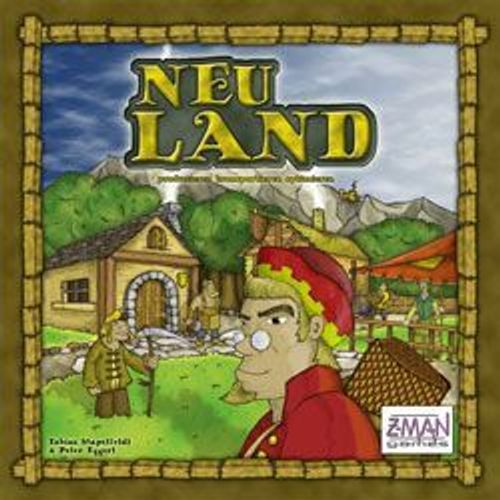
Neuland
Neuland Rulebook
Table of Contents
Table of Contents
Number of Players and Playing Time
Number of Players: 2 – 4 Playing time: 60 – 120 minutes
Contents
- 10 Hex tiles (1 single and 9 double hex tiles: 7 Forests, 7 Fields, 5 Mountains)
- 32 Product markers (8 each in brown, green, natural and black)
- 72 Victory points (VP) (18 each in brown, green, natural and black)
- 21 Mineral markers (9 Coal (black), 6 Iron (grey), 6 Silver (white))
- 55 Building tiles (1 each: Studio, Academy, Theatre, Laboratory, Library, Guilds, Abbey, Church, Cathedral, Town hall, Court, Senate, Barracks, Castle, Fortress; 2 each: Farms, Paper mills, Shepherd shacks, Weaving mills, Charcoal-burners, Mechanics, Mints, Smiths; 3 Smelting works, 4 Hunting lodges, 5 Lumberjack cabins, 6 Quarries, 6 Mines)
- 2 Building display boards (wooden buildings, stone buildings)
- 1 Time Cycle marker
- 1 Time board
Preparations
New players should place the Hex tiles as suggested in the set-up found in Figure 1 (see Setup Diagram below). In later games you may place the hex tiles randomly, but in the same shape. The Building display boards, the Time board and the Mineral markers are kept near the game board.
Each player receives a Hunting Lodge and a Lumberjack Cabin. In addition they each take 8 Product markers and the following Victory Point markers in one color: 2 players: 18 VP markers, 3 players: 12 VP markers, 4 players: 9 VP markers.
The remaining Building tiles are sorted and placed on the Building displays. Building tiles with numbers (the Cultural Advances) are placed in numerical order with the highest number at the bottom of the stack (i.e. Science: Guilds 3, Library 2 and Laboratory 1).
The Time Cycle marker is placed on any space on the Time board.
Margin notes: Place game board. Each player receives a Hunting Lodge, a Lumberjack Cabin, Product markers and VP markers in one color.
Game End
The game ends immediately after one player has placed his last VP marker on the board. This player wins the game.
Margin note: Game end — as soon as anyone places his final Victory Point.
1. Playing the Game
1.1 Starting Phase
The starting player is determined randomly by drawing a VP marker. Each player will take turn during the first round in seating order. Thereafter there is no fixed playing order anymore.
On his first turn each player must place both his Lumberjack Cabin and his Hunting Lodge on a single vacant Forest tile. When playing with a fixed set-up (Figure 1) each player must begin in one of the indicated starting hexes. There are room for up to 3 buildings in each hex, and their mutual relation does not matter.
One of the player's Product markers are used as a Time marker on the Time board. Place it in the same space as the Time Cycle marker.
The player may now make his turn.
Margin notes: First round is played in seating order. First turn: Lumberjack Cabin, Hunting Lodge, + normal turn.
1.2 Player Turn
If the player has any Product markers on the board at the beginning of his turn these are put on their sides. The effect of this will first trigger at the end of the turn.
The player may now perform up to 10 actions in any combination of:
- Produce product (cost minimum 1 action)
- Build Building (cost minimum 0 action)
For each action is the player's Time marker moved one space forward in the direction of the arrow. The marker may not reach or pass the space with the Time Cycle marker, and the player will thus be able to perform a maximum of 10 actions when starting from the same space as the Time Cycle marker.
Note: The player may not end his turn if his Time marker is standing in the same space as another player's Time marker. The player may move his marker to the first vacant space without doing any action in order to avoid this.
At the end of his turn the player must remove all Product markers that are laying on their sides. The markers are returned to his supply. During his turn a Product marker can only be removed as a result of an action.
The first round is over when all players have moved their Time marker. From now on the Time Cycle marker will be moved after each player's turn. The Time Cycle marker is moved in the direction of the arrow until it reaches a space with a Time marker. The owner of this marker will be the next player to take his turn.
Margin notes: Beginning of turn — Products are put on their sides. For up to 10 actions: Produce Product, Build Building. Move Time marker for each action. End of turn — Remove all Products laying on their sides. Move Time Cycle marker forward to the next marker.
2. Production
2.1 Producing a Product
The player may produce a product by placing one of his Product markers upright on any vacant foundation building. There are 3 different types: the Farm and Hunting Lodge will produce Food, while the Shepherd Shack will produce Wool. This will cost minimum 1 action.
All other Building types will have Product symbols on either side of an arrow. The first symbol indicate the type of Product (raw material) needed, and the second symbol indicate the final product produced by this building.
To produce a final product the player must remove the needed raw material from the board and place a Product marker from his supply as the final product on the building (this could be the same Product marker).
The player may only use Raw materials of his own color, but it can be any marker on the board — whether lying down or standing up.
If the needed Raw materials comes from Building tiles in the same hex or adjacent hexes the production will cost 1 action. If the needed Raw materials must be transported across longer distances the production will cost 1 action per hex moved (see Example 1A).
Note: As long as a player has a Product standing on a Building no other player can use that Building for production.
Margin notes: Produce Product (min. 1 action). Place Product On Building. Remove Raw material from same or adjacent hex. Raw materials may be removed from greater distances by using additional actions. Production only on vacant buildings.
2.2 Cultural Advances
Products marked with numbers from 1 to 4 are cultural advances. When one of these advances is produced the player will not place a Product marker, but instead place a number of Victory markers equal to the number listed upon the tile (see Example 1B).
The Victory Points will stay on the tile until the end of the game, and no player may add further points to that tile.
The cultural advances are separated into 5 different categories: Religion, Science, Culture (art), Society, and War. Within each category only the lowest numbered tile is available for production.
Margin notes: Advances — Victory points instead of Products. Advances must be produced in numeric order.
2.3 Search for Food
Food is normally produced by the Farm and the Hunting Lodge. But a player may also acquire food without the use of a building or a Product marker. By spending 3 actions the player will "find" an imaginary Food which may be used instantly anywhere on the board.
Margin note: Search for Food (3 actions).
2.4 Raw Materials and Products from Mines and Smelteries
Mines are built with up to 3 stacked Mineral markers. Only the top marker is available for production (see 3.2 Placing a Mine). When produced is the top marker returned to the supply and the next Mineral marker becomes available. When the last marker is removed the Mine has become depleted and the building tile is returned to the Building display.
Smelteries needs 1 Coal and 1 Ore. There are two different kinds of ore: Iron and Silver. When a Smelter produces the Coal is returned to the supply while the Ore is moved from the Mine to the Smeltery tile. The Ore has now become the end product (Iron or Silver). When the end product is used the Mineral marker is removed from the Smeltery and returned to the supply (see Example 2).
Margin notes: When using Raw materials from Mines or Smelters — Remove Mineral marker. Smeltery production — Ore marker is moved from Mine to Smeltery.
3. Building
3.1 Placing a Building
All visible Building tiles on the two Building displays are available. One board contains buildings of Wood, the other buildings of Stone.
To place a Building the following conditions must be fulfilled:
- A Building tile can only be placed in a hex of the same color. The two-colored Smeltery may be placed in Field or Forest.
- There can be no more than 3 Buildings in the same hex.
- A Wood or Stone marker (depending on the type of building) must be removed from the same or an adjacent hex.
If the Wood/Stone Production marker is taken from a hex further away the player must spend 1 action for each additional hex.
A new building may immediately be used for production (see Example 3).
Margin notes: Place Building (min. 0 actions). Building rules — Same landscape, Max. 3 per hex. Remove Production marker and pay Action points if taken from further away than adjacent hex.
3.2 Placing a Mine
When a player builds a Mine he must stack any 3 Mineral markers (if available) of his choice onto the Mine tile in any order.
Margin note: Determine Mineral markers for Mine.
Setup Diagram (Figure 1)
Figure 1 shows the suggested setup for the first games: a symmetrical arrangement of Field, Forest and Mountain hexes with the labeled starting hexes for 2, 3, or 4 players placed around the ring. Legend: light green = Field, dark green = Forest, grey = Mountain. Hexes marked "2 players" are used only in a 2-player game; hexes marked "3 or 4 players" and "4 players" are added as player count increases.
Examples
Example 1: Producing an Advance with 2 Raw materials from several hexes away
A: The player has Paper and Stone, held in a Papermill (2 hexes from the Studio) and a Quarry (3 hexes from the Studio).
Production across 3 hexes = 3 actions.
B: The result — 1 Victory point for the player, placed on the Studio (A to B gives 1 VP).
Example 2: Metal production in a Smeltery
A: The player has Iron ore and Coal stacked in two adjacent Mines next to a Smeltery.
A → B: 1 action.
B: The player has Iron now — the Ore marker has moved from the Mine to the Smeltery and become the finished Iron product; the Coal is returned to the supply.
Example 3: Building followed by immediate production from the new building
A: The player has Wood and Food, produced from a Lumberjack Cabin and a Hunting Lodge.
A → B: Build a Paper Mill with Wood (0 actions).
B: The player has Food.
B → C: Food → Wood → Paper (2 actions).
C: The player has Paper, produced immediately from the newly-built Paper Mill.
Component Reference
Hex tiles: Field, Forest, Mountain.
Wooden components: Product marker, Victory Point marker, Time Cycle marker, Mineral Ore marker.
Building tiles: each tile shows its Landscape type (Hex type) in the background color, its Name across the middle, its Raw material symbol on the left, and its Final product symbol on the right.
Symbols (Cultural Advance categories): Religion, Science, Culture (art), Society, War.
Symbols (Foundation buildings): Hunting Lodge, Farm, Shepherd Shack.
Symbols (Products): Wool, Food, Wood, Stone, Cloth, Paper, Coal, Iron ore, Silver ore, Iron, Silver, Coins, Tools, Weapons.