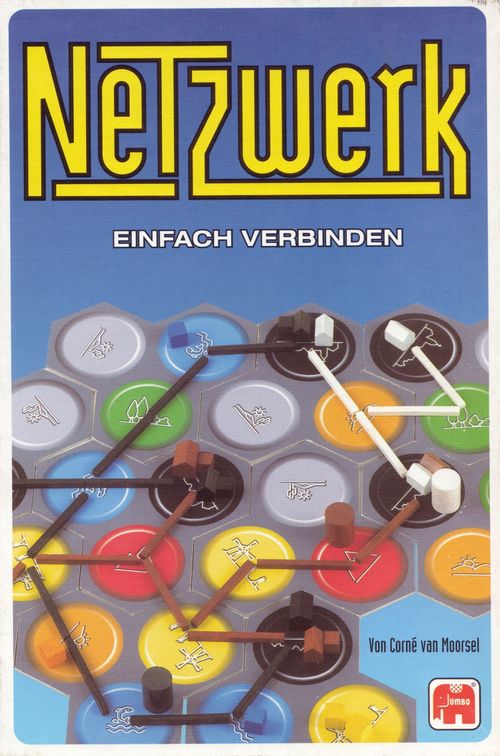
Netzwerk
Netzwerk Rulebook
Table of Contents
Table of Contents
Contents
13 tiles each containing 3 land types (Black for cities – each worth between 2 and 10 points; Grey for Desert; Other colours represent the countryside)
50 cubes (10 each of yellow, orange, red, green and blue)
In each of 4 player colours (black, white, grey or brown):
1 game figure
20 route sticks
3 large houses
3 medium-sized houses
8 small houses
Goal of the Game
Players aim to create a network of trade routes joining cities together. To achieve this, players travel the countryside to gain the necessary resources to build their routes. The player who manages to coneect the most and most valuable cities to his network wins the game.
Preparation
Players choose a colour and receive the various pieces in that colour.
The tiles are shuffled and laid out randomly to form a "roundish" landscape. (With two players the 2 tiles with the 6-value city and the orange/red/green fields are not used and should be put back in the box.)
On each yellow, orange, red, green and blue field, two cubes of the corresponding colour are placed.
The youngest player puts his game-figure on any coloured space other than a grey one (desert). If the space is not a black (city) space, he takes one of the cubes on that space. The other players, in clockwise order round the table, do the same but cannot choose to place their game-figure on the same space as another player.
Course of the Game
The youngest player starts and play continues clockwise round the table. On a player's turn he takes three actions. The first is compulsory, the other two are optional.
First Action: Move and Collect Resources
The player must move his game-figure to an adjoining field. He cannot stay on the same field and cannot move to a grey (desert) space or one occupied by an opponent's figure. He may, however, jump over an opponent's figure to the space immediately behind the opponent (in a straight line). If that space is also occupied, he may continue to the next vacant space, again in a straight line. (See example 2)
If the new field contains any resource cubes, the player takes one of the cubes on that space.
Second Action: Build Trade Routes
The player may spend the cubes he has collected to build trade routes. Only one trade route per turn can be built. Each stick placed costs 1 cube. Sticks are placed across two fields, from the middle of one field to the middle of another. One of the fields must either be a city space or a field which already contains one of the player's sticks. The other field must be a countryside space and the player must pay a cube of the same colour as that land type. All cubes spent are returned to the game box. (See examples 3a, b and c)
It is not possible to build across desert spaces. It is also not possible to build between adjacent black (city) spaces.
A player may build parallel to an existing connection. However, if one stick is already present, the cost is doubled; if two sticks are present it is tripled; and if three are present, it is quadrupled. (In the two-player game, parallel building is not allowed).
The player cannot leave a trade route incomplete. All sticks placed must form a connection between two cities, or one city and an existing trade route, or two existing trade routes.
Third Action: Place Houses
When a player connects two or more cities, he places houses in those cities. The number of houses added to a city is determined by the number of cities to which it is connected.
The small piece represent one house, the medium-sized pieces two houses, and the large three houses. Houses may be freely exchanged as long as the total value in each city is maintained.
If two cities are connected by two different routes of the same player, no new houses are built.
(In example 4, the brown player has two connected cities and therefore one house in each. The white player is connected to four cities. The two on the left are each connected to 2 cities so contain two houses – a medium-sized piece. The one on the far right is connected to just one city so contains one house – a small piece. The remaining one is connected to three cities so contains three houses – a large piece).
End of the Game
The game ends when the last cube of any one colour is taken from the board. The player is allowed to finish his complete turn. Players then calculate their scores as shown below. The player with the highest score wins.
The game also ends as soon as one player builds his last house. In this instance, the player ending the game wins.
Scoring
The number of houses placed on the board is totalled. Small houses are worth 1 point; medium sized worth 2 points; large worth 3 points.
The value of all cities, in which the player has at least 1 house, is totalled. Each city is worth the number printed on the space.
The sum of (1) and (2) is the player's score.