Net Results Soccer
Net Results Soccer Rulebook
Table of Contents
Table of Contents
What is needed
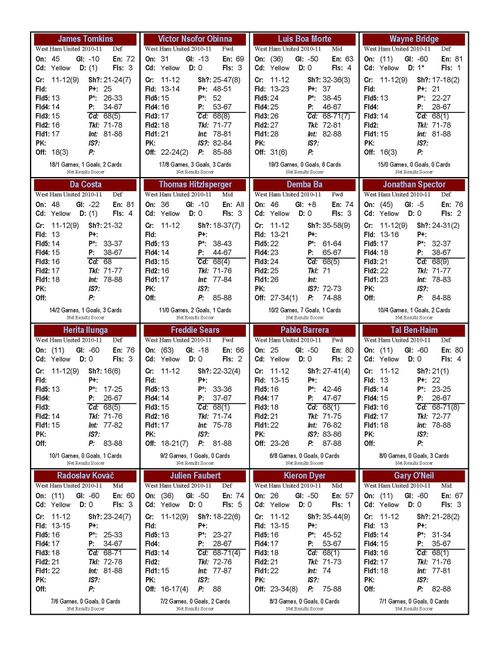
Net Results Soccer comes with every player and keeper that played at least one minute during the specific season you are holding right now. It also comes with a scoresheet, a full-time report, and the couple of charts that are needed to play the game. These come in a PDF format.
There are other items that you need yourself or we strongly suggest you use. They are:
-
Dice. To play the game you need two 8-sided dice, two 10-sided dice and one 20-sided die. They can be purchased at many hobby shops and/or toy stores. You will want the two 8-sided dice and the two 10-sided dice to be different colors.
-
Baseball card sheets. Anyone that has collected baseball cards before probably has seen the nine-pocket baseball card sheets used to protect and store cards. I use two of these for my lineups when I play Net Results Soccer. Each pocket can hold up to two cards. Typically I put one card in each pocket except the middle one. There, I place two players. I keep keepers outside the sheets on top of the rest of the team player pile.
Preparing for game play
-
Select two teams to play the game.
- One needs to be the home team and the other the visiting team.
-
Decide on the starting 11, with one of the players being the keeper.
- The 10 other position players can be placed in a formation of your choosing. In many cases, you can find actual lineups for games on the internet. It is suggested to use realistic formations to encourage accuracy.
-
Place your lineup within the baseball card sheet.
- You will need to give a number distinction of 1 to 10 to each position player. The keeper will not be numbered. I generally go from 1 with defenders, work my way to midfielders and then to forwards. These numbers will be important when you play the game.
-
Select your substitution pool list.
- In most games you may select up to seven players (one being a keeper) for your possible substitutions during the game. In most games you may only substitute three times, and once a player is subbed out of the game, they are out for good. If you are playing an actual game that occurred, frequently it's easy to find the players that were the actual potential subs on one of many web sites. I place my potential subs right under the starting keeper. After the possible subs, I turn the other players not available for this game face down so I don't mistake them for available players.
Dice with Net Results Soccer
Each "turn" starts with a roll of the five dice. There will be two 10s and two 8s. One of each is considered red and the other white.
Each die has a purpose. Each is detailed here.
The 20-sided die
a) For many "turns", it will dictate which team is considered the "offensive" team during this roll. If the die is a 1-11, the home team is considered the offensive team. If it is an 11-20, then the visiting team is considered the offensive team. There are times when this rule won't come into play, and we'll detail that later.
b) During any regular "turn", a roll of 1-4 or a roll of 18-20 will represent a minute elapsed. The only time this won't occur is if a shot is being resolved.
c) When a shot is being resolved, frequently a defender may have a chance to "stop" a shot, based on their D reading on their card. This will be a number 0 to 20.
The two 8-sided dice
a) One die represents a 10s digit and the other a ones digit, giving you a range of 11-88. Check the sample cards in the middle of the page. You'll notice in the middle of the cards you'll see numbers ranging 11 to 88. For example, you'll see on Denilson's card if a 14 to 27 is rolled there is a FLD reading. These numbers will capture most of the play during the game. You'll also notice the line between the P: and the Cd: readings. This is a division for offensive random numbers and defensive random numbers. If the dice roll an 11-67, the reading will be off of the offensive player's card. If it is 68-88, it's read off the defensive player's card.
b) On ratings: You'll notice on each position player card, there is an On: reading near the top right corner. Robin Van Persie's is 36. If the two 8ds is a number between 11 to 36, his shot will be on target.
The two 10 sided dice
a) Mainly they are used to determine which player a reading will be read off of. I use the red die as the offensive player that will be used during this "turn" if needed. The white die will be used to determine which defensive player is used if needed during this "turn". If your die has a 0, read that as a 10.
b) Also, if a shot is taken, you will use it to see the result of the shot. But instead of reading the 10Ds as 1 to 10 and adding them to get a result 2 to 20, you will use the red one as the 10s digit and the white one as the singles digit. The only exception to this will be a roll of 0 and 0. Read this as 100. Look at Szczesny's card below. If a shot is on target and a 77 is rolled, it's a goal. If a 09 (or 9) is rolled, it's a normal save.
c) Some "split" rolls. Look at the Van Persie's PK row. It says 22(7). This means if a 22 is rolled on the two eight-sided dice, it is a Penalty kick if the opposing defender's 10D is a 1-7. An 8, 9 or 0 (10) means the PK didn't occur.
Playing Net Results Soccer
For the start of each "turn" you will need to roll the five dice. You won't always use all five dice during that "turn" but in some cases you will.
- First roll example
Let's say the first rolls are 11 with the 20D, a 4 with the red eight-sided die, a 3 with the white eight-sided die (meaning a roll of 43), a 10 with the red 10-sided die and a 3 with the white 10-sided die.
First, look at the 20D. It states 11. A roll of 1-11 means you'll read any offensive readings off of a home player's card. A roll of 12-20 means you'll read offensive readings off of a visiting player's card. In this case, an 11 means the home team will have an offensive number read off one of their player cards. In this case, it would be player No. 10 (Red 10d), who is probably a forward. In this case we'll say Van Persie is the 10 player. You would read 43 off his card (the two eight-sided dice), and see the reading falls in between his Sh? reading. This means he may get a shot.
- Second roll example
Let's say we get the same dice rolls except the two eight-sided dice are a 6 with the red die and an 8 with the white die. That results in the number 68. In this case we'll use the defensive 10-sided die to see what the result is off of a defensive player's card, since 68-88 are considered defensive rolls. If Denilson is the defender, he has rolled a Cd, or a card.
SPLIT READINGS: Look at Denilson's Cr reading. It states this... Cr: 11-13(7). This means if the two eight-sided dice make up a roll of 13, check the defensive 10D. If it is a 1-7, it is a Cr reading (Cr stands for a corner). If it is an 8-10 (or 0), it is a P reading. On the next page, we'll detail what each abbreviation means and how to play it within the game.
ROLLS OF 11-67 are read off the offensive player's card. ROLLS of 68-88 are read off the defensive player's card.
Offensive rolls off of player cards (11-67)
Here is what each offensive result stands for, and how you play it according to the game. We'll start with the top left of the position player card and work our way to the middle right of the player card.
Cr: The offense has earned a corner kick. For the next "turn" only, disregard the 1-20 possession rule. This team is assumed the offensive team and the opposition is the defense. Read any 11-67 roll off the team receiving the corner kick. All 68-88 rolls are read on the defensive team's card.
- If a shot occurs, the team will get added benefits toward making the shot good. Adjust a home team player's GL by +20 and a visiting team player's GL by +10 for just this shot if a shot ends up being on net. If it is a neutral site game, the player's GL is adjusted +15.
- After one "turn" all play returns to normal.
Fld: The offensive player has been fouled. Read the defensive 10-sided die to see which player fouled him. That player records a foul committed. For the next "turn" only, disregard the 1-20 possession rule. This team is assumed the offensive team and the opposition is the defense. Read any 11-67 roll off the team earning the free kick. All 68-88 rolls are read on the defensive team's card.
- If a shot occurs off the free kick, the team will get added benefits toward making the shot good. Adjust a home team player's GL by +10 and a visiting team's player's GL by +5. If it is a neutral site game, the player's GL is adjusted +8.
- After one "turn" all play returns to normal.
Fld5: The player may have been fouled. Look on the defensive 10-sided die to see which player may have committed the foul. Check his Fls reading near the top right portion of the card. If it is a 5, he records the foul and you play it as though it was a Fld reading. If it is a 0-4, there is no foul and read the play as though it's a P reading.
Fld4: The player may have been fouled. Look on the defensive 10-sided die to see which player may have committed the foul. Check his Fls reading near the top right portion of the card. If it is a 4 or 5, he records the foul and you play it as though it was a Fld reading. If it is a 0-3, there is no foul and read the play as though it's a P reading.
Fld3: The player may have been fouled. Look on the defensive 10-sided die to see which player may have committed the foul. Check his Fls reading near the top right portion of the card. If it is a 3, 4 or 5, he records the foul and you play it as though it was a Fld reading. If it is a 0-2, there is no foul and read the play as though it's a P reading.
Fld2: The player may have been fouled. Look on the defensive 10-sided die to see which player may have committed the foul. Check his Fls reading near the top right portion of the card. If it is a 2, 3, 4 or 5, he records the foul and you play it as though it was a Fld reading. If it is a 0 or 1, there is no foul and read the play as though it's a P reading.
Fld1: The player may have been fouled. Look on the defensive 10-sided die to see which player may have committed the foul. Check his Fls reading near the top right portion of the card. If it is a 1 to 5, he records the foul and you play it as though it was a Fld reading. If it is a 0, there is no foul and read the play as though it's a P reading.
PK: The player will earn a penalty kick due to a foul in the box, but not necessarily on this player. This is the player that was chosen to take the PK. All players with a PK range, also have a number located near the middle-left of their card. VanPersie has one, a 62. Re-roll the two 8Ds. If it is an 11-62, it is a goal. If it is a 63-88, it isn't a goal. If the miss is odd, the shot was saved. Use the keeper's On (Sv+) column on the next "turn" to figure out the result. If the reading is a goal then consider it a rebound shot for the same player that just took the PK. If the miss is even, the ball is out of bounds. The next play is read off the keeper's Off column.
Note: Keepers can have PK adjustments of -10 or +10. Check Szczesny's card. He has a -10 adjustment. While the shots are base-8, disregard that and convert VanPersie's chance of a goal from 11-62 to 11-52.
Off: The player is offsides. For the next "turn" only, disregard the 1-20 possession rule and assume the team receiving the ball is the offensive team. The team that had the offsides call is on defense. There are no other adjustments beyond that.
Sh?: There is a potential shot. Check the defensive team's 10-sided die to see who the potential defender is, and check their D reading, located near the top-middle of the card. For this example, let's say VanPersie is taking the shot and Denilson is the defender. We'll re-roll all five dice for a non-timing roll (a minute can not elapse). The two eight-sided dice will determine if the shot is on target, and the two 10-sided dice will determine details of the shot regardless if it is on or off target. The 20-sided die will determine if the shot is stopped. Denilson's D reading is (4). This means if the 20D is a 1-4, he stops the shot. The fact that it is in ()s means he did more than stop a potential shot, he has intercepted or tackled the ball and now has possession. For more details read the section detailing the D reading.
Newer editions (2011-12 and newer): D ratings have changed a tiny bit. Split ratings are now represented with two numbers with a slash between them. Consider home games to be the higher number and the lower number for visiting games. If a D rating has a *, consider it a steal or a tackle.
If the shot isn't stopped, then check the two 8-sided dice. VanPersie's On: reading is 36. The keeper has an On adj: reading of +3. Adjust that +3 using base-8 counting. Adding three makes 36, now 41 (36 with three added base eight is 37, 38 and then 41. Since there are no singles digits involving a 9 or 0, you skip those numbers). If the eight-sided dice range from 11 to 41, the shot is on target. If it is a 42-88, it is off target.
If it is on target: Check the two 10-sided dice and adjust that number with the shooter's GL: reading. Now consult that adjusted number with the keeper's On+Sv column. You'll get your detailed reading about the shot from the keeper's card. To find a more detailed explanation about the shot, check out the keeper's section.
If it is off target: Check the two 10-sided dice and consult that number on the keeper's Off column. To find a more detailed explanation on keeper results, check out the keeper's section.
P+: This player's presence on the pitch could result in a dangerous scoring chance and some added possession time. For the next "turn" disregard the 1-20 possession rule. This team will remain the offensive team on 11-67 rolls. It will remain the offensive team on each "turn" until one of any several results occur. They are:
- a) the defense gets a card, fouls a player, gets an interception or gets a tackle.
- b) the offense earns a corner, a penalty kick or a shot.
- c) the offense is offsides.
- d) the end of a half ends action.
This benefit will enhance the team's chances of creating a dangerous scoring play or at the very least create some possession. If a shot does occur, use the following adjustments on the shot, due to the player that received the P+ benefit.
- a) For home teams, adjust the GL+20 and increase the On: rating to include 87 and 88 as on shots, if not already otherwise.
- b) For visiting teams, adjust the GL +10 and increase the On: rating to include 88s as on shots, if not already otherwise.
- c) For neutral site games, adjust the GL +15 and the On rating to include 88s as on shots, if not already otherwise.
If a goal is scored on this possession by anyone else on the team besides the player that earned the P+, the P+ player earns an assist.
P:* This player's presence on the pitch has helped the team's ability to possess the ball. For the next "turn" disregard the 1-20 possession rule. This team will remain the offensive team on 11-67 rolls. It will remain the offensive team on each "turn" until one of any several results occur. They are:
- a) the defense gets a card, fouls a player, gets an interception or gets a tackle.
- b) the offense earns a corner, a penalty kick or a shot.
- c) the offense is offsides.
- d) the end of a half ends action.
This is very similar to the P+ reading with one difference. There are no enhanced GL or On ratings with the play.
P: No serious actions took place during this "turn." Return to normal play.
Defensive rolls off of player cards (68-88)
Here is what each defensive result stands for, and how you play it according to the game. We'll start with the top left of the position player card and work our way to the middle right of the player card.
Cd: The player receives a card. To see what type of card, consult near the top left of his card where you will see the Cd: reading again. If it says yellow or red, that means the player receives that type of card. One red or two yellows in a game means an automatic ejection and the loss of a player on the pitch who can't be replaced.
You may see a result that says something like this: 32Red. This means you need to roll the two eight-sided dice. If they result in a number 11-32, it's a red card.
Second yellow cards: If a player already has a yellow card, it is more difficult to get the second yellow card in most cases. Re-roll the 20-sided die. For every two minutes since the player's first card, add one to his yellow card chance the second time. So if a player received a card in the 10th minute and it's not the 30th minute of the game, that's a 20-minute difference, or a 1-10 chance of a card the second time. The range can never be any higher than 1-14. If it isn't a card, consider it a foul committed by the player that almost received the card. The only exception to this rule is if a player has a * designated near his Cd: reading. If that's the case, he always has at least a 1-10 chance of another card and the range can become as great as 1-20.
Tkl or Int: The player has earned a tackle (Tkl) or an interception (Int) and has possession. For the next "turn" only, disregard the 1-20 possession rule. The team regaining possession will automatically be considered the offensive team for this turn.
IS?: The player has earned an interception and may earn a shot. Follow normal shot procedure, except use the offensive 10D to see who the defender is against the player earning the interception and the possible shot. If there is no shot, consider it a P and return to normal play on the next "turn."
OG: Some players have an OG reading instead of an IS? reading. If this comes up, the player has allowed an own goal. The opposition scores and this player is credited with the own goal.
P: The defender was unable to tackle or intercept the ball. Return to normal play on the next "turn."
Split ratings
Split readings are readings that can be one of two results. They typically appear in one of two ways. Some look like this: 54(3), others like this: (23), and others like this: 4*. What each means is listed below.
Cr: 13(5): You may see numbers like this on Cr, PK, Off, Sh?, Cd and OG readings. What this example would mean is if the opposite 10D is a 6-10 (0), then disregard the possible result and consider it a P reading. If the other 10D is a 1-5, then the actual reading holds true.
On: (24): If a 24 is rolled, it may or may not be a shot on target. If the minute in the game and the split reading are both even or odd, then it is on target. If they are not both even or odd, then it's off target.
(2010-11 editions) Def: 5:* If a 5 is rolled in an attempt to stop a shot, then it may or may not be stopped. If the minute in the game and the split reading are both even or odd, then it is stopped. If they are not both even or odd, then it's a shot.
(2011-12 and newer) Def: 4/5: If the team is at home, use the 5. If the team is on the road, use the 4.
HOME/ROAD OPTIONAL RULE: In the case of On and Def ratings, one could consider all split readings good if the team is the home team and the weaker result if the team is on the road.
Keeper Readings
On (Sv+) shots
If a shot is on target, consult the two 10-sided dice and use one as the 10s digit and the other as the ones digit. Take this number +/- any GL adjustments from the shooter's card and/or based on a special shot and consult the reading off the card.
- Counter: The keeper has made a save and sent a relatively safe pass to a teammate. For the next "turn" only, disregard the 1-20 possession rule. This team is assumed to be the offensive team.
- Normal: The keeper has made a save. On the next "turn" use the normal 1-20 possession rule to figure out who has possession.
- Card: The keeper has made a save, but soon afterwards earns a card. Follow normal card procedures.
- Own goal: It doesn't happen, but upon occasion a keeper may record an own goal. Score this a goal for the opposition due to the keeper's own goal.
- Fouled: The keeper makes a save and then is fouled on the play. Consult the keeper's team's 10-sided die to see what defender gets the foul.
- Corner: The keeper has made a save but deflected it out of bounds for a corner kick. Follow regular corner kick rules.
- Reb. Sh: The keeper has made the save but the ball is loose near the net for a shot. Re-roll the dice to see if that player gets a shot and to see if the team scores. Unlike most shots, this will be a timed shot.
- Injury: The keeper has made a save, but there is an injured player on the pitch. Roll the 20D and one 10D. 1-10 is the home team, 11-20 is for the visiting team. If the 10D is a 0, then one of the keepers is hurt - if the 20D is a 1-10 it's the home keeper. If the 20D is 11-20, it's the visiting keeper. The only exception would be if the keeper is the only one on the team. This ironman keeper doesn't suffer an injury.
- Goal: It's a GOOOOOOOOOOAAAAAAAAAAAAAAALLLLLLLLLLLLLLLLLLL!
Two FAQs answered here!
What happens if after adjustments, the 1-100 number is below 1? Consider it a save and a counter play.
Off shots
- Counter: The keeper collects the ball and sends a relatively safe pass to a teammate. For the next "turn" only, disregard the 1-20 possession rule. This team is assumed to be the offensive team.
- Normal: The keeper has the ball and punts. On the next "turn" use the normal 1-20 possession rule to figure out who has possession.
- Corner: The shot is deflected out of bounds off the defense. Follow regular corner kick rules.
Keeper split ratings
If you see a number like Tim Howard's 72(9), that means if a 72 is rolled and a 1-9 is rolled on the opponent's 10D, he would get the save but still receive a card. If a 0 is rolled, it is just a save and return to "normal" play.
Game Time
Games consist of two 45 minute halves with extra time included at the end of each half. Most games don't include overtime, but if there is, most leagues have two 15-minute "halves" which both must be played to completion regardless if a tiebreaking goal has already been scored or not.
How do minutes elapse? Anytime a 1-4 or an 18-20 is rolled on the 20-sided die on a non-shot roll, a minute has elapsed. Once a minute has been slashed, that minute is complete.
How do you record time of possession? Any time a minute is recorded, whoever has the ball after the "turn's" action is given a minute of possession. I make a / mark on the minute for the home team and a \ for the visiting team. At the end of the game, create a percentage.
How about extra time? Use the chart below. Roll the 10D.
Playing a man short
If a team is forced to play a man short, keep one of the positions on the pitch empty. If that die roll occurs there will be alternative rules.
- Any offensive reading to that position is forfeited to the defense. Use the defensive 10D to see who gets the benefit of the offensive reading.
- If the player's position is in question of committing a foul, a foul does occur. The player with the highest Fls reading gets the foul. If there is a tie, give it to the player with the lower number of fouls or the position player that makes the most sense based on the position of the player fouled.
- On defense the empty spot cannot earn tackles or intercepts or stop shots due to the fact no one fills the spot.
Optional Rules
Endurance
We strongly suggest players use some form of this rule during a game. All players have an En rating. Some are a number. Others say "All." A player with an "All" rating never has to be subbed. Players with numbers can be forced out of the game if they started or subbed in the first 20 minutes of the game. Every time a 1 or a 20 is rolled in the second half, consult the defensive player's endurance rating. If the rating is equal to or less than the minute of the game, then the player must sit out after the next "dead ball." We'll consider that to be after a corner, an offsides, a shot off target, a goal, a foul or a card is called.
A player that remains out on the pitch due to endurance issues can not stop a shot, earn a tackle or an intercept, always fouls when in question, can never get a corner off his card (read it as a P), cannot get a PK (read it as a P), and does not get the benefit of the P+ or P*. Also, his GL is adjusted -30.
Some players have En* readings. They cannot start and can only play the number shown without risking an endurance check.
We suggest putting a cap of 3 forced rests during a game, and no more than two for any team. This allows some decision making for the player. Another interesting rule would be to allow only one "forced rest" for the home team and up to two for the visiting team. That would create an advantage for the home team. Another rule would be to just allow one for each team.
Home team advantages
If you want a more powerful home team edge, here are some ideas.
SPLIT RATINGS: As discussed earlier, split ratings for Ds and On ratings can be given to the benefit of the home team and to the non-benefit of the visiting team. It would be a slight edge for the home team.
ON RATINGS: Consider all 88 rolls as on shots for the home team. Consider all 11 rolls as shots off target for the visiting team.
GL RATINGS: Increase all GL ratings for home players by 5 and decrease the GL ratings for visiting players by 5.
ENDURANCE RATINGS: Subtract 10 minutes from a visiting player's endurance ratings, making it possible for them to be forced to use their depth earlier and more frequently.
EXTRA TIME: If the home team is trailing by a goal or tied entering extra time, change the 20-sided die possession rule to 1-12 to the home team and 13-20 to the road team. It should give you a feel of the visiting team just trying to hold on for the result.
Extra time chart
| Die roll | First half | Second half | Overtime |
|---|---|---|---|
| 1 | 1 | 1 | 1 |
| 2 | 2 | 2 | 2 |
| 3 | 3 | 3 | 1 |
| 4 | 4 | 4 | 2 |
| 5 | 2 | 5 | 0 |
| 6 | 2 | 5 | 0 |
| 7 | 1 | 2 |
- Any injuries, add two minutes to the extra time.
Special play adjustments
GL and (On adjustments)
| Die roll | Home | Road | Neutral |
|---|---|---|---|
| Corners | +20 GL | +10 GL | +15 GL |
| Fouls | +10 GL | +5 GL | +8 GL |
| P+ | +20 GL (87) | +10 GL (88) | +18 GL (88) |
| P* | None | None | None |
The printed chart gives the neutral-site P+ adjustment as +18 GL, while the P+ text above gives +15 GL. Both are kept as printed.
Remains offensive team (Max turns)
| Die roll | Home | Road | Neutral |
|---|---|---|---|
| Corners | 1 turn | 1 turn | 1 turn |
| Fouls | 1 turn | 1 turn | 1 turn |
| P+ | Multiple | Multiple | Multiple |
| P* | Multiple | Multiple | Multiple |
Multiple means the team retains offensive turn privileges until there is a corner, a foul, a PK, an offside, a shot, a card, an intercept or a tackle.