Net Results Soccer
Net Results Soccer Neglected Stuff Addendum
Table of Contents
Table of Contents
Neglected stuff
Over the years I've gotten lazy with adding some new rules or readings to the instructions. Here are some of them.
CT Readings
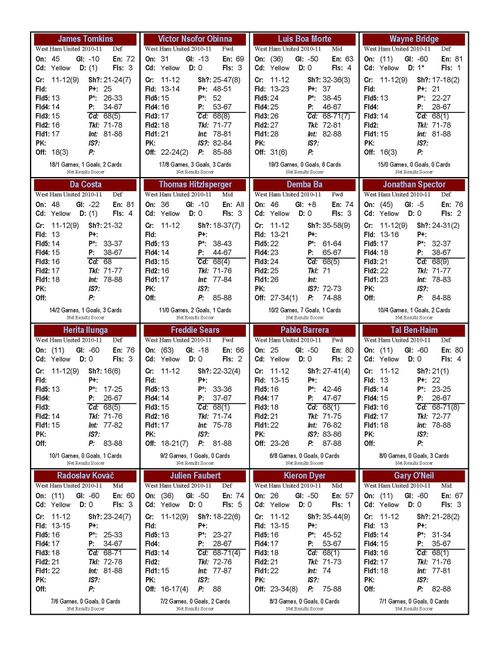
Frequently with current sets you'll see the following reading in the 68-88 defensive portion of a card. If you see a CT reading and it reads like this:
CT: 68-71(4)
This is how you play it. If a 68 is rolled, it's a card. If a 71 is rolled, then if the opposing 10-sided die is a 1-4, it's a card. If it is a 5-10, it's a tackle. This adds some drama to the card/tackle situation, helps give a visual to gamers when a 71 is rolled and this play comes up ("Oh, oh, this one could be a card!"), and also gives the game a better chance to give players their proper defensive readings on their cards.
"11 Yel" reading
Starting with the 2015 MLS set, there has been a rare change you may see on the Cd: reading located near the top right of the outfielders' cards. I've started giving a Cd: reading of 11 Yel for players who played a considerable amount of time during a season and never were given a yellow card. The players who have this reading always have a Cd: range of 68(1) on the 68-88 portion of their card. If you happen to roll a 1, which in the past would've resulted in a yellow card, now you must reroll the two eight-sided dice. If the result is an 11, then he gets the card. Otherwise, the play is a P result or maybe a tackle result if he has a CT range listed on his card. It will be a very rare reading, and players won't get it if they received no cards while playing 800 minutes. Maybe 2,500 minutes, but not 800.
+/- Gaming option
This optional rule was created to do a few things:
- To have moments when a given player may be "hot" or "cold" or maybe injured.
- To reflect how that player's sudden change in play may influence how the team's defense is playing as a whole.
- It helps give defenders a bit more power in the game.
How to play it:
a) During a game, any time an 11 is rolled, the player in possession of the ball may get a + or a - reading. Check the defensive 10-sided die. If it is odd, the player will get a + adjustment. If it is negative, the player will get a negative adjustment.
b) Use the following chart to determine what the + reading may be if it is supposed to be a + adjustment.
- +5: Defenders located on the 1-4 spots of the lineup.
- +4: Any other ONE defender or defensive mid that may be part of the lineup. Once a player earns a +4 on a team, no one else the rest of the game will be eligible for the +4 adjustment.
- +3: Any other player.
c) If the player is expected to record a - result, the result will always be -2. Once the game enters the second half, for any position that is vacant due to red cards or injuries, place a -2 reading to that vacant player position as well.
d) A player can only have one + or - reading given to them in a game. All other adjustments to the player during the game are ignored. However, if a player rolls two negative readings, you may want to indicate an "optional" injury rule. The chart is located below.
e) Any time the game reaches the 20-minute mark, halftime, the 65-minute mark or the 85 minute mark, recalculate to see what team has the best +/- reading. When teams are tied (as they will be at the start of the game), ignore the following benefits/penalties.
f) Here are the benefits/penalties teams with the stronger or weaker +/- receive (different than the past rule):
- Any Int reading for the team with the stronger +/- results in an interception and then a P* reading.
- Any P* for the weaker team only gets the benefit of being the assumed offensive team for one turn, not unlimited turns.
- Any 66 or 67 P reading for the team results in lost possession to the defense. Who will earn the offensive team benefits the next turn. If the 66 or 67 is not a P reading on the player's card, then ignore this adjustment.
Other pros/cons of the +/- optional rule?
The clear positive is it gives defenders more benefits. They receive stronger + adjustments. Another positive is it may give gamers more of a reason to sub out stronger players they otherwise may never sub out for usually weaker players. Or it may give a reason to keep a typically weaker player on the pitch.
The clear negative is checking the team +/- four times during the game can end up being a pain and ruin game flow.
Optional Injury chart
Follow the guidelines listed if a player is injured based on the +/- rule.
| Games started | Days out | Days can only sub |
|---|---|---|
| All games | None | Next four days |
| All but 1 or 2 | 7 days | 8-10 days |
| 30 or more | 10 days | 11-14 days |
| More than half | 15 days | 16-19 days |
| 10 to half of games | 22 days | 23-27 days |
| <10 games | 30 days | 31-35 days |
Note: If a player qualifies under more than one games started category, use the one that results in the longer injury. On days a player can only sub, he cannot enter the game until after halftime.