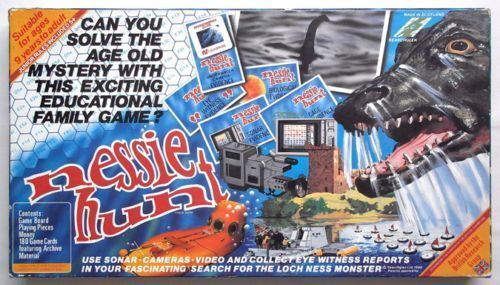
Nessie Hunt
Nessie Hunt Rulebook
Table of Contents
Table of Contents
- Basic Rules
- Components
- Objectives
- Rules for Four Players
- The Hunt Begins
- Climax of the Hunt
- Special Rules on Borrowing
- Shortened Games
- Summary Cards
- Evidence and Logistics Cards
- Children's Rules
- Rules for Five Players
- Rules for Three Players
- Rules for Two Players
- Nessie Hunt Solitaire
- Advanced Rules
- Diagrams
- Glossary
- Special Introductory Rules
Basic Rules
Designer's Note. As with most board games that are interesting and well-researched, the initial process of learning and playing NESSIE HUNT may appear slow. However, once the first two or three rounds have been completed the tempo increases rapidly and you will find it a most exciting and enjoyable game.
CHOOSE SOMEONE TO READ THE RULES ALOUD DURING THE PREPARATION STAGE AND THE FIRST TWO ROUNDS.
Components
- 4 cards showing order of play and details of search equipment purchase and running costs.
- 4 transparent sheets of search equipment (eye witnesses, sonars, cages etc.). Before starting the game these must be cut out taking great care to cut just along the outside edge of the thin black lines and down the centre of the thick black lines. In deluxe versions of the game the transparencies will already have been perforated, but care in separation must still be taken.
- 1 dice
- 1 plastic monster head and neck
- 4 plastic 'submerged' monster outlines
- 4 plastic expedition leaders
- Pack of LOGISTICS cards (some with 'LOGISTICS' printed in red, others in green)
- Pack of SONAR EVIDENCE cards
- Pack of BIOLOGICAL EVIDENCE cards
- Pack of CAGE EVIDENCE cards
- Pack of EYE WITNESS EVIDENCE cards
- Pack of UNDERWATER CAMERA EVIDENCE cards
- Pack of SURFACE CAMERA EVIDENCE cards
- £5, £10, £50, £100 and £500 banknotes
- Tally sheets.
Objectives
Read aloud to explain principles of game to all players.
Each player is the leader of an expedition trying to discover more about Loch Ness while attempting to solve the famous mystery.
The board is a representation of Loch Ness and surrounding landmarks. The loch itself is the white area covered in slightly elongated hexagons. This is the playing surface, upon which the monster appears.
Players must deploy their search equipment (represented by transparencies) in the most advantageous way to obtain sightings, photographs, sonar contacts, video and biological evidence. Sightings occur when the monster appears in a hexagon on the map of the loch. If your transparencies are covering even a small part of the monster's hexagon then you collect evidence cards.
The winner of the game is the first expedition leader to present, to the world, proof that the monster exists. For the purposes of the game, 'PROOF' is represented by collecting evidence cards totalling 750 points.
As a general rule, the sooner a player has most of his/her equipment deployed, the quicker points will be obtained ... but beware ... Logistics Cards can hold some nasty surprises for the over-ambitious and great care should be taken if you allow your running-costs to exceed your income except for short periods when you have ample cash in hand.
Rules for Four Players
Opening of the Nessie Hunting Season for four players.
a. Choose which player is going to act as Sponsor. (The Sponsor acts as Banker, Tally man and issues equipment.) It is suggested that this be undertaken by someone over 14 years of age. The Sponsor also takes a full part in the game as the INDEPENDENT research team leader and must take care to keep INDEPENDENT'S own money separate from that of the Sponsor.
b. The other players choose from the AMERICAN (blue), BRITISH (red) and JAPANESE (yellow) expeditions. The seating order should be clockwise — Independent, Japanese, British and American. Turn the board to the most convenient position once all players are seated.
c. Place the red, blue, green and yellow Expedition Leader tokens on the named squares on the appropriately coloured tracks. The tracks are situated at opposite ends of the board, American and Independent at one end, Japanese and British at the other.
d. The Sponsor issues £50 to each player including himself as INDEPENDENT. This is made up of 4 x £10 and 2 x £5.
e. All the packs of cards must be shuffled thoroughly and placed on their appropriate squares. Before shuffling the LOGISTICS cards, separate out those with 'LOGISTICS' printed in red. The two halves of the pack should now be shuffled separately. Now place the first fifteen of the green printed cards face down on the space provided. Place all the red printed cards on top of these and finally place the remaining green printed cards on the top of the pack.
f. The Sponsor issues three eye-witness transparencies to each player in their own colours.
g. Each player now places their eye-witness transparencies on the board. The pointed end of each MUST be on shore. This rule applies to ALL equipment except the CAGE and BIOLOGICAL UNIT transparencies. Cover as much of the loch's area as you can. Your equipment is useless if most of its coverage is on land!
h. No player is allowed to position more than two of their own transparencies on top of each other (see diagram), but it is perfectly acceptable to overlap as many opponents' transparencies as you wish.
i. Each player should be given a summary of the rules that also lists search equipment prices and running costs. The reverse of each of these cards describes various forms of research.
The Hunt Begins
Read aloud and stick strictly to the sequence.
The game is played in rounds comprising nine stages. There are a number of steps in each stage. The basic rules may appear both lengthy and complex, but if followed carefully for three or four rounds, they quickly become automatic. However, the SEQUENCE OF ROUNDS, STAGES AND STEPS is VITAL to the game and great care must be taken not to miss any, particularly early in the game. Nessie Hunt is a most rewarding game to play once players have fully grasped the principles so it is strongly recommended that no short cuts are taken, nor assumptions made in playing through the first few rounds. The first two rounds may take as long as an hour, but by round five, rounds will take as little as ten minutes. On the second and subsequent playing of Nessie Hunt elements of skill can be used and games can easily be completed in less than two hours.
Reference to the rules will quickly become unnecessary, but players are STRONGLY ADVISED to make CONSTANT REFERENCE to the order of play on the summary cards, particularly during the first two rounds.
To enjoy the game to the full, the steps must be taken in strict sequential order.
INDEPENDENT always plays first in each stage/step with the others following in a clockwise order. Playing first or last has no advantage or disadvantage.
Stage One
N.B. MISSED TURNS are determined by Logistics cards during play. They are obtained during stage one and the missed turn finishes in stage eight unless the card states two missed turns, in which case the card is kept until the second time stage eight is reached.
Each player in turn, starting, as always, with INDEPENDENT, follows these steps:
- Step 1. Throw the dice, EVEN IF YOU ARE CURRENTLY MISSING A TURN. The dice must not be thrown on the board as it might disturb equipment.
- Step 2. Advance your Expedition Leader around the path in an anti-clockwise direction, EVEN IF YOU ARE CURRENTLY MISSING A TURN.
- Step 3. If you land on a space with a large '*' then take, and immediately act upon, a LOGISTICS card. NO LOGISTICS CARD IS TAKEN IF YOU ARE ALREADY MISSING A TURN. Cards must be read aloud.
N.B. The next player does not start this stage until after the previous player's LOGISTICS card has been read and dealt with, as some involve further dice throws.
If you obtain a trump card, it is suggested that you keep it until its purpose becomes clear.
Stage Two
-
Step 1. Look beneath the American token and find a capital letter from A to H. Look beneath the Japanese token and find a number between 1 and 6. Look beneath the British token and find a lower case (small) letter from a to f.
Note: If, in later rounds, the Japanese or British tokens land back on their starting spaces (the spaces showing their names) no monster will appear in that round.
-
Step 2. When the capital letter, number and small letter are put together the combination represents a hexagon on the loch's surface. i.e. A4d, F2a, H3c etc.
-
Step 3. The Sponsor (banker) places the Head and Neck token (this represents surface sightings) on that location on the map of the loch. If no players have underwater equipment in use (i.e. early rounds) then go directly to stage three, but DO NOT FORGET step four in later rounds when underwater equipment does come into play.
-
Step 4. If underwater equipment is in use then the underwater Nessies must also be positioned. This is done as follows: The sponsor counts four hexagons in each direction left and right from the surface Nessie's location and positions two of the four monster outline tokens (these represent totally submerged Nessies). The sponsor then counts four hexagons up and down from the surface Nessie and positions the remaining monster outline tokens. SEE DIAGRAM FOR FURTHER EXPLANATION OF SUB-MERGED NESSIE POSITIONING. IMPORTANT, due to the shape of the playing area there may often be only one or two underwater monsters positioned and sometimes NONE. Again if no player has any underwater equipment in use, there is obviously no need to position the underwater Nessies. ALL EQUIPMENT SEES UNDERWATER EXCEPT EYE-WITNESS AND SURFACE CAMERAS.
Stage Three
INDEPENDENT completes all three steps of stage three first, then the other players in the usual order.
PLAYERS MISSING TURNS TAKE NO PART IN STAGE THREE
- Step 1. Look at the position of the monster or monsters and see if any part of any of your transparencies covers the monsters' locations or their border lines. REMEMBER EYE WITNESSES AND SURFACE CAMERAS CAN ONLY 'SEE' THE (surface) HEAD AND NECK MONSTER. ALL OTHER EQUIPMENT CAN 'SEE' BOTH TYPES OF MONSTER. Disputes as to whether or not your equipment transparency is touching a scoring hexagon should be settled by agreement with other players. Viewing from directly above usually settles the matter, but the sponsor makes the final decision.
- Step 2. Take the evidence card or cards, to which you are entitled, from the top of the appropriate packs. Advise the sponsor of the points value and read the card aloud. Reading the cards aloud will help each player learn more about Loch Ness and its mystery as well as giving considerable amusement on occasion. Any pictures on the cards should also be shown to other players. Evidence cards should then be KEPT, NOT RETURNED.
- Step 3. The sponsor must now total your points on the tally sheet. Your points are kept as a cumulative running total (see example).
Stage Four
- Step 1. As soon as all players have completed the previous round, the monsters are removed from the board. It is quite likely that there will be no evidence obtained in the early rounds. The early days of monster watching expeditions were often fruitless!
- Step 2. If one or more players have over 750 points at this stage the game is over. See section on CLIMAX OF HUNT.
Stage Five
The Sponsor performs the following procedure with each player in turn, as usual starting with him/herself. PLAYERS MISSING TURNS STILL RECEIVE INCOME AND PAY COSTS.
Each player is due £150 income. The Sponsor subtracts the equipment running costs (as on the equipment list) on the Tally Sheet for each player and pays the player the difference. If a player's costs exceed the income due, the player pays the Sponsor the difference. The first time this stage of the game is reached there will be no running costs involved so players get the full £150.
NOTE: It should always be borne in mind that running costs are not the same as purchase price.
Stage Six
This stage deals with the buying and/or disposal of equipment. Each player takes the following steps in turn.
YOU CANNOT BUY EQUIPMENT WHILE MISSING A TURN. You may, however, return equipment while missing a turn.
- Step 1. Choose any ONE PIECE of new equipment from the list. You CANNOT buy more than ONE piece of equipment in any turn. No player can buy underwater equipment until they have ALL THREE surface cameras positioned, so, in the first three rounds you have no option but to buy surface cameras.
- Step 2. Pay the Sponsor the purchase price. The Sponsor then enters the running costs figure in your column on the Tally Sheet as a running total. BEWARE OF EXPENDITURE EXCEEDING INCOME.
- Step 3. Hand back to the Sponsor any equipment you no longer require. There is NO REFUND of purchase costs. [Equipment may NOT be re-purchased after being returned during the following round (turn).] The Sponsor then reduces your running costs on the Tally Sheet by the appropriate running cost figure of returned equipment. You may return as many pieces of equipment as you wish in any turn, except the cage and eye-witnesses which, once in position, must never be removed. Surface cameras cannot be returned until all that player's underwater equipment (except the cage) has been returned.
NOTE: When removing transparencies from the board have another player assist you for minimum disturbance of other transparencies. They can usually be slid sideways off the loch if evidence cards are removed temporarily from their places. It is INEVITABLE that other players' transparencies will be disturbed a little when others' are being removed. With care and practice disturbance is usually insignificant, but players are perfectly entitled to reposition their own equipment if moved during the removal process. This repositioning must be done immediately, NOT after the dice is thrown!
- Step 4. Place your new transparency (if any) on the board remembering that no more than two of your own may overlap at the same spot. The pointed end of all equipment EXCEPT the Cage and Biological Unit must be on shore. ONCE POSITIONED equipment MAY NOT be moved, but it may be adjusted slightly if disturbed accidentally during play. The sponsor's decision on these matters is final.
NOTE: Biological units can be placed in any position but MAY NOT be moved. Cages may only occupy ONE HEXAGON, and can only obtain evidence IN that hexagon. When cages are placed the sponsor must keep a note of the hexagon reference on the tally sheet.
Equipment can be repositioned by returning it during one round and re-purchasing it two rounds later. The cage and eye-witnesses, however, must not be removed after first being positioned and surface cameras cannot be returned if a player has any underwater equipment, except the cage, in use.
Stage Seven
The Sponsor reads out the total points for each player.
Stage Eight
PLAYERS MAY NOW RETURN MISSED-TURN LOGISTICS CARDS TO THE PACK UNLESS THEY HAVE FURTHER TURNS TO MISS.
Stage Nine
PLAYERS WHO HOLD TRUMP CARDS SHOULD PLAY THEM NOW IF THEY WISH TO INFLUENCE THE MONSTER'S POSITION IN THE NEXT ROUND.
ONLY ONE PLAYER MAY PLAY A TRUMP CARD IN ANY ROUND. IF NECESSARY THROW DICE TO CHOOSE WHO CAN PLAY THEIR CARD AND WHO MUST WAIT.
No explanation of how to use Trump Cards, which are obtained from the Logistics pack, is given here as their use will become clear after the first few rounds. It is recommended that, should you draw a Trump Card early in the game, you should retain it until its benefits are clear.
ONE ROUND IS NOW COMPLETE. RETURN TO STAGE ONE.
Climax of the Hunt
As would be expected, the hunt will only end when one of the Expeditions has proved conclusively, to an incredulous world, that the monster exists.
For the purpose of the NESSIE HUNT basic game*, the incredulous world has determined that 750 points represents proof of Nessie's existence. Total up the points on the actual cards in case a mistake has been made on the tally sheet.
If more than one player has attained more than 750 points at this stage, then the highest pointed player wins.
If points are equal, the player with the highest pointed card wins. If there is still no winner then an additional round is played to decide the matter.
You cannot win while missing a turn.
*THE BASIC GAME NORMALLY LASTS BETWEEN 60 MINUTES AND THREE HOURS. When playing for the first time you should expect to add at least one additional hour to this time, mostly taken up in the first rounds while interpreting the rules. Later rounds can take as little as seven minutes each as familiarisation with the rules enables turns to be played far more quickly.
Special Rules on Borrowing
Any amount can be borrowed from the Sponsor to pay debts that players are unable to meet. The money plus 50% interest must be repaid within four rounds (turns). Failure to repay in this time puts you out of the game. The Sponsor must keep a record of the four rounds.
If you have to borrow then YOU CANNOT GET ANY EVIDENCE UNTIL THE LOAN AND INTEREST IS REPAID. It may be that you have to return most, if not all, of your equipment (except those with zero running costs), in order to repay quickly and get back into the hunt.
The Bank Loan card, from the Logistics Pack, is a term loan and does not prevent you from seeing the monster.
Shortened Games
It is NOT recommended that shortened games be played until players have experience with the basic game. Games may be shortened by fixing the number of rounds to be played or by reducing the 750 point target to 600. When the basic game is in full swing with the majority of equipment in use, points can be quickly accumulated. Scores of 300-500 are not unusual in a single round. It is always possible, therefore, to pull back and indeed win the game even after a poor start. Similarly, the early leader can receive heavier penalties from Logistics cards later in the game.
IT OFTEN TAKES A LONG TIME FOR PLAYERS TO ACCUMULATE THEIR FIRST FEW HUNDRED POINTS, BUT, BY THAT TIME, THE GAME MAY ONLY LAST ANOTHER THREE OR FOUR ROUNDS.
Summary Cards
Four summary cards are provided with a précis of the rules. These also show the purchase prices of the equipment and their running costs. It must be remembered that the purchase price is handed over when receiving equipment while the running cost is entered on the Tally Sheet for payment in stage five of each round.
Evidence and Logistics Cards
The game is intended to be educational and based, as far as possible on fact. However, for reasons of playability and to ensure the game is enjoyable, a few liberties have been taken. All game cards are in italics, ordinary type or a mixture of the two. Anything shown in ordinary type is for game purposes only. Everything in italics is as near factual as possible. Certain comments on evidence interpretation are necessarily the opinion of the game's designer. However, as he was Curator of the Official Loch Ness Monster Exhibition and is currently its consultant director, you can make your own judgement of his authority to express opinions on Loch Ness evidence.
The points shown on Evidence Cards are for game purposes only and do not reflect the designer's opinion of the comparative quality of the evidence concerned. The poor reproduction of some photographs is due to their being archive material.
Children's Rules
For 5 plus with parental assistance.
The recommended minimum age for the basic game is nine, but younger players can enjoy it with a little assistance from an adult.
However, there are some simple rules below for parents wishing to play the game with children between five and ten years old.
The design of the game is such that parents may amend the Children's Rules to suit the individuals' abilities, while still having a great deal of fun.
N.B. Children under ten often play with the transparencies and tend to fold and crease them. This can affect the game's playability and should be discouraged. If transparencies are damaged, sets of four are available direct from the manufacturer at a cost of £2.45 including postage and V.A.T.
Junior Rules (ages 5 to 10)
- Issue each child with three eye-witness transparencies, one surface camera, one cage, one sonar, one underwater camera and a biological transparency.
- Each child positions his/her cage. Once the cages are in place, they position all their remaining transparencies.
- Issue each child with £500.
- Any child with less than £100 after a round is given another £500.
- All remaining transparencies are put away.
- No equipment is purchased and no running costs are paid.
- Each round comprises throwing the dice, moving the tokens, acting on Logistics cards, finding the monsters' positions, taking evidence cards and totalling points.
- The winner is the first child to get 400 points.
NOTES: It is suggested that complicated Logistics cards are removed from the pack at the parents' discretion.
This very simple version of Nessie Hunt can give a great deal of fun to younger children as well as helping to develop their reading skills.
Additional rules from the basic game may be added at the parents' discretion depending on the children's ages and abilities.
Rules for Five Players
The fifth player takes the role of sponsor, thus easing the workload of INDEPENDENT and speeding up the game.
Rules for Three Players
INDEPENDENT takes no part in the game and the role of sponsor is taken by the AMERICAN, BRITISH or JAPANESE player. The green equipment and green expedition leader are not used during the game.
Rules for Two Players
The two players choose from the AMERICAN, BRITISH and JAPANESE expeditions. The transparencies of the expedition not being used, plus INDEPENDENT'S transparencies can be put to one side. They will not be used during the game.
The green INDEPENDENT expedition leader token takes no part in the game either, but the leader of the other non-participating expedition must be placed on its starting position in the normal way.
One of the players looks after the tally sheet and issue of equipment, the other player acts as banker and throws the dice to move the non-participating token around the path.
If the non-participating expedition leader lands on an asterisk NO LOGISTICS CARD IS TAKEN.
The reason that the non-participating plastic expedition leader token needs to move around the pathway is purely to allow a location for the monster to be determined.
It is not possible for Nessie to appear unless the AMERICAN, BRITISH and JAPANESE plastic expedition leader tokens are all moving around the pathways.
No money is issued to the non-participating expedition, nor evidence cards taken.
Nessie Hunt Solitaire
The player chooses from the AMERICAN, BRITISH or JAPANESE expeditions.
All the transparencies of all the other expeditions are put to one side and take no part in the game.
The green INDEPENDENT expedition leader token takes no part in the game either.
The AMERICAN, BRITISH and JAPANESE tokens take a full part in the game, but no Logistics cards are taken unless the player's own token lands on an asterisked square.
The player must throw the dice for each of the other two tokens in strict sequence according to the basic rules in order to determine the monsters' positions.
One player can, in this way, fully enjoy playing the game, learning about Loch Ness and its mystery, while developing strategies and skill levels that can give a distinct advantage when the game is played with others.
By keeping a record of the number of rounds needed to prove the monster's existence, a solitary player can assess how successful his/her strategies are.
Advanced Rules
Those interested in role playing games and mobile equipment operations at Loch Ness should send for the NESSIE HUNT ADVANCED GAME which complements the basic NESSIE HUNT.
In addition a colour booklet entitled LOCH NESS, THE MONSTER, written by the game's designer, is available at £2.15.
For both of these exciting supplementary products see the 'Response Slip' included with this game. Whether or not you require these other products we would be grateful for the return of the slip with your comments on the game.
Diagrams
Example of positioning of monsters. Underwater monsters are positioned by counting four hexagons in each direction [left and right, up and down] from the surface head and neck monster. See above.
No more than two of your own transparencies may overlap at any point. However, you may overlap as many of your opponents' as you wish. (Diagram captions: "Two of your own overlapping is allowed"; "Three of your own overlapping NOT ALLOWED".)
Glossary
- Academy — The Academy of Applied Science, Concord, New Hampshire, U.S.A.
- Aerodynamic — description of a structure that maintains stability when moving through the air.
- Air-sac — the swim-bladder of a fish. It can also be used to refer to the lungs in mammals and reptiles.
- Animate — live.
- ASA — measure of film speed. Most films are between 25 and 400 ASA. 1,000 ASA is considered 'very fast' for a colour film.
- Benthic — creatures of the deep water.
- Bi-lateral symmetry — is seen when one side of an object is the mirror-image of the other i.e. a statue of a person shows bi-lateral symmetry if seen face-on. Bi-lateral symmetry cannot be seen in a two-dimensional photograph of such a statue unless, either it faces directly towards the lens, or unscientific assumptions are made about the missing detail.
- Biopsy — sample of skin or body tissue.
- Bureau — see Loch Ness Bureau.
- Caledonian Canal — a canal running between the North Sea and the Atlantic. It incorporates Loch Ness, Loch Oich and Loch Lochy in its journey from Inverness to Fort William.
- Calibration — The Project use a standard-sized 'calibration sphere' to help them graduate strengths of sonar echoes on various types of equipment.
Special Introductory Rules
For inexperienced or casual game players.
Object
Up to four players take the roles of competing EXPEDITIONS in a race to prove the existence of the Loch Ness Monster.
Summary
The game is played in short rounds during which: From their limited income; EXPEDITIONS purchase and pay running costs for research EQUIPMENT represented by TRANSPARENCIES. These are deployed to best advantage upon the hexagons making up Loch Ness on the playing board. For this Introductory Game, Eye Witness transparencies are not used.
EXPEDITIONS then move their coloured TOKENS by throw of dice around the loops in the corners of the board. Here they collect eyewitness evidence and experience the ups and downs of expedition life.
The TOKENS are then lifted to reveal the letters and numbers indicating the positions of surfaced and submerged MONSTERS. Any EQUIPMENT even slightly covering the "MONSTER HEXES" entitles the owner to take and retain appropriate EVIDENCE CARDS which bear a points value. The first EXPEDITION to reach 750 points (or any agreed score) wins.
Setting Up
- Place coloured EXPEDITION TOKENS on the NAMED SQUARES of their respective loops on the playing board.
- Shuffle red and green backed LOGISTIC CARD packs SEPARATELY. Deal fifteen green face down onto board space provided, then all the reds on top and finally the rest of the greens.
- Shuffle the various EVIDENCE CARD packs and place on correct board spaces.
- Issue each player with £50 (4 x £10 and 2 x £5) and a SUMMARY CARD. Do not follow the summary of rules on the Summary Cards, these are for the basic game only. Use Summary Card only for equipment prices and running costs.
- One player should act as banker (referred to as Sponsor during the game).
Expedition Colours and Playing Order Clockwise
- Japanese — Yellow
- British — Red
- Independent — Green
- American — Blue
Sequence of Play Each Round
All expeditions in order.
- Take income of £150 (except first round).
- Pay running costs on equipment retained (see Summary Card).
- Remove equipment no longer required (no refund).
- Purchase & deploy new equipment on the board.
Diagram caption: No more than two of your own transparencies may overlap at any point. However, you may overlap as many of your opponents' as you wish.
All expeditions in order.
Take and retain appropriate EVIDENCE CARDS for any of their EQUIPMENT TRANSPARENCIES even touching the MONSTER HEXES.
Note: SURFACE CAMERAS only photograph the SURFACE MONSTER. All other equipment records both SURFACE and UNDERWATER MONSTERS.
PLAYERS DECLARE POINTS TOTALS. THE HIGHEST SCORE OVER 750 WINS THE GAME. IF THERE IS A TIE THE EXPEDITION WITH HIGHEST POINTED EVIDENCE CARD WINS.
All expeditions in order.
THROW DICE and move TOKEN around LOOP.
EYEWITNESS EVIDENCE CARD taken and retained for a throw of 5 or 6.
LOGISTIC CARD taken and acted upon if token lands on square marked *.
Do not miss turns when instructed to do so. Missed turns only apply in the basic game. Obey all other instructions on Logistics Cards.
When All Tokens Have Moved
PLACE SURFACE MONSTER on board hex discovered by looking beneath TOKENS ie D3b. No letter, no monster!
PLACE UNDERWATER MONSTERS
Underwater monsters are positioned by counting four hexagons in each direction (left and right, up and down) from the surface head and neck monster. See above.
Basic Game Notes
This simple game represents the early days of the search and the following restrictions apply:
- Expeditions may only buy one piece of equipment per round.
- All three SURFACE CAMERAS must be in use before buying any UNDERWATER EQUIPMENT but thereafter, equipment may be discarded and repurchased in any order. To move equipment, it is necessary to remove the transparency in one round before repurchasing in the next.
- All equipment is shore based i.e. placed with the point ends touching the loch shore. The Biological Unit and CAGE however, may be placed anywhere and the cage's position recorded as an insurance against accidental movement. All players have access to the whole shoreline for placing equipment.
Less Than Four Players
Use AMERICAN, JAPANESE & BRITISH tokens to ensure location of monster. Players, having chosen from these, then use the spare tokens as dummies on the dice loops. It is best to throw dice for any dummies at the start of each dice round. They take no other part in the game.