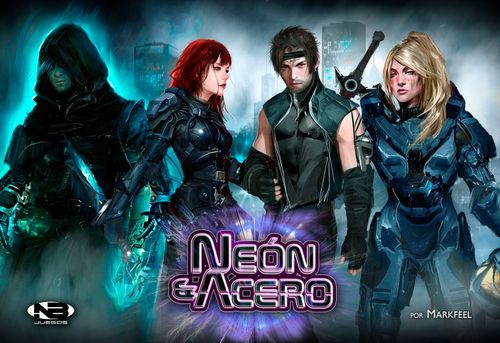
Neón y Acero
Neón y Acero Rulebook
Table of Contents
Table of Contents
- Card Types
- The Exploration Deck
- Spheres
- Great Enemy
- Heroes
- Game Modes
- Solo Incursion
- How to Obtain Spheres
- Setup
- Playing Area
- Turn Sequence
- Explore
- Attack
- Steal a Sphere
- Draw
- Playing at Any Moment
- Chains
- Active Player Priority
- Summary: Phases and Steps
- Extra Exploration
- Factions
- Tendency
- Doubts
- Deck Building Tips
- Winning Tips
- Solo Incursion Challenges
- Glossary
Card Types
Whatever the Game Mode, there will be at least two Decks on the table: the Resource Deck and the Exploration Deck. You can easily tell which Deck a card belongs to by looking at its back.
The Resource Deck
You will draw your hand from this Deck. There are 3 types of Resources:
- Characters: they will help you explore in search of Spheres, protect your own Spheres, or steal from other players.
- Actions: they have unique effects. Play them at exactly the right moment and surprise your rivals!
- Objectives: they state secret conditions that, if you meet them, score as Spheres!
Each card states what it is, as well as its effects and its values in game terms. You can also identify them at a glance by their colour.
Characters
A Character card shows its Tendency icon, its Faction icon, its Effect, its ATK value (Attack) and its EXP value (Exploration).
You can play one Character from your hand to your field each turn. Once in play, it can:
- Explore to obtain Spheres.
- Attack another player to steal theirs.
- Protect your Spheres from other players.
- Support another Character in its attack.
- Activate effects (some effects, such as "Discard:", can be activated by discarding that card from your field or directly from your hand).
Champions
Some very powerful Characters have a cost to play from your hand to your field: as their card indicates, to play them you must tap a Character in your field of a certain Faction or a certain Tendency. These Characters are the Champions (although this name has no effect in the game). A Character whose effect says "Tap [Faction icon] to play this card" cannot be played to your field unless you tap a Character whose card has the [Faction icon].
Actions
You can play an Action at any moment, even during another player's turn. Each Action has an immediate effect and, once resolved, is discarded.
Almost all of them have a Requirement at their bottom part, which you must meet in order to play them. If the Requirement is Disadvantage, you may only play that Action against a player who has more Spheres than you (you are at a Disadvantage with respect to that player).
If the effect of the Action is not aimed at a specific player, you must be at a Disadvantage with respect to all the other players (in other words: if you are the player with the fewest Spheres on the field, you can probably play any Action you have in hand).
All Actions whose Requirement is Disadvantage offer another option of the type: "[Alchemists icon] in your field". You do not need to meet both Requirements: if one of the Characters in your field has the [Alchemists icon], you may play the Action even if you are not at a Disadvantage.
Chains
If the effect of an Action or of a Character activates in response to another, a Chain is formed, which resolves in reverse order: the newest resolves first. It is simple: if one player plays an Action and you respond with another, the effect of yours resolves first.
We will look at Chains in depth on page 47. For now, it is enough to know that you can respond to any effect with an Action at any moment in the game.
Objectives
An Objective states a condition: if you meet it, play it! Once in your field it is worth as many Spheres as shown in its top right corner.
As with an Action, you may play an Objective at any moment, even if it is not your turn.
Objectives are secret missions: they are in your hand, so try to keep your rivals from guessing what you are aiming for until it is too late!
Condition
If, at the moment an Objective is resolved, something causes its condition not to be met, the Objective is discarded.
EXAMPLE: Your rival plays the Objective "Luchadores". To play it, they must meet its condition: you check that the total ATK of the Characters in their field exceeds 15.
In response, you decide to play the Action "Reducción". A Chain is formed which resolves in reverse order: first "Reducción", which lowers the ATK, so that by the time the Objective is resolved its condition is no longer met. Therefore, the Objective is discarded.
Objectives are key to the game. Often the last Sphere - and therefore the whole game - depends on an Objective, so it is worth being clear about how they work.
Unlike an Action, you cannot play an Objective in response to something, since an Objective consists of meeting a condition and not of triggering an effect. Therefore, you cannot respond with an Objective in a Chain.
An Objective in your field scores its value in Spheres, but it is not a Sphere. As we will see later, the possibility of stealing a Sphere from an unprotected player does not include Objectives.
Once you have completed an Objective and its card is in your field, it cannot be stolen or discarded (unless a card states otherwise).
The Exploration Deck
This Deck contains dangerous enemies, powerful weapons... and Spheres! You will reveal its cards when exploring with your Characters.
Of course, exploring means taking risks... but you may obtain great rewards.
Enemies
Each Enemy card shows its ATK value (Attack) and its EXP value (Exploration).
When you reveal an Enemy while exploring, your Character will face it! Compare its EXP value: if your Character beats the Enemy, you have defeated it! Its card goes to your Trophies. If you do not beat it... you lose your Character.
We will look at this in depth on page 38.
Equipment
Equipment cards have an effect. You may equip it to a Character of your choice in your field, placing it under that card (maximum one Equipment per Character). If the Character is discarded, discard its Equipment too (page 37).
Spheres
Lucky you! If you reveal a Sphere while exploring, it goes directly to your Trophies. As the cards indicate, the White Sphere is worth 1 Sphere. The Blue Sphere is worth 2!
When you obtain a Sphere, its card goes to your field tapped: it cannot yet be stolen, but from your next turn it will stand up with the rest of your cards, and you must protect it to prevent other players from stealing it.
Great Enemy
There is one unique type of Enemy that is much more dangerous. It stays in play (even if your Character's EXP beats it) until it receives an attack higher than its ATK, which is really high! To make matters worse, it prevents exploring or attacking... Although this turn of events may benefit some player, it is easy for you to agree on a combined attack to eliminate it. It is worth 2 Spheres, so you may negotiate in exchange for providing support...
Heroes
Your HERO is the only Character that will be in your field from the start of the game, marking your style of play (take a look at the back of the card to get the most out of it).
If a defeat or an effect would discard it, it is instead KO'd (face down). At the start of your next turn it will become tapped, and the turn after that it will be standing (page 34).
Game Modes
There are several Game Modes you can choose from depending on the number of players or your style of play. Broadly speaking, the mechanics are the same, but the game will change completely!
The Game Modes listed in the rulebook are:
- Free Play (Partida Libre): All vs All; Teams; Variant: Spiral.
- Tournament (Torneo): All vs All, Variant: Spiral; Teams, Variants: Themed Game (Partida Temática) and Closed Factions (Bandos cerrados).
- Solo Incursion (Incursión en Solitario): 1st Ed. Challenges; Thematic Challenges.
Free Play
This is the perfect mode for casual games among your friends, even if they have never played the game before. You can play with up to 5 players using a single copy of the game: if what you are looking for is to open the box and have fun without complications, this is your ideal Game Mode.
In a Free Play game, all players draw cards from the same Resource Deck. Deal one HERO at random to each player, place the Resource Deck on one side of the playing area and the Exploration Deck on the other side, and that's it!
This Mode is the simplest, both one-on-one and for 3 or more players.
Although the usual way to play Free Play is All vs All, if the number of players is 2 or 4 you can form Teams.
All vs All
In an All vs All you take turns until someone obtains 6 Spheres. You may attack the player of your choice or support their attacks against another. This Game Mode is made for Pacts, betrayals and rivalries.
Another way to play All vs All is to allow each player to attack only the player seated to their right. This variant offers some respite, since you only have to protect yourself from the attacks of the player on your left.
Teams
If you are 2 or 4 players, you may form pairs at random. Each plays individually, but the total Spheres are counted by team: the first team to add up 6 Spheres (between the two of them) wins.
This makes these games faster. Of course, you may support your teammate's attacks, but you may not exchange cards or accept/reject Pacts between teammates in order to complete an Objective.
Tournament Mode
In Tournament Mode you will also share the Exploration Deck, but each player brings their own Resource Deck. This means you may choose both your HERO and every card in your Deck. If you are attracted by the idea of finding your style and your star combination, and you enjoy building Decks, this Mode is for you.
The point of Deck building is not to look only for the best strategy, but for the style of play that suits you best.
Tournament Mode is compatible with all the options of Free Play games.
- All vs All
- Variant: Spiral
- Teams
In Tournament Mode, since each player builds their own Resource Deck, in the Teams option you may choose a HERO and a strategy that complements your teammate's, to secure your victory together.
Later you will find tips for building your best Deck. For now, we will look at the basic rules for choosing your favourite cards.
A good starting point is to begin by choosing your HERO: it is the only card that will accompany you throughout the whole game, and it can help you choose Characters, Actions and Objectives that combine with its abilities.
Deck Building
The rules for building your Resource Deck are few and very simple:
-
Your Deck must have a minimum of 40 cards (in addition to your HERO).
-
You may include a maximum of 3 copies of each Action or Character card.
-
You may not include Characters whose Tendency (Good or Evil) is opposite to that of your HERO. This does not apply to HEROES or to Neutral Characters.
-
You may only play one Heroic Action per game, which will be the one corresponding to your HERO (if you try to play another, it returns to your hand).
-
You may not have 2 Objectives with the same name in play (the second one returns to your hand).
-
Variant: Themed Game (Partida Temática)
If you want each player to have their own Resource Deck but you only have one copy of the game for everyone (or if you do not want to build your own Decks), you can form a Resource Deck for each player by dividing the cards included in the game by Faction, to play Themed Games. It is very simple: choose a HERO and all the Resources (Characters, Actions and Objectives) whose icons and colours match it.
If you want to add other Factions, you may pit The Resistance and Bounty Hunters VS The System and Alchemists.
- Variant: Closed Factions (Bandos cerrados)
You can take this a little further by using the Deck Building rules from the previous page, changing this rule:
- You may not include Characters whose Tendency (Good or Evil) is opposite to that of your HERO.
for this other one:
- You may only include Characters of the same Faction as your HERO.
Solo Incursion
If you want to play alone, this Game Mode is still expanding. In addition to the Challenges included in the 1st Edition of the game, you can download new Challenges for free from the website.
1st Ed. Challenges
This series of simple Challenges will teach you everything basic for playing. They gradually become more complicated as you progress, with trap Actions and enemy HEROES. Beat them all!
Thematic Challenges
These new Challenges reflect key moments in the story, which you can read and download for free from the website. Each Challenge has its own rules, and your result will influence the following ones.
More details: pages 78 and 88.
How to Obtain Spheres
The first player to obtain 6 Spheres is the winner! You can obtain them in several ways:
-
Explore
-
Complete Objectives
-
Steal from other players
-
Gather Trophies
-
You may Explore once per turn with each Character. If you reveal a Sphere, it is yours!
-
If you complete an Objective in your hand, play it! It is worth as many Spheres as it indicates.
-
If a player has no Characters standing, you may Steal a Sphere from them!
-
Gathering Trophies: each time you defeat an Enemy it goes to your Trophies. If you gather 6, form a face-down stack: it is worth 1 Sphere.
Setup
- Shuffle the Exploration Deck and the Resource Deck, and place one on each side of the play area, within reach of all players.
- In Tournament Mode each player brings their own Resource Deck, and the Exploration Deck will include the cards of the expansion "Sombras de Ankar".
- Deal one HERO at random to each player.
- In Tournament Mode each player chooses their HERO.
- Decide the order in which you will play. (You may do this at random, or let whoever lost the last game choose.)
- Draw 6 Resources as your starting hand. If you do not like your hand, you may shuffle it back into your Resource Deck, shuffle, and draw again (only once).
Playing Area
- Example of a 2-player Free Play game with the Exploration Deck on the left and the Resource Deck on the right, and next to them their respective discard piles (in Tournament Mode each player will have their own Resource Deck). It does not matter if they are the other way round, as long as players can reach them without any trouble.
- Place your HERO in the upper half of your field with the rest of your Characters. In the lower half will go your Trophies: Spheres, Objectives and defeated Enemies.
Turn Sequence
On your turn you may carry out a series of actions in sequence, such as standing up your cards, playing a Character from your hand to your field, exploring, or drawing. When your turn ends, the next player's turn begins.
At any moment of the game you may play Action cards, completed Objectives, activate your Characters' effects, or make Pacts with other players. Some cards have a much more powerful effect during another player's turn.
Turn Phases
- Stand Up
- Play a Character
- Explore / Attack
- Draw
AT ANY TIME:
- Play an Action
- Play an Objective
- Activate a Character's Effect
- Pact
1. Stand Up
The first thing you do at the start of your turn is stand up all the cards in your field that are tapped, both Characters and Spheres. If your HERO is KO'd, it becomes tapped. On your next turn it will be fully standing.
Standing up your Characters allows you to explore again, attack, activate their "Tap:" effects, or leave them standing to protect your Spheres.
On the other hand, standing up your Spheres means that from this moment on they can be stolen from you if you have no Characters standing. Even if you miss an exploration or an attack, do not forget to leave some Character standing to protect them!
2. Play a Character
Once you have stood up your cards, you may play one Character from your hand to your field.
Unless an effect states otherwise, you may not play another one in the same turn. You may have a maximum of 6 Characters in your field. If you already have 6, you may not play more until one is discarded.
To play a Champion you must tap a Character of the Faction indicated on its card (the tapped Character cannot explore, attack or activate its effect this turn).
3. Explore / Attack
In this phase you may explore or attack once with each Character in your field.
The first player's first turn skips this phase.
Tap the Character with which you want to explore or attack. Once the effect of its action has been resolved, you may start another one with another Character (it may be a different one: if you have 3 Characters in your field, you may explore with one, attack with another, and leave the last one standing to protect your Spheres).
Exploring will face you against powerful Enemies, but it gives you the chance to accumulate Trophies, find Spheres or Equipment for your Characters.
Attacking allows you to defeat other players' Characters. If a player has no Character standing, you may steal a Sphere from them.
Explore
- Tap the Character with which you want to explore.
- Reveal the top card of the Exploration Deck, turning it face up for all players to see.
- Sphere: Congratulations! Put it in your Trophies tapped (this turn it cannot be stolen from you).
- The Blue Sphere is worth 2.
- The White Sphere is worth 1.
- Equipment: Place its card under the Character you want to equip.
- If you choose a Character that already has Equipment, discard the one you do not want.
- If the Character is discarded (or, if it is a HERO, is KO'd), discard the Equipment as well.
- Enemy: If you reveal an Enemy while exploring, your Character will face it!
- Compare EXP.
- If your Character's EXP value exceeds the Enemy's, you have defeated it! Its card goes to your Trophies.
- If your Character's EXP value is equal to or lower than the Enemy's... you lose your Character! Both cards are discarded (your Character goes to the Resource Discards and the Enemy to the Exploration Discards. You can easily see which discard each card belongs to by looking at its back).
- If it is a HERO, instead of being discarded it is KO'd.
- The higher your Character's EXP (Exploration) value, the less risk it runs when exploring. Whenever you can, explore with your Characters that have the highest EXP.
- Sphere: Congratulations! Put it in your Trophies tapped (this turn it cannot be stolen from you).
Stacks
- If you gather 6 defeated Enemies in your Trophies, they will form a stack worth 1 Sphere!
- Turn their cards face down to form a stack.
- Other players' Characters that you have defeated when attacking also count as Enemies for forming a stack.
- Unless an effect states otherwise, they cannot steal a stack from you.
Although it involves taking risks, exploring is a quick way to obtain Spheres. However, you may want to eliminate another player's Character or even try to steal a Sphere from them if they barely have any Characters standing to protect it. If that moment comes, it is time to attack.
Attack
- Tap the Character with which you want to attack.
- Point to which Character you are attacking: it may be any Character standing in the field of the player you choose.
Support
- You may tap more Characters to support your Character in the attack. Each support adds half of its ATK to that of the attacking Character.
- The other players may also support the attacking Character.
- Once all supports for the attacking Character have been declared, the attacked player as well as the others may declare supports for the attacked Character. At this point it is no longer possible to declare more supports for the attacker (you may consider your attack a bet where you go all in).
Compare ATK
- If the ATK value of the attacking Character exceeds that of the attacked Character, you have defeated it!
- Its card goes to your Trophies (if it is a HERO, it is instead KO'd).
- If the ATK value of the attacking Character is equal to or lower than that of the attacked Character, your Character is defeated!
- Your card goes to the Trophies of the attacked player (if it is a HERO, it is instead KO'd).
- In case of a tie, the attacked player wins.
- Supports do not go to the rival's Trophies.
- Do not forget that supports for the attacked Character, as well as Action cards, can turn a combat around. Take everything into account when you plan your attack!
Steps of the Attack
- Tap the attacking Character.
- Point to the attacked Character.
- Supports are declared for the attacking Character.
- Supports are declared for the attacked Character.
- Compare ATK.
- The defeated Character goes to the rival's Trophies.
As with the Turn Phases, both before and after each step of the attack Action cards may be played. We will look at this in depth on page 47: "Chains".
Once the attack has been resolved, you may move on to the action of another Character in your field: explore, start another attack, etc.
Steal a Sphere
If another player has at least one Sphere standing in their field and no Character standing to protect it, you may steal it!
- Tap the Character with which you want to steal a Sphere.
- Point to which Sphere you intend to steal: it may be any standing Sphere in the field of the player you choose.
- The other player may use an Action card or activate an effect that prevents the theft. If not, the Sphere goes to your Trophies (standing)!
One Sphere per Turn and Player
Unless an effect states otherwise, you may not steal more than one Sphere from the same player in a turn.
Nor may you steal a completed Objective or a stack of Trophies: they have a value in Spheres and score as such, but they are not Spheres. In other words, you may steal Blue or White Spheres from the Exploration Deck.
Draw
Once you have explored or attacked with all your Characters, the last phase of your turn arrives.
- If you wish, you may discard one card from your hand before drawing.
- Draw cards from the Resource Deck until you have 6 in your hand.
If at this point you have more than 6 cards in your hand due to some effect, you are not obliged to discard any, but you may not draw more cards.
Once you draw, your turn ends and the next player's turn begins.
Playing at Any Moment
[The source page 45 prints no section title; the two headings below are the page's own sidebar titles.]
Play an Action
You may play an Action card at any moment of the game: it does not matter which phase of your turn you are in, or whether it is another player's turn, before or after each Phase or each intermediate step, as well as in response to an effect or to another Action.
Play an Objective
You may also play an Objective at any moment of the game, as long as you meet its condition at the moment you play it. The only exception is that you may not play an Objective in response to an effect or to an Action.
Activate Character Effects
You may activate your Characters' effects, such as "Tap:" or "Discard:", at any moment of the game, just like an Action card: before or after each phase and each intermediate step, as well as in response to an effect or to another Action.
Pacts
Pacts are verbal agreements between players. For something to count as a Pact, you must ask for and offer something in return: "I will not attack you this turn if you do not activate your Hero's effect".
A Pact can be beneficial, even necessary, but do not trust too easily: there are Objectives that have to do with them.
You may also propose a Pact at any moment of the game.
Chains
Every play causes an effect: attacking, exploring, playing a Character, playing an Action, etc. As you may play an Action or activate a Character's effect at any moment, it is easy for you to want to do so in response to another effect that is happening in the game.
If an effect is activated in response to another, a Chain begins, which resolves in reverse order: the newest resolves first.
- Remember to give the opportunity to respond before continuing to add effects to the Chain.
- You may add an effect to the Chain each time another one resolves.
- Every effect in a Chain resolves, even if the conditions have changed or even if the card that caused it has been discarded. The only case in which an effect does not resolve is if it is cancelled.
EXAMPLE: Your rival plays the Action "El Sistema de los fuertes", which discards all Characters whose ATK is less than 4. In response, you decide to play "Heroísmo", which raises the ATK of your Characters by +2. Your rival plays "Anular" to negate the effect of your "Heroísmo".
The Chain resolves in reverse order: "Anular" negates "Heroísmo", so your Characters do not increase their ATK. Finally "El Sistema de los fuertes" resolves, discarding the Characters with ATK less than 4.
Order in which they were played (top to bottom): "El Sistema de los fuertes", "Heroísmo", "Anular".
Order in which they resolve (bottom to top): "Anular", "Heroísmo", "El Sistema de los fuertes".
Chains give the game unpredictability. Without them, there would be no way to interrupt your rivals' plays or to turn the game around in surprising ways. Make use of them!
Active Player Priority
If, during your Explore / Attack phase, another player activates an effect that could prevent your Character's action (by tapping or discarding it), you may respond with your Character's action, tapping it in response in order to explore or attack.
EXAMPLE: It is your explore phase. Before you can do anything, your rival activates the effect of "Patrulla de Sheltark" to tap your Character. Since it is your explore phase, you apply Active Player Priority and, in response, you tap your Character to explore with it. Your exploration resolves first and, when the time comes to resolve the effect of "Patrulla de Sheltark", your Character is already tapped.
This exception to Chains occurs only in your Explore / Attack phase and has a simple purpose: to avoid "I said it first" conflicts. Instead, there is always the option to respond with effects in the game.
Summary: Phases and Steps
- Stand Up
- Play a Character
- Explore / Attack
- Tap the exploring Character. Reveal the exploration:
- Sphere: goes to your Trophies.
- Equipment: goes to the Character you choose.
- Enemy: compare EXP.
- If you beat it, it goes to your Trophies.
- If not, discard your Character.
- Tap the attacking Character. Point to the attacked Character.
- Supports for the attacking Character.
- Supports for the attacked Character.
- Compare ATK.
- The defeated Character goes to the rival's Trophies.
- Tap the exploring Character. Reveal the exploration:
- Draw
Both before and after the 4 main phases, as well as after the steps of the Explore / Attack phase, you may play Actions, play Objectives or activate effects that start a Chain.
Extra Exploration
Some Characters or Action cards allow an extra exploration, sometimes even outside your Explore phase.
Whenever a card contradicts the rules, the card takes priority. The strength of many cards is precisely that they break the rules of the game.
If your card allows you to make an extra exploration outside your Explore phase, follow the steps on the previous page as a normal exploration:
- Tap the exploring Character.
- Reveal the top card of the Exploration Deck, turning it face up for all players to see.
- Resolve the exploration normally.
Although an extra exploration is resolved as one more explore phase, you may not play an Action whose Requirement is "In your explore phase". That Requirement refers only to your natural Explore phase.
Factions
Each Character belongs to a Faction, which you can see in the top right corner of its card.
There are 4 Factions with very different play styles:
- THE RESISTANCE (purple icon)
- THE SYSTEM (yellow icon)
- ALCHEMISTS (green icon)
- BOUNTY HUNTERS (grey icon)
[The icon colours are as printed on the page: purple, yellow, green and grey.]
Knowing the strategy of each Faction is a good starting point for building your Deck, but it is also interesting when sharing Resources in Free Play games. Although this Game Mode is more random, the Faction of your HERO and of your other Characters will determine the Action cards and the Champions you can play.
If a card has as its Requirement or cost to have a Character of a specific Faction, simply look at the colour and icon of your cards.
The Resistance
Tendency: Good
Explore fast! The style of the Resistance is as simple as it is effective, with Characters and Actions based on exploration. Recovery and speed are its strong points.
The System
Tendency: Evil
Stay in control! Neutralise your rivals and do not let them get one over on you. The strategy of the System centres on maintaining dominance of the field and attacking without mercy.
Alchemists
Tendency: Neutral and Evil
Surprise your rivals! Transform discards into weapons, destroy, and even create your own Spheres. In the hands of Alchemists, nothing is what it seems.
Bounty Hunters
Tendency: Neutral
Why look for Spheres when you can steal them? Bounty Hunters can join any HERO to dodge attacks and effects, gain extra resources, loot... and flee.
Tendency
In addition to belonging to a Faction, each Character is guided by a moral Tendency, which you can see in the top left corner of its card.
- GOOD
- NEUTRAL
- EVIL
Tendency plays an important role when building your Deck: you may not include Characters whose Tendency is opposite to that of your HERO (this does not apply to Characters or HEROES of Neutral Tendency).
As with Factions, some cost or Requirement may call for a Character of a specific Tendency.
If you look carefully at an Objective, you will see that to the right of its name there is a coloured shadow that may give you hints about the Faction or the Tendency with which it could be easier to complete.
Doubts
If you have doubts about a very specific aspect of the game, you will easily find the answer here.
Actions
- Several Actions are played: how are they resolved? If an effect is activated in response to another, a Chain begins in which the newest resolves first. This Chain may have several links, and all of them will resolve (unless one of them is cancelled).
- If the card I choose as the target of an Action's or a Character's effect disappears through another effect before my card resolves, may I choose another target? There are no "repeats". Your effect would be lost, in the same way that when playing an Objective, another effect may cause its condition to no longer be met before it is resolved.
- What is the "Disadvantage" Requirement? You may play an Action with this Requirement against a player who has more Spheres than you (you are at a Disadvantage with respect to that player; you do not need to meet the other Requirement). If the Action is not aimed at a specific player, you should be at a Disadvantage with respect to all the other players (or meet the other Requirement).
Enemies
- What happens if my Character's EXP ties an Enemy's? Unless your Character beats the Enemy (in which case the Enemy goes to your Trophies), both are discarded: the Enemy card goes to the Exploration Discards and your Character to your Resource Discards.
- If my Character's EXP beats "El Despertar", does it go to my Trophies? No. Your Character survives, but "El Despertar" stays in play.
- If "El Despertar" is defeated by several players, who takes it to their Trophies? It will most likely be defeated in a joint attack, and there is no strict way to resolve this: it is a matter for a Pact! You may allow the attacking player to take it, or perhaps someone offers support in exchange for a Sphere.
- What happens if my Character gathers enough support and attacks "El Despertar", but, due to some effect, when it resolves it does not exceed the ATK of "El Despertar"? As with any other Enemy that beats your Character, your Character is discarded.
Equipment
- What happens if a HERO equipped with a weapon is KO'd? For a HERO, being KO'd is the equivalent of being discarded. As with any other Character, its Equipment is discarded (it goes to the Exploration Discards). If any other equipped Character is discarded, its Equipment goes to the Exploration Discards and the Character goes to the Resource Discards.
- If I reveal a weapon while exploring, which Character keeps it? You may equip it to the Character of your choice (except a KO'd HERO).
- How many Equipment cards can a Character carry? One. If you reveal a better Equipment while exploring (or if all your Characters already have one), you may discard the one you do not want. You cannot move an Equipment from one Character to another.
Characters
- When can I activate a "Discard:" effect? At any time you can activate the effects of Characters in your field. "Discard:" effects can also be activated from your hand, discarding that same Character. If that Character were about to be discarded for some reason, you may activate its "Discard:" effect in response and resolve it first.
- What is the difference between "Discard:" and "Discard a card"? To activate an effect such as "Discard: cancel an attack", the cost is discarding that same Character (from your field or from your hand). In effects such as "discard a card" you may choose any card from your hand.
- What happens if another player's effect taps a Character that has already declared an action? A Chain forms which resolves in reverse order: your Character is tapped, and the attack, exploration or support still resolves, since that effect has not been cancelled.
Heroes
- Is a HERO considered a Character? Yes, for all purposes (unless a card states otherwise). The only exception is that your HERO never leaves your field: instead, it is KO'd, but it stays in play.
- Can I explore or attack again with my HERO if, through another card's effect, it stands up again in my Explore / Attack phase? Yes, just like any other Character.
- Can I stand my HERO up with the effect of "Eva"? Yes, unless it is KO'd, in which case it becomes tapped instead. (The effect of "Eva" is equivalent to Phase 1, Stand Up, at the start of your turn, and a KO'd HERO needs two Phases to become fully standing.)
- Can I use my HERO's KO effect twice in the same turn if, through other cards' effects, it stands up again? No, since your HERO has already been KO'd this turn. Other effects, such as the extra exploration of "Angela", are not recovered either, even if an effect stands their card up again (see the back of her card).
Objectives
- What happens if an Objective's condition stops being met when I play it? You cannot play an Objective without meeting its condition (it would simply return to your hand). If at the moment of playing it you meet the condition, but something makes it no longer met when it is resolved, it is discarded. EXAMPLE: if you play "Expandir el Bien" and another player responds with an effect that reduces the number of Characters in your field below 4, the condition is no longer met and the Objective is discarded. The ability to respond to an Objective adds opportunities to the game, and the fact that it cannot be played without meeting its condition prevents players from discarding unmet Objectives to draw more cards.
- Can someone steal an Objective from my Trophies? No, unless a card states otherwise.
- Can I play an Objective in response to another? No, since an Objective consists of meeting a condition, not of triggering an effect. In other words, an Objective can only be the first link of a Chain. An extreme case: if a player keeps an Objective to play when another player gets their last Sphere, they could not play it in response and would lose.
Resources
- If an effect lets me draw extra Resources, may I have more than 6 in my hand? No problem, but in your Draw phase you would not draw any.
- May I look at another player's discarded Resources? Yes.
- What happens if we cannot draw because the Resource Deck has run out? In Free Play, shuffle the discarded Resources and form a new Deck with them to keep playing. In Tournament Mode or Themed Game, where each player has their own Resource Deck, apply the following rule:
- Zero Resources (the source labels it "Recursos A-cero"): if a player cannot draw Resources in their Draw phase because their Deck has run out, that player loses the game.
Turn Phases
- Can I play the Phases of my turn in any order? No. The Phases of the turn are played in sequence: you cannot go back.
- Stand Up
- Play a Character
- Explore / Attack
- Draw
Pacts
- What exactly is a Pact? A verbal agreement between players. In a valid Pact, something must be offered and something must be asked for in return. A proposal such as "Give me 2 Spheres in exchange for nothing" is not a Pact (even if, for some reason, it is accepted).
- Am I obliged to fulfil my side of a Pact? Not really. You may accept the Pact and change your mind, or even betray it on purpose. To avoid surprises, it is worth getting to know the other players in this kind of direct interaction.
- Can I ask for anything in a Pact? In game terms, yes. Pacts allow game rules to be broken: you may give another player Equipment, even a Character, or let them see the cards in your hand.
Deck Building Tips
- Can I include any card in my Deck? Page 26 contains all the Deck building rules. Although there are few limitations (such as not including Characters of a Tendency opposite to your HERO), you may keep the following points in mind:
HERO
- Choose your favourite HERO. It is the only card that will accompany you throughout the whole game, and it can completely mark your style of play. Make the most of its abilities with the rest of your cards!
- If you have Heroic Actions, in this Mode you may only play the one that includes your HERO's name. So the moment you choose your HERO is the perfect time to include its Heroic Action in your Deck as well.
- Your HERO's Faction and Tendency will determine the rest of the Characters you can include in your Deck. Find your winning combination!
Characters
- Each turn you may play one Character from your hand. Do not skip this Phase for lack of Characters, as you would lose ground in the field; Characters should make up, more or less, half the cards in your Deck.
- Include the Champions you can play: the most powerful Characters cost tapping other Characters of a certain Faction or Tendency. If it is your HERO's Faction you will have no problem playing it. If not, make sure you carry enough Characters of that Faction in your Deck. Each Faction has its own Champions; choose the ones that best fit your other cards.
- Actions and Objectives can be more decisive than Characters. Think about which ones you will include, so that you carry Characters that let you play them easily.
Actions
- Action cards will be your best asset for surprising your rivals. Almost all of them have, among their Requirements, a Character of a certain Faction in your field: if it is not your HERO's Faction, check that you carry a reasonably high number of Characters of that Faction.
- If you are at a Disadvantage, you can play almost any Action. Bearing this in mind (unlike Champions), you may include an Action characteristic of another Faction to catch your rival off guard if things get complicated.
Objectives
- Include at least 20% Objectives in your Deck so that you always have some Spheres in sight.
- Choose Objectives you can complete according to the rest of the cards in your Deck!
Combos
- Some cards work better together. Keep these synergies in mind when choosing your Deck. [The source shows sixteen example Resource cards under this heading, in four rows. The card images are not reproduced here. Read from the card images, they are: Noah Black; Airi, huérfana de Ezyra; Raise, Líder Defensor; Noche de Neón; Angela; Noche de Acero; Incursora urbana; Cry; Fuerza de Élite; Unidad de Rastreo; Ellen; Tropa Reductora; Lya; Hela, creadora oscura (the title is only partly legible at this resolution); Rayo; ¡A por su líder!]
Winning Tips
Here are a few more tips, from the Tournament winners!
"If I had to give advice to future players, I would tell them never to give up on games. The beauty of the game is that at any moment you can turn the course of the battle around; you just need a little patience and originality to know how to seize the right moments. As a final note, I would like to stress that if you intend to make friends, it is better to leave that for after the games." (xPiniAa, winner of the 1st In-Person/Online Tournament)
"Exploration-focused Decks often concentrate on drawing Spheres and winning quickly, but let us remember that this is a card game and partly also a game of chance. Always have a plan B in case the game freezes. It is important to bear this in mind when designing your Deck. You need a good balance of card types. Objectives can give us this plan B that we need, but it is important to select carefully which ones we take. "Aplastarlos" or "Refuerzos" are quite risky and we may never get to use them. Instead, "Exploradores", "Remontar" and "En pelotas" are easy to use if we play with the Resistance. Keep in mind that the Tendency of our HERO is probably B [the source writes only the letter "B" at this point]. "Hela", "Eva" and "Airi" must not be missing from our Deck. Alone they are not much use, but when combined... An "Eva" can raise a "Hela" and speed up the process of generating Spheres. "Airi" returns to our hand any discarded card, which can mean that in a single turn we play countless cards such as "Seguir explorando" or "Heroísmo"." (Sarabia, 3rd place in the 1st In-Person/Online Tournament)
Next, a special text by Skellt, winner of 2 Tournaments and currently 2nd in the '22 League.
Deck Building
It is a fact that the limits on the number of cards and the rules of Tournament Mode can leave many players unsure about how to build their Deck. My recommendations:
- Neón & Acero is a game in which you do not have all the information or all the variables, as can happen in other games where the opponent's pieces are visible. In N&A strategies are partly hidden, since you know neither your opponent's hand, nor their Deck, nor your own starting hand. Knowing how to build a good Deck is essential, since luck is another important part of the game: the better your Deck is built, the more likely it is that luck will favour you.
- All Decks and play styles have their strengths and weaknesses. Do not insist on including Resources for every kind of situation; that only reduces the efficiency of your combos and synergies and, consequently, of your Deck. Currently (before the 1st Expansion), the minimum number of cards for Tournament Mode is 30. In my case, in the previous tournament I played with 31 cards and in the current one with 33. [Transcriber's note: this figure is the player's own and predates the 1st Expansion. It differs from the 40-card minimum stated in the Deck Building rules above; it is transcribed as printed.]
- When building your Deck it is important to establish a foundation first: a hard core that stays the same whatever your rival, and then a part of situational Resources. If you have the advantage of knowing your rival and their style of play, you can prepare your Deck to face them. Likewise, if you are playing a "best of three" and had many problems in the first game, it is advisable to make changes to reverse the situation. For this reason, I recommend keeping a "bench" of cards outside your Deck that let you face, more easily, situations where your current Deck has difficulties.
- Do not saturate your Deck with Objectives: it is better to play a few, easy-to-complete ones than to have to discard them half the time because they are difficult.
Play Style
Once the Deck-building tips have been considered, the next step is to choose a play style. The style you choose is either given by your experience with similar games or by knowing what you most enjoy playing. Either way, in my opinion N&A has 3 well-differentiated play styles:
- Aggressive: I call it aggressive because it seeks to end the game as soon as possible. Decks based on exploring quickly and with guarantees of success, taking extra Resources, good defence and little capacity for trading (exchanging attacks).
- Control: the turtle of the game, basically. Designed for longer games, these Decks aim to annoy your rival until you are strong enough to start dominating every aspect of the game.
- Midrange: a versatile Deck, good at every point of the game, with little synergy or combos, in pursuit of Resources that let you be dangerous at every stage of the game.
An example of this type of Deck would be, with the game's starter pack, mixing the System with Bounty Hunters such as "Noche de Acero" or the "Incursora", compensating for the System's low exploration capacity. Within these styles there are many variables.
Combos
Many of them are already well known, that is: they will not be very effective, since the strongest combos are also the ones that all players prepare to counter. Do not base your strategy 100% on a combo. In my opinion, most of the time it will not work for you.
Starting Plan
For me, the most important thing is not to go all in from the first minute. Holding Resources in reserve can sometimes win you the game. Saving an Objective such as "Exploradores" for when you are playing the Resistance, so that you can play an "Anular" when you are at a Disadvantage, can be half the game. Being the first to get Spheres will not make you the winner, and being behind in the first few turns will not make you lose. Do not worry or play in desperation: wait for your moment.
Final Conclusion
Having set out all of the above as a kind of subjective "guide", I just want to tell new players never to give up, since the game takes many turns. I have won games with 4 Spheres against me and lost games with 4 Spheres in my favour. If you are going to use several Resources on a decisive play, have an alternative option in case it goes wrong, so you are not left exposed. It is better to wait a couple of turns to have that option than to gamble on it and have it fail, although there will be occasions when you have no choice but to go all in. You cannot win without taking risks. Do not try to protect yourself from every threat; prioritise. And finally, and most importantly, enjoy the game and share it with all your friends. Do not be afraid to sign up for every tournament, event or get-together organised for fun, even if you feel very "green" at the game: what really matters is having a good time, and there is no better way to learn. Best wishes to everyone! See you on the battlefield! (Skellt, winner of the 1st Winter Tournament and of the RF)
Solo Incursion Challenges
In this Extra Mode for one player, you step into the shoes of a Character of the Resistance and face The System in a series of Challenges.
The game includes 6 Challenges to familiarise you with the game system, but this is only the beginning: Thematic Challenges are coming! Each Challenge recreates a key scene in the story, and your result can affect the following ones.
You can download more free Challenges from the website. Each one will have its own special rules, and the Characters and Victory Conditions will be different!
We will begin with the 6 basic Challenges.
1st Ed. Basic Challenges
The Resistance
Characters:
- HERO: Angela or Cry
- Noah Black (x2)
- Raise, Líder Defensor (x2)
- Noah Black (x2) [printed twice in the source]
- Eva, renegada de Akron (x2)
- Airi, huérfana de Ezyra (x2)
- Mei, huérfana de Ezyra (x2)
- Incursora urbana (x2)
- Noche de Acero (x2)
- Noche de Neón (x2)
Actions:
- Heroísmo (x3)
- Seguir explorando (x2)
- Rapidez (x2)
- Rastreo (x1)
- Esquivar (x1)
Objectives:
- ¡Refuerzos! (x1)
- ¡A por su líder! (x1)
- Expandir el bien (x1)
- Apoyar / En pelotas (x1)
- A explorar (x1)
The System
Characters:
- HERO: Ellen
- Fuerza de Élite (x2)
- Unidad de asalto (x2)
- Unidad de rastreo (x2)
- Patrulla de Sheltark (x2)
- Ryo, Portavoz de Akron (x2)
- Hades, Heraldo del Mal (x2)
- Hela, creadora oscura (x2)
- Atractor de peligros (x2)
Actions:
- Reducción (x2)
- Anular (x2)
- Blindar Esfera (x2)
- Bomba Trampa (x1)
- Transmutar (x1)
Exploration Deck Setup
Remove "El Despertar" and the Blue Spheres (they will not take part in any Challenge). Set aside 3 White Spheres and shuffle the rest of the Deck.
The System's Field
- Place the Exploration Deck and the Deck formed by the System's Characters to your left. Place their respective discards to the right of each Deck.
- Place the 3 White Spheres you set aside face up in front of you.
- Draw 3 System Characters and place one face down in front of each Sphere. This will be the Attackers row.
- Draw 3 more and place one face down in front of each Attacker. This row will be the Explorers.
- To the right, place the System's HERO and the Trophies you collect (Enemies you beat when exploring, new Spheres... or your own Characters if they are defeated in an attack against theirs).
- Place your HERO and draw your starting hand of 6 Resources.
Once everything is ready, you will play your first turn as the Resistance, following the Turn Phases with the same rules as in any other Mode. Then you will play the System's turn, whose rules are different.
The game alternates between the two turns until you overcome the Challenge or are defeated. This can happen in several ways. The basic conditions are:
- You get 6 Spheres.
- You steal all of the System's Spheres. OVERCOME CHALLENGE!
- The System gets 6 Spheres.
- Your HERO is KO'd.
- Your Deck runs out and you cannot Draw. YOU LOSE!
The System's Turn
- Explore
- Attack
- Complete Explorers
- Stand Up
1. Explore
- Turn face up the Explorer on the left.
- Tap it to explore with it.
- Unless it gets a Sphere, it will keep exploring with the Character to its right.
- If it gets a Sphere, it will not keep exploring this turn (keep the rest of the Explorers face down).
- This Phase ends when it gets a Sphere, or when the 3 Characters in the row have explored.
2. Attack
- If the System's HERO is in play, it will attack your HERO whenever it is standing, supported by the whole Attackers row!
3. Complete Explorers
- If there are fewer than 3 Explorers, fill the row with new face-down Characters. (If the Deck runs out, shuffle the discards and form a new Deck with them.)
4. Stand Up
- Stand up all tapped Characters.
Special Rules
In addition to the phases of the System's turn, a few things do not work the same way here:
- The effects of System Characters do not apply (look only at their ATK and EXP).
- To steal a Sphere from the System, its row of Explorers must be empty (you will have to defeat all 3 before the row is refilled).
- You may have to risk attacking a face-down Explorer. If you attack a Character whose EXP exceeds yours, you will be DISCOVERED! (even if you win the ATK comparison).
- If you steal 2 Spheres from the System, you will be DISCOVERED!
DISCOVERED!
- Ellen enters play! Remember that she will attack your HERO, supported by all her Attackers. (This attack can be devastating, so make the most of your Actions, support your HERO and KO Ellen whenever you can!)
- Ellen is not KO'd if you defeat her; she is tapped instead.
As you advance through the Challenges, some rules will change, such as the inclusion of trap Actions, which are activated before you steal a Sphere. Some will have no effect, but others will be really dangerous.
Thematic Challenge: The Betrayal of Ankar
In addition to the 6 basic Challenges included in the 1st Ed., the website is updated with new Challenges whose results affect the following ones. Complete the whole campaign!
A soldier in the Resistance? What does this mean? This Challenge puts you in the shoes of young Alan Raise at the moment when everything he believed in collapsed: his comrades, his brother... all of them risked their lives to give humanity the hope of surviving on a dying planet. Or so they had told him...
The Chronicles of Bellquiem would know this fateful episode as "The Betrayal of Ankar."
The Resistance
Characters:
- HERO: Raise (x2)
- Incursora urbana (x2)
- Noche de Acero (x2)
- Noche de Neón (x2)
- Fuerza de Élite (x2)
- Unidad de asalto (x2)
- Unidad de rastreo (x2)
- Patrulla de Sheltark (x2)
Actions:
- Heroísmo (x3)
- Seguir explorando (x2)
- Rapidez (x2)
- Esquivar (x1)
Exploration Deck Setup
Remove everything except the Lizards (you will find no Spheres or Equipment when exploring).
In this Challenge, soldiers and bounty hunters fight shoulder to shoulder on a rocky wasteland to free the Last Continent from the threat of the reptiles.
You are Alan Raise: a soldier of the System, and your mission consists of one thing: exterminate the lizards.
You will start the game alone, facing an empty field. Raise will be your HERO for all purposes. If you allow both of his cards to be discarded, you lose!
- Even though you have two Raise cards, you cannot explore or attack twice; he is a Character with an extra life. In other words, you can only make a mistake once.
Draw your starting hand of 6 Resources and play the Resistance's turn phases. (Remember that if you explore recklessly and lose Raise, the game will be very short.)
Special Rules
- In this Challenge you cannot change the order of the cards in your hand or in your field.
- You may play Characters to the left or to the right of Raise. After that, you cannot move them.
- If a Lizard matches or beats you, it remains in play. You cannot explore while a Lizard is in play, so attack it as soon as you can and eliminate it.
- At the end of your turn, each Lizard in play will attack the first standing Character in your field, starting from the left. (If there is more than one Lizard, resolve first the attack of the Lizard on the left and move right until all of them have attacked.)
- Each Lizard you beat when exploring or in an attack will go to your Trophies.
- As in any Solo Incursion, Enemies stand up before your turn starts again.
- Alternate your turn with the Lizards' attacks until one of these conditions is met:
- You defeat 6 Lizards: OVERCOME CHALLENGE!
- Alan Raise is KO'd.
- Your Deck runs out and you cannot Draw: YOU LOSE!
But this is not all. When you have defeated 4 Lizards, a milestone takes place:
THE BETRAYAL OF ANKAR!
You have almost completed your mission. The historic union of soldiers and mercenaries is toppling the reptiles... until your superiors point their weapons at you.
At this moment, all the Soldiers in your field and in your hand pass to the Lizards' field. (Place first those that were already in your field, respecting their position. Then place the rest from left to right, as they were in your hand.)
From now on, if at the end of your turn there are Soldiers in your hand, they pass to the System's field.
When your turn ends, the Lizards and Soldiers in play will attack you. The Soldier on the left will attack the first standing Character in your field from the left, if its ATK is higher than yours. If it is not, it will support the Soldier to its right (keep resolving until all of them have attacked or supported). Then stand up all Enemies: it is your turn. You cannot explore while a Soldier is in play.
Eliminate them and complete your mission before it is too late!
SURVIVAL!
Keep alternating between your turn and the System's attack until you overcome the Challenge... or until you are defeated.
The result will determine what happens in the following Challenges. Will Alan Raise survive and take revenge for everything he believed in? For an Akron soldier, the System is everything.
From this moment on, Alan is a renegade. Will he join the Resistance in his next Challenges? Or will he fall before the System to which he has dedicated his life?
Do not miss the next Challenges on the website! You can also read the chapter on which this Challenge is based. It was originally going to be the prologue of the original story, but it was never published: in "Bellquiem" only the account told in Alan's own words appeared...
Glossary
- Action: card type from the Resource Deck that you may play at any moment. More details on pages 11, 45 and 47.
- Activate: when you play an Action, an Objective or a Character effect, you are activating it. You have the option to respond with another Action or effect before it resolves.
- Support (verb): to tap a Character in order to make a support.
- Support: each Character that supports adds half of its ATK to the supported Character during the attack.
- Attack (verb): 3rd Phase of your turn, in which you can defeat other players' Characters.
- Attack: the phase that runs from the moment a player declares their intention to attack until it is resolved, before starting another Explore / Attack phase with another Character or moving on to their Draw phase.
- ATK: numerical value that reflects your Character's ability to attack, support or resist an attack.
- Play Character ("Bajar Personaje"): 2nd Phase of your turn, in which you play a Character from your hand to your field.
- Faction ("Bando"): each Character belongs to one. There are 4, with different play styles: [faction icons]. Some cards will ask for a Character of a certain Faction in your field.
- Chain ("Cadena"): when you activate an Action or a Character effect in response to another, a Chain starts, which resolves in reverse order: the newest resolves first.
- Field ("Campo"): the zone where your cards in play are located.
- Condition: a situation you must meet in order to play an Objective.
- Cost ("Coste"): a requirement you must meet to activate some effects, such as "Tap:" or "Discard:". The cost comes before the colon; what follows it is the effect. Texts such as "Tap X to..." are also costs.
- Discard: send one or more cards to their corresponding discards (see the back of the card).
- Discards ("Descartes"): cards removed from play. Resources (Actions, Objectives and Characters) go to the Resource Discards, while Enemies, Equipment and Spheres go to the Exploration Discards.
Source pages 94-96 (community links, acknowledgements and credits) are not transcribed; they contain no rules.