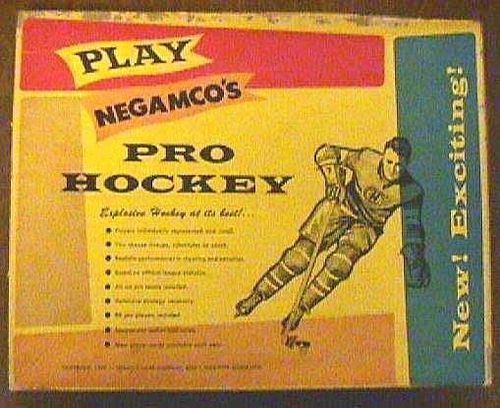
Negamco Pro Hockey Game
Negamco Pro Hockey Game Rulebook
Table of Contents
Table of Contents
Rules
Equipment of the game: playing board, one puck marker, spinner, a penalty-injury chart, one Numbered Marker Board, one Rink, 102 individually rated, represented hockey players, and of course complete rules.
Distribution of playing equipment: One playing board is given to each side, (both alike) and one puck marker, then place the game box containing the numbered marker board between you. Now each side is given a Penalty-Injury Chart found on back of playing board chart.
Those playing the game choose their teams and starting line-ups. This is done by putting five individual player cards on the numbered marker board (NMB) for each team. Now, put the goalie's player card in the net for each team. The rest of the player cards, of each team are put off to the side to use as substitutions. As to the order in which the player cards are put on the NMB, it does not matter, however it is best to put them playing their regular positions.
1. Numbers on Players' Cards
For instance; G 1-20, would mean goal number 1 thru 20; A 1-18, would mean Assist numbers 1 thru 18; PIM 41-52, would mean Penalty-Injury-Minutes numbers 41 thru 52; and Saves 1-46, means Saves numbers 1 thru 46. Of course, different numbers are on different players' cards.
2. G-Goals
Player shooting spins number attempting shot at goal. (Later on we will explain how you become eligible to shoot at goal) If number spun corresponds to G numbers on his player card, this counts as goal, 1 point. (providing Goalie didn't make Save. See Saves). If goal attempt was good, then player directly opposite player shooting on NMB gets puck.
Example: Player shooting spins #30. On his player card is G 28-44, so this counts as goal, 1 point. (Check for Save; See Saves) If the number spun had been say, 23, goal was missed and player directly opposite shooter on NMB gets puck.
3. Saves
Using the preceding paragraph, let's assume #30 had been spun by player attempting shot. Ordinarily, it would be a goal, G 28-44, but opponent then spins #17, and looks at his Goalie's player card, under Saves. Let's assume the numbers under Saves are; 1-48, so he slapped shot away, and player who shot gets the puck and starts board play over again. (See Board Play) If Goalie's spun number had been #49, or above, goal would have been good, 1 point. (See Assists)
4. A-Assists
(Only used for scoring purposes, not in actual score of game) When goal has been scored, check for assist or assists. Using the preceding paragraph, let's assume goal has been scored, then side who scored goal spins a number, say 38. Now, looking at player cards on the NMB, check for assist. Example: Card #'s.
| LW | C | RW | LDM | RDM | |
|---|---|---|---|---|---|
| A | 1-23 | 21-46 | 41-58 | 52-60 | 61-90 |
is the cards line-up, for team who scored goal, on the NMB. Will also assume that LDM (A 52-60), is the one who scored goal, so naturally he couldn't get the assist. Now, we see that the card under C (Center) is the only one which #38, the spun number is in among the assist numbers. (21-46) So, he gets credit for an assist. If none of the four eligible players had assists number 38 on them, then no assist on the play. There can be only two assists, or less, credited on any 1 goal scored. If, in the above examples, there would have been three or four who were eligible for assists, then only credit the two players with the most assist chances with assists.
5. PIM-Penalties-in-Minutes
Player who has puck, spins #69, using board. (See board play) Player, who is directly opposite on NMB from player who shot, looks at numbers by his PIM on his player card. Say, it's #'s 52-72. So, Penalty on him. Wait till completion of shot before finding penalty, then stop play immediately to find penalty on Penalty-Injury chart. You do this by spinning number, say it is #91. Now, look on Penalty-Injury chart. #91 is between 8 thru 93, so two minute penalty (check time), but no injury. If there had been an injury, then another two numbers would have to be spun to find out how serious the injury, and who was injured. When a penalty has been assessed, then player(guilty of infraction) will be removed from the game the amount of time the penalty requires. No player can come into replace him. (Except if it's a 10 minute misconduct) As you know, in hockey, there can be as many as five players against three players plus the two goalies. However, there can never be more than two players out for penalties on any one team, at anyone time. There could also be three players playing against three other players plus the two goalies. However, this situation rarely occurs. If a player commits a penalty, and his team already has two men in the penalty box he must join them and is replaced by another player from the bench, and cannot return until he has spent his time in the penalty box.
6. Puck Marker
Used as puck for marking which player has puck on NMB.
7. Time
When you have spun 100 times, this constitutes a period. There are three periods in a hockey game, and no overtimes. If a game is tied at the end of three periods, then it ends up a tie game. Also, if a player is in the process of shooting when the spins are used up, let the player finish his shot, and if it's good, check for goalie making Save, and if it's still good, then check for assists. Penalties are carried from one period to the next. Also, a two minute penalty requires a player to be in the penalty box for 10 spins; a five minute penalty for 25 spins; and a ten minute penalty for 50 spins. (Player however is replaced in the game for any 10 minute penalty by a teammate.)
8. Face-offs
A face-off to see who gains control of the puck, occurs at the start of each period, after every goal scored, after each infraction, and after each penalty. You face-off by each side spinning a number, the highest spun numbers team gets control of the puck. The side who gets the puck, can then choose which player they want to have the puck to start the Board Play.
9. Board Play
Now you will learn the use of the playing board [words missing in scan]. We will do this by running through examples (as shown on separate sheet) of actual play. Suppose you and I are playing. You will be team A, and I will be team B. First, set separate page of rules in front of you. Then put [words missing in scan] the playing board also in front of you so you may follow the playing examples. Now, it's time to start. Both you and I spin a number. The highest of the two numbers gets the puck. Suppose you spin the highest. You then take one puck marker and put it on any player you wish. Let's suppose you put it on Bob Green's player card, LW. Now, spin, and let's say it's #18. You look in N column numbered 16-20, and under LW. (Look at top of playing board). It reads, Pass to LDM, which means, pass to LDM of your line-up. So, you put the puck on your card LDM, Tom Red. Now, I look at the number and at PIM numbers on my players card under RDM, which is Andy Johnson. It reads, PIM 1-5, so since #18 doesn't correspond to these numbers, there is no penalty. (See playing examples on separate sheet) In other words, everytime offense spins number to find play on board, then defense looks at the same number offense spun and which he used on NMB, to find it there's a penalty on him. Defense must use player directly opposite on NMB, as offense used when it spun number, to find if there's a penalty on him. If there is a penalty, he, the defense, announces it, and play stops. (Except if player who spun the number gets to shoot. Then you wait for shot, Saves if good, and if still good, then assists). Then, check penalty! If there was no penalty, as in the above example, then play continues. Now, we will give the number spun, by team with puck, and explanation as to what happened. (Remember offense is team with puck and defense is team without puck. When puck changes teams, the offensive team becomes the defensive team and vice versa.) Play now continues with Tom Red having puck. #26 is spun. (Look in column 26-30 under LDM) Pass to C (Center). #84 is spun. (Look in column 81-85 under C (Center)) Pass to RW. #32 is spun. (Look in column 31-35 under RW(Right Wing). Pass to RDM(Right Defensive Man). You'll notice there were no penalties in the three preceding examples, the reason being that, numbers spun didn't correspond to the PIM numbers of the player card directly opposite the players involved. When #97 was spun for LDM it didn't correspond to opponents PIM numbers, 61-66. Also, when #84 was spun for C, it didn't correspond to opponents PIM numbers 41-45. Play now continues. #48 is spun. (Look in column 61-65 under RDM) Interception RDM, which means RDM of the other team has Intercepted the puck, so, I being the other team has the puck, so I put my puck marker on my RDM, Andy Johnson. Play continues. (Also, check for penalty on preceding interception play. As you see, there was none.) #87 is spun. (Look in column 87-90 under RDM) Pass to LDM. #21 is spun (Look 21-25 in column under LDM) Pass to LW. #76 is spun (Look in column 76-80 under LW) Pass to RW. #88 is spun (Look in column 86-90 under RW) Pass to C. #52 is spun. (Look in column 51-55 under C) Interception RDM, which means you put puck marker on your RDM player, George Yellow. Play continues. (In preceding examples, check for penalties. As you'll see, there are none, but check for them anyway as you will get into the routine of checking). #6 is spun. (Look in column 6-10 under LDM) Infraction, which means either icing, off-side, or puck out of rink. So, a face-off is played. (See face-offs) Let's assume you have highest of two spun numbers, so you choose, Jim Black, C. Play continues as before. #64 is spun. (Look in column 61-65 under C) Shoot. Now you spin another number trying for goal. Let's say it's #75. (On this card I do not have to watch for penalty because you are shooting. You do not have penalties called when shooting, only when finding play on board.) The shot is no good because Goal numbers, on his Jim Black players card are, 21-53, so my LDM, Chuck Jones gets puck because he's the player opposite on NMB. Play then continues. But, let's say you spun #25 trying for goal instead of #75, so it's a goal! (unless my goalie slaps (Save) it away). Now I spin a number, say #45, so I slapped puck away, no goal, and your player who shot gets puck and play continues with you spinning another number to see what play is used. Let's say instead of #45, I spin #60, so goal for Jim Black. Now, spin another to check for assists. Say it's #68, so John Brown and Tom Red, are credited with an assist. If it had been #77, the same players would have gotten assists, but George Yellow wouldn't get an assist, because only two players can get assists, and since these players have more assist chances they get the assists. After completion of the play, go through a new face-off. Let's assume I win the face-off, and I put the puck marker on my C, John Doe. Now, I spin another number say #46. (Look in column 46-50 under C) It reads, Interception LDM, however penalty on your Tom Red, because his card is directly opposite on the NMB from my John Doe, C. Also, your Tom Red's PIM numbers are 41-50. So, since #46 is within these numbers, it's a penalty. Now, you spin another number and look on the penalty-injury chart to find out what the penalty is, if anybody was injured, and if so, how long they'll be out. If a player is injured, he may be replaced by another player. Also, of course, the player who had the penalty called on him, must leave the game for the amount of time as the penalty calls for. As we said before, if it's a 10 minute misconduct penalty, he may be replaced with another player. Now, for another important rule: while passing the puck around you pass it to where there is no players card, as he is out of the game temporarily because of a penalty called on him, and the space that he occupied on the NMB is vacant, so the puck goes over to the opposite player card. In other words, say Andy Johnson, RDM, passes to Chuck Jones LDM, but Jones is out with a penalty, and his space on the NMB is vacant, then the puck goes over to Jim Black, C, of your team because his card is directly opposite that of Chuck Jones. If Jim Black had been serving time in the penalty box too, then there must be a face-off. If a pass is intercepted, but the player who intercepted it is out of the game, and his space is vacant, then player who passed puck into interception, gets to spin another number for another play. If a player is out of the game on a face-off, then of course puck couldn't get him, or his vacant spot in the line-up. If a shot is no good, and opposite player on NMB gets puck, but is out of the game, and his spot in the line-up is vacant, then player who shot gets puck, and spins number to continue board play.
10. Substitutions
When play is dead (stopped), such as when; infraction, penalty, goal scored, or period ends, a whole new line may come in. When a new line comes in, you may put them in what order you want. However, if any players are staying in the game, then you cannot put any of the substitutions in their place. Of course, if a player is out with a penalty, he may not be replaced with another player, unless of course, it's a 10 minute misconduct, previously explained. One, two, three or four players may replace one, two, three or four others in the line-up, without changing the whole team. You cannot re-arrange your players cards in the line-up, except between periods. In other words if you wanted to put Bob Green's player card where John Brown's player card is and put John Brown's player card where Bob Green's player card is, you cannot do this except between periods of the game. Then, of course you can. This rule applies to all teams. (In above, there is one exception to the rule. You could for instance, take Bob Green's and John Brown's player cards out for substitutions, then replace them in the spots you want them when it's legal to substitute.)
11. Penalty-Injury Chart
First, spin number to see what penalty is and if anyone is injured. If player is injured, spin two numbers to see who was injured (first number), and how long they'll be out (second number). If player injured is not in game, and card space is vacant, then spin another number to see who is injured. In the event you keep spinning numbers of players who are out of the game and their card spaces are vacant, then keep spinning numbers till one isn't.
12. Per Playing Rules
If a goal is scored the defensive team (team who didn't score) subtracts "1" from every player's PER that is playing! In other words, if one of defense's five players that are playing has a PER of 10 and a goal is scored by the Offense, that PER goes down to 9 and the other 4 player's PER go down by "1" too! When a player's PER gets down to "0", the player opposite him, for the other team, has five(5) numbers added to his Goal numbers every time he attempts to score a goal and the player with a PER of "0" is still opposite him!
NOTE- Players with a Per of 10 usually are in most of the game.
13. PK- Penalty Killing
If a team has fewer players on the ice because of penalties, that team may use their PK part of the game till both teams have the same amount of players on the ice. A team uses the PK rating to pass the puck around till an even number of players are on the ice. The team announces they are using the PK part, and spins for a number and looks at the PK rating of his player who has the puck. If the number corresponds to the PK numbers the puck is passed to the next player. The same procedure is then repeated. If the number does not correspond to the PK numbers, the player across from him on the opposing team has stolen the puck. Play then continues in the usual way. If no player was across from him because he was in the penalty box, an automatic pass is then made. In PK play, the defense always checks for a penalty. Also, in PK play, the charts are not used till the PK play is over. Each time a pass is completed or stolen in PK play, a turn is completed, thus time is used up. A team does not have to use the PK part. They may use the usual way of playing, this is solely a choice for the players to make.
14. Summary
When player, of opponents team, has puck on the same opposite card number of the NMB as your player, who is vacant, then you needn't watch for penalty. Only when your player is opposite opponents player with puck, do you watch for penalties. Also, when player of one team is actually attempting shot (not just spun number allowing him to shoot on board), the other team needn't watch for penalty, until play on board (See board play) begins again.
While the rules of the game are fairly simple, you may have to read them over again a few times to understand them clearly.
Special Negamco Hockey Tournament Rules
The tournament rules can be used in addition to the regular rules. It is best to learn the game using the basic rules. After you understand the game thoroughly you can switch to tournament rules and play.
I. Player Use
-
Use men only for the number of games they actually played as given on team roster sheet under symbol GP.
-
Use players only at position given on their card. If a man has two positions given, such as C-F, you have a choice of either position.
-
Substitution of players is necessary at frequent intervals. (See III. Tournament rule 12-T) Line changes and defensemen can be substituted when there is:
a.) a penalty is called and play is dead (Note-Rule V). b.) an infraction is called during board play. c.) a goal is scored. d.) a horn for the end of a period. e.) a team voluntarily ices the puck. (Note-Rule IV)
-
Changes can be made "on the fly", also.
a.) Team making a change on the 'fly' must have puck control.
b.) Team making a change on the 'fly' loses the puck to either one of the opposing team's defensemen. The defenseman getting puck must use one spin for board play before icing is attempted. The defenseman also cannot take a shot on goal even if board play indicates this on first spin after getting puck. If shot is indicated he keeps possession and spins for board play again. If team keeps possession and gets a shot chance on next two spins add 5 to the shooter's G numbers.
c.) Team getting puck because other team changes "on the fly" can ice the puck or continue play as shown in b) above. The decision to ice the puck is simply announced and is automatic. This use is suggested if your skaters need a rest.
II. Special Team Defense Rating
-
Each team has a defense rating on the team roster sheet of either M, P, or E. M means minus, P means plus and E means no change. Add or subtract the rating to the opposing team's shooting ability. For example, if team rating is M3 all G numbers on opponents would lose 3 numbers. If player's G rating is 1-40 on card, it would become 1-37. If team rating was P2, it would become 1-42.
-
The team defense rating has 3 added when the fatigue penalty rule is in effect. (See III.) In example above player's G would become 1-40 and 1-45.
III. Tournament Rule 12-T (Takes the place of basic rule 12)
Do not use basic rule 12; PER playing rule. Instead use the rule as indicated below.
- Add up PER of all five men on the ice. Refer to PER table below. You have a given # of spins from table this line can use before the fatigue penalty rule goes into effect. Suppose the total team PER for the five men is 48. You count 13 spins before fatigue penalty play begins. (These must be spins which count as time elapsed, Sec VI). The purpose of the rule is to force changes in your lineup and makes you plan player use like a real coach. (See I.3.)
PER Table
| Team Player(5) Per Total | # of Spins Before Fatigue Penalty Begins |
|---|---|
| 50 | 15 |
| 49 | 14 |
| 48 | 13 |
| 46-47 | 12 |
| 44-45 | 11 |
| 41-43 | 10 |
| 38-40 | 9 |
| 34-37 | 8 |
| 30-33 | 7 |
| 1-29 | 6 |
- Fatigue Penalty Play
When PER SPINS are used up and the same players are still on the ice you must add 1 to opposing team's shooting rate for each spin made until a new line is put in. Each spin is added. If your men have puck control you must try to ice the puck (See rule IV). You may not try a shot on goal. If all PER spins are used up before substitutions are made these players may not return until 15 more spins have been made. If you substitute before using up all PER spins these men can be used again after 6 spins. They must be rested at least 6 spins after being on the ice in any situation.
IV. Voluntary Icing
- A team may attempt to ice the puck any time it has possession. If a spin is even # the puck is iced and a face-off is called. If spin is odd # the opposing player has intercepted the puck and may continue regular board play.
V. Penalty
When a penalty is called on defensive team player the team with puck may pull goalie and play as follows. After penalty is indicated on defense, pull goalie and spin as usual once, then if puck is still in possession put another skater card on the ice in place of goalie and continue board play as usual except, if the #'s 26, 31, 36, 41, 46, or 51 are spun the new player has been passed the puck and he also has a shot on goal. As long as team on offense, when penalty was called, has puck control continue in this way. As soon as puck is lost to defense play is dead and penalty is assessed. Then continue with a face-off, restoring pulled goalie.
VI. Timing
Spins do not count as time elapsed on face-offs, penalty-injury calls, assists determinations, goalie save spins or voluntary icing attempt.
VII. Penalty Shot
Change the Penalty Chart so that #1 is called a Penalty Shot penalty rather than a 10 Minute Misconduct. Then pick your best shooter and have him take his shot, but the goalie save numbers are changed to 10% normal. Thus if goalie is Jack Orange (1-57 saves) is in nets trying to save he would have only 1-6 save numbers on penalty shot. The spins on penalty shots do not count as time elapsed.
VIII. Pulling Goalie at Game End if Behind
Use same procedure as given in V. on use of extra skater for goalie. Of course if other team gets puck and shoots to score you do not have a chance for a goalie save. Also you should add 10 to any shooter's G numbers.
IX. Rule 2 and 3 Basic Game Change
If goal shot is no good or if goalie made a save use table to determine who gets rebound. If offense gets rebound then player gets a shot chance without going to the play board, until defense captures puck on rebound. If goalie gets puck then you must have a face-off.
| Spun # | Player Getting Rebound Shot |
|---|---|
| 1-10 | Defensive Goalie |
| 11-20 | Defensive LDM |
| 21-30 | Defensive RDM |
| 31-44 | Defensive Center |
| 45-57 | Defensive RW |
| 58-70 | Defensive LW |
| 71-78 | Offensive Center |
| 79-86 | Offensive RW |
| 87-94 | Offensive LW |
| 95-97 | Offensive LDM |
| 98-100 | Offensive RDM |
X. Face-offs
Face-offs can be determined by calling one team odd & other team even. Then one spun number determines who gets puck. Your choice of player to give puck to as board play begins.