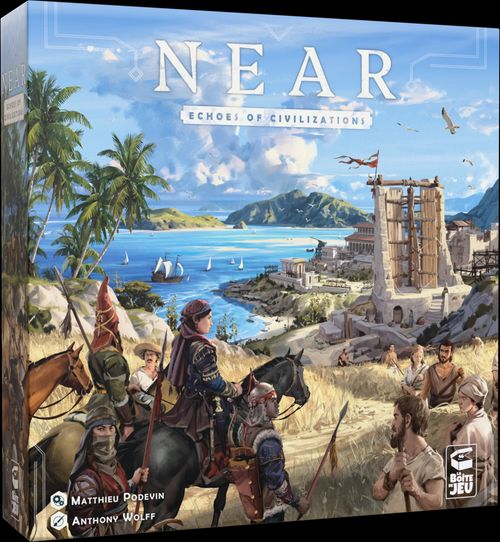
Near: Echoes of Civilizations
Near: Echoes of Civilizations Rulebook
Table of Contents
Table of Contents
Core Mechanic
NEAR is a hand management game: players use their cards in different ways and choose the right moment to maximize their effects.
On their turn, a player plays 2 cards from their hand. For each card, they may:
- play it to carry out its effect
- discard it to build the associated Building
- discard it to obtain the associated Development token
At the end of their turn, the player draws 2 cards to refill their hand.
Game Components
- 3 double-sided Age tiles
- 6 double-sided Domination tiles
- 1 first player token
- 130 Action cards – 26 for each of the 5 domains (10 Age I, 8 Age II and 8 Age III)
- 1 double-sided History board
- 10 divider cards
- 8 Event tiles
- 20 Expertise tiles, 5 per player
- 4 Player boards
- 10 Wonder cards
- 10 Civilization cards
- 1 double sided Central tile
- 8 double-sided Terrain tiles
- 1 Epoch pawn
- 4 Score pawns
- 4 100+/200+ tokens and 4 300+/400+ tokens
- 4 Capital pawns, 1 per player
- 20 Resource pawns, 5 per player
- 25 Victory tokens
- 128 History marker tokens, 32 per player
- 9 Ruin tokens
- Gold tokens: 1 Gold (×45), 3 Gold (×20), 5 Gold (×10)
- 13 Enemy tokens
- 100 Building pawns, 25 per player (5 Production site – 5 Shops – 5 Routes – 5 Armies – 5 Temples)
- 50 Development tokens, 10 of each type (Health, Food, Power, Culture, Craft)
Game Setup
History Board
-
Place the History board on one side of the table, with the beige laurel side face up (side A).
Tip: after a few games, try the reverse side of this board, with the black laurel side face up (side B). The end-game objectives on this side are different—and more challenging!
-
Each player places their Score pawn on the "0" space of the score track.
-
For each Millennium, place the corresponding Age tile on the timeline, choosing either side.
-
Place the Epoch pawn on the first space of the Age I tile. Each Age is divided into 4 spaces called "epochs" (250 years).
-
Take 3 Domination tiles at random. Place one to the right of each Age tile, choosing either side.
-
Draw 3 Event tiles at random. Place them face down, without looking at them, in the designated spaces.
-
Place the following components within reach of all players: Gold tokens, Development tokens, Expertise tiles, and Victory tokens.
Creating the World
Games of NEAR are played on a different World each time. It consists of a Central tile (identified by the compass-star symbol) surrounded by 2 Terrain tiles per player. The World therefore includes 5 tiles for 2 players, 7 for 3 players, and 9 for 4 players.
To build this World, choose which side of the Central tile to use: the sea side to play with a large central sea, or the land side to play with a large central landmass.
Then, place 4, 6, or 8 Terrain tiles around the Central tile, depending on whether there are 2, 3, or 4 players. Make sure there are as many tiles with 1 tidal wave as tiles with 2 tidal waves (excluding the Central tile).
Follow the placement rules described below:
- Central sea side: each tile must have a sea space connected to the central sea (directly or indirectly). With 4 players, place the last 2 tiles by connecting a sea space to a sea space on tiles already in play, if possible.
- Central land side: each placed tile must have a land space connected to the central land. With 4 players, place the last 2 tiles by connecting a land space to a land space on tiles already in play, if possible.
Note: As long as the placement rules are followed, you may choose the side and orientation of the tiles when placing them.
Then, randomly place 1 Ruin token on each mountain and 1 Enemy token on each City-state, with the bonus sides face up.
Cards
On the opposite side of the History board, form a row with the 5 domain decks—PRODUCTION, TRADE, TRANSPORT, MILITARY, and RELIGION—by stacking the cards (previously shuffled within each Age) face down in the following order, from the bottom to the top of each deck: Age III, Age II, and finally Age I.
Once the decks are formed, insert a divider card into each of them: one before the first Age II card, and another before the first Age III card. These cards prevent players from drawing cards from an Age that has not yet begun. When such a card appears on a deck, it is no longer possible to take cards from that deck during the current Age.
Place 1 card from each domain face up in the reveal area below each deck.
Player Board
Each player takes a Player board on which they place the following components:
- Buildings in the color of their choice (5 Production sites, 5 Shops, 5 Routes, 5 Armies, 5 Temples) placed in their respective spaces.
- 5 Resource pawns placed on the 0 space of each corresponding track: Stone, Clay, Wood, Livestock, Wheat.
- Each player then receives 1 Capital and 32 History markers in their color, which they place above their Player board.
Anatomy of the Game Components
Player Board
The Player board has 5 resource tracks:
- Stone, Clay, Wood: Resources (required to play cards).
- Livestock: Grants access to Expertise and provides VP at the end of the game.
- Wheat: Increases population and grants developments.
You gain resources by constructing a Building on a territory or by playing cards. When you gain a resource, move the corresponding Resource pawn forward the required number of spaces (see Terrain tiles).
Once you reach the last space of a track, you have reached the maximum level of that resource for your civilization. From then on, whenever you gain that resource again, your pawn does not move; instead, you trigger the special effect of that track.
Important: This special effect can be triggered only once per turn. Thus, even if you gain 4 resources while you are already at the maximum of a track, you trigger the effect only once (not 4 times).
Special feature of the Livestock track: Spaces 3/5/7/8 allow you to unlock an Expertise. As soon as you reach one of these spaces, place on your Player board the Expertise tile of your choice among those you have not yet unlocked. You now benefit from the bonus effect of that Expertise when constructing a Building from its column.
Important: If your Livestock pawn drops below an Expertise space, lose one Expertise of your choice and return its tile to the common supply. You no longer benefit from its bonus effect. You may unlock it again if you gain Livestock.
Special feature of the Wheat track: Spaces 1/3/5/7 represent the size of your population. Some cards have enhanced effects depending on your population size. Spaces 4 and 6 allow you to gain 1 Development token of your choice when you reach them.
Important: If your Wheat pawn drops below a Development space, lose 1 Development token of your choice.
The board also has 5 columns, one for each domain of the game, each with Building spaces and their associated effects, and a Domain Expertise track along the bottom. The domains and their associated Buildings are: Production (Production sites), Trade (Shops), Transport (Routes), Military (Armies), and Religion (Temples). A Cemetery space holds destroyed Buildings.
The player aid area of the board explains:
- Change: 2 Gold may be used as 1 missing resource to play a card.
- Ore: Gain 3 Gold.
- Achievements: 1 card played for its effect = 1 History marker on the timeline.
- Production: Each Building constructed grants 1 resource from its territory.
Terrain Tiles
Each of these tiles has a different front and back and consists of:
- 1 or 2 sea spaces marked by a white border, each including a tidal wave area.
- 8 types of territory on which Buildings can be constructed to gain resources and other effects:
- Clay terrain: gain 1 Clay
- Quarry: gain 1 Stone
- Field: gain 1 Wheat
- Mountain: gain the Ruin token present. If there is none, gain nothing.
- City-state (free): place 1 History marker.
- Forest: gain 1 Wood
- Plain: gain 1 Livestock
- Mine: gain 1 Ore (3 Gold)
Important: If an Enemy token is present on a City-state, no Building may be constructed on that territory (except an Army).
Important: Buildings can never be constructed on sea spaces.
Card Anatomy
Verso (card back): shows the card color (indicates its domain), the Building symbol (linked to the card's color, it determines the type of Building that can be constructed with this card), the Development symbol (linked to the card's color, it determines the type of Development token that can be obtained with this card), and the Card Age (used to organize cards during setup).
Recto (card front): shows the effect used to develop your civilization, along with the cost to play it:
- Requirement: type and quantity of resources you must have to play the card.
- Cost: amount of Gold to spend to play the card.
- Name of the card.
- Reminder of the Building that can be constructed by discarding the card.
- Color: reminder of the card's domain.
- Effect (icons): the benefit this card provides to your civilization.
- Effect (text): explanation of the icons.
Start of the Game
At the dawn of History, nothing has yet been written. From the first cities to emerging empires, humanity is shaped through its discoveries, beliefs, and conquests. Inspired by some of the great civilizations that have marked our world, you will forge your own—unique and fictional.
Birth of Civilizations
Randomly determine the first player and give them the First player token.
Each player is randomly dealt 1 Civilization card, 1 Wonder card, and 5 Gold. They then place their Capital and their starting Building, beginning with the last player and ending with the first player. These steps are detailed below.
1. Each player receives 1 Civilization card at random. This card determines three things for the player:
- The type of territory to control at the end of the game to gain VP (Victory Points).
- The starting Building they will construct at the same time as their Capital.
- The color of 2 of the 4 cards that will make up their starting hand, to be taken immediately from the corresponding decks (not from the reveal area).
After taking their 2 cards and their starting Building, the player places their Civilization card and the Building in the civilization area above their Player board.
2. Each player receives 1 Wonder card at random. This card determines three things for the player:
- The type of action to perform during the game to earn VP.
- The starting Expertise held by their civilization. They add the corresponding Expertise tile to their board to unlock it.
- The color of 2 of the 4 cards that will make up their starting hand, to be taken immediately from the corresponding decks (not from the reveal area).
After taking their 2 cards and unlocking their Expertise, the player places their Wonder card in the achievements area, to the right of their Player board. This card now counts as the first card of that color played in their civilization.
The remaining Civilization and Wonder cards will not be used in this game.
3. Starting gold. Each player receives 5 Gold.
Initial Placement
Each player places their Capital and starting Building, beginning with the last player and ending with the first player.
4. The capital. Construct your Capital on a territory (not a City-state) and gain the resource of that territory. The Capital must follow these two placement rules:
- It must be located in an area of at least 7 connected land spaces.
- It must be at least 4 spaces away from any opposing Capital (there must be at least 3 spaces between two Capitals).
Example: The orange player places their Capital on a Fields space and moves their Wheat pawn forward 1 space on their Wheat track.
Tip: To optimize the placement of your Capital, consider your Civilization and Wonder cards, as well as your starting hand. An open and diverse location, away from opponents, offers safety and efficient production, but limits trade opportunities and profitable confrontations.
5. Starting building. Construct your starting Building on a territory on the board adjacent to your Capital and gain the resource of that territory. Then apply the effect of the constructed Building, as well as any bonus effect if it has been unlocked by your starting Expertise (see Constructing a Building).
Example: The orange player places their starting Building, a Shop, on the Forest space adjacent to their Capital. They move their Wood pawn forward 1 space on their Wood track and gain 3 Gold from their Shop's effect.
Game Sequence
NEAR is played over 3 Ages of 4 turns each, for a total of 12 turns. Throughout the game, civilizations leave their mark by placing History markers on the timeline. During each Age, a negative event occurs. Each Age ends with two scoring phases: the Golden Age, followed by Domination. At the end of the game, additional scoring conditions are applied.
Turn Structure
In NEAR, cards are the central element of the game; they determine the 3 different actions available to you. Starting with the first player, each player plays 2 cards on their turn, then draws 2 cards at the end of their turn.
1. Play 2 Cards
Play or discard a card from your hand and apply all actions associated with that card. Then repeat the process by playing or discarding a second card from your hand.
a) Discard a card on its reverse side
Discard the card face down in your civilization area and apply only one of the following options:
- Gain 1 Development token.
- OR Construct 1 Building.
Gain 1 Development token: Gain 1 Development token of the type shown on the reverse side of the card you just discarded, and place it in your civilization area. Developments will grant you VP at the end of the game, during the Heritage of Civilizations. They may also be useful for certain cards.
Tip: This action is rarely used, but it can help you obtain a Development token you need. These tokens are not limited in number; you may use a substitute if necessary.
Construct 1 building: Take 1 Building piece from your Player board (the first available from the top of the column) of the type indicated on the reverse side of the card you just discarded. Then apply the following actions in order:
- Place the Building on a territory adjacent to one of your existing Buildings (including your Capital). Reminder: It is not allowed to construct on a sea space or on a City-state occupied by an Enemy token (except with an Army in the latter case).
- Immediately gain the resource (or token/effect) provided by that territory.
- Apply the effect on your Player board corresponding to the row of the constructed Building. The strength of the effect increases progressively. For example, your 1st Production site allows you to gain 1 additional resource, and your 5th allows you to gain 4 additional resources.
- If you have the Expertise for that type of Building, apply its bonus effect (see Expertises).
Example: The player has this Expertise, allowing them to gain the resource of a space adjacent to where they just constructed their Building. They choose a Forest space and move their Wood pawn forward 1 space on their Wood track.
b) Play a card for its effect
Requirement: To play a card in your achievements area, check that your civilization has the required level of resources shown on the card. These may include Stone, Clay, or Wood.
Important: These resources are not spent. They are a requirement your civilization must have in order to play the card. This requirement increases over the Ages, along with the power of the cards.
Exchange: If you do not have the required resource level, you may pay 2 Gold per missing resource. This is the only case where this exchange may be used.
Important: A resource level paid using this exchange is temporary. Do not move the corresponding Resource pawn.
Example: The "Exporter" card costs 4 Gold and requires 4 Wood. Matthieu only has 3 Wood. He therefore pays 2 Gold for the missing Wood level and 4 Gold for the cost of the card, for a total of 6 Gold. He can now play the card. Since this Wood gain is temporary, his civilization remains at a level of 3 Wood.
Cost: If you meet the requirement, pay the card's Gold cost and place it in your achievements area. Arrange the cards in this area in columns of the same color, stacking them so that only their effects remain visible.
Then, perform the following 3 steps in the order of your choice:
- Apply the card's effect.
- Place 1 History marker on the timeline and gain the associated bonus.
- Check Domain objectives.
Tip: In some cases, the effectiveness of a card may depend on the order in which you perform these 3 steps.
Apply the card's effect: Follow the card's text and apply its effects in order.
Some cards have a permanent effect, indicated by an hourglass symbol on the left side of the icon block. This effect is not triggered when the card is played, but will be activated each time its conditions are met.
Example: Matthieu has enough Clay to play the "Tomb" card. He pays 2 Gold and places the card in his Religion column, leaving only its effect visible. As the card has a permanent effect, Matthieu gains nothing when playing it, but will gain 1 VP throughout the game each time one of his Buildings is destroyed.
Important: Apart from these cards with permanent effects, all other cards have an immediate effect that is triggered only once, when the card is played.
Place 1 History marker on the timeline and gain the associated bonus: Place 1 of your History markers on the current epoch (indicated by the Epoch pawn on the History board) and immediately gain the bonus shown at the bottom of that epoch.
Check Domain objectives: The History board includes 5 objectives that grant VP at the end of the game, one for each of the game's 5 domains: PRODUCTION – TRADE – TRANSPORT – MILITARY – RELIGION.
For your civilization to score VP in a domain at the end of the game, you must place 1 History marker on that domain. To do so, you must have played at least 3 cards of the corresponding color in your achievements area, as indicated in the top right corner of each domain.
Important: Your Wonder card counts as one of the 3 cards required to unlock Domain scoring.
Thus, when you play your 3rd card in a domain, place 1 History marker on the corresponding Domain objective. You now know that you will score the VP from that domain at the end of the game. Each player may have only one History marker per domain.
Additionally, each Domain objective grants 1 Development token to the first player to place a marker on it. It is therefore advantageous to be the first player to have 3 cards of the same color in your achievements area!
Example: This player has just played their 3rd Transport (blue) card and therefore places one of their markers on the corresponding Domain objective. They gain 1 Health Development token, as they are the first to place a marker on this domain.
The details of the VP scored for each domain are explained under Heritage of Civilization scoring.
After playing their 2 cards, the player proceeds to the second step of their turn: drawing 2 cards.
2. Draw 2 Cards
Draw 2 new cards, choosing from either the face-up cards in the reveal area or the face-down cards from the domain decks.
If a divider card is visible at the top of a deck, it is no longer possible to draw from that deck during the current Age. Cards in the reveal area remain available at all times, regardless of their Age.
Example: This deck has a divider card hiding the Age III cards. As the game is still in Age II, this deck remains unavailable until Age III. This Age I card, however, is available.
Important: There is no limit to the number of cards a player may have in hand.
Then, if you played cards for their reverse side (to construct a Building or to gain a Development), move them from your civilization area to the reveal area shared by all players. Place these cards face up below the corresponding domain deck. They are now available for all players to draw. Your turn is over.
Example of a Full Turn
Matthieu discards 1 Religion card to his civilization area, placing it face down. He constructs the first available Temple from his Player board by placing it on a Forest space, and therefore gains 1 Wood.
Then, Matthieu applies the effect of the constructed Building. As it is a Temple (see Buildings and Expertises), he may either destroy one of his Buildings or place 1 Building from his Cemetery on a territory adjacent to his civilization. He therefore places 1 Building from his Cemetery on a City-state. This territory allows him to place 1 History marker on the current epoch, which grants him 2 VP.
He then plays the Trade card "Potter" in his achievements area, making sure he has at least 5 Clay and paying 4 Gold. He applies its effect and gains 8 Gold from the 2 Temples in his civilization.
As he has played a card in his achievements area, he places 1 History marker on the current epoch and gains the associated bonus (here, 2 VP).
Then, he checks whether the card he just played in his achievements area is his 3rd Trade card. It is, so he places 1 History marker on the Trade Domain objective on the History board. As he is the first player to place a marker here, he gains 1 Craft Development token.
As his turn comes to an end, he now draws 2 new cards. He chooses the Age III Production card "Apiculture" that was visible in the reveal area. Then, he draws 1 card from the Military domain deck. He could also have taken 2 face-up cards or drawn 2 cards from the domain decks.
Finally, he makes the Religion card (which he discarded in his civilization area at the beginning of the turn) available by placing it face up in the reveal area, below the Religion deck. His turn is now complete.
Structure of an Age
A game of NEAR is played over 12 turns. At the start of the game, the Epoch pawn is placed on the first space of Age I. This pawn represents the current turn. Each time all players have taken their turn, an epoch ends, the Epoch pawn moves forward one space, and a new turn begins.
Events
During each Age, an event disrupts the development of civilizations. These events are placed at the beginning of the game below the History board and may sometimes be consulted through game effects (Religion cards, bonuses from certain Ages).
When the Epoch pawn moves forward and passes the event symbol, players must, before starting a new turn, reveal the Event tile and apply its effect, the intensity of which depends on the current Age.
Example: The "Crisis" event is revealed during Age II; each player must lose 5 Gold. A player with only 3 Gold loses only 3 Gold, without any additional penalties. The other two players have 12 and 9 Gold respectively and therefore each lose 5 Gold. If this event had occurred during Age III, each player would have lost 7 Gold.
Important: It is useful to look ahead at an event before it is revealed in order to anticipate it and minimize losses. Some Religion cards allow you to completely ignore an event (3 cards in Age I and 3 cards in Age II).
Once the event has been resolved, players may begin a new turn.
End-of-Age Scoring
At the end of each Age, an intermediate scoring phase takes place. Move the Epoch pawn onto the Domination tile and carry out the following 2 steps, in order:
-
Golden age: the player with the most History markers on the Age that is ending gains 7 VP, the second gains 3 VP, and the third gains 1 VP. In case of a tie, players share the total VP of the tied positions, rounded down (for example, 5 VP each—(7 + 3) ÷ 2—if 2 players are tied for first place, and 1 VP for the possible third player). Players must have placed at least 1 History marker to take part in this scoring.
-
Domination: the player who best fulfills the domination condition gains 15 VP, the second gains 9 VP, and the third gains 3 VP. In case of a tie, players share the VP of the tied positions, rounded down. Players must have at least 1 element required by the domination condition to take part in this scoring. The different domination objectives are detailed under Domain Objectives (Expert).
Example: At the end of Age I, Matthieu has 5 History markers on the Age I spaces. Jeanne has 4, Thibaut 2, and Violaine 2. For this Golden age, Matthieu gains 7 VP, Jeanne 3 VP, and Thibaut and Violaine gain nothing ((1 VP ÷ 2), rounded down = 0).
Then, each player counts the number of resources they have in their civilization to determine the Domination VP (here, Production). Jeanne gains 15 VP as she has the most, followed by Violaine (9 VP) and Thibaut (3 VP). Matthieu is in 4th place and gains no VP.
Important: Each Age always awards "Golden age" VP to the players who have placed the most History markers. However, the criteria for awarding "Domination" VP differ for each Age. A game includes 3 Domination scorings, randomly selected during setup from the 12 available. Be sure to anticipate these scorings from the start of the game.
Start of a New Age
Once the End-of-Age scoring is complete, if you were in Age III, proceed to final scoring (see End of the Game).
Otherwise, prepare for the new Age by carrying out the following steps:
- Remove the cards in the reveal area from the game, then remove from the domain decks the cards of the Age that has just ended, along with any visible divider cards.
- Reveal the first card of the new Age for each domain by placing it face up in the reveal area.
- Move the Epoch pawn to the first space of the new Age.
- The player whose Scoring pawn is in last place on the score track becomes the first player and receives the First Player token. In case of a tie, the pawn on top of the stack takes precedence.
End of the Game
Heritage of Civilizations
After completing the End-of-Age scoring for Age III, move the Epoch pawn to the "Heritage of civilizations" space and calculate end-of-game VP as follows:
- 15 VP per set of 5 different Developments in your civilization.
- 2 VP for each Livestock your civilization possesses.
- VP from your Civilization card, the total of which depends on the placement of certain Buildings at the end of the game.
- 2 VP per set of 5 Gold.
Example: Matthieu has 12 Development tokens. He scores 15 VP for his first set of 5 different Developments. He cannot form a second set because he has 3 Power, 2 Craft, 1 Culture, and 1 Health Development, but no Food Development. He therefore does not gain the 15 VP for a second set. His Livestock track is at level 4, so he gains 8 VP. He then looks at his Civilization card (the Romans), which requires him to have Buildings on as many different Terrain tiles as possible. Matthieu has at least 1 Building on 4 different tiles, so he gains 20 VP (5 VP × 4). He then gains 2 VP for the 8 Gold he has left. His total for Heritage of Civilizations is 45 VP. He moves his pawn forward that many spaces on the score track.
Domain Objectives
Standard (side A, beige laurels visible)
Move the Epoch pawn onto each of the 5 Domain objectives. Players whose History marker is present on a Domain objective calculate the associated VP. This step is repeated for each domain.
- PRODUCTION: gain 1 VP per resource level in your civilization.
- TRADE: gain 2 VP per card in your achievements area.
- TRANSPORT: gain 4 VP per Building or group of coastal Buildings (adjacent to a sea space) in your civilization (the example shown on the Domain objective would be worth 8 VP).
- MILITARY: gain 3 VP per Victory and Enemy token in your civilization (the example shown on the Domain objective would be worth 6 VP).
- RELIGION: gain 2 VP per Building in your civilization (those placed on Terrain tiles).
Example: Matthieu has a History marker on the Production, Transport, and Military domains. Production earns him 21 VP for the total of 21 resources on his civilization's resource tracks. For Transport, he has 6 Buildings or groups of coastal Buildings, gaining 24 VP (4 VP × 6). In Military, he has 6 Victory or Enemy tokens and therefore gains 18 VP (3 VP × 6). His total for Domain objectives is 63 VP. He moves his Scoring pawn forward that many spaces on the score track. Matthieu scores no VP in the Trade and Religion domains, as he has not placed any History markers there.
Expert (side B, black laurels visible)
If you are playing with the expert Domain objectives, here is how they work:
- PRODUCTION: gain 4/9/16/25/36 VP if your civilization reaches the maximum in 1/2/3/4/5 resource types.
- TRADE: gain 4/9/16/25/36 VP if you have at least 2 cards from 1/2/3/4/5 different domains in your achievements area.
- TRANSPORT: gain 4/9/16/25/36 VP if you have isolated 1/2/3/4/5 different types of Buildings from the rest of your civilization. These Buildings do not need to be isolated from opposing civilizations.
- MILITARY: gain 4/9/16/25/36 VP if you have a total of 2/4/6/9/12 Victory and Enemy tokens.
- RELIGION: gain 4/9/16/25/36 VP if you have 1/2/3/4/5 empty columns or rows of Buildings on your Player board (choose whether to count columns or rows; the two cannot be combined).
The player with the highest score wins the game; their civilization has left a greater mark on Antiquity than any other. In case of a tie, the player who has placed the most History markers wins. If the tie still remains, the tied players share the victory.
Additional Rules and Clarifications
Buildings and Expertise
Important: The Capital, constructed at the start of the game, is considered a Building, but cannot be attacked, destroyed, or moved (except by the "New Era" card).
Here is the effect of each type of Building, followed by its bonus effect if you have the corresponding Expertise:
Production site: When you construct a Production site, gain +X resource(s) from the territory it occupies.
Example: Matthieu constructs his 4th Production site. He places it on a Fields space and gains 1 Wheat + 3 additional Wheat.
Production Expertise: also gain 1 resource from a territory adjacent to the constructed Production site (even if that territory is occupied). Example: In addition to the 4 Wheat, Matthieu gains 1 Clay from an adjacent territory.
Shop: When you construct a Shop, gain X Gold.
Example: Matthieu constructs his 1st Shop. He places it on a Quarry space and gains 1 Stone + 3 Gold.
Trade Expertise: also gain 2 Gold for each opposing Building or Enemy token adjacent to the constructed Shop. Example: In addition to gaining 1 Stone + 3 Gold, Matthieu gains 6 Gold as his Shop is adjacent to 2 opposing Buildings and 1 Enemy token.
Route: When you construct a Route, move that Route or another one of your Buildings X space(s). The Capital cannot be moved as a result of constructing a Route.
Important: If you move another Building, it must pass through the space of the newly constructed Route (even if it was isolated from your civilization). Buildings may move through occupied spaces but cannot end their movement there (even if the moving Building is an Army).
Movement across sea spaces is not allowed. You do not gain the resource of the destination territory when moving (only Ruin tokens can be gained when moving).
Example: Matthieu constructs his 3rd Route. He places it on a Forest space and gains 1 Wood. He then moves his Production site 5 spaces (passing through the Route's space) from its position 2 spaces away from the constructed Route. Alternatively, he could have moved his Route 5 spaces to a destination of his choice in order to expand his civilization more quickly.
Transport Expertise: your Buildings may now cross sea spaces. Each large sea area (outlined in white) costs 1 movement.
Example: Matthieu moves his Production site across the sea to reach an isolated area (passing through the Route's space). Crossing these 2 large sea areas costs him 2 movement.
Army: When you construct an Army, you may attack one opposing Building or one Enemy token up to X spaces away.
Important: The Army is the only Building that can be constructed on a space occupied by an opponent or an Enemy token (only if that territory is adjacent to one of your existing Buildings, including your Capital). In that case, the attack takes place on that same space.
Reminder: Capitals can never be attacked or destroyed!
Resolving an attack against an opposing Building:
- The targeted player places the destroyed Building in the Cemetery on their Player board.
- The attacker gains 1 Victory token. These tokens are not limited in number; you may use a substitute if necessary.
- The attacker activates, on their Player board, the effect of the first row of the type of Building that was destroyed. However, if the destroyed Building was an Army, the attacker does not activate any effect on their Player board; instead, they place 1 History marker on the current epoch (symbolizing a major battle that has marked History) and gain the associated bonus.
Example: Matthieu constructs his 3rd Army. He places it on a Quarry space and gains 1 Stone. He then attacks an opposing Building (a Shop) located on a Forest space 3 spaces away from his Army. The targeted player places the destroyed Building in their Cemetery. Matthieu gains 1 Victory token and activates the first-row effect of that Shop, allowing him to gain 3 Gold. If the Building had been a Production site, Matthieu would have gained 1 Wood (since the attacked territory is a Forest) instead of 3 Gold.
Military Expertise: after the attack and before gaining the effect of the destroyed Building, you may move your Army onto the attacked territory to take control of it (without gaining the resource of that territory, as it is only a movement).
Important: If the destroyed Building was a Route (whose effect grants you 3 movement) and you choose to move this Army, the 3 movement are applied starting from the newly conquered space.
Example: After attacking the opposing Shop on a Forest territory, Matthieu moves his Army onto that territory. He then gains 1 Victory token and 3 Gold. If the destroyed Building had been a Route, Matthieu could have moved his Army 3 spaces from the conquered territory, or moved another one of his Buildings instead.
Resolving an attack against an Enemy token:
- The attacker places the Enemy token in their civilization area and immediately gains the bonus shown on the token.
- The City-state is now free, and its territory becomes available to all players for construction.
Temple: When you construct a Temple, you may choose between two distinct actions:
- Destroy 1 Building on your Player board (the first available from the top of its column) and place it in your Cemetery. This speeds up access to more powerful Buildings.
- Place 1 Building from your Cemetery on a territory adjacent to your civilization and gain the resource from that territory. This is the "Rebuild" effect, also found on certain cards.
Important: You do not apply the effect of the reconstructed Building.
Your first 2 Temples constructed grant 1 action, chosen from the two available. Subsequent Temples grant 2 or 3 actions, which may be distributed as you wish between the two available options. Each action is fully resolved before moving on to the next one. It is possible to choose the same action multiple times.
Example: Matthieu constructs his 3rd Temple. He places it on a Fields space and gains 1 Wheat. He then destroys the first available Route on his Player board and places it in his Cemetery. As his second action, he rebuilds 1 Production site from his Cemetery (previously destroyed by an opponent) on a Plain territory adjacent to his civilization and gains 1 Livestock.
Religion Expertise: place 1 History marker on the current epoch and gain the associated bonus. Example: After constructing his Temple, Matthieu places 1 History marker and gains the current epoch's bonus: 2 Gold.
Tip: When you (re)construct a Building, do not forget to apply the permanent effects of your Wonder and any permanent-effect cards in your achievements area. Permanent effects are indicated by the hourglass symbol on the cards.
Ruin Tokens and Enemy Tokens
Ruin tokens: This token occupies Mountain spaces at the start of the game. There are two ways to gain a Ruin token:
- Construct a Building on its territory to gain the token.
- Move a Building onto its territory to gain the token. This ends that movement (however, it is possible to continue the movement if you choose not to take the Ruin token).
In both cases, place the Ruin token in your civilization area and immediately gain its bonus.
Enemy tokens: These tokens occupy City-state spaces at the start of the game and prevent any Building construction on those spaces (except Armies). There are two ways to gain an Enemy token:
- Attack its space using a Military action.
- Gain the token from any City-state through a card effect (e.g., the "Fortification" card).
In both cases, place the Enemy token in your civilization area and immediately gain its bonus. The City-state space it occupied then becomes available for Building construction.
Event Tiles
When an event is revealed, players apply only the effect corresponding to the current Age.
- Civil War: During Age I, II, or III, each player discards 1, 2, or 3 card(s) from their achievements area. These cards are removed from the game. (Adjust Domain objectives if necessary.)
- Extreme Cold: During Age I, II, or III, each player loses 1, 2, or 3 resource levels of their choice.
- Flood: During Age I, II, or III, each player loses 1, 2, or 3 Buildings adjacent to a tidal wave space.
- Crisis: During Age I, II, or III, each player loses 3, 5, or 7 Gold.
- Earthquake: During Age I, II, or III, each player loses 1, 2, or 3 Buildings located on a Mountain or within 3 spaces of a Mountain.
- Invasion: During Age I, II, or III, each player loses 1, 2, or 3 History markers located on the two epoch spaces preceding this event.
- Epidemic: During Age I, II, or III, each player loses 1, 2, or 3 Buildings located within 3 spaces of their Capital.
- Revolt: During Age I, II, or III, each player loses 1, 2, or 3 Buildings located on, or adjacent to, a City-state. Then place 1 Enemy token on each unoccupied City-state, up to the number of tokens available in the supply. If there are more unoccupied City-states than available Enemy tokens, prioritize the City-states closest to the Central tile.
Domination Tiles
- War: have more Victory and Enemy tokens than your opponents.
- Population: have more population than your opponents.
- Trade: have more Gold than your opponents.
- Production: have more resources than your opponents.
- Expansion: have more coastal Buildings than your opponents.
- Navigation: have more coastal Routes than your opponents.
- Control: have more Buildings on City-states than your opponents.
- Science: have more Expertise tiles than your opponents.
- Construction: have more constructed Buildings than your opponents.
- Discovery: have more Ruin tokens than your opponents.
- Development: have more Development tokens than your opponents.
- Achievement: have more cards in your achievements area than your opponents.
FAQ
When moving a Building, do you gain the resource of the destination territory? No. You gain a territory's resource only when you "place" a Building on it, never when you "move" it.
During a permanent epoch bonus, when exchanging a Building with one from your Player board, do you gain the resource of the territory again? No. You gain a territory's resource only when you "place" a Building on it, never when you perform a Building "exchange".
When moving across the sea, do I need to count each hex space making up a sea? No. Each sea is outlined in white and represents a single large space. It only takes one movement to cross the sea on a single tile. However, if multiple sea tiles are connected, or if a tile contains two distinct seas, count 1 sea movement per large sea space.
Is a Building still on my Player board considered to be "in my civilization"? No. For a Building to be considered part of your civilization, it must be placed on a Terrain tile. Buildings that have not yet been constructed, or that are in your Cemetery, are not part of your civilization.
If a player takes the last card of a domain in the reveal area, should a new card be revealed for that domain? No, the space remains empty.
Is a card I just discarded for its reverse side (to construct a Building or to gain a Development token) considered a "played" card? No. "Played" cards are those in your achievements area. These are played for their front side.
When an effect allows me to attack up to 3 spaces away, must those spaces form a straight line? No. The attack can target any space within a radius of 3 spaces. However, it cannot pass through a sea space; it must go through land spaces.
Some cards allow you to place a History marker on the timeline. Do you gain the current epoch's bonus when doing so? Yes.
Some cards refer to an "isolated" space. What does that mean? An isolated space is a space not connected to your civilization or to another player's civilization.
Clarifications on Certain Cards
- Granary: if you placed a History marker upon reaching the maximum level of a resource but later lose levels of that resource, nothing happens. However, if you later reach the maximum level of that resource again, you place a new History marker.
- Courier / New Era / Emissary: the actions of these cards have no movement restrictions; you may move across as many spaces as needed and may cross seas.
- Messenger: The path must only pass through land spaces. The example on the card would be worth 5 VP.
- Surgeon: apply the Military effect on your Player board corresponding to the last Army you constructed.
- River Dam: each pair of cards of the same color grants 1 resource of your choice. A player with 4 yellow cards, 2 red cards, and 3 purple cards would gain 4 resources of their choice.
- Great Lighthouse: if you scored 5 VP by constructing a Shop on a tile, but that Shop is later destroyed, nothing happens. However, if you later construct a new Shop on that tile, you will score 5 VP again.
- Accountant: if the same action allows you to gain Gold multiple times, count the total amount of Gold gained from that action and its consequences. This card grants a maximum of 2 VP per turn (1 VP per action that gains 3 Gold or more).
- Canals: be sure to count pairs of identical resources. For example, with 3 Wood and 3 Stone, you gain 2 VP. You have 6 resources but only 2 pairs of identical resources. With 2 Wood, 2 Stone, and 2 Clay, you gain 3 VP. With 5 Wood, 2 Stone, and 4 Wheat, you gain 5 VP.