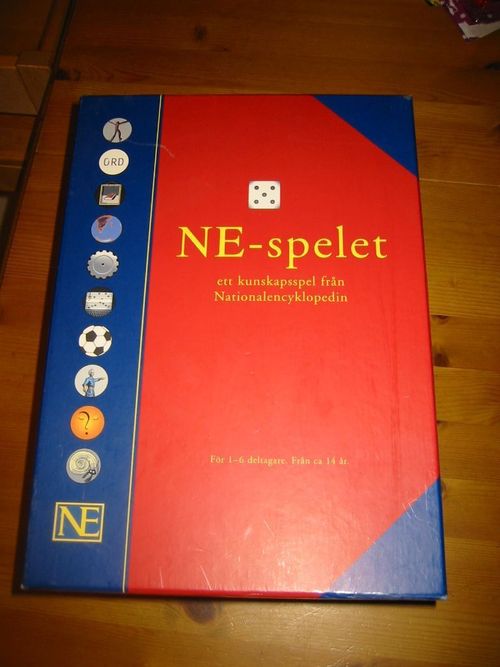
NE-spelet
NE-spelet Rulebook
Table of Contents
Table of Contents
Game Scenario
The game scenario can be likened to a library with different subject rooms. Each player has a half-filled bookshelf that is to be filled with the ten missing volumes of a complete encyclopedia containing all of the world's knowledge. Each of the volumes represents a subject category. You win the volumes by answering the questions correctly in the various subject rooms of the library. Along the way you must also clear other questions, and you have clue cards to help you, among other things.
Components
- one game board
- 400 question cards with 4,000 questions
- six bookshelves
- 40 clue cards
- 60 NE volumes in miniature
- six "take a volume" cards
- six game pieces
- six "choose a topic" cards
- one die
Setup
Each participant receives a bookshelf with ten volumes, one game piece and four clue cards. Shuffle the question cards well and place them in their boxes beside the game board. Shuffle the other cards (clue, take a volume, choose a topic) and place them in a face-down pile on the game board. Set up one game piece for each player in the NE square in the middle of the game board.
Starting the Game
Decide who starts by rolling the die. The player who rolls highest begins. Start from the NE square in the middle of the game board. Roll once and move your game piece in any direction as many steps as the die shows. You may not move forward and back within the same turn. Players may stand on the same square as a fellow player. You may move your game piece by any route across the game board, and you may pass the start square and the subject rooms.
Question Squares
When you land on a question square (which looks like the symbols above), you must answer a question from the question cards. The player seated to your left takes the question card at the front of the box and reads the question from the subject category that the symbol on the square shows.
Topics
The symbols on the game board and the question cards correspond to the following subjects:
Body and Soul – This group contains questions on medicine, psychology, religion and philosophy.
Language – Here are questions, sometimes tricky, about our words and their meanings, perhaps tempting to the crossword enthusiast.
Form and Imagination – The drawing of a book inside a picture frame signals that this is about literature and art. Architecture, photography and fashion are also placed here.
The Surrounding World – By the surrounding world we mean subjects such as geography, political science, economics and law, everything that concerns us as citizens of society and of the world.
Screws and Stars – The cogwheel in the picture makes one think of technology, but there are also questions from the natural sciences here.
Heard and Seen – The stylised drawing of an audience watching musical notes on a film screen is meant to show that in this group you must remember what has happened in the performing arts, music and film.
Arena and Kitchen – Behind this heading are leisure activities, from sports to food and drink.
Then and Now – Here it is evidently history you must know, but there are also questions drawn from archaeology and ethnology.
Profiles – In this group you cannot be sure which subject it concerns, but it is always a question about a person. Here it sometimes means knowing what famous people have said, written and sung.
Nature – Plants and animals of all kinds.
Clues and Answering
If you cannot answer the question, you may ask to hear the clue to the question. To hear the clue you must hand over a clue card.
If you answer correctly, you knock again and move your game piece in any direction. You may keep rolling as long as you answer correctly, with or without a clue. The answers are numbered and are printed at the bottom of the question card. If you answer incorrectly, it is the next player's turn.
Card Squares
When you land on a card square you have two options. Either you take the top card from the pile of cards on the game board and stop on the square, letting the next player roll, or you roll an extra time and continue onward. If you choose to take a card, you keep it and use it when you need to. Place the card at the bottom of the card pile once you have used it. There are three kinds of card:
-
Request a clue If you cannot answer a question you may request a clue. You then pay with a clue card. You receive four such cards when the game begins and may receive more when you land on card squares.
-
Take a volume from a fellow player With this card you may "steal" any volume from a fellow player when you land on the same square as them or when you pass a fellow player's game piece. It can be a way to stop lucky players who are on their way to winning.
-
Choose a topic when you have won a volume This card gives you the opportunity to exchange a won volume for one in another subject category. It can be useful when you find it hard to clear the questions in a certain subject, or when you are in the final stretch and far from a subject room where you are missing a volume. You may use the card just after you have won a volume in a subject room.
Subject Rooms
When you enter a subject room (the rooms the arrows point to) you must, as usual, answer a question within the relevant subject from the question cards. If you answer correctly, you take an NE volume in miniature from the box and place it at the correct subject symbol on your bookshelf. Then roll again and leave the room.
If you answer incorrectly while in the room, you must stay where you are and get a new question when it is your turn again. If you answer incorrectly again, you must, when it is your turn, leave the room and come back in before you may try again. If you prefer, you may instead head for another subject room when it is your turn.
To enter a subject room you do not need to roll the exact number of pips. It is enough that you can move one step into the subject room.
Winning
When you have collected ten different NE volumes, one from each subject room – that is, twenty in total with those you already have on your bookshelf – you must return to the NE square. The first player to reach it with a complete encyclopedia on their bookshelf wins. You must reach the square on an even number of rolls.
Number of Players
The game can be played by 1–6 players, from about age 14. You can play alone and test yourself. You can also play in teams, up to six teams.
Own Rules
Of course you may adapt the rules yourself so that they suit the players and the situation.
If you want to speed up the game you may, for example, choose one of the following additional rules:
- Limit the answering time, and let each participant think for at most 30 seconds.
- Request a clue without paying with a card.
- Stay in the subject room as long as you need and wait for your turn to try to answer the question again.
- Limit the number of subject volumes to six. Begin the game by letting the player seated to your left place four volumes in any positions on your bookshelf. Let all players do the same before you start.
Kunskapsjakten on the Internet
Printed promotional section of the source sheet, not part of the game rules. On the internet service, NE.se, you can meet even more tricky challenges. Here is the digital version of Kunskapsjakten, where the aim is to answer as many questions as possible in a row under time pressure! If you answer incorrectly you start over from the beginning. If you clear many questions you can look forward to immeasurable honour via a place on the Top List.