Navigare
Navigare Rulebook
Table of Contents
Table of Contents
Buying and Selling Ships. Length of the Game
-
The number of shipowners ("redere") can be from 2 to 6. In addition, a bank manager ("banksjef") must be chosen, who ideally should not be a shipowner (Norwegian banking legislation forbids bank managers to be engaged in business). The number of shipowners can be increased by letting two of them join together on one ship.
-
At the start, each shipowner receives the following banknotes from Den norske Creditbank:
- 2 notes of kr. 1 000 000, and 3 notes of kr. 50 000
- 3 notes of kr. 500 000, and 3 notes of kr. 10 000
- 3 notes of kr. 100 000, and 3 notes of kr. 5 000
-
At the beginning of the game each shipowner must buy 1 ship from the Creditbank. The one who rolls the highest number on the die chooses a ship first. Then the shipowner to the left chooses a ship, and so on. When everyone has bought one ship each, the game is opened by the one who chose a ship first.
-
Each ship has 5 share certificates ("aksjebrev"). One of these is the main share certificate ("hovedaksjebrevet"), which represents 6/10 of the share capital and gives its holder the right of disposition over the ship. The other 4 share certificates are loose ("løse") and only entitle the holder to a certain share of the freight income. At the start, a shipowner may only buy the main share certificate of his own ship. Loose share certificates, in his own ship or in others' ships, may be bought from the Creditbank when the ship later stops on or passes START. If fewer than 6 shipowners take part, so that not all ships are sold at the beginning of the game, the main share certificate of one of the unsold ships may be bought by the shipowners when their ship passes START. A new ship is set in motion from START immediately when it is bought — the shipowner thereby gets an extra throw of the die, which applies only to the new ship. The right to buy share certificates or deeds ("skjøter") lapses as soon as the next shipowner has moved his ship.
-
A shipowner may sell share certificates and deeds to the highest bidder when he is short of cash. The Creditbank buys at half price, if none of the shipowners bids higher. If the Creditbank is short of cash, it must sell its share certificates or deeds to the highest bidder.
Movement Rules
-
The shipowners get one throw of the die for each ship they own. A shipowner who has two or more ships may wait to choose which ship he will move first until he has thrown the die. When an extra throw ("ekstrakast") is made, the same ship must be moved.
-
Spaces with a ship's valve ("skipsventil") represent open sea. If a ship is already standing on such a space, it is regarded as a collision. Both ships are moved back to the nearest shipyard, and the owner of the ship that arrived last must pay kr. 100 000 to the shipyard and kr. 100 000 to the owner of the ship he collided with.
-
If the ship stops on a telegram space, the shipowner must draw a telegram and carry out what is written on it. Unless the telegram states otherwise, all payments must be made through the Creditbank.
-
Among the telegrams there are four insurance policies ("forsikringspoliser") in Storebrand. As long as a policy is running, the Creditbank pays on behalf of Storebrand the expenses the ship incurs as a result of accidents — i.e. collision, grounding and the like. The policy does not, however, cover ordinary new acquisitions, operating costs (charter hire, provisions, bunker and harbour dues), classification costs, taxes and gifts. If a shipowner takes out a new policy for the same ship before the old policy has expired, the last policy taken out applies to the new voyage, against payment of a ½ premium.
-
On six of the spaces there are marked, named Norwegian shipyards ("verfter"). (The figures depict the main stages in the building of a ship: drawing work, laying the keel, the framework, launching, fitting out and the trial voyage.) A ship that stops at a shipyard without being repaired or similar must pay the shipyard owner kr. 10 000 for the use of the quay. — Deeds ("skjøter") that give the right to the income the shipyard receives may be bought by the shipowner whose ship stops at or is directed to the relevant shipyard. If he has at the same time been given an order to carry out a repair at the shipyard, the costs of this must first be paid to the Creditbank. Quay rent must also be paid before the purchase.
-
On four of the spaces there are named, foreign harbours ("havner"). A ship that stops in or is directed to a harbour must pay the harbour charges ("havneutgifter") — pilotage, lighthouse and harbour dues, loading and unloading charges — stated for that ship in the main share certificate ("hovedaksjebrevet"). — Deeds that give the right to the income the harbour receives may be bought by the shipowner whose ship stops in or is directed to the relevant harbour. Before the purchase he must pay the harbour charges for his ship to the Creditbank.
Game Equipment
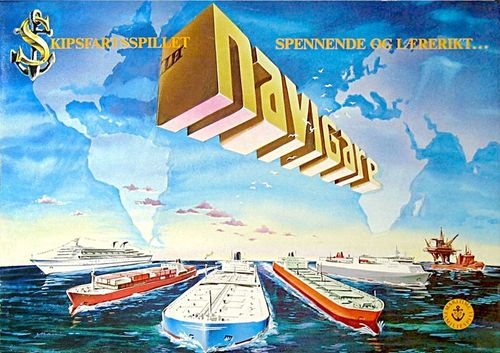
The board is a world map, on which the players' trade fleet is drawn in representative positions, with an indication of the ships' trade (sailing areas).
- 6 ships make up the game's trade fleet:
- Passenger ship BERGENSFJORD (grey) — kr. 4 000 000
- Tanker ROSS BAY (yellow) — kr. 3 500 000
- Liner TORONTO (dark blue) — kr. 3 000 000
- Tramp ship INGERTRE (green) — kr. 2 500 000
- Fruit ship BRISEIS (light blue) — kr. 2 000 000
- Liner HØEGH ARIANE (red) — kr. 1 500 000
- 30 share certificates. Each ship has 5 share certificates (1 main and 4 loose), with the design and text in the same colour as the ship.
- 80 telegrams give the players' shipowners different orders.
- 80 freight cards (on the same card as the telegrams) show what amounts the ships have sold for on the round trip.
- 14 deeds ("skjøter") give the right of disposition over the game's 6 shipyards, 4 harbours, 3 bunker stations and 1 salvage company.
- 102 banknotes:
- 12 notes of kr. 1 000 000
- 18 notes of kr. 500 000
- 18 notes of kr. 100 000
- 18 notes of kr. 50 000
- 18 notes of kr. 10 000
- 18 notes of kr. 5 000