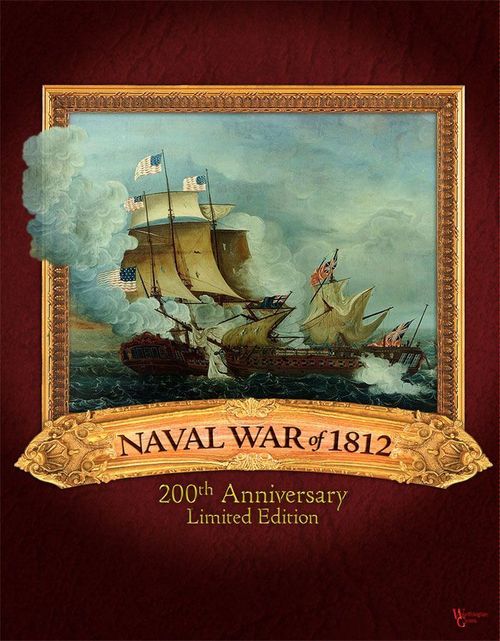
Naval War of 1812
Naval War of 1812 Rulebook
Table of Contents
Table of Contents
Game Board
The game board shows an open sea area with "starred" movement point locations in various colors. They are used to move and turn ships and are referred to as navigation points. All navigation points, regardless of color, are used for movement by both players.
The game board is divided in half with black navigation points defining the center of the board. On one side of the game board are four blue navigation points and on the other side four red navigation points. These are home port navigation points, the blue points for the American ships and the red points for British ships. This is where warships start the game and return if sunk.
Near the blue home port navigation points is a blue line identifying an area called American Home Ports. Near the red home port navigation points is a red line identifying an area called British Home Ports. These areas are where merchant ships attempt to move to earn victory points. Merchant ships are the only ships that may enter their home ports area and entry is from their home port navigation points.
The game board also shows status dials in the corners. The numbers around the status dial are used to track victory points, and can be used to track turns and movement points.
Game Ships
The plastic ships are used to represent the American and British navies. The ship types and capabilities are:
- Blue Ship: American warship that has a 3 straight movement point limit. It can take 2 hits before it is sunk and it rolls 2 dice in ship combat. There are 4 blue ships and they are worth 3 victory points each when sunk.
- White Ship: American merchant ship that has a 2 straight movement point limit. It can take 1 hit before it is sunk and rolls 1 die in ship combat when defending. White ships can not be an attacker in ship combat, they can only be a defender. There are 4 white ships and they are worth 2 victory points each when sunk. They can also earn 1 victory point by moving into its American Home Ports area.
- Red Ship: British warship that has a 2 straight movement point limit. It can take 2 hits before it is sunk and rolls 3 dice in ship combat. There are 7 red ships and they are worth 3 victory points each when sunk.
- Gray Ship: British merchant ship that has a 2 straight movement point limit. It can take 1 hit before it is sunk and it rolls 1 die in ship combat when defending. Gray ships can not be an attacker in combat, they can only be a defender. There are 6 gray ships and they are worth 2 victory points each when sunk. It can also earn 1 victory point by moving into its British Home Ports area.
Blue and Red Chips: These are used for hit markers on warships, blue chips for the Americans and red for the British. They are also used to track victory points and can be used to track turns and movement points.
Cards
Each player has a deck of 27 cards. The American player uses the blue faced cards and the British uses the red faced cards. The 27 card deck forms the strategic and tactical options each side has available.
Cards are used for movement points and tactics in the game. Card movement points must be fully used if there are enough ships in play to use them. Card tactics may be used depending on events that develop in the card round.
Card Movement
Each card shows a movement point (MP) number that represents the number of MPs a player's ships can take with that card during its movement portion of a card round. The card MPs can be distributed to as many or few ships as a player desires as long as at least one ship moves, all MPs are used if possible, and ship movement limits are not exceeded.
For example: A 6 MP card could be used to turn a blue warship 90 degrees on a navigation point and move straight 2 navigation points, and 3 white merchant ships could move straight one navigation points each.
For example: A 7 MP card could be used by a player to move 7 of his ships straight one navigation point each.
Card Tactics
The tactics portion of the card offers an advantage or disadvantage that is in play during the card round in which the cards are used. In some cases the tactics may only apply to movement for an active player, whereas in other cases it may apply for the entire card round.
For example: A British card tactic that says "Britannia Rules - Add 1MP to maximum straight movement limits of British red warships." means that while that card is in play any British red warship moving may add one movement point to its maximum straight movement allowance increasing it from two to three. This card tactic can only be used by the British player when he is active and moving. It would not be useable if the American player was active because British ships can not move when the American player is active.
For example: An American card tactic that says "Superior Gunnery - Add 1 die to blue warship combat die rolls" means that American warships roll 3 dice instead of 2 dice during ship combat that occurs for the card round. This card can be used by American warships during ship combat in a card round when they are the attacker (active player) or defender (non-active player).
Historical Note (Fast Frigates card): American frigates were sheathed with copper bottoms making them the fastest frigates afloat.
Example card: "Fast Frigates" (8 MP). Tactic: "Add 1MP to maximum straight movement limits for blue warships."
Setup
To start the game, separate the American and British cards and shuffle each deck and place face down. From the top remove two cards and discard them. The remaining 25 cards in the deck are the draw deck for each player. Next deal five cards to each player from their deck. These cards are the player's hand for the first turn.
British Setup
As shown on the Setup Illustration, place three of the seven British red warships on red navigation points facing in any direction the British player chooses. The other four British red warships are placed to the side of the game board. These ships are added to the British warship mix later in the game, one to start each new turn. Also, place the British six gray merchant ships as shown on the Setup Illustration.
American Setup
As shown on the Setup Illustration, place the four American blue warships on blue navigation points facing in any direction the American player chooses. Also, place the four American white merchant ships as shown on the Setup Illustration.
[Setup Illustration: the printed setup diagram of the game board is not transcribed; the placements are given in the text above.]
Game Turn Sequence
Each turn the players deal themselves the top five cards from their draw deck to start a game turn. Each hand of cards is dealt out of the remaining cards in the draw deck and any cards played during a hand and round are discarded. A player's hand of five cards is played in a series of card rounds where each player plays one card each. After all cards of the hand are played the turn ends. From a hand of cards there are five rounds of cards played, and a hand of five cards played is a turn. The game ends after five turns or hands of cards are played.
Cards are played in rounds where each player places a card face down and then both players flip their cards to reveal the MP and tactics of their card. Both players may use the tactics portion of their cards during the card round if applicable.
The player with the lowest MP showing on the card moves first followed by the other player (with the higher MP card). In the case of ties the American player moves first.
The player using his card for movement is the active player and the other player is the non-active player. The active player moves his ships based on the movement points on his card and may use the special tactics of the card as applicable during the round.
After all movement is completed, the active player completes combat as the attacker in the order he desires for any ships in position to have combat. The non-active player is the defender in ship combat. After all combat is completed then the non-active player becomes the active player and uses his card to move and complete the card round. After both players have used their card, the card round ends, the cards used are discarded, and a new card round begins.
Order of Play
- Start the game by shuffling player decks into draw decks. Remove two cards from each deck and deal five cards to each player from their draw decks.
- Each player plays one card face down.
- Players flip cards to reveal. Both players may use the tactics portion of their cards during the card round if applicable.
- The player with lower MP moves first as the active player and conducts ship combat after movement is completed. Remove sunk ships, apply hit chips.
- The player with the higher MP moves second as the active player and conducts ship combat after movement is completed. Remove sunk ships, apply hit chips.
- The card round is over and the flipped cards are discarded. Any tactics the cards provided during the card round are over.
- Repeat steps 2 through 6 until all five cards are played by each player which ends the turn.
To start the new turn, each player deals themselves five cards from the top of the draw deck.
The British player adds one red warship to start each new turn, beginning on game turn two. The red warship starts on a red open home navigation point facing in any direction the British player chooses. If none is open, then place it on navigation point nearest a red navigation point.
Return of Sunk Ships
Any merchant ships that are sunk return to the game at the start of the next card round. Any warships that are sunk return to the game at the start of the next game turn.
When returning merchant ships to the game, place them on any available navigation point within their opponents half of the game board. Players alternate with the British player going first. See illustration.
[Returning Sunk Ship Illustration: the printed diagram is not transcribed; the placement rules are given in the text above.]
When returning warships to the game, place them on their respective open home navigation points, blue for the American and red for the British. If none are open, then place them on navigation points nearest their color coded navigation points.
Ship Movement
The active player uses movement points (MP) on the card played to move his ships. It costs 1 MP to move one ship one space straight ahead. It costs 1 MP to turn one ship one quarter on a navigation point at the start of that ship's movement.
Ship movement consists of moving a ship in a straight line, navigation point to adjacent navigation point, or turning a ship. It costs one movement point to move from one navigation point that the a ship is on to an adjacent navigation point. Movement is in a straight line in the direction the bow of the ship is pointing. A ship straight movement limit applies to its movement from navigation point to navigation point.
For example: The American card that has 7 movement points and the event "Fast Frigates" allows American blue warships one extra straight movement point per ship that moves. This would allow the 3 maximum straight movement points for blue warships to increase to 4 for any blue warship moved its maximum during the card round that card is in play. This is a temporary increase that would end after the movement points from this card were completed.
Turn Movement
As the first move of the ship, it may turn one quarter (90 degrees) to change direction on the navigation point that they begin movement on. This is the only time during a ships move it is allowed to turn. It costs one movement point to turn, but the turn does not count against ship straight movement limits.
For example: In the example above it would cost 1 MP for a blue warship to turn one quarter on a navigation point it starts movement on and then 3 MPs to move 3 navigation points straight ahead, for a total of 4 MPs. Three straight movement points are the MP limit for a blue warship per card played, but the turn does not count against the limit.
Ships can also turn in place one quarter turn for the cost of one MP and not move.
Straight Movement
Ships move straight ahead in the direction their bow is pointing to adjacent navigation points. Ships can not enter or cross a navigation point another ship is in. Ships can not exceed their straight movement limits unless a card tactic allows it. Each movement action (one turn 90 degrees or straight movement one space) costs one movement point.
No ship can be activated for movement more than once per card played by their active player.
Card tactics can affect ship movement and ship movement limits. These affects are only applied during the movements in which the card is used by the active player.
For example: In the example above the American blue warship (maximum of 3 straight movement points) could: Move 3 spaces straight ahead for 3 MP, or turn one quarter (for 1 MP) and move up to 3 spaces straight ahead (costing 1MP for each space moved until reaching the ship MP limit) for a total of 4 MP, or turn one quarter in place for 1 MP.
Earning VPs with Merchant Ships
Merchant ships are the only ships that may enter their Home Ports area. American Home Ports area can only be entered by American white merchant ships from blue navigation points. British Home Ports area can only be entered by British gray merchant ships from red navigation points. When this occurs, one VP is earned. The merchant ship returns to the game at the start of the next card round. It is placed on any available navigation point within their opponents half of the game board facing any direction.
Ship Combat
Ship combat occurs after all ship movements of the active player. The active player is the attacker and the non-active player is the defender. The active player initiates combat. If any ships (even ships that did not move) of the active player are adjacent with their starboard or port side ("broadsides") facing the opposing players ships, ship combat may occur if the active player chooses to initiate it. There may be multiple combats depending on how many ships of the active player are adjacent with their broadsides to the non-active player's ships when the active player has completed movement.
In some cases a ship can attack twice in a card round when its starboard and port side faces adjacent of two different ships. In some cases a ship may have to defend more than once in a card round. In no case may a player move his ships more than once in a card round and this only occurs when he is the active player of the card round.
An attacking or defending ship may not fire through its direct front (bow) and rear (stern). A ship may only fire from each side as shown.
For example: In the example above the British red warship is firing broadside on the two American blue warships.
Ship combat is resolved by a single round of die rolls by opposing ships. Each ship rolls the number of dice it uses in combat. White and gray merchant ships roll 1 die, but only as defenders since they may not attack. Blue warships roll 2 dice as attacker or defender. Red warships roll 3 dice as attacker or defender. Some cards can change the number of dice rolled while the card is in play as well as ship capabilities.
Combat Die Roll Chart
| # of Dice Rolled | Attacker | Defender |
|---|---|---|
| British Warship | 3 | 3 |
| American Warship | 2 | 2 |
| British Merchant | 0 | 1 |
| American Merchant | 0 | 1 |
Ship combat between ships of each player is resolved by comparing the results of the die rolls of the ships. Regardless of how many ships are attacking a defender ship, the ship combat is completed one ship vs. one ship at a time.
Ship Combat Results
During the combat, regardless of how many dice are rolled, the highest die rolled for each player is compared and the highest number wins that round of ship combat. Results are as follows:
- In the case of ties, combat ends without any winner.
- If the attacker wins, the defender takes one hit and combat is over.
- If the defender is a warship and wins, the attacker takes one hit and combat is over.
- If the defender is a merchant ship and wins, then combat ends without any hits being applied.
Crossing the "T" in Ship Combat
When an attacking ship is firing on another ship at the exact front or rear of the target ship (Crossing the "T") it adds + 1 to its combat die rolls (example: a die roll of 4 would be a 5 when crossing the T).
For example: In the example above the British red warship is Crossing the "T" of the American blue warships.
Sinking Ships in Ship Combat
Once a ship has taken its hit limit it is sunk and removed from the game board. The winner gets the Victory Points (VP) for the sunk ship at that time. If a ship can take more than one hit (warships) then the hits are tracked by placing a chip under the ship.
For example: A blue American warship attacks a gray British merchant ship. The American rolls 2 dice, rolling a 4 and a 5. The British merchant rolls 1 die and rolls a 6. The British merchant wins with no hits to either ship and the ship combat is over.
For example: A red British warship attacks an American blue warship that has already received one hit and has a blue chip under it signifying that hit. The American ship rolls two dice and the British ship rolls three. The British die rolls are 2, 3, and 5. The American player die rolls are a 2 and a 4. The British wins the combat with its high die being a 5 compared to the American 4. Since this is the second hit on the American warship it is sunk and 3 VP is awarded to the British player at that time.
Winning The Game
The game is won by earning victory points. Victory points are earned for each player as follows:
American Player:
- American White Merchant Ship Entering American Home Ports Area: 1 Victory Point
- British Gray Merchant Sunk: 2 Victory Points
- British Red Warship Sunk: 3 Victory Points
British Player:
- British Gray Merchant Ship Entering British Home Ports Area: 1 Victory Point
- American White Merchant Sunk: 2 Victory Points
- American Blue Warship Sunk: 3 Victory Points
Players can also earn Victory Points from some cards.
The player with the most victory points when the game ends wins the game. In the case of ties, the American player is the winner. The game ends when all cards have been played after 5 game turns.
The British or American Player can also win an automatic victory by gaining 24 victory points. Automatic victory occurs the instant a player achieves his victory point total.
Reference Charts
Victory Point Values
American Player: American White Merchant Ship Entering American Home Ports Area, 1 Victory Point. British Gray Merchant Sunk, 2 Victory Points. British Red Warship Sunk, 3 Victory Points.
British Player: British Gray Merchant Ship Entering British Home Ports Area, 1 Victory Point. American White Merchant Sunk, 2 Victory Points. American Blue Warship Sunk, 3 Victory Points.
Straight Movement Limits
| Ship | Straight Movement Limit |
|---|---|
| British Warship | 2 |
| American Warship | 3 |
| British Merchant | 2 |
| American Merchant | 2 |
Ship Combat Results (Reference)
- In the case of ties, combat ends without any winner.
- If the attacker wins, the defender takes one hit and combat is over.
- If the defender is a warship and wins, the attacker takes one hit and combat is over.
- If the defender is a merchant ship and wins, then combat ends without any hits being applied.
Sunk Ships Return
- Sunk American merchant ships: placed on any available point at the start of the next card round.
- Sunk British merchant ships: placed on any available point at the start of the next card round.
- Sunk American warships: return to Blue Navigation Points at the beginning of a new turn.
- Sunk British warships: return to Red Navigation Points at the beginning of a new turn.
Ships on board are at the starting location to begin the game.