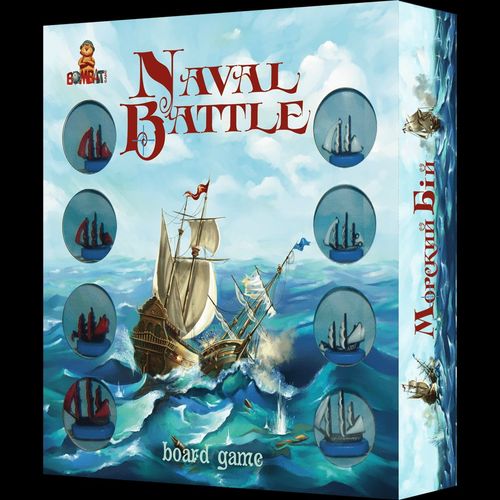
Naval Battle
Naval Battle Rulebook
Table of Contents
Table of Contents
Gameplay
During each turn of gameplay, the players try to move their own ships across the game board, attack by fire the other player's ships, sink the flagship of the opposing party, or capture their opponent's fort. The player is considered a winner if they complete one of these tasks before the rest of the players. Prior to starting the game, the player can appoint the flagship from among the ships that belong to them (an admiral is on board of this ship). If the player does not appoint the flagship, then a battleship is considered the flagship. Changing the flagship during gameplay is not allowed.
Preparing for the Game
Players should decide which ships and forts belong to each player. This can be decided by mutual consent of players or by way of rolling a dice.
Before starting the game, all forts should be placed on the board by the players. The fort can be placed on land or within the limits of any hexahedron (hex) at the edge of a map.
Ships should be placed on hexes, adjoining to the fort of the player. Only one ship can be placed on a hex at a time. A ship should be placed no more than 1 hex from the fort at the start of the game.
The Table of Damages sustained in a fight should be placed near the board. Meanwhile, the tokens representing damages for each of the ships are placed on a zero mark (on the image of a ship on the game board).
(The source prints this heading as "TTable of damages"; the doubled letter is corrected here.)
Every player places his fort and ships on the half of the field that belongs to them.
The first player should be defined by way of rolling a dice. The player with the highest number goes first.
Game Rounds and Turns
The game consists of rounds and turns. In the course of one round, players take turns choosing actions. When taking their turn, the player has the right to move one ship or a few ships, or not to make a move.
At first a ship can be moved, and then a ship can take a shot, or at first, a ship can take a shot, and then a ship can be moved – at the discretion of the player. Also, at first the player can move one ship, then they can move another ship, and then a ship can take a shot finally, or the other way around – at first or vice versa – at first one ship can take a shot, then the second ship can take a shot, and then the player can move a ship.
Basic Rules
(Perfect for novice players)
Movement of Ships
Before starting a new round, one of the players should roll a dice. The right to roll the dice is transferred from one player to another player in turn before each new round. If the numbers 1 or 2 are shown on a dice after it has been rolled, then this means that during this round the wind will be calm over the sea, and only brigs will move. If numbers from 3 to 6 are shown on a dice after its rolling, then this means that there are windy conditions, and all ships can move on the sea.
Ships can move on hexes in any direction and change their direction of movement during one turn. The maximum number of hexes that each ship can move during a turn is indicated in the Table on the last page of the rules (see Table of Characteristics of Ships below). According to the decision of the player, the ship can move the maximum distance, a distance less than the maximum or simply remain in place.
Ships can only move on those hexes that are crossed out with the use of fine black lines. Ships cannot go on hexes that are off course (the black sea route line does not cross through the hex). Also, a ship also cannot move through a hex that is occupied by another ship.
During each turn, a ship can be moved only one time. It is impossible, for example, to move a ship, then to take a shot, and then move the same ship again – even if it did not move the maximum distance of movement during the first action.
Shooting
A ship can take a shot in the direction of other ships that are located within the distance of the shooting accessibility of its guns. Depending on the type of ship, the player can take a single shot or multiple shots. To determine the results of every shot, it is necessary to roll a dice. If numbers from 3 to 6 are shown on a dice after its rolling, then this means that a shot was successful (hit), and one damage is to be counted in the total for a ship of the opposing side for every precise shot. If numbers 1 or 2 are shown on a dice after its rolling, then this means missing the target (lose), and no damage is to be counted in the total. If a target ship is placed on an adjacent hex, then any result of rolling a dice should be considered as a shell hit, except for number 2. The distance from the target and the number of shots made during one turn for each of the ships are indicated in the Table on the last page of the rules (see Table of Characteristics of Ships below).
A ship that can take a few shots per turn can take shots both in the direction of one ship and in the direction of a few ships of other players for one turn (for example, a battleship, having 3 shots, can take a single shot at first in the direction of one ship, and then in the direction of another ship two times, or take one shot at a time in the direction of three different ships). A ship can take a shot, then it can be moved, and then finally it can take a shot again. If the player does not use all their shots, they cannot be transferred to a subsequent turn.
Obstacles When Shooting
Shooting is possible only in the direction of those ships that are not protected from a shooting ship by way of obstacles. To determine whether the line of fire is free, it is necessary to draw a line from the center of a hex on which a shooting ship is placed to the center of a hex where a target ship is placed. If this line crosses even one hex occupied by any other ship or a hex through which movement is not allowed, then this means that the line of fire is closed and shooting is not possible.
A brig is a single ship which can shoot through obstacles (by way of plunging fire). If a brig shoots by way of plunging fire, the result of taking a shot is determined by way of rolling a dice. If numbers 5 or 6 are shown on a dice after its rolling, then this means that a shot was successful (hit). If any other numbers are shown on a dice after its rolling, this means missing the target (lose).
(Figure caption in the source: yellow lines indicate the boundary of the firing range of the battleship, yellow arrows – an open line of the fire and red arrows – blocked lines.)
Sinking a Ship
Every ship has a safety coefficient (indicated in the table of damage). This safety coefficient should be reduced by 1 every time the ship is hit. Damages sustained in a fight should be saved until the end of the game.
Players mark every damage, sustained by their ship, moving a token to the right on a table of damage based on how much damage was endured.
If the damage sustained by a ship is equal to its safety coefficient (a token is placed on the last number on a table of damages) – this ship is subject to sinking and should be removed from the board.
Capture of a Fort
For the purpose of capturing a fort, the flagship of opposing player must be in the hex next to the fort and remain there during their next turn.
Extended Rules of the Game
(More realistic)
With the extended rules of the game, all players are able to move their ships and to fire more realistically. This game is more difficult, but it is also more interesting.
Movement of Ships (Extended)
At the use of the basic level of rules, the player was able to move their ship without limitations as to changing the direction of its movement. When using the extended rules of the game, the player will only be able to change a course gradually as is typical for a ship.
At the start of the game, the player should place a ship in a hex with its orientation (orientation of a ship) in the direction of one of three lines of course (thin black lines, crossing a hex from one side to the other side). Each ship should be placed along one of the lines in a way similar to that shown in the picture. (Source figures: "Correct position of a ship" and "This position of a ship is incorrect".)
During movement of a ship, the player can choose one of two actions:
- To turn a ship by one direction and to change the line of course, which the ship is oriented along, without leaving a hex. Large ships, such as battleship and galleon, can be turned only by one line, and smaller ships, such as a frigate or brig, can be turned by one line or by two lines at the discretion of the player. After execution of a turn, a ship cannot be moved, but this ship is able to shoot.
- To move a ship to an adjacent hex, but only in the direction that the ship's bow is pointed in. After moving a ship to an adjacent hex, the player can simultaneously turn it by one line (battleship and galleon) and by one or two lines (frigate and brig) to the left or to the right. Different ships have different movement ranges. Each ships movement range is shown in the table on page 8 (see Table of Characteristics of Ships below). This might mean that you can move your ship from one hex to another as many times as indicated in the table for the ship.
(Source figure caption: "Movement of galleon and brig are shown in picture".)
The rules of determination of presence/absence of wind and its influence on ships are the same as in the basic level. Also, a ship can move a distance that is less than the maximal distance or choose to remain in place.
Shooting (Extended)
The biggest part of artillery of sailing-ships was along the board; only a few guns were located at the front of the ship and on the stern of the ship. Therefore, most damage can be inflicted by a sailing ship to the target ship if the sailing ship uses its board guns. When shooting with the front or stern guns, the likelihood of inflicting considerable damage to the target ship is much less.
Now every ship has four sectors of shooting: two board sectors, such as on the left board and on the right board of the ship, and one front sector and one stern sector of the ship. The board sectors for shooting are hexes, which are located between two lines of course, going away from the board of a ship. The front sector and the stern sector for shooting are the hexes through which a line of course is passed and along which the front part and the stern part of a ship are located. The distance of shooting of ships is the same as at the basic level. The hexes not included in the sectors of shooting are considered a "dead zone," and a ship will not be able to fire at a target that located outside its sectors of shooting.
If a ship provides fire on a target in the board sector of shooting, then the results of taking a shot are determined in the same way as for the basic level: representation of numbers 1 or 2 on a dice means missing the target (lose), and representation of numbers from 3 to 6 means that a shot was successful (hit). If a target ship is placed on an adjacent hex, any result of rolling a dice should be considered as a hit, except for number 2.
If a target ship is placed within the front sector or within the stern sector of shooting – representation of numbers from 5 to 6 after rolling a dice means that a shot was successful (hit). If any other numbers are shown on a dice after its rolling, then this means missing the target (lose). If a target ship is placed on an adjacent hex, representation of numbers from 3 to 6 after rolling a dice means that a shot was successful (hit).
A plunging fire is provided according to the rules of the basic level.
(Source figure caption: the sectors of shooting of a battleship are shown in the picture. A galleon of the opposing party is located within the limits of the board sector of shooting, a frigate – within the limits of the front sector, a brig – within the limits of the "dead zone" and cannot be attacked by fire at such position of a battleship.)
All other rules are the same as at the basic level.
Thus, when playing the game using the extended rules, the players should give special consideration to maneuverability – the ships already will not be turned, being "on a bead heel" and the ships cannot be moved by the stern. In addition, more light brigs and frigates will have an advantage due to their maneuvering benefits.
But that is not all we can say about possibilities of extension of the game. On the publisher's site bombatgame.com, additional sets are available, consisting of 4 ships and another fort. After purchase of the above additional sets, it is possible to increase the number of players to 3 players or even 4 players. You can try things out, experiment, and see what new possibilities for gameplay are opened for you.
Table of Characteristics of Ships
| Kind of ship | Movement range (hexes): wind/calm | Firing range (hexes)/number of shots | Plunging fire | Safety margin |
|---|---|---|---|---|
| Battleship | 4/0 | 3/3 | no | 5 |
| Galleon | 3/0 | 3/2 | no | 4 |
| Brig | 4/2 | 2/1 | yes | 3 |
| Frigate | 5/0 | 3/1 | no | 4 |