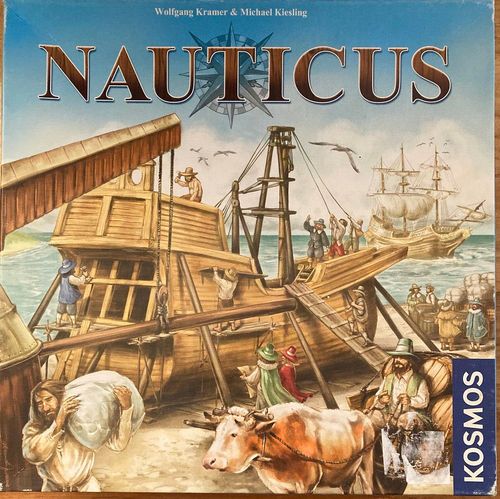
Nauticus
Nauticus Rulebook
Table of Contents
Table of Contents
Components
- 1 game board
- 1 turntable
- 8 action tiles
- 1 anchor tile
- 4 player warehouse boards
- 1 round marker
- 4 victory point markers, in the player colors
- 18 single-vessel (1-tile) hull tiles
- 18 bow tiles
- 18 stern tiles
- 9 center-hull tiles
- 72 masts (4 sets of 15 masts, each set with a different coat of arms, plus 12 masts with a crown)
- 72 sails (4 sets of 15 sails, each set with a different coat of arms, plus 12 sails with a crown)
- 48 goods tiles (12 each of coffee, grain, salt and fish)
- 28 worker cubes (workers)
- 42 coins (26 x 1-Taler, 16 x 5-Taler)
- 12 pass tiles (4 sets of tiles worth -3, -2 and -1 victory points)
- 4 "extra action" tiles
- 1 overview tile (victory points at game end)
- 1 start player figure
Setup
The game board is placed in the middle of the table.
The following material is placed on the game board:
- The turntable is placed in the middle of the game board. At the start of the game, it is aligned so that the space with the anchor points to the bonus space with the 3 workers.
- The round marker is placed on space 1 of the round track.
- The victory point markers of the colors in play are placed on space 10 of the victory point track.
The remaining game material is sorted as follows:
- The workers are placed as a general supply next to the game board.
- The ship tiles (single-vessel, bow, stern and center-hull tiles, masts, sails) are sorted by type and placed in 14 open stacks next to the game board. (It is recommended to group masts, sails and hull parts together, and to separate the crown sails and crown masts from the other sails/masts.)
- The goods tiles are likewise sorted by type and placed in 4 open stacks next to the game board.
- The coins are placed as a general supply next to the game board.
- The 8 action tiles, the anchor tile and the round overview tile "victory points at game end" are set aside for now.
Each player now receives (once, at the start of the game):
- 1 warehouse, which they place on the table in front of them
- 4 workers from the general supply, which they place beside their warehouse as their personal stock
- 15 Taler in any denomination, which they place beside their warehouse as their personal stock
- 1 "extra action" tile
- 1 set of "pass tiles" worth -3, -2, -1 victory points. The tiles are placed with the "pass" side face up next to the warehouse. (It is best to stack the three tiles so that the tile worth -1 victory point is at the very bottom of the stack, and the tile worth -3 victory points is visible on top.)
Notes on handling the game material
- The number (and, where relevant, type) of all workers and Taler in a player's personal stock, tiles in the warehouse, goods already delivered, and the status of the pass tiles and possession of the "extra action" tile are fundamentally open information. This material must be kept visible on the table, and the exact number must be disclosed to the other players on request.
- Workers and Taler in the general supply are unlimited. Should the unlikely event occur that there are not enough workers or Taler available, a shortfall should be bridged with other suitable material.
- Ship tiles and goods are limited in number. If the stack of a particular tile type is used up, players can no longer acquire or otherwise obtain that tile type. It is always permitted to count how many tiles of a given type are still available.
The least experienced player becomes the start player and receives the start player figure. The player in position 2 receives 1 additional Taler. In a three-player game, the player in position 3 receives 2 additional Taler and 1 additional worker. In a four-player game, the player in position 3 receives 1 additional Taler and 1 additional worker, and the player in position 4 receives 2 additional Taler and 2 additional workers.
Note: The start player figure is passed to the next player clockwise after each action phase is completed. The start player figure is not (additionally) passed at the end of a round.
Game Course (Overview)
The main focus in NAUTICUS is on shipbuilding. Completed ships earn victory points at game end and are essential for gaining additional victory points from goods. 4 different ship sizes can be built: 1-tile, 2-tile, 3-tile and 4-tile ships. Larger ships earn significantly more victory points, but are harder to complete and therefore take longer before they can be used to transport goods, since every ship must have matching rows of masts and sails.
NAUTICUS is played in rounds. In a three- or four-player game, 5 rounds are played. In a two-player game, only 4 rounds are played. Each round consists of exactly 7 action phases. The players decide which action phases these are, and in which order they are carried out. At the start of an action phase, the current start player chooses an action. This action is then carried out first by them, then, clockwise, by all the other players. In this way, all players are constantly involved in the game. Once all players have carried out or passed on the current action, the start player changes. This player then chooses the next action. At the end of the round, a short intermediate phase takes place, in which the selection of actions for the next round is newly assembled, and in which penalty points are awarded, where applicable, for remaining "pass" tiles. The next round then begins immediately, or, after 4 or 5 rounds, final scoring follows instead.
The Golden Rule
In NAUTICUS the following rule applies fundamentally and without exception: whenever a player receives a tile (a ship part or a good) for free, they must first place this tile in their warehouse. "Free" means that no Taler had to be spent for it. (Since it is not unlikely that you will forget this rule, we will repeat it a few more times. And when you explain the game, you should not fail to repeat this Golden Rule often, and to respond to questions like "Does this have to go in the warehouse now?" with a firm "Yes, as always!")
Preparing a New Round
- The round marker is advanced one position on the round track. (Not applicable at the start of the game.)
- The turntable is turned so that the anchor on the wheel points to the action tile on which the anchor tile is lying. (Not applicable at the start of the game.)
- As soon as the turntable has been realigned, the anchor tile is set aside. Then the 8 action tiles are collected by the current start player, shuffled face down, and then laid out randomly, face up, on the 8 action spaces of the game board, starting with the space that the anchor on the turntable points to. The bonus spaces must remain visible while doing this!
Round Sequence
A round consists of a total of 7 action phases. The start player begins the first action phase by choosing one of the 8 action tiles and carrying out the action. (Alternatively, they may choose an action tile but not carry out the action, and pass instead.) Next, the next player clockwise decides whether to carry out this action or to pass. This continues until all players have had the opportunity to carry out the action or pass. The action phase then ends. The corresponding action tile is turned over and is no longer available for the rest of the round. After the first action phase of a round, the anchor tile is placed on the turned-over action tile. The start player figure is passed to the next player clockwise. This player then chooses one of the remaining action tiles and decides whether to carry out the action or pass. The other players again follow in clockwise order, the action tile is turned over, and the start player figure is passed on. This continues until 7 of the 8 action tiles have been chosen and carried out. The round then ends; the remaining eighth action is not carried out in this round.
Performing an Action
1. Bonus
The current start player, who chose the action, first receives the bonus printed on the game board that is associated with the chosen action. The player receives this bonus in every case, regardless of whether they then carry out the chosen action or pass. Once the player has received the bonus, they push the action tile down so that the bonus space is covered. Then they decide whether to carry out the action (in the example below, "buy hull parts") or not.
Important: Only the start player who chose the action receives the bonus. All other players only carry out the chosen action, or pass.
The following bonuses exist (in the order in which they are printed on the game board):
- 3 workers (beige clothing): The start player receives 3 workers from the general supply and places them in their personal stock.
- Mast: The start player receives, for free, 1 "regular" mast of their choice (not a crown mast!) and places it in their warehouse. (Do you still remember the Golden Rule?)
- Sail: The start player receives, for free, 1 "regular" sail of their choice (not a crown sail!) and places it in their warehouse.
- 2 victory points: The start player receives 2 victory points and immediately advances 2 spaces on the victory point track.
- 2 workers (beige clothing): The start player receives 2 workers from the supply and places them in their personal stock.
- 1 worker (beige clothing) + 1 good: The start player receives 1 worker from the general supply and places it in their personal stock. They also receive 1 good of any type, which they place in their warehouse.
- 1 worker (beige clothing) + 1 victory point: The start player receives 1 worker from the general supply and places it in their personal stock. They also receive 1 victory point and immediately advance 1 space on the victory point track.
- 4 Taler: The start player receives 4 Taler from the general supply.
Example: Player A is the start player and chooses the action "buy hull parts". They first receive the bonus assigned to this action (2 victory points). They then push the action tile down so that the bonus is covered.
2. Blue Workers on the Turntable
Workers are also depicted on the turntable, but with blue clothing. Every space, except the anchor space, shows 1, 2 or 3 workers. When an action is chosen, the workers assigned to the chosen action on the turntable are available to all players who carry out this action. Important: unlike the workers with beige clothing, these workers are not received in the form of wooden pieces from the general supply. These 0, 1, 2 or 3 workers are only available for carrying out the action. If a player does not need all of these workers, or passes, these workers are forfeited.
3. The Actions
3.1 General Principles for Actions
- When an action is chosen, the start player carries it out first, then, clockwise, every other player carries out the chosen action. None of the 8 actions has to be carried out. Alternatively, a player may pass — the start player, too, may choose an action and then pass. If a player passes, they turn over one of their 3 pass tiles to its back. It makes sense to turn over the -3 tile first, then the -2 tile, and on the third pass, the -1 tile. (The back shows a crown, whose significance is explained under "3.2.2.4 Scoring the Crowns".)
- Each of the 8 actions can be used multiple times by the players within one action phase. However, each use of the action requires 1 worker. You can (and will) naturally use the blue workers shown on the turntable first. If you want to use an action more times than there are blue workers available, you must additionally spend a corresponding number of worker pieces from your personal stock.
- 4 action tiles have a blue background, the other 4 have a light background. The numbers 0–3 printed on the game board next to the storage spaces for the action tiles are only relevant for the blue action tiles. With the blue actions, you buy ship parts or goods. These cost not only workers but also Taler. The price of a particular ship part/good is determined by the number shown next to the relevant part of the ship/good on the action tile. For the light actions there are no Taler costs, so the numbers are irrelevant for these actions.
- If a player wants to buy more than 1 ship part or good at the printed, regular price, these parts must all be of different types.
- If a player wants to buy more than 1 ship part/good of the same type, the second and every further identical tile costs 4 Taler (and 1 worker), regardless of the actual listed price of that tile.
- If a player buys all 4 different ship parts/goods within one action, they receive 1 additional ship part/good of that action tile's type as a gift (without spending any Taler or worker).
- Reminder: All tiles received for free must be placed in the warehouse. Workers do not count as a cost. A tile bought for 0 Taler (and one worker) is "free". It follows that all tiles for which at least 1 Taler was paid can be used immediately, without going by way of the warehouse. (More on this in the explanation of the individual actions.)
Example: The start player chooses the action "buy hull parts". They receive a bonus of 2 victory points and push the action tile down, covering the bonus space. They then carry out the action "buy hull parts". They buy all 4 hull parts, and therefore must pay 6 Taler and spend 4 workers. 2 blue workers are available to them from the turntable, so they still need to spend 2 workers from their personal stock, returning them to the general supply. Because they bought all 4 parts, they receive a free hull part of their choice as well, which they place in their warehouse. Then the next player takes their turn. They buy a bow and a stern and pay 1 + 3 = 4 Taler for it. Since this uses the 2 available blue workers, they need not spend any workers from their own stock. The third player "buys" the 0-cost single-vessel tile and places it in their warehouse. They need not pay any Taler and need not spend any workers from their personal stock, since 2 blue workers are available for the action, of which they need only 1. The unused worker is forfeited.
3.2 The Individual Actions
3.2.1 Paid Actions (Blue Action Tiles)
Only for the 4 paid actions are the printed numbers 0–3 next to the action tile spaces relevant. "Paid" means that each carried-out action costs 0–4 Taler and 1 worker.
3.2.1.1 Buy Hull Parts
Hull parts are the basis of all ships. Without hull parts, masts, sails and goods cannot be usefully employed. In NAUTICUS, 4 different ship sizes can be built. For the small 1-tile ships there is a separate, complete hull tile. The larger ships consist of a bow part and a stern part, between which 0, 1 or 2 center parts can be placed.
Whoever buys hull parts places the tiles bought — which, thanks to the Golden Rule, they do not have to place in their warehouse — normally directly in front of themselves on the table (in their "shipyard"). In doing so, the player may have to decide immediately how large a ship is to become, since parts once placed cannot later be rearranged. A player who lays out only a bow or only a stern has not yet committed to whether it will become a 2-, 3- or 4-tile ship. But a player who places a bow and a stern next to each other has begun a 2-tile ship — it is not possible to later insert a center part. 3- and 4-tile ships can only be started from one end, or from the middle. So you cannot leave a gap between a bow and a stern in order to later build a 3- or 4-tile ship there with 1 or 2 center parts. A player who places a bow and a stern separately from each other in their shipyard has begun 2 ships "under construction". It is not possible to later combine these into a single ship. Note: The hull of a ship does not have to be completed in a single action — it is possible (and, for large ships, often the case) that several "buy hull parts" actions are needed to complete a hull.
Example: Player A buys all 4 parts using 4 workers and 6 Taler. As a bonus, they receive an additional hull part for free. They choose another 1-tile hull. Both 1-tile hulls must go into the warehouse, since they were received for free. They immediately form a 2-tile ship from the bow and stern. They set the center part aside for now. They will later attach further hull parts and build a 3- or 4-tile ship.
3.2.1.2 Buy Masts
There are 5 types of masts, distinguished by the coats of arms on the flags. Only 4 of these mast types can be bought via this action. Crown masts cannot be bought — they can only be received as a reward for completed ships (see p. 10, "4. Rewards for Completed Ships"). Bought (paid) masts can be built directly onto hull parts as soon as they are bought. It does not matter whether the hull is already complete or not. However, only one type of mast may be built on a given ship — mixing different mast types is not allowed. (Exception: crown masts are wild. They can be combined with any other mast type.) Bought masts that a player cannot or does not want to place directly onto hulls must first be placed in the warehouse, together with any free masts.
Example: Player A buys 1 green-red "whale" mast for 0 Taler and 2 light-green "anchor" masts, one for 1 Taler and the second for 4 Taler. For this they need 3 workers. They must place the "whale" mast in storage; the two "anchor" masts can be placed directly on their ship.
3.2.1.3 Buy Sails
There are 5 types of sails, distinguished by the coats of arms on the sails. Only 4 of these sail types can be bought via this action. Crown sails cannot be bought — they can only be received as a reward for completed ships (see p. 10, "4. Rewards for Completed Ships"). Bought (paid) sails can be placed directly, as soon as they are bought, onto masts bearing the same coat of arms. (Exception: crown sails are wild and can be placed onto masts of any type.) Bought sails that a player cannot or does not want to place directly onto masts must first be placed in the warehouse, together with any free sails.
3.2.1.4 Buy Goods
Buying goods works exactly like buying ship parts. Bought (paid) goods can be placed directly onto hull parts, even onto unfinished ships. Every hull part offers space for exactly 1 good, with the good placed directly beneath the hull part. Both identical and different goods can be loaded onto a single ship. Goods that have been loaded onto a ship can no longer be moved to a different ship — they can only leave the ship they were loaded onto by means of the action "deliver goods" (see p. 9, "3.2.2.3 Deliver Goods").
Example: Player A buys 4 goods: fish, grain and 2 coffee. The second coffee costs them 4 Taler. For this they need 4 workers and 7 Taler. They place 1 coffee and the grain directly beneath 2 of their hulls in their shipyard. They place the free coffee and the fish in their warehouse, even though they could have placed the fish on the remaining free hull. It might have been more sensible for Player A to buy the salt for 3 Taler instead of the second coffee for 4 Taler, and then receive an additional coffee as a gift, since they would then have bought all 4 goods. This would have saved them 1 Taler and gained them 1 additional good, except that they would then have had to place both coffee tiles in the warehouse.
3.2.2 Free Actions (Light Action Tiles)
For the 4 free actions, the printed numbers 0–3 next to the action tile spaces are not relevant. "Free" means that no Taler need be paid for these actions. However, each carried-out action still requires 1 worker.
3.2.2.1 Transport (from Warehouse to Shipyard)
In their warehouse, players collect all ship parts and goods that they either received for free, or that they could not or did not want to place directly in the shipyard onto already-laid-out ship parts. Every hull, every sail and every good takes up exactly 1 space. Masts take up 2 spaces. You may rearrange your warehouse at any time (for example, if you want to store a mast but no 2 adjacent spaces are free). But if the warehouse is full, no further ship parts or goods can be stored.
With the "transport" action, stored ship parts and goods are moved into the shipyard. You may transport any number of stored tiles from the warehouse to the shipyard, but each transported tile requires 1 worker. The transported ship parts/goods are immediately attached to/placed on ships, or a new ship is begun with them.
3.2.2.2 Withdraw Money
With this action, a player receives new money from the general supply. For each worker a player spends, they receive 2 Taler from the general supply.
3.2.2.3 Deliver Goods
This action can only be carried out by players who own at least 1 completely finished ship (hull + mast(s) + sail(s)) that is fully loaded with goods — that is, with a good lying under every hull part. If a player decides to deliver goods, they may do so from any number of fully loaded ships. However, they must always deliver the entire cargo of a ship. Each delivered good requires 1 worker. Partial deliveries are not possible. If a player cannot deliver all the goods of a large ship because they do not have or do not want to spend enough workers, they may not deliver any goods from that ship at all. Delivered goods are collected on the right side, next to the warehouse. These goods earn the player victory points at game end, with more points the more goods of a single type (see p. 11, "End of Game"). As soon as a ship has been unloaded, it can be loaded again with goods via the "buy goods" or "transport" action.
3.2.2.4 Scoring the Crowns
With this action, a player can gain victory points directly. How many victory points a player can receive depends on the number of workers spent and the number of that player's currently visible crowns. When a player carries out this action, they first count all their visible crowns. Crowns are depicted on crown sails and crown masts, and it does not matter whether the crown sail or crown mast is in the warehouse or is already part of a ship — only ownership counts. Crowns are also depicted on the backs of the pass tiles. The sum of crowns on masts, sails and already-turned pass tiles gives the number of victory points the player receives per worker spent, and they immediately advance that many spaces on the victory point track. Important: a player can receive a maximum of 15 victory points per round from this action. (Exception: if the extra action, see p. 10, "5. Extra Action", is used, a player can gain victory points from scoring the crowns a second time within a round — theoretically making it possible, once per game, in one round, to gain up to 15 victory points twice.)
Example: Player B owns 1 crown mast on a ship and 1 crown sail in their warehouse. In addition, they have turned over 1 pass tile. They use the 2 blue workers currently assigned to this action, and spend 1 further worker from their own stock. For this they receive 3 x 3 = 9 victory points and advance their marker on the victory point track. Had they spent 2 more workers, they would have received the maximum amount of 15 victory points.
3.3 Passing
If a player does not want to, or cannot, carry out an action, they pass. This is not necessarily bad, since every time a player passes, they may turn one of their pass tiles over to its back. At the end of the round, every player who still has un-turned pass tiles in front of them loses victory points accordingly. A player who does not pass at all during a round loses a total of 6 victory points. A player who passes once already reduces this loss to 3 victory points. So, in most rounds, it makes sense to pass at least once. In addition, turning over a pass tile grants 1 additional crown for the rest of the round, which can bring additional victory points via the "scoring the crowns" action. Reminder: if the start player passes, they still receive the bonus for having chosen the action.
4. Rewards for Completed Ships
Every time a player completes a ship, they interrupt their turn and immediately receive one or more rewards. A ship is complete when all its ship parts are in place. A 1-tile ship is thus already complete with hull + 1 mast + 1 sail; a 4-tile ship is complete with 4 hull parts (bow + 2 center parts + stern) + 4 masts + 4 sails. Goods have nothing to do with completing ships. For every mast a completed ship has, the player receives 1 reward.
There are 6 rewards to choose from:
- 1 crown mast: The player receives 1 crown mast and places it in their warehouse.
- 1 crown sail: The player receives 1 crown sail and places it in their warehouse.
- 3 victory points: The player receives 3 victory points and advances their victory point marker accordingly.
- 7 Taler: The player takes 7 Taler from the general supply.
- 3 workers: The player takes 3 workers from the general supply.
- 2 goods: The player receives 2 different goods and places them in their warehouse.
Each reward may be chosen at most 2 times per completed ship. A player who completes a 4-tile ship can thus, for example, take 2 crown masts and 2 crown sails, or also 4 different rewards. The distribution of rewards is entirely up to the player, as long as they do not choose the same reward more than 2 times.
Important: when a ship is completed, the current turn is interrupted and the reward(s) are taken. Should this happen as a result of the "transport" action, the player may, for example, immediately use a further "transport" action to build a crown sail taken as a reward — which had to go into the warehouse — into a ship, and may even complete that ship as a result, thereby receiving further rewards. Taler or workers received can likewise be used immediately for further actions.
5. Extra Action
At the start of the game, every player received 1 "extra action" tile. A player may use this once during the game, while it is their turn, to carry out an additional action, before or after the current action, under slightly modified rules. First, the player receives 2 workers from the general supply. They then choose one of the 8 known actions and carry it out according to the following rules: if the player chooses a paid action, every ship part or good has a purchase price of 2 Taler. All other rules remain in effect: each use of the chosen action still costs 1 worker. When buying tiles, a player may still buy only 1 of each type at the price of 2 Taler — if they want to buy further tiles of the same type, the price rises to 4 Taler starting with the second tile. If a player buys all 4 tiles, they receive 1 additional tile for free. Once a player has carried out their extra action, they return the tile to the box. Important: the action tile on the game board has nothing to do with the extra action. The extra action does not cause the corresponding action tile to be turned over, and it may also be used to carry out an action whose action tile has already been turned over!
Note: it is usually sensible to save the extra action for the last round, so that you can still react to an unfavorable order in the selection of actions.
6. End of an Action Phase
As soon as all players have carried out or passed on the action chosen by the start player, an action phase ends. The start player turns the action tile face down; the action is no longer available this round (except as an extra action). At the end of the first action phase of each round, the anchor tile is placed on the action tile that is now face down (see "End of Round" below). It stays there until the end of the round. The start player passes the start player figure to the next player clockwise. If 2 or more action tiles are still face up, this player begins the next action phase and chooses an action. After 7 action phases, only 1 action tile remains face up, and the round is over.
End of Round
As soon as 7 action phases have been carried out and only 1 action tile remains face up, the round ends. The remaining 8th action is not carried out this round.
Then the players' pass tiles are scored. Every player now loses victory points corresponding to their un-turned pass tiles and moves back on the victory point track accordingly. (In the unlikely case that a player's score drops below 0 victory points, the score may go negative.) Afterward, all pass tiles are turned back to the side showing the penalty points. So every player starts the next round with a potential loss of 6 points and with no crowns.
The round marker is advanced one space. (Watch for the end of the game.) If at least 1 more round remains to be played, the turntable is realigned so that the anchor on the turntable points to the action space on which the action tile with the anchor tile is lying. As soon as the turntable has been realigned, the start player places the anchor tile beside the game board, takes all 8 action tiles, shuffles them, and lays them out randomly, face up, on the action spaces, starting with the space next to the anchor on the turntable.
Now the start player begins the new round by choosing one of the 8 actions. Note: there is no steady income of Taler or workers — players must make do with their starting capital and with whatever they receive through actions, rewards and bonuses.
End of Game
The game ends after the 5th round in a three- or four-player game, or after the 4th round in a two-player game. All players now receive victory points for their completed ships and for delivered goods. But remaining Taler, unused workers, ship parts of unfinished ships in the shipyard and warehouse, as well as undelivered goods, are also still worth something. An overview of the victory points to be awarded can be found on the round overview tile (or, for delivered goods, on the warehouse boards).
Victory Points for Delivered Goods
Delivered goods are grouped into sets by type. For each set of identical goods, the player receives the following victory points:
- Set of 1 good: 2 victory points
- Set of 2 goods: 5 victory points
- Set of 3 goods: 9 victory points
- Set of 4 goods: 14 victory points
- Set of 5 goods: 20 victory points
For every further good in a set, the victory points increase by an additional 5 points.
Victory Points for Completed Ships
For each completed ship, the player receives the following victory points, depending on the size of the ship:
- 1-tile ship: 2 victory points
- 2-tile ship: 8 victory points
- 3-tile ship: 20 victory points
- 4-tile ship: 35 victory points
Victory Points for Remaining Material
After that, all unused workers, ship parts of unfinished ships in the shipyard and warehouse, as well as undelivered goods, are each converted into 1 Taler. For every 3 Taler a player now owns, they receive 1 victory point. Remaining amounts are forfeited. Players keep all of their Taler in doing so, since it may still count as a tiebreaker in case of a tied score.
Whoever now has the most victory points wins this game of NAUTICUS. In case of a tie, the player with the most remaining money (0, 1 or 2 Taler) wins. If there is still a tie, the player who has the most Taler overall — that is, including the Taler for which they already received victory points — wins. If there is still a tie, the players involved share the corresponding placement.
Example of final scoring: Victory points for delivered goods: the set of 2 grain is worth 5 victory points, the fish set is worth 9 victory points, and the coffee set is worth 25 victory points. In total, the player receives 39 victory points for their delivered goods.
Victory points for completed ships: the player receives a total of 6 victory points (3 x 2) for their 3 completed 1-tile ships, 8 victory points for their completed 2-tile ship, and 20 victory points for their completed 3-tile ship. In total, the player receives 34 victory points for their completed ships.
Victory points for remaining material: the player still has 2 workers and 3 tiles in the warehouse. For these they receive 5 Taler. For the ship parts of unfinished ships (3 hull parts, 1 mast, 1 sail) they likewise receive 5 Taler, and for undelivered goods they receive 3 Taler. In total, the player receives 13 Taler for their remaining material, which they add to their remaining money of 8 Taler. In sum, that is 21 Taler, for which the player receives a further 7 victory points. They keep the 21 Taler, since it may count as a tiebreaker in case of a tied score.