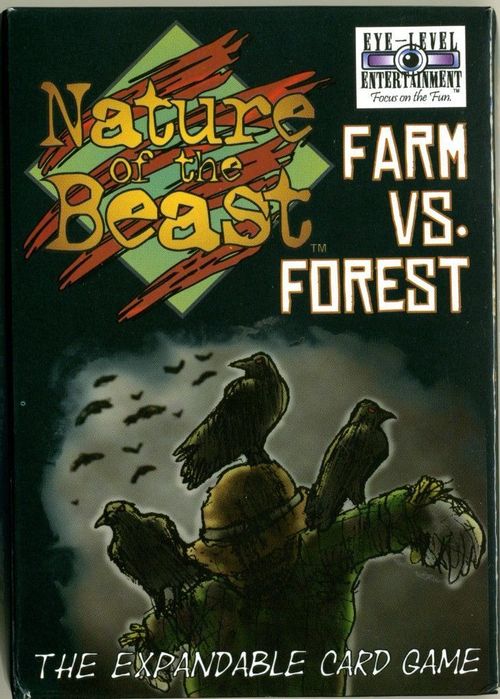
Nature of the Beast: Farm vs. Forest
Nature of the Beast: Farm vs. Forest Rulebook
Table of Contents
Table of Contents
I. Game Summary
Nature of the Beast (NOB) is a game for two or more people. Each player plays from his or her own deck of cards. These cards represent animals from different habitats along with the tools and tricks they'll employ in their battle for supremacy. Each deck is split into two piles: TROOPS and TRICKS.
TROOPS:
- ANIMALS - The grunts and generals of your battle for supremacy
- LEADERS - Enhancements that turns ordinary animals into an extraordinary ones
TRICKS:
- EVENTS - Happenings that can work to your benefit or your opponent's grief
- LOCATIONS - Notable territory that supplies advantages when under your control
- ITEMS - Tools of humanity commandeered for your cause
- HUMANS - People with various talents to contribute to your triumph
While there are multiple variants of gameplay, the standard game requires each player to fill an imaginary 3 by 3 square made up of nine spaces. This area is your FIELD. The row closest to you is the BACK row, and the row furthest from you is the FRONT row. Fill your Field to win the game!
Favor and Fury
Each player has two tallies to track during the game. The first tally is FAVOR. This measures how much influence you have in the human world. It is used to call assistance, get items, or generally make things happen that animals can't do for themselves.
The second tally is called FURY. It represents how big of a 'blip' you are on humanity's radar. The more violent your group becomes, the more Fury you acquire. If you gather too much Fury, humanity takes up arms against you and exterminates your army. If your Fury ever reaches 10 points, you are automatically out of the game!
A Special Note About Fury...
Fury represents not only how threatening humanity views you, but also an attitude among your army. A higher Fury indicates increased recklessness, violence, and a view that the ends justify the means. If your Fury rises to 5 or above, you have crossed a dangerous threshold into DARK NATURE.
Dark Nature cards can only be played by you if your Fury is 5 or above. They represent various powerful, deadly, and ruthless actions that threaten to isolate you even further from 'respectable society'. You won't win friends playing Dark Nature cards... but you might win the game!
Ending the Game
LAND VICTORY: The instant you have your animals in all nine spaces of your Field, you win the game. Some variants of the game offer different winning conditions; see Section VII for details!
FURY DEFEAT: If your Fury ever reaches to 10, you are instantly out of the game. Humanity feels threatened enough by your violence that it stops watching cable TV long enough to purge your army from the good Earth. Tough luck.
SCORCHED EARTH: Should the game go on so long that no one has enough animals left to claim victory then nobody wins. Don't think of it as losing, but instead consider it 'victory impairment'.
By the way... Many cards give you the ability to bend or flat-out break the rules of NOB. When the handbook and the card text disagree, the rule on the card overrides rules printed in the text.
II. Gameplay
Preparing to Play
- Separate your deck into TROOPS and TRICKS.
- TROOPS: Animals and Leaders
- TRICKS: Events, Equipment, Humans, and Locations
- Keeping each pile separate, shuffle them and place them on the table to the right of your Pen.
- Each player chooses his starting values for Favor and Fury. You may select any value between 0 and 9, but you must choose the same value for each tally (ex. 3 points of Favor and 3 points of Fury). Use the included tally cards to keep track of these values during the game.
- Players draw the top animal card from their Troops deck. The player with the highest RANK may go first (If you draw a LEADER card, redraw until you get an animal.) Shuffle the card(s) back into your Troops deck. Play proceeds clockwise around the table.
- Each player deals themselves three Tricks. These form the player's starting hand.
- Each player deals three Troops face-down in his PEN. These are your starting recruits.
During Your Turn
Step 1: Preparation
- If you have any face-down animals in your Pen, you may choose to turn them face-up. If you turn up a Leader card, you should play another Troop card on top of it automatically, unless you plan to defer the card until later in the game (more on deferral later). If you play a second Leader or a Legend card on top of the first Leader card, you must trash or defer the second card.
- Draw the permitted number of cards from your Trick deck and add them to your hand. EACH recruit you turned face up this turn reduces the number of new Tricks you can draw by ONE.
- Example 1: You turned over two animals in your Pen. You may only draw one new Trick card.
- Example 2: You turned over no animals in your Pen. You may draw three new Trick cards.
Step 2: Complete Your Actions
Under normal circumstances, each player can complete three actions in his turn. A complete list of the possible actions follows!
A. RECRUIT ANIMAL (One Action)
Each face-up animal in your Pen is a potential recruit. Their Rank indicates their overall power and, thus, how difficult it is to get them to join your cause. Low Rank animals are more easily persuaded than their higher Ranked counterparts. Due to its unfamiliarity with the customs of foreign Habitats, an animal is considered to have only half its Clout (rounded down) when recruiting animals from outside it's own Habitat.
Your goal is to meet or beat the recruit's Rank with other animals' Clout. There are two ways to do this. You may use them separately or combined:
-
TILTING ANIMALS IN YOUR FIELD: Tilting an animal in the Field represents that animal spending some time to seek out the recruit and selling him on the idea of joining your army. Each tilted animal adds their Clout to the recruiting total.
-
TRASHING OTHER POTENTIAL RECRUITS: Sometimes you'll choose to trash a potential recruit in order to lavish attention on another prospect. This bold willingness to dismiss other valuable animals never fails to impress a potential recruit. Each Pen animal trashed adds its Clout to the recruiting total (same as an animal in your Field).
A new recruit enters the Field from the Pen space it was in. It must move into your back row as permitted by its Vectors. The animal may not be recruited if there is no allowable open Field space. An animal's (or Item's, or Human's...) powers are not available for use until it is in play on the Field.
Remember: No matter how many animals you tilt and/or trash, recruiting one animal is one action.
Immediately after completing a recruiting action, fill any blank spaces in your Pen with new FACE-DOWN animals from your Troops deck (from left to right). These animals will remain face-down until the beginning of your next turn, when they can be flipped over if you want.
SPECIAL NOTE ABOUT LEGENDS: Only one copy of any particular Legend can be in play in ANY Field. You can leave a duplicate Legend in your Pen for as long as you want. Duplicates can be trashed or deferred, but not used for recruiting (they are already working for another player's army).
SPECIAL NOTE ABOUT LEADER CARDS: Only one Leader may be in play in your Field at any time. You can leave extra Leaders in your Pen for as long as you want. Extra Leaders in your Pen can be deferred or trashed for recruiting (or just trashed if that's your thing).
B. MOVE ANIMAL (One Action)
An animal may move to an open, adjacent Field space in its Vectors at the cost of one action. Normal movement does not tilt an animal and a single animal could spend multiple actions to move multiple times.
C. UNTILT ANIMAL (One Action)
Each action spent can untilt one animal. Tilted animals are pretty much useless. They cannot move, attack, ally, recruit, claim Locations, or equip Items! In addition, tilted animals are considered to have no Vectors.
D. DISMISS ANIMAL (Zero or One Action)
Occasionally, you may need get rid of an animal on your Field (usually because of Vector concerns). You must spend an action and tilt an animal with a higher Rank than the animal you wish to dismiss. Dismissed animals get put in your Trash pile. You may also dismiss animals in your Pen as a free action and this does not require you to tilt any animals. Trash the recruit and fill the empty space with a new face-down recruit.
E. DEFER RECRUIT (One Action)
Sometimes, an animal shows up as a recruit in your Pen at the wrong time. You can spend an action to shuffle the animal back into your Troops deck. Fill the empty Pen space with a new face-down recruit. You can also do this for Leader cards, but you MUST chose to defer BEFORE placing an animal on top of it. Once an animal is matched with a Leader card, it can only be recruited or trashed.
F. DECLARE BATTLE (One Action)
See Section IV: Battles for details!
G. DRAW ADDITIONAL TRICK (One Action)
Spend an action to add a Trick card to your hand.
H. PLAY EVENT CARD (Zero or One Action)
If the card has a Deployment Icon with an arrow facing down, then you may play it during your turn. The effects are specified on the card. If there is a number inside the Deployment Icon, then you must spend that number of actions to use the card. If there is a number inside the Discard Icon (Trash Can), then you must discard that number of Tricks from your hand when you use the card. Using Items or animal/Human special abilities falls under the same guidelines.
I. PASS ACTION (One Action)
You cannot save actions; if you pass, the action is lost.
The following actions can be completed without using one of your three actions. You cannot perform one of these in the middle of a previously-initiated action. For example, you cannot play a Location in the middle of a battle.
J. CALL HUMAN ALLY (Free Action)
If you have a Human card in your hand and you meet the prerequisites marked on their card, you may bring it into play at any time during your turn (outside of a battle). Each row can hold one Human to the left of the field (maximum three Humans per player at any one time). You can dismiss a Human as a free action in order to free up a space for another one.
Humans begin untilted. As long as you continue to meet their prerequisites, Humans untilt for free at the start of your turn, unless otherwise marked. If you stop meeting her prerequisite, the Human will not untilt such time that you meet her prerequisite once again.
J. CLAIM LOCATION (Free Action) (lettered "J" a second time in the handbook)
If you have a Location in your hand, you may bring it into play if you meet its Rank requirement. An animal does not have to be in the space where you plan to put it. To meet the Rank requirement: count the Rank of the animal in the target space (if any), plus any adjacent animals whose Vectors point to that space. If your total meets or exceeds the Rank requirement, you may bring the Location into play immediately. This does NOT tilt any of the involved animals, but tilted animals may NOT contribute to claiming Locations.
K. EQUIP ITEM (Free Action)
If you have an Item in your hand, you may bring it into play by spending the Favor cost listed on the 'price tag'. Place it under an animal in your Field. An Item is available for use immediately upon being equipped. An Item MUST be equipped to an animal before it can be used. Alternately, an animal may tilt to pass any or all Items it has to another untilted animal in its Vectors. This also has no action cost.
Step Three: Wrap Up
Once you finish your three actions (and any free actions), your turn is complete. Before the next player begins her turn, you must discard extra cards from your hand if you have more than five Tricks.
III. The Cards
Animal Cards
Each card represents an animal that you can recruit into your army.
- NAME: Usually, this will be a general animal type. LEGENDS are famous individuals with their name in quotes.
- HABITAT: This indicates where the animal hails from and determines who their natural allies will be. Cards from different habitats have different background colors.
- ANIMAL SIZE (Secondary Trait): Ranges in size from Tiny, Small, Medium, Large, and Huge.
- SPECIAL MOVEMENT (Secondary Trait): Possibilities include Leap, Flight, Swim, Burrow, and Climb. (Not every animal will have these.)
- RANK (Primary Trait): This indicates how difficult it is to recruit the animal and its overall place in the pecking order.
- COMBAT (Primary Trait): Physical strength and fighting ability.
- CLOUT (Primary Trait): Charisma and recruiting ability.
- CUNNING (Primary Trait): Intelligence and strategic vision.
- SPECIAL ABILITY: See each card for details!
- VECTORS: These show directions where the animal can act. A direction allowed by the animal's vectors is referred to as 'legitimate' or 'valid'. Vectors influence things like moving, allying, and claiming Locations. If the circle is transparent, then there is no Vector in that direction.
NOTE: The value of primary traits may be modified during the game, but any effort that would permanently drop the value of a trait to less than zero will only bring it down to zero.
Leader Cards
Even the most humble animal can become very powerful if it accepts the mantle of leadership. Leaders help unify your forces under a single vision.
- LEADER ABILITY: Each Leader card specifies a special ability that the Leader can use IN ADDITION TO its normal printed special ability.
- STAT BONUS: Some Leader types give bonuses to the traits. The Leader card is designed to skew under the animal card so that the bonus lines up to the right of the original printed traits.
- RANK INCREASE: Leaders come with a cost: increased Rank. This adds to the animal's base Rank for purposes of recruiting and all other matters of Rank.
Special Rules for Leader Cards
Leader cards are shuffled into your TROOPS. Only THREE Leader cards (of any kind) may be built into a deck (you may, of course, choose to put in fewer or none at all). Only ONE Leader can be in play in your Field at a time. You can have one or more waiting in your Pen. When a Leader card turns face-up in your Pen, draw the next Troop and place it face-up on the Leader card. The Leader card is designed to sit under the animal card so that the trait modifications line up with those printed on the animal card. The animal's stats are often boosted by the Leader card. Playing an animal on top of a Leader card is a permanent pairing until the animal is trashed.
If a second Leader or a Legend card plays onto the face-up Leader card, then you must choose which card to keep. The other must be sent to your Trash pile or deferred at the cost of one action. Legends cannot have a Leader card attached to them!
Event Cards
These twists of fate often fuel brilliant victories.
- DEPLOYMENT ICON
- Arrow pointing up: can only be played during an opponent's turn.
- Arrow pointing down: can only be played during your turn. A number inside the arrow (if any) tells how many actions must be spent to activate the card.
- Arrow is multi-directional: may be played at any time (as indicated by the card specifics).
- DISCARD ICON: If the trash can is present, then the number inside of the trash can indicates how many additional Tricks must be discarded from your hand in order to play this card. With great power, comes great expense!
- EVENT DESCRIPTION: This section describes the card's specific effects upon game play.
Item Cards
Some people were unsettled by the discovery that animals can also use tools. Imagine how they'd feel to see an escaped lab monkey with a loaded .38 special.
- FAVOR COST: You must spend this amount of Favor to bring the Item card into play.
- ITEM ABILITY: The card must be equipped to an animal BEFORE its ability can be used.
Location Cards
Locations are strategic areas worth the effort to control for the vast array of advantages they can give your army.
- HABITAT: Only animals from the Location's Habitat can contribute to activating the Location. Special CIVILIZED Locations can be brought into play by animals from City, Suburb, or Farm locations. Special WILD Locations can only be brought into play, for now, by animals from the Forest.
- SPECIAL ABILITY: This bonus is granted only to animals that are on this space in the field.
- RANK PREREQUISITE: This number indicates how much Rank you need before you can place the Location from your hand. (Review the 'Claim Location' in the previous section for more details.)
Human Cards
Few Humans are even aware of the secret battles that rage around them. Fewer still wish to get involved.
- PREREQUISITE: Once you have met the condition(s), the Human may be placed beside your Field during your turn as a free action. You may place one Human to the left of each row. In a standard game, this limits you to a maximum three Humans at any time.
- SPECIAL ABILITY: Generally, you must tilt the Human to use her ability. Humans untilt automatically at the start of your turn, assuming that you still meet the card prerequisite. Should you ever fall short of the prerequisite, the Human remains tilted until you fix the problem.
IV. Battles
Quick Summary
Declaring a battle takes one action. Generally, you'll gain one point of Fury when you attack. This happens at the battle's end whether you win or lose. The more you duke it out, the more attention you draw from humanity! Any untilted animal in your Field can declare an attack on any other opposing animal in play. Spend an action, tilt the attacker, and declare your target. If the attacker's Combat total beats the defender's, then the attacker wins and the defender is trashed. If the attacker cannot beat the defender's total, he loses and is trashed. Defenders win all ties.
Detailed Battle Rules
The battle is broken into PHASES. During the battle, the defender goes first, followed by the attacker, then back to the defender, etc. This continues until both the attacker and defender each pass a battle phase. The PRIMARY COMBATANTS are the two main animals fighting and, as such, are at highest risk of being trashed. The primary attacker tilts to begin the battle. The primary defender is the animal targeted by the primary attacker.
Battle Phase Options
PLAY AN EVENT CARD: Playing an Event takes one phase of the battle. See specific cards for their effects. This also includes the usage of Items, special abilities, or tilting Humans whom can affect a battle.
LEGEND BOOST: If a Legend is your primary combatant, you may choose to discard a Trick from your hand in exchange for a +1 Combat bonus. While you may only discard one Trick per battle phase, you may repeat this during later phases as many times as you would like; you are only limited by the number of Tricks in your hand!
Call for Allies
If you are calling for an ally from your own Field, they must be untilted, adjacent to the primary combatant, and have a Vector pointing towards it. Tilt the ally to add +1 to your Combat total as a battle phase action.
You may instead ask a specific player to join you. An ally may only contribute animals from the front row of his Field. When he tilts his animal, you gain +1 Combat to your total. You may come to an informal verbal agreement before extending an official invitation for an ally. However, if he declines to ally after you extend him a formal offer, you are considered to have PASSED that battle phase. Other players can provide no assistance other than allying animals. They are not allowed to play cards, use Humans, etc., during the battle. It's your fight... you'll have win it!
Calculating Victory
Once both players pass their battle phase, the battle enters the resolution phase. Add up the Combat totals:
- If the attacker's Combat total is higher than the defender's, the attacker wins and the primary defender is trashed.
- If the Combat totals are tied or the defender's total is higher, the attacker loses and is trashed.
Under most circumstances, the attacking player gains +1 Fury after the battle. This is added even if the defender wins the battle!
V. Gameplay Examples
The following pages show a single player's initial four turns. For simplicity, the other players will be ignored.
Turn 1
In our Pen, we turned up a Stubborn Mule, a Field Mouse, and a Wily Jackrabbit. Not bad! Since we flipped three animals in the Pen, we can draw no additional Tricks to start. That's OK, since we started the game with a hand of three Tricks anyway.
Action 1: I want to recruit the Mule. He's no charmer, but his 3 Combat will enable him to hold his own against most early-recruited opponents. He has a 3 Rank, so I'll need to trash animals with at least that much Clout. The Jackrabbit is neat, but a bit expensive right now. I can trash her and use her 2 Clout to help recruit the Mule. I'll also trash the Field Mouse to add his 1 Clout to the recruiting pitch. The trashed animals' Clouts add up to 3, so I can bring out the Mule. The Mule moves up into the field diagonally as allowed by his Vectors. Afterwards, I refill all three empty Pen spaces from left to right with face-down animals from my Troops deck.
Action 2: There are no face-up animals left to recruit, so I'll move up the Mule another space and free up that back row.
Action 3 (Not shown): I could move the Mule again, but I'll spend my last action to draw an extra Trick. I plan to be flipping over a lot of new recruits for these first few turns so it might be a while before I get a chance to draw more Tricks.
Turn 2
I flip three animals in the Pen and so I'll gain no additional Tricks this turn (unless I spend actions for them). I find a Charming Pig, a Sneaky Horse, and a Legend: Baron Kozel!
Action 1: Kozel is a very powerful animal, but with 10 Rank, he is too expensive. I won't be able to bring him out soon, but I don't want to trash him either. I choose to spend an action to defer him; he is shuffled back into my Troops deck. I hate to use the action, but it'll be worth it when Kozel reappears later in the game when I can afford to bring him out.
Action 2: The Charming Pig is a great recruiter; I want to get him in play. Trashing the Horse gives me 3 Clout towards the 4 points needed to meet the Pig's Rank. I can then tilt the Mule to add the last point since the Mule has a 1 Clout. The Charming Pig is recruited and moves out onto my Field.
Free Action: The Trick I drew last turn was the Condor Scout: a Human. I am not in Dark Nature at this point (trust me), so I meet his prerequisite for joining my cause. He can be placed to the left of any row. As long as I meet his prerequisite he'll untilt for free at the beginning of every one of my turns.
Action 3: I'm out of Pen animals, so I move the Pig up a space. Remember: an empty back row is a happy back row.
Turn 3
Again, a fresh set of face-down recruits. I could leave any number of them face-down in return for drawing some Tricks, but I need an army! The following animals turn up in my Pen: a Hungry Goat, the Legendary Bessie, and the Schemer: a Leader card! I could could defer the Leader card, but I take a chance on love and place my next Troop card face-up on it: an EXTREMELY Wily Jackrabbit.
Free Action: I spend one Favor and equip my Pig with the Bullhorn. This Charming Pig is going to be hard to ignore now!
Action 1: I untilt the Stubborn Mule.
Action 2: I want that Schemer Jackrabbit. Since it's a Leader, it is more expensive than normal. I tilt the Pig (4+2 = 6 Clout) and trash the Goat (2 Clout). That gives me a total of 8, which is more than the Jackrabbit costs (6 + 1 = 7 Rank). The extra point is lost, but the Jackrabbit Schemer is in play.
Free Action: I'll place the Location, 'Under the Chicken Coop' under the Jackrabbit. (Note: they don't have to be placed under an animal.) The Rank prerequisite is 6. The Jackrabbit Schemer has enough to bring it out, but the Mule could have helped.
Action 3: I'll need that Pig again next turn, so I'll untilt him.
Turn 4
With Bessie still in the Pen from last turn, I only have two animals to flip. That means I can draw one new Trick. That's good, because I was almost out! I reveal the Old Hound Dog and another Field Mouse shows up.
Action 1: I move the Stubborn Mule up a space.
Action 2: I move the Jackrabbit up a space. Notice that the Location remains behind in the space where it was placed originally.
Action 3: I'll tilt the Pig to recruit the Hound Dog (4+2= 6 Clout vs. 5 Rank).
Combat Example 1
Evan (5 Fury) is playing a "City" deck and Patrick (1 Fury) is playing a "Forest" deck. Pat recently hampered Evan's plans for expansion, so Evan has decided to visit Pat's troops with a little payback.
Battle Declaration: Evan tilts his Stray Dog (Primary Attacker) and declares an attack on Pat's untilted Possum (Primary Defender).
- Attacker Total = 3: Stray Dog (3)
- Defender Total = 2: Playful Possum (2)
1st Battle Round
Defender Phase: Pat calls a Recluse Mole to ally. The Mole is in an adjacent square with a Vector pointing towards the Possum. The Mole tilts and adds +1 to the Combat total. If the battle were to end now, Pat would win the tie.
Attacker Phase: Evan plays 'Cornered'. This prevents the Possum from calling any additional allies.
- Attacker Total = 3: Stray Dog (3)
- Defender Total = 3: Playful Possum (2) + Recluse Mole (+1)
2nd Battle Round
Defender Phase: Pat has the advantage, since he'll win a tie. He passes this round.
Attacker Phase: Evan calls an ally from his own field, tilting his Alley Cat (who has the appropriately oriented Vector).
- Attacker Total = 4: Stray Dog (3) + Alley Cat (+1)
- Defender Total = 3: Playful Possum (2) + Recluse Mole (+1)
3rd Battle Round
Defender Phase: Pat is out of allies to join the fight. He plays 'Shield of the Righteous' from the Tricks in his hand. Evan pays a price for being in Dark Nature, as Pat now gains a +2 Combat bonus!
Attacker Phase: In a moment of clarity, Evan realizes that he doesn't want to spend what he'd need in order to overcome this battle deficit. He decides this battle is a lost cause and passes this phase.
- Attacker Total = 4: Stray Dog (3) + Alley Cat (+1)
- Defender Total = 5: Playful Possum (2) + Recluse Mole (+1) + Righteous Shield (+2)
4th Battle Round
Defender Phase: Pat is winning, so he passes as well. Since two consecutive phases were passed, the battle moves to resolution.
Battle Resolution: Since Pat's total is higher, he wins the fight! Evan's Stray Dog is trashed, and all the allies remain tilted. Evan gains one point of Fury (Fury gain for a battle occurs after the resolution).
In a small act of defiance, Evan plays 'Short-Lived Victory' from his hand and the Stray Dog is reshuffled back into his Troops deck instead of being trashed. Pat is unimpressed.
Combat Example 2
A bit later in the game, Patrick (Forest) decides that Amanda (Suburbs) is a bit too close to winning for his comfort. He decides to level his biggest gun against her most formidable animal.
Battle Declaration: Patrick tilts the Grizzly Bear (Primary attacker) and declares an attack on Amanda's Legend, Arco (Primary defender). Arco has several untilted animals near, but none have the Vectors to ally. At the end of the battle, Pat will increase his Fury by 1. Arco has previously equipped the Secret Mutagen, giving him a permanent +2 Combat bonus.
- Attacker Total = 8: Grizzly Bear (8)
- Defender Total = 6: Arco (4) w/ Secret Mutagen (+2)
1st Battle Round
Defender Phase: Amanda has come too far to roll over. She begins by playing 'Unexpected Allies' from her hand, tilting an adjacent Chipmunk to ally despite lacking the appropriate Vector. She gains a +1 bonus, while Pat snickers.
Attacker Phase: Patrick passes his phase, since he still has the advantage.
- Attacker Total = 8: Grizzly Bear (8)
- Defender Total = 7: Arco (4) w/ Secret Mutagen (+2), Chipmunk (+1)
2nd Battle Round
Defender Phase: Amanda has one card left in her hand. Arco, a Legend, can trash cards for a bonus. She does so, gaining +1 Combat.
Attacker Phase: Patrick grumbles before tilting an adjacent Wild Turkey with an appropriate Vector to add +1 to his Combat total.
- Attacker Total = 9: Grizzly Bear (8), Wild Turkey (+1)
- Defender Total = 8: Arco (4) w/ Secret Mutagen (+2), Chipmunk (+1), Burned Card (+1)
3rd Battle Round
Defender Phase: Amanda is out of Tricks... literally. Louis (Farm) does have an untilted Sneaky Horse in his front row that could ally. This would give Amanda +1 bonus and tie things up again. Amanda smiles and formally invites Louis to ally as her action. Lou ponders this, but then notices that Amanda is fairly close to winning and politely declines.
Attacker Phase: Patrick smiles. Since Amanda's call for aid was unanswered, it counts as a passed phase. Patrick also passes.
Battle Resolution: Pat's winning streak continues. Since he beat the defender's total, he wins the battle. Amanda loses Arco and the Chipmunk is tilted. On Pat's side, the Bear and Turkey remain tilted. Pat gains +1 Fury and the ire of Amanda.
VI. Deck Building
Mix and Match the Prebuilt Decks
To start you off, we have assembled 'blocks' of themed cards in the Battle Boxes. They are broken into two types: Habitats and Style. Habitat blocks represent cards hailing from a specific region. Predominantly animal cards, Habitat blocks also include relevant Humans and Locations. Each Habitat has been matched up with a specific Style block. Starting styles include: Combat, Tricky, Resource, and Dark. Events, Items, Leaders, and Humans make up Style blocks. Mix and match the different Habitat and Style blocks for different decks.
Custom Build Your Own
The decks shipped with the Battle Boxes are a good start. They were built to give you all the cards in the initial run, so they are not tweaked to maximize the power of specific card combinations. Once you're comfortable with the game, you'll easily be able to construct more devious, devastating, and daring decks!
When you're ready to build from scratch, here are the rules:
- Maximum deck size: 70 cards
- Maximum # of Troops in a deck: 30 cards
- Maximum # of Leader cards (any type): 3 total cards
- Maximum # of any individual card: 3 cards
Just like a boat, a deck need a good name. Come up with a cool name like 'Concrete Justice', 'Kozel and his Merry Men', or 'For the Birds' and watch your opponent wet himself in unadulterated fear.
Starting Blocks - Default Habitats
Each Habitat block has 39 cards.
City (39 cards)
- Legends: (1) "Grendel", (1) "Kongo", (1) "Nickel"
- Animals (2 each): Abandoned Kitten, Alley Cat, Chimney Swifts, City Mouse, City Squirrel, Junkyard Dog, Lab Rat, Organ Grinding Monkey, Pampered Poodle, Peregrine Falcon, Pigeon Bombardier, Police Canine, Seasoned Parrot, Sewer Rat, Stray Dog
- Humans: (1) College Professor, (1) Street Mime
- Locations: (1) Derelict Factory, (1) Harbor Docks, (1) Storm Drain
Farm (39 cards)
- Legends: (1) "Bessie", (1) "Baron Kozel", (1) "Lukas"
- Animals (2 each): Barn Owl, Charming Pig, Delicious Goose, Field Mouse, Hungry Goat, Industrious Hen, Murder of Crows, Nomadic Sheep, Old Hound Dog, Pesky Gopher, Raging Bull, Rooster Herald, Sneaky Horse, Stubborn Mule, Wily Jackrabbit
- Humans: (1) Old Farmer, (1) Veterinarian
- Locations: (1) Corn Field, (1) County Fair, (1) Slaughterhouse
Forest (39 cards)
- Legends: (1) "Abraham", (1) "Illia", (1) "Tecumseh"
- Animals (2 each): Baby Bear, Busy Beaver, Evasive Bullfrog, Gray Squirrel, Gray Wolf, Grizzly Bear, Martyr Duck, Playful 'Possum, Prickly Porcupine, Prudent Deer, Recluse Mole, Red Fox, Resourceful Otter, Veteran Wolverine, Wild Turkey
- Humans: (1) Eco Activist, (1) Solitary Hermit
- Locations: (1) Briar Patch, (1) Earthen Lair, (1) Scenic Vantage
Suburbs (39 cards)
- Legends: (1) "Arco", (1) "Mr. Whiskers", (1) "Rex"
- Animals (2 each): Captive Songbird, Chipper Chipmunk, Family Dog, Ferret Fatale, Fuzzy Bunny, Garden Snake, Guerrilla Gerbil, H2Orangutans, House Cat, House Mouse, Nimble Hummingbird, Raccoon Scout, Reliable Robin, Spunky Hamster, Vigilant Goldfish
- Humans: (1) Realtor, (1) Sadistic Child
- Locations: (1) Animal Control Center, (1) Crumbling Foundation, (1) Deserted Playground
Starting Blocks - Default Styles
Each Style block has 30 cards.
Resourceful (30 cards)
- Items: Bullhorn, Caffeine Pills, GPS System, Grooming Certificate, Human Costume, Secret Mutagen
- Leader: The Propagandist
- Humans: Attorney-At-Law, Bird Guy, Politician, TV Journalist
- Actions: A Dry Spell, Animal Control, Booby Trapped!, Damage Control, Down-Sized, Dropping In, Fifteen Minutes, For A Good Cause, Give 'Em The Slip, Going For Help, Inattentive Driver, Moving Company, Riding Coattails, Sabotaged Equipment, Salvage Rights, Speedy Recovery, Spring Cleaning, Steal Their Thunder, Strategic Withdrawal
Dark (30 cards)
- Items: Gas Can, Human Child, Loaded Revolver, Poison, Stolen Credit Card
- Leader: The Taskmaster
- Humans: Contract Killer, Petty Criminal
- Locations: Animal Hospital
- Actions: Benefit Of The Doubt, Betrayal, Collateral Damage, Corruption's Cloak, Corruption's Dagger, Fell Off The Truck, Flanking Action, Forceful Coercion, Framed!, Identity Theft, Kidnapped!, Lost Opportunity, Massacre!, Mob Ties, Obscuring Fog, Scars Of Battle, Share The Blame, That Was My Idea!, Trench Warfare, Vandalism, Vengeance
Combat (30 cards)
- Items: Iron Talons
- Leader: The Duelist
- Humans: Condor Scout
- Locations: Mystical Burial Ground
- Actions: Annoyance, Ascent to Safety, At A Safe Distance, Awesome Rout, Battle Hardened, Call For A Hero, Caught Off Guard, Clever Ruse, Cornered, Davy Jones' Locker, Distant Opponent, End It Now!, Going Underground, Heavy Competition, Hidden Strength, Into the Fray, Over-Extended, Penance, Redeeming Eulogy, Righteous Shield, Righteous Sword, Shift The Blame, Stand Aside, Tight Squeeze, Tunnel Fight, Underdog Story
Tricky (30 cards)
- Items: Hidden Camera, Smoke Canister, Tracking Bug, Voodoo Doll
- Leader: The Schemer
- Humans: Bodyguard, Outdoor Celebrity, Taxi Driver
- Actions: Ace Under The Collar, Airlift, Appeasement, Bait and Switch, Barricade, Caught In The Act, Counter Offer, Decoy, Deep Six, Deft Maneuvers, False Tracks, In A Single Bound, Late Start, No One's Looking, Renegade Soldier, Second Wind, Short-Lived Victory, The Old Switcheroo, Trashed HQ!, Tunnel Collapse, Under Cover of Darkness, Unexpected Ally
VII. Gameplay Variants
Love filling your day full of NOB goodness, but feel like something a little different? Expand your NOB-ventures into new realms of competition and challenges with these variants! Before playing a variant, all players must agree on it and any sub-variant choices.
Rush (a.k.a. 3x2) - Play hard. Play fast.
In this variant, the Field is only two rows high (no middle row). The first player to fill their Field with 6 animals wins. Watch out, it happens faster than you think!
This is a good variant for players who want to learn the basics of movement, recruitment, and battles. Also great if you have a limited amount of time. Sub-variants include playing without Fury and Favor and/or eliminating Tricks entirely!
Doubles (a.k.a. (3x3)2) - Double the challenge. Square your fun.
This is a game for four players. The players pair off and sit across from each other on the table. The goal is for either player to fill his Field. Whichever team completes a Field first wins.
Sub-variants (can combine any or all of the following):
- Same Team, Same Faction: The two members of each team must play animals from the same faction. This puts constraints on how easily Legends come into play.
- Limited Leadership: Only one player from a team can have a Leader in play at a time.
- Ultimate Extreme Doubles: Both teammates must have their Field filled at the same time to win!
Supply Line (a.k.a. 3x5) - Advanced gameplay. VERY close combat.
This two-player variant is the most significant deviation from standard, 3x3 gameplay. You and your opponent share a common Field of five rows between your Pens. Your back row is still considered to be closest to your Pen. However, your front row is now the row furthest from you that contains at least one of your animals. (Yes, theoretically your front and back row could be the same row.)
Your goal is to create an 'unbroken' string of UNTILTED animals (your 'supply line') leading from one Pen to the other. Each animal in your supply line must have a Vector pointing towards the animal in the supply line ahead of it. The first player to create a supply line immediately wins. Alternately, if you can get three of your untilted animals in your opponent's back row you also immediately win the game.
You can only attack adjacent animals that are in one of your animal's Vectors. Your other animals may ally for your combatant as normal.
Since there are now five rows, you may bring up to five Humans into play, but you cannot place a Human in a row if your opponent already has one across from it.
You cannot move into a space occupied by an opposing animal, but you may move onto their unoccupied Locations and use it if you meet the Habitat requirements! This is a tough, but rewarding variant... have at you!
VIII. Gameplay Tips
- Animals or Items with the Dark Nature trait can be played into your Field even if you are below 5 Fury. However, you cannot use the abilities of those cards until cross over into Dark Nature's seductive realm.
- While there is no official time limit to complete a turn (feel free to set one if you want), some people are slower than others. Go buy a little squeaky animal toy. If someone is taking too long, squeeze it to remind him of the fleeting nature of life and of how precious every moment we have on the good Earth really is. (Bonus use! Players can pass the toy as they finish their turn, eliminating the 'Who's turn is it?' phenomenon!)
- Learn to shift attention away from your own Field. Try phrases like, "Look, Hillary's going to win next turn," or, "Jeez, Lindsay only has two empty Field spaces." One risky technique in a three or more player game is to leave it to the next player to deal with the impending victory of another player. (Serves you right if you lose.)
- When choosing targets, consider their Field placement as well as their Combat values. An animal trashed in an opponent's front row will usually take more actions to replace than an animal trashed in the back row.
IX. Glossary
- Action - This is the main event in NOB; you get three of these each turn (plus all the 'free actions' you can eat)
- Battle Phase - The action of a player engaged in a fight with an opponent
- Clout - A numeric trait given to animals to indicate how well they recruit other animals
- Combat - A numeric trait given to animals to indicate how effective they are in a fight
- Civilized Habitats - Regions where the influence of humanity is rampant: (City, Suburbs, and Farm)
- Cunning - A numeric trait given to animals to indicate their mental acumen and sense of strategy
- Events - Part of the Tricks deck representing super cool things that happen during the game
- Favor - A value from 0 to 10 indicating how much influence you have in the realms of humanity
- Field - The 3x3 imaginary playing board that animal cards move on; different variants may alter size of field
- Fury - A value from 0 to 10 indicating how threatening humanity finds your army's actions; in addition it is an overall measure of the amount of restraint and control evident among your troops
- Habitat - The general environment an animal hails from (starting Habitats: Farm, City, Forest, Suburbs)
Appendix: Icons
- Size icons: Tiny, Small, Medium, Large, Huge
- Habitat icons: Suburb, Forest, Farm, City, Wild, Civilized
- Movement icons: Leap, Burrow, Flight, Climb, Swim
Deployment / Discard Icons
- May be played only during your turn.
- May be played only during your turn at the cost of one action. The number indicates the specific number of actions required.
- May be played only during another player's turn.
- May be played at any time, as dictated by card text.
- One card must be discarded from your hand in order to play this card. The number indicates the specific number of discards required.
NOB Quick Reference Guide
Action Options
- Recruit Animal (One action): Use Clout to meet or beat the recruit's Rank by totaling Clout of tilted animal(s) and/or trashed recruits. Replace trashed recruits with face-down animals. New recruit comes in as allowed by Vectors.
- Dismiss Animal (Zero or One Action): Tilt an animal of higher Rank in order to remove any animal from your Field to your Trash pile. Dismissing an animal from your Pen can be done without tilt or action cost.
- Defer Animal (One action): Reshuffle face-up Troop card in pen back into Troops deck.
- Move Animal (One action): Move untilted animal into an open, legitimate Field space.
- Untilt Animal (One action): Spend one action to untilt one animal in your Field.
- Declare Battle (One action): Tilt primary attacker. Declare primary defender.
- Play Event Card (Zero or One Action): See individual cards for costs and effects.
- Draw Trick Card (One action): Spend an action to pick up a new Trick to add your hand.
- Pass Action (One action): Use it or lose it, folks.
Claim Location (Free - no action cost): Animals with legitimate Vectors pointing towards the desired Field space (including those on that space) must meet or beat the Rank Prerequisite printed on Location card to place it.
Call Human (Free - no action cost): Meet prerequisites on Human card and play along left side of field.
Purchase Item (Free - no action cost): Spend Favor cost to bring Item card into play from your hand.
Battles
Battle phases pass between defender and attacker. Defender goes first. Repeats until two phases are passed in a row. The higher scoring side trashes his primary opponent. Defender wins ties. Attacker adds one Fury to his total at the end of battle.
- Call Ally (+1 Combat bonus): Tilt another one of your animals with a legitimate Vector OR invite another player to tilt an animal in his front row. If the other player declines your formal invitation, it counts as a passed phase.
- Play Event Card (Variable effect): Effects take place immediately during phase as described on card.
- Legend Boost (+1 Combat bonus): If your primary combatant is a Legend, you may trash (discard) a Trick from your hand in exchange for a +1 Combat bonus.