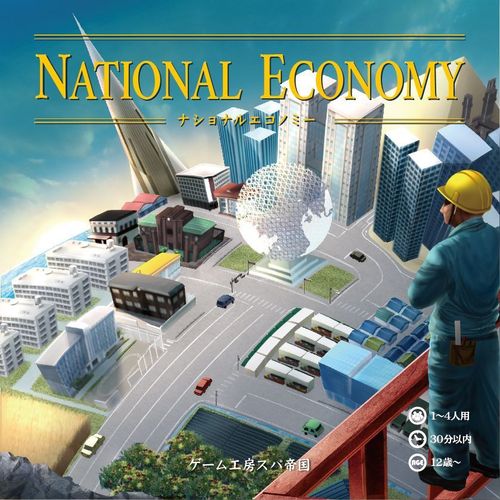
National Economy (2015)
National Economy (2015) Rulebook
Table of Contents
Table of Contents
Contents
- Money cards: $1 x16, $2 x20, $5 x12, $10 x16
- Worker cards: 4 colors x 7 = 28 total
- Round cards: 9
- Initial public workplace cards: 6
- Building cards: 64
- Consumer goods cards: 24
- Start player card: 1
- Unpaid wages cards: 15
- Game summary cards: 4
- Rulebook: 1
Game Setup
- Each player chooses a color and is dealt 2 worker cards.
- Place the initial public workplace cards* face up in the center of the table.
- Shuffle the building cards face down to form a draw pile. Leave space beside it for a discard pile.**
- Stack the round cards face down in round order.
- Create a dedicated building area on the table in front of each player.
- Place the money, unpaid wages cards, and remaining workers into the Supply.
- Stack the consumer goods cards into a pile.
- Create a money area separate from the Supply, called the Household. It starts with nothing on it.
* Place one each of Quarry, Mine, and School, plus a number of Carpenter cards matching the player count. Return any unused Carpenter cards to the box.
** When the draw pile runs out, shuffle the discard pile and use it to make a new draw pile.
Game Setup, Continued
Decide seating order and the starting player by a fair method, and give that player the Start Player card.
Starting with the starting player and going clockwise, give out $5, $6, $7, and $8. (This is for a 4-player game. In 2- or 3-player games, also give the starting player $5, and give each following player $1 more than the last.)
Each player draws 3 cards from the building card draw pile as their starting hand.
Now the game is ready to begin!
Flow of the Game
The game proceeds in the following order:
- The starting player places 1 worker card onto a workplace and uses its function.
- Going clockwise, the next player places 1 worker card onto a workplace and uses its function.
- Repeat the above until every player has used all of their workers. The round then ends.
- As round-end processing, each player pays money to the Household equal to the wage times the number of workers they have. If a player doesn't have enough money, they must sell buildings (details below). Also at this point, any player with 6 or more cards in hand must choose cards to discard until they have 5.
- Flip over the top round card and place it face up at the public workplaces. After round 9 is completed, the game ends.
Things You Can Do On Your Turn
What you can do on your turn is very simple. Just place 1 worker card from your hand onto any workplace you like, and use its function.
After using the workplace's function, play passes clockwise to the next player's turn.
Once you have used all of the workers you have on hand, there is nothing more you can do that round. Your turns are skipped for the rest of the round. The round ends once everyone has used all of their workers.
How to Read a Card
- Cost and name
- Function
- Asset value
- Category icon
About Workers
Workers are used to activate workplaces. Except for special cases such as the Mine, only one worker can be placed at a single workplace per round.
At the start of the game, each player is given 2 workers. You can gain more by using workplaces such as the School.
The maximum number of workers is 5. However, building Company Housing raises this limit.
When You Hire a New Worker
When you newly hire a worker, add it to your hand face down, in its "in training" state. It generates a wage, but it cannot work yet. At the start of the next round, turn it face up, and from then on you can use it as a worker.
Household and Supply
In this game, the two money areas called the Household and the Supply are both very important. They may look the same, but they have completely different functions, so be careful.
Supply
This is where money from outside the game is kept. When you sell a building at the end of a round, you receive money from here. Money never moves out of the Supply for any other reason.
Household
This is the shared money area that circulates within the game. Wages paid by workers are placed into the Household. Workplaces such as the Street Stall let you take money out of it.
Making Change
You may make change at any time during the game. However, be careful that a player's own total holdings, and the total amounts in the Supply and in the Household, must each remain unchanged.
The Important Function: "Build a Building"
Using a "Build a Building" workplace, you may "construct" a building card from your hand, placing it out into your own area. This is your property, and only you may use it (other players may not place workers on it). It is also worth points equal to its asset value at the end of the game.
When building, you must discard a number of cards from your hand equal to the number printed in the card's cost. You may freely choose which cards to discard — either building cards or consumer goods cards are fine.
Discarded building cards are moved face up to the discard pile, and discarded consumer goods cards are returned to the consumer goods pile.
End of the Round
When a round ends, first each player returns their workers to their hand.
Each player pays money to the Household equal to the wage printed on the round card times the number of workers they have.
If a player doesn't have enough money, they must "sell" a building they own, moving it to the public workplaces.* They receive money equal to its asset value from the Supply. A sold building can be used by anyone starting from the next round.
Wages must always be paid in full. If a player has given up every sellable building and still doesn't have enough money, they pay as much as they can, and take 1 "Unpaid Wages" card for every $1 they are short.
Flip over the top round card and place it face up at the public workplaces, then begin the next round starting with the starting player.
Once the round-end processing for round 9 is complete, the game ends.
* You may not sell a building if you already have enough money to pay.
Round-End Processing, Step by Step
- Each player returns their workers to their hand.
- Any player with 6 or more cards in hand chooses cards to discard until they have 5.*
- Pay money to the Household equal to the wage times the number of workers. If you have enough, proceed; if not —
- Sell a building, move it to the public workplaces, and take money equal to its asset value from the Supply. If you now have enough, pay; if not —
- Take 1 Unpaid Wages card for every $1 you are short. The round ends.
- Flip over a round card and place it at the shared workplaces. Begin the next round with the starting player. The game ends after round 9.
* When applying this rule strictly, resolve it in turn order starting from the starting player.
Game End
Once round-end processing for round 9 is finished, calculate scores as follows:
- Add the asset value of the buildings in your own area directly to your score.
- If a building in your area has a function that reads "at game end," calculate its bonus points and add them to your score.
- Add 1 point for every $1 you have.
- Subtract 3 points for every Unpaid Wages card you have.
Add all of this up. The player with the highest score wins.
If there is a tie for the highest score:
- If one of the tied players is the starting player, they win.
- Otherwise, whichever tied player is closest to the starting player in turn order wins.
Frequently Asked Questions
Q: Does my hand count toward my score? A: No. However, if you have the Agricultural Cooperative, your score increases based on the number of consumer goods cards in your hand.
Q: What if the Supply runs out of money? A: Substitute other denominations. Treat the money in the Supply and the Unpaid Wages cards as unlimited.
Q: What if the consumer goods cards run out? A: Substitute other cards. Also note that discarded consumer goods cards are returned to the consumer goods pile, not to the [building] discard pile.
Q: What if the building cards run out? A: The next time someone needs to draw a card, shuffle the discard pile and use it to remake the draw pile.
Q: Why don't we draw a card at the start of the round? A: You don't. Cards are only drawn when a workplace's function tells you to.
Q: What is the difference between a "workplace" and a "facility"? A: A "workplace" uses a worker to produce an effect. A "facility" functions just by being owned, without using a worker.
Solo Rules
In a 1-player game, the following changes apply to the rules.
Setup
- Don't use the Quarry. Return it to the box.
- Before shuffling the building cards, set aside 1 Farm and 1 Factory.
- After drawing your starting hand of 3 building cards, place the set-aside Factory on top of the draw pile.
- The initial public workplaces are the set-aside Farm plus the normal starting public workplaces — School, Carpenter, and Mine — for 4 cards total. Arrange them with the Farm as the newest and the Mine as the oldest.
(oldest ------------------------------> newest, then the next building drawn)
Rule Changes
- The Start Player card always stays with you; it never moves.
- The public workplaces have an order. Ones added later count as newer than ones already there. Buildings you sell are also added to this row.
- Buildings sell for half their price. The points for buildings you still own don't change.
- Every time you place a worker, rotate the newest not-yet-filled public workplace 90 degrees sideways to make it unusable. These workplaces become usable again at the end of each round.
- If you score 100 points or more at the end of the game, you clear the game!
Card Reference
Refer to this section if you get confused during the game.
Quarry — "The card pile" refers to the top card of the building card draw pile. If you already had the Start Player card, it stays with you and does not move.
Mine — Even if a worker card has already been placed here, another worker card can still be placed and used. The same player may use it more than once.
School — Take 1 worker card of your color from the general stock. Place it face down in the "in training" state. Turn it face up at the start of the next round to use it as a worker. Wages must also be paid for workers who are in training.
Carpenter — Lets you play a card from your hand out into your own area. The cost may be paid with either building cards or consumer goods cards. Discarded building cards go face up to the discard pile; discarded consumer goods cards return to the consumer goods pile.
Carpenter (3-4 player games only) — Depending on the player count, place these cards among the initial public workplaces.
Street Stall — Discarded cards are placed face up. Also, this cannot be used if the Household has $6 or more. In 1- or 2-player games, it may be used only once per round.
Market — Cannot be used if the Household has $12 or more. In 1- or 2-player games, it may be used only once per round.
High School — Your worker limit becomes 4. That is, if you originally had 2 workers, you gain 2; if you had 3, you gain 1. It cannot be used if you already have 4 or more workers.
Trade School — Workers gained this way do not become "in training" — they can work starting that very round.
Supermarket — Cannot be used if the Household has less than $18. In 1- or 2-player games, it may be used only once per round.
World's Fair — Cannot be used if the Household has less than $30. In 1- or 2-player games, it may be used only once per round.
University — Your worker limit becomes 5. It cannot be used if you already have 5 or more workers.
Farm — Take 2 cards from the consumer goods draw pile. Consumer goods cards have no use as buildings, but can be discarded as the cost when building, or when using the Street Stall, Factory, and so on.
Department Store — Cannot be used if the Household has less than $24. In 1- or 2-player games, it may be used only once per round.
Slash-and-Burn Field — This workplace disappears and is discarded after a single use. Turn the placed worker face down to make clear it has already worked. Note that nothing happens at the moment it is built.
Design Office — First reveal the top 5 cards of the building card draw pile so everyone can see them. Choose 1 to add to your hand, and discard the rest.
Construction Company — A "Carpenter" whose cost is 1 lower. For example, building a Factory using the Construction Company only costs 1 card to discard.
Warehouse — Cannot be used as a workplace; it functions just by being owned. It raises your hand-size limit at the end of the round.
Law Office — Cannot be used as a workplace; it functions just by being owned. It reduces the scoring penalty at the end of the game.
Coffee Shop — Cannot be used if the Household has less than $5. Unlike the Street Stall and Market, it doesn't require discarding a card.
Orchard — Draw consumer goods cards: 1 if your hand has 3 cards, 2 if it has 2, 3 if it has 1, or 4 if it has 0. It cannot be used if your hand has 4 or more cards.
Factory — Cannot be used unless your hand has 2 or more cards. You must discard from your hand first, then draw building cards.
Large Farm — An upgraded Farm. Among the cards that draw consumer goods, this one is the most expensive.
Restaurant — Cannot be used if the Household has less than $15.
Pioneer — The Farm, Slash-and-Burn Field, Orchard, and Large Farm each carry a farming-tool mark. If you hold these cards in your hand, you may build them into your own workplace area without paying their cost.
Real Estate Agent — Cannot be used as a workplace; it functions just by being owned. It increases your score at the end of the game. This building itself is also counted among the buildings you own.
Steel Mill — Lets you draw building cards without discarding any.
Agricultural Cooperative — Cannot be used as a workplace; it functions just by being owned. It increases your score at the end of the game, calculated based on your hand after you have discarded down to the hand limit.
Labor Union — Cannot be used as a workplace; it functions just by being owned. It increases your score at the end of the game. The number of points depends on how many workers you employ.
General Contractor — First build a building and pay its cost, then draw 2 building cards. You must be able to pay the cost with the hand you have before drawing those 2 cards.
Automobile Factory — Cannot be used unless your hand has 3 or more cards. You must discard from your hand first, then draw building cards.
Railroad — Cannot be used as a workplace; it functions just by being owned. It increases your score at the end of the game. The cards with an industrial mark are the Factory, Steel Mill, Automobile Factory, and Chemical Plant.
Head Office Building — Cannot be used as a workplace; it functions just by being owned. It increases your score at the end of the game. Cards with a lock mark cannot be used as a workplace — this includes this building itself.
Company Housing — Cannot be used as a workplace; it functions just by being owned. Your worker limit is normally 5, but Company Housing lets you increase it further.
Mansion — Scoring only; it has no special function.
Chemical Plant — When used, draw 4 cards if your hand has 0 cards, or 2 cards otherwise.
Twin Towers Construction — You must build two buildings of the same cost at the same time. If that cost happens to be 3, you discard 3 cards from your hand to pay for both of them together.
Round Card (back) — Shows the round number and the wage that must be paid at the end of the round. Note that the wage grows higher as the rounds go on.
Consumer Goods — These exist to be discarded as a cost. Return discarded ones to the consumer goods pile. Their artwork varies, but they have no functional difference. If they run out, substitute other cards. Consumer goods cards also count toward your hand-size limit.