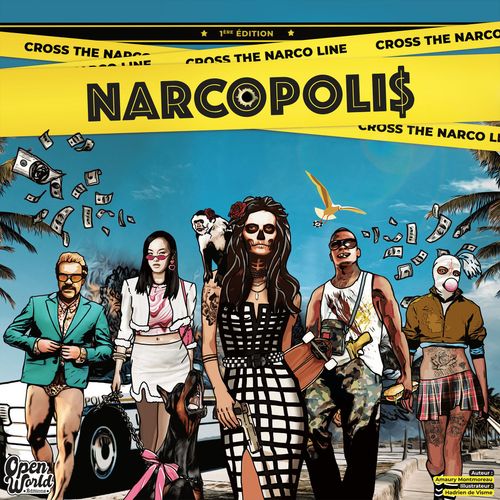
Narcopolis
Narcopolis Rulebook
Table of Contents
Table of Contents
- 2. Game Components (Les éléments du jeu)
- 3. Setup (La mise en place)
- 4. The Game (Le jeu)
- 5. Playing the Game (Jouer)
- 1. Collect your income (Prendre ses recettes)
- 2. Move (Se déplacer)
- 3. Take position (Prendre position)
- 4. Manage your Business (Gérer ses Business)
- 5. Manage your Influence (Gérer son Influence)
- 6. Manage your Jobs (Gérer ses Jobs)
- 7. Manage your Reputation (Gérer sa Réputation)
- 8. Event Cards (Les cartes Évènement)
- 9. Prison (La prison)
- 10. Combat (Les combats)
- 11. Exchanges (Les échanges)
- 6. End of Game (Fin de jeu)
- 7. Two-Player Version (Version 2 joueurs)
- 8. Advanced Level (Niveau avancé)
- 9. Quiz
2. Game Components (Les éléments du jeu)
- 5 Character pawns
- 5 Reputation pawns
- 75 banknotes (25 x 1M$, 25 x 5M$, 25 x 10M$)
- 58 Job cards (including 10 advanced-version cards)
- 45 Influence cards (10 different)
- 30 Event cards (including 10 two-player-version cards)
- 5 player boards
- 6 Role cards
- 8 Weapon cards (Armement)
- 8 Corruption Police tokens
- 10 Blocked District tokens (Quartier Bloqué)
- 2 Corruption City Hall tokens (Corruption Mairie)
- 30 Business tokens: Weapons (6 per colour)
- 30 Business tokens: Brothels (6 per colour)
- 30 Business tokens: Drugs (6 per colour)
- 30 Business tokens: Casinos (6 per colour)
- 1 first player token (NARCOPOLIS)
- 3 dice and 1 cup
The Board (Le plateau)
Narcopolis is a city made up of 5 zones (Notorious Beach, Elliott Island, Nate Village, Cypress Park, Matic Hill). Each zone contains 7 districts (Quartiers) of the same colour.
- Districts: the 7 districts of each zone.
- Scores track (Piste des scores): the track along the edge of the board used to record Reputation.
- Starting points (Points de départ des joueurs): the starting district of each player.
- Prison: the prison space on the board.
3. Setup (La mise en place)
Individual setup
Each player chooses one of the 5 characters and receives:
- 1 player board,
- 2 Influence cards,
- 6M$,
- 2 Job cards,
- 1 starting advantage*.
Then:
- On your player board, place your future potential Businesses (Weapons, Brothels, Drugs, Casinos tokens) in the spaces, covering the potential earnings.
- Place your Character pawn on your starting district.
- Place one token of each Business on one or several districts of your starting zone.
- Place your Reputation pawn on the number 5 of the scores track.
* Each player takes their starting advantage: Booki: 1 Job card. Busta: 2 Influence cards, including one bomb. Furi: 2 Business. Killah: 8M$. Miss T: 1 Reputation point.
Collective setup
- In the classic version of the game, it is recommended to use only the 10 Event cards of scenario 1 (see p.14) and to remove the Job cards of type "Baron".
- Place the Influence, Job and Event decks (Event on the board, face down), along with the banknotes that will form the bank, face down.
- In the 2-player version, the Blocked District tokens close 2 districts per zone (see p.18-19).
The first player to have 2 correct answers to the quiz (see the end of the booklet) starts. If you have all already played and know the rules, the most cunning player starts.
If you are a beginner, the Help Sheet (Fiche Aide) supplied with the game will make it easier to get into the game.
Each character is unique. Each has a history, a starting district, a starting advantage and a personal income board (Tableau des gains).
4. The Game (Le jeu)
Narcopolis has a classic version and an advanced version (with several modules, see p.20). It is advised to play your first game with the classic version.
To win and become the new Boss of Narcopolis, you must have the most Reputation points at the end of the game.
There are 3 ways to gain Reputation points:
- Carry out Jobs (cards)
- Exert Influence (cards)
- Make a Patronage (Mécénat) (buy Reputation points)
Each point won moves you forward on the scores track. During the game you can gain and lose Reputation points.
You cannot leave the game. If you are at 1 Reputation point, you earn an income of 10M$ per turn, paid by the bank.
To develop in Narcopolis you need money. The base unit is the million Dollars.
There are 3 ways to earn money:
- Develop Businesses (Weapons, Brothels, Casinos, Drugs)
- Exert Influence (cards)
- Humiliation (sell Reputation points)
Players take turns in clockwise order.
At the start of each round of play, the first player reveals an Event card which changes a rule of the game. Its effect impacts all players and lasts until a new Event card is revealed.
On each turn you start by collecting your income (Prendre ses recettes). The rest of the actions are optional and can be carried out in any order.
On each turn you can only perform one action per category (MANAGE YOUR BUSINESS, MANAGE YOUR INFLUENCE...), except for those marked with a number symbol*.
Example: TAKE POSITION = Attack OR Deploy.
* A category marked with a 2 can be performed 2 times; one marked with a 3 can be performed 3 times; one marked with the infinity symbol can be performed unlimited times.
Turn structure
Phase 1: Collect your income
- COLLECT YOUR INCOME (Prendre ses recettes)
Phase 2: Actions
- MOVE (Se déplacer)
- TAKE POSITION (Prendre position)
- Attack: 3M$ per Business
- Deploy: 5M$ per Business
- MANAGE YOUR BUSINESS (2 times)
- Develop Businesses in districts already exploited: 3M$ per Business
- Dismantle a district: 10M$
- MANAGE YOUR INFLUENCE
- Play an Influence: 3M$ to 25M$
- Buy an Influence: 3M$
- MANAGE YOUR JOBS (3 times)
- Carry out a Job: 0M$
- Exchange a Job: 10M$
- MANAGE YOUR REPUTATION (unlimited)
- Patronage (Mécénat): +1 Reputation point for 20M$
- Humiliation: sell 1 Reputation point for +10M$ (can be performed 2 times)
5. Playing the Game (Jouer)
1. Collect your income (Prendre ses recettes)
This is the first action of each turn.
Your player board has an income board (Tableau des gains) that lets you calculate your income. Every Business you develop brings you money each turn, unless stated otherwise (Corruption Mairie, Event card). This money represents your income.
Businesses are built from left to right on your income board. When you build a new one, you take a Business pawn from your income board and place it on the district you are exploiting; a new number is then revealed. This is the new amount of your income for that Business.
Only the highest number of each Business row is counted when calculating income.
Example from the rulebook: the income of a turn is the sum of the highest income of each Business (here 8 + 4 + 2 + 2 = 16M$).
2. Move (Se déplacer)
In Narcopolis, movement is free on the Map. You can go to any district of your choice, provided it is not occupied by an opponent's Character pawn.
3. Take position (Prendre position)
There are four types of Business in Narcopolis: Weapons (Armes), Brothels (Bordels), Casinos and Drugs (Drogues).
The 35 districts of the city can be exploited.
- Attack an opposing district (see p.15, Combat): move your Character pawn onto a district already exploited by an opponent and pay 3M$ per Business on it to attack.
- Deploy a Business in a new district: move your Character pawn onto a district that is not exploited by an opponent and pay 5M$ to develop a new Business.
4. Manage your Business (Gérer ses Business)
- Develop a Business in a district already exploited (up to 2 times per turn): developing a new Business in a district you already exploit costs 3M$. Your Character pawn may be placed on that district or on another district.
- Dismantle a district: for 10M$ you may dismantle all the Businesses of one district you exploit. You take the Business tokens back and place them on your income board.
When you develop a new Business in a district, you take it from your income board and place it on the board. The new number revealed on your income board is your new income for that Business (see above).
In a district, a type of Business can only be exploited once.
Example: you cannot have two Casino pawns on the same district.
A district can only be exploited by one player.
The prison cannot be exploited.
5. Manage your Influence (Gérer son Influence)
Influence cards are actions in the city and/or against opponents (bribe, assassinate, take part in Fight Clubs...).
Each Influence card has the layout described below. The description explains how to use the card.
- Card name: the name of the Influence card (for example, Corruption Mairie).
- Description: the effect of the card.
- Cost: the price to pay to play the card.
- Influence icon: the icon identifying the card as an Influence card.
- Token icon: the icon of the tokens involved by the card, if any (for example, "Corruption" tokens).
Example: CORRUPTION MAIRIE (cost 6M$). Description: "For one turn, blocks the income of an opposing district. Designate it with the 'Corruption mairie' token."
Influence cards can involve other players or even be used against yourself. Some can bring in money and/or Reputation points.
- Play an Influence: each turn you may play an Influence card by paying the cost shown on it (3M$ to 25M$). It directly affects your situation or that of an opponent.
- Buy an Influence: otherwise, you may buy an Influence card by paying 3M$ to the bank. You then draw the top card of the Influence deck.
6. Manage your Jobs (Gérer ses Jobs)
In Narcopolis, Jobs are missions that let you win Reputation points. There are 58 Jobs, all unique: 48 for the classic version and 10 more ("Baron" cards) for the advanced version (see p.20).
Each Job card shows: the Job card type pictogram, the Job to carry out, the corresponding gain, and the number of Reputation points won.
Example: LE REQUIN. Job: "Exploit 3 Brothel Businesses in Nate Village." Gain: 2 Reputation points.
- Carry out Jobs (up to 3 times per turn): when you finish a Job, advance your Reputation pawn on the scores track by the number of points you have just won, then put the Job card back under the deck and draw a new one on top.
When a Job is finished, the points are acquired, even if you no longer meet the conditions later in the game.
When you draw a card and its conditions are already met, you can take the associated Reputation points immediately and draw a new card.
- Exchange a Job: on your turn, instead of carrying out Jobs, you may discard one or more Jobs at once and draw new ones for 10M$ each, paid to the bank.
You may play one or more Job cards (maximum 3) only during YOUR turn, even if their conditions were met during an opponent's turn. Example: you win a combat in a zone when it was one of your opponents who started the combat on their turn (see p.15). On your turn, you can then play the corresponding Job card.
7. Manage your Reputation (Gérer sa Réputation)
- Patronage (Mécénat): each turn you may win over future local elected officials and make Patronage by financing their electoral campaigns, in exchange for as many Reputation points as you wish. Patronage costs 20M$ per point, paid to the bank.
- Humiliation (up to 2 times per turn): each turn you may earn more money by selling 1 or 2 Reputation points to the bank for 10M$ each.
You can no longer make Patronage when you have 16 Reputation points or more.
8. Event Cards (Les cartes Évènement)
At the start of each turn, before starting, the first player reveals a new Event card. This card changes a rule of the game for one turn, until a new Event card is revealed. Its effect impacts all players.
At the start of the game, choose 10 Event cards at random OR the cards of Scenario 1 (recommended for the classic level, see the card layout below).
Each Event card shows: the Event card type, the impacted element, the story and effect of the card, the scenario number, and the card typology (blue = positive, red = negative).
Example card text: "Narcopolis hosts all the Leaders of the surrounding Cartels for the 21st NTBA congress, 'new money-laundering techniques'. Casino income is doubled."
9. Prison (La prison)
When an opponent puts you in prison with a "Balance" Influence card, you move your Character pawn into prison for 1 game turn. You can play normally the following turn.
When you are in prison:
- The only action affected is Movement. You cannot move, so you cannot attack or deploy into a new district.
- You can still collect your income and carry out all other actions not linked to movement.
If you play a "Corruption Juge" card, you can move and carry out your turn normally. The "Corruption Juge" card also means you are not affected by prison.
10. Combat (Les combats)
Combats serve to take possession of the Businesses an opponent exploits on a district.
To attack an opponent, you must go to a district they exploit and pay the bank 3M$ per Business exploited on it.
Example: if your opponent has a Casino pawn and a Drugs pawn on the district, you must pay 6M$ to the bank.
a. Stakes (Enjeux)
If the attacker wins the combat, they replace the defeated player's Businesses on the district, identically. Concretely, the defender returns the district's Business tokens to their income board, and the attacker does exactly the opposite: they take the same Businesses from their income board and place them on the district.
If the attacker loses the combat, there is no movement of Businesses.
If the attacker wins but does not have enough of one or more Businesses to replace identically, they cannot substitute another Business.
b. How to fight (Comment combattre)
Combat is played with 3 classic six-sided dice. It stops when one player announces that their opponent is bluffing and checks the result.
A bluff is when the score is different from the score announced.
When the dice are rolled, the highest value represents the hundreds, the second the tens and the third the units (for example, 4, 1 and 6 are worth 641). 111 is the lowest score and 666 the highest.
When you attack, you place the 3 dice in the cup, shake it, and look only at the result showing on the dice at the bottom of the cup. Then you announce a result (the true one, or another one), always without showing the dice to your opponent. Two cases then arise:
- Your opponent does not believe you: they must announce "you're bluffing" (tu bluffes). Hold out the cup so they can check. If you bluffed, you lose; otherwise, they lose.
- Your opponent believes you and wants to continue the combat: they take the cup, shake the dice on their turn, and announce a result above the one you announced. You may also decide whether or not to believe them, and the combat continues until one of you announces "you're bluffing" to check the winner.
Example: Booki attacks Killah. He rolls the 3 dice without showing the result to his opponent. He gets 421 but announces 531 (he bluffs). Killah takes the cup, rolls the dice without showing the result to Booki. She gets 544 and announces 544 (she is not very gallant). Booki takes the cup, rolls the dice without showing the result to Killah. He gets 541 but announces 621 (he has no choice but to bluff, since his score is below the last score announced by Killah). Killah says he is bluffing; Booki reveals the dice. He had indeed bluffed, so he loses.
11. Exchanges (Les échanges)
In Narcopolis, cash and influence circulate. Barter, negotiation and deals are strongly recommended.
Between players, money can be lent, negotiated, given, or returned with interest. Influence cards can be sold, exchanged or bequeathed. It is up to you to decide whom you trust.
It is forbidden to exchange Reputation points, Jobs and Businesses.
6. End of Game (Fin de jeu)
The last round of the game is triggered when a player reaches at least 20 Reputation points OR when the 10th Event card is revealed.
If you reach 20 Reputation points, the game must end in such a way that all players have played the same number of turns.
Once you have at least 20 points, you can no longer lose any, even if your opponents still have to play. They can still challenge you in combat, take your Businesses, or play an Influence card against you.
It is possible to exceed 20 Reputation points. The winner is the player with the most Reputation points at the end of the game.
In case of a tie in points, the player who finishes with the most developed Businesses wins.
If there is still a tie, the game is settled by a final combat.
7. Two-Player Version (Version 2 joueurs)
Furi is the new Boss of Narcopolis and you are her henchmen... Your objective is to take her place!
The rules and mechanics of the 2-player version are the same as for the version described above. It is therefore recommended that you read them beforehand.
Setup
- Before starting, each of the 2 players chooses a character from: Booki, Busta, Miss T and Killah. Neither player can choose Furi.
- Furi starts on her ordinary starting zone, Cypress Park.
- Furi receives 5 Influence cards (Bombe, Balance, Racket, Hitman and Corruption Mairie).
- Furi starts with 10 Reputation points, whereas you always start with only 5.
- From the start of the game, Furi has 2 districts per zone (of her choice), on which her 4 types of Business are spread. She therefore starts with 20 Businesses in play, that is, the first 5 columns of her income board.
- Each player then takes 5 Blocked District (Quartier Bloqué) tokens and places them on the board so as to block TWO districts PER zone (that is, 10 districts in total).
- Each player takes the player board of their character and sets up as in a classic game (see p.6).
- Select only the "2 joueurs" Event cards and place them face down on the board, as in the classic version.
The game stops when a player has passed Furi.
Furi
- At each turn, when a "2 joueurs" Event card is revealed, Furi takes 1 Reputation point and carries out the action shown on the card: combat, Influence card, or deployment.
Card layout: the Event card shows the impacted element for the players and Furi's action, which is one of the following icons:
- Crossed swords: Furi attacks an opposing district.
- Flag: Furi deploys into a new district.
- Influence hand: Furi plays an Influence card.
- Crossed circle: Furi does nothing.
Example card text: "The mayor of Narcopolis decides to install cycle lanes throughout the city, slowing movement. Except Furi, no one can leave the zone they are currently in."
- To determine which player carries out Furi's action, the player who started the turn rolls one die. If the result is odd, player 1 controls Furi; if it is even, player 2 controls Furi.
- The player who starts the turn changes every turn, so each player plays two turns in a row (EXCEPT on the first turn).
- At the start of each turn (when the Event card is turned over), Furi advances one Reputation point on the scores track.
- Furi never collects her income.
- Furi never pays for her actions, and is not allowed to attack the same district two times in a row.
- When Furi wins a combat, she destroys the Businesses of the attacked district. The Business tokens then go back onto the income board of the player concerned.
End of the 2-player game
The game ends if:
- Furi reaches 20 Reputation points. She wins and all players lose.
- A player passes Furi. If the turn is over, that player is declared the winner. If the turn is not over, the last player takes a final turn, and the winner is the one of the two who has passed Furi with the most points.
8. Advanced Level (Niveau avancé)
The advanced level is recommended for players who have played the classic version at least once. One or more of the following points may then be introduced into the rules, at will.
1. Introduce the "Baron" cards into the Job cards
The "Baron" cards offer Job extensions that let you win Bonuses. They are therefore recommended for a more advanced level.
Example card: BARON DE ELLIOTT ISLAND. Exploit at least 8 Businesses in Elliott Island. Gain: 2 Reputation points. BONUS 1: +2 Reputation points, exploit at least 12 Businesses in the zone. BONUS 2: +2 Reputation points, exploit at least 14 Businesses in the zone.
The card shows the number of Reputation points won, the potential Reputation point bonuses, and the optional bonuses to carry out.
2. Development limit
You cannot develop a Business if it creates a gap of more than two levels between the most developed Business and the least developed Business, unless that gap results from an interaction with another player (Influence card or combat).
The rulebook illustrates this with two examples: one layout is crossed out as not allowed, and one is shown as allowed.
3. Under-announcing in combat
During a combat, if a player under-announces a score (announces a lower number than the one rolled), this is not considered a bluff.
Example: if you roll 632 but announce 621, this is not a bluff.
This variant offers opportunities for strategy and trickery, recommended for a more advanced version of the game.
4. Raising the stakes
You may now, if you wish or if the fever of the challenge takes you, bet 10M$ or 1 Reputation point during a combat against an opponent, to spice up the stakes, provided your opponent is also a player.
5. Random Event cards
In the classic version, it is recommended to play with the Event cards of Scenario 1 (see p.14).
To spice up the game at the advanced level, shuffle all the Event cards into the deck to build a random scenario with more impacts.
6. Armament cards (Les cartes Armement)
Introduce the Armament cards into the game.
Armament cards spice up combats by giving an advantage to the player who plays them.
At the start of each combat, both opponents each draw 2 Armament cards at random from the deck and look at them. They keep one and put the other back in the deck. During combat, they can only use the kept card once.
Example card: FUSIL À POMPE (Shotgun). Effect: "Exceptionally, you may announce a number lower than your opponent's. The combat restarts from this last announced number."
7. Role cards (Les cartes Rôle)
Introduce the Role cards into the game.
Role cards change your game objective (or not) and add strategy and trickery to the game.
At the start of the game, each player draws a Role card. Depending on whether you are a Gangsta or an Infiltrator, you must play the game normally or sabotage it entirely to prevent anyone from winning.
- Gangsta: to win, you must have the most Reputation points at the end of the game. Warning: if one of you is an Infiltrator, that Infiltrator must reach 20 Reputation points to win.
- Infiltrator (Infiltré): to win, you must sabotage the game. Make sure no one reaches 20 Reputation points (or more), including yourself.
9. Quiz
To determine who starts the game.
The first player to have 2 correct answers to the quiz starts the game. (See also the Setup section.)
- A: How many Businesses can you develop at most in one turn?
- B: What is the only movement constraint?
- C: How many ways are there to earn money?
- D: How many ways are there to gain Reputation points?
- E: How many districts are there in one zone?
- F: How many actions can you take at most in one turn?
- G: How much does Humiliation cost?
Answers (printed upside down in the original booklet): A: 3 - B: You cannot move onto a district occupied by an opposing player's Character pawn - C: 3 - D: 3 - E: 7 - F: 7 - G: 1 Reputation point for 10M$.