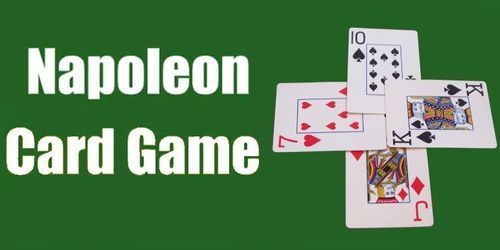
Napoleon
Napoleon Rulebook
Table of Contents
Table of Contents
Players and Cards
Nap can be played by as few as three people, but it works better with four or more. There are no fixed partnerships — on every hand, the player who wins the bidding plays alone against everyone else at the table.
The game uses a standard 52-card pack. Within each suit the cards rank, from high to low:
Ace, King, Queen, Jack, 10, 9, 8, 7, 6, 5, 4, 3, 2
Nap was traditionally played with the complete pack, but many players today prefer to strip out the low cards so that fewer cards are left undealt. Common reductions are: three players use 24 cards (Ace down to 9), four players use 28 cards (Ace down to 8), and five players use 32 cards (Ace down to 7).
Deal
Except at the very start of the game, the cards are not reshuffled between hands — they are simply gathered up and cut by the player to the dealer's right — unless a bid of Nap (five tricks) or higher has just been won, in which case the pack is shuffled before the next deal.
The dealer gives five cards to each player, dealt as a batch of three followed by a batch of two, or a batch of two followed by a batch of three. Both the deal and the play of the hand move clockwise around the table, and the turn to deal passes to the left after every hand.
Bidding
Bidding opens with the player sitting to the dealer's left and continues clockwise, finishing with the last person to make a bid. Each player gets exactly one turn to speak: at your turn, you must either pass or make a higher bid than the one currently on the table.
The standard bids, from lowest to highest, are:
- Three — the bidder commits to winning at least three of the five tricks.
- Four — the bidder commits to winning at least four of the five tricks.
- Nap (also called Five) — the bidder commits to winning all five tricks.
- Wellington — also a commitment to win all five tricks, but for a bigger payout. Wellington may only be bid once someone else at the table has already bid Nap.
If every player passes without making a bid, the hand is abandoned without being played, and the next dealer shuffles and deals a fresh hand.
Play
The winner of the bidding leads the very first card of the hand, and whatever suit that card belongs to becomes trumps for the rest of the hand — there is no separate trump announcement.
Every trick is won by the highest trump played to it; if no trump was played, the trick goes to the highest card of the suit that was led. Whoever wins a trick leads to the next one.
Players must follow suit whenever they are able to: if you hold a card of the suit that was led, you must play one. If you have no card in that suit, you may play any card you like — either trumping the trick or discarding a card from a different suit.
Scoring
If the bidder makes their bid — winning at least as many tricks as promised — every other player pays the bidder according to the level of the bid:
- Three: 3 units from each opponent
- Four: 4 units from each opponent
- Nap (Five): 5 units from each opponent
- Wellington: 10 units from each opponent
If the bidder fails to win enough tricks, the bidder instead pays each opponent the same amount they would otherwise have received — so a failed bid of Nap costs the bidder 5 units to every player at the table.
Variations
Two. Some groups allow an additional bid of Two, ranking below Three, in which the bidder undertakes to win only two tricks. It is worth 2 units.
Misère (or Mis). A bid to lose every single trick. It ranks between Three and Four in the bidding order and is worth 3 units. The bid fails if the other players manage to force the bidder to win even one trick.
Blücher. A bid to win all five tricks, worth 20 units. It may only be made after another player has already bid Wellington. The bid is traditionally said to be named after the Prussian general Blücher, who fought alongside Wellington against Napoleon at the Battle of Waterloo.
Some tables double the stakes for a won Nap, Wellington, or Blücher while leaving a lost bid at the normal rate; others double the payment in both directions, so that Nap becomes 10 units, Wellington 20 units, and Blücher 40 units regardless of whether the bid succeeds or fails.
Purchase Nap. Before the bidding begins, each player may pay a fixed stake — typically 1 unit — into a shared pool and discard any number of unwanted cards. The dealer then gives each player who bought in the same number of fresh cards from the undealt stock. The pool is claimed by the first player who bids Nap, Wellington, or Blücher and then wins all five tricks.
Peep Nap (the Floater Variant)
Peep Nap is an older variant of Nap that adds one extra, shared card to each deal, called the "floater." Before bidding, any player may pay into a pool for the chance to look at the floater privately, without showing it to the rest of the table. In some groups, only the eventual bidder of Nap or higher is allowed to make use of it. Whoever wins a bid of Nap or better collects the pool on top of the normal payments from the other players. Everyone at the table — including players who speak after the eventual winning bidder — is entitled to pay to peep before their own turn to bid.
One commonly reported version of Peep Nap, played in the south of England, works as follows. It supports three to seven players, with the pack reduced according to the number of players:
- 3 players: 20 cards (Ace–10 of each suit)
- 4 players: 24 cards (Ace–9 of each suit)
- 5 players: 28 cards (Ace–8 of each suit)
- 6 players: 32 cards (Ace–7 of each suit)
- 7 players: 36 cards (Ace–6 of each suit)
As in standard Nap, the pack is only reshuffled at the start of the game and after a bid of Nap or higher is won.
Before each deal, every player pays 1 unit into the kitty. The dealer then deals five cards to each player and one extra card, the floater, face down in the middle of the table. Bidding begins with the player to the dealer's left and goes once around the table; immediately before bidding, each player may look at the floater privately by paying one further unit into the kitty.
Every bid can be made either "with the floater" or "without the floater," and a bid without the floater ranks just above the equivalent bid with it. A player may bid "with the floater" without having paid to look at it, and equally may pay to look at it and then choose to bid "without the floater" if it turns out not to help. If the winning bid was made "with the floater," the bidder picks up the floater card and discards one unwanted card — possibly the floater itself — before leading to the first trick.
In this version the lowest permitted bid is Four with the floater. The full list of bids, from lowest to highest, along with their payouts, is:
| Bid | Requirement | If the bidder wins | If the bidder loses |
|---|---|---|---|
| Four with floater | Win at least 4 tricks | Receive 2 units from each player | Pay 2 units per player into the kitty |
| Four without floater | Win at least 4 tricks | Receive 2 units from each player | Pay 2 units per player into the kitty |
| Nap with floater | Win all 5 tricks | Win the kitty, plus 5 units from each player | Pay 5 units per player into the kitty |
| Nap without floater | Win all 5 tricks | Win the kitty, plus 5 units from each player | Pay 5 units per player into the kitty |
| Bonaparte with floater | Win all 5 tricks; must lead your lowest trump to the first trick | Win the kitty, plus 10 units from each player | Pay 10 units per player into the kitty |
For example, with five players at the table, winning a bid of Nap collects the whole kitty plus 20 units (5 from each of the other four players); losing it means paying 25 units into the kitty and nothing directly to the other players. Because the kitty keeps growing whenever a bid fails, riskier bids become more tempting the longer the pool has gone unclaimed.
The highest bidder still chooses trumps by leading the first card, and normal play and follow-suit rules apply: the highest card of the suit led wins the trick unless it is beaten by a trump, and the trick winner leads next.
Note that a Wellington bidder is required to lead a non-trump card. This means a player holding five cards of a single suit cannot realistically bid higher than "Wellington with the floater," and even that is only playable if the floater is a different suit — allowing the player to discard a trump and lead the floater instead. A player stuck bidding Wellington with a hand of one suit only has the option of naming a different suit as trumps, in which case the bid is effectively doomed once an opponent trumps in.
If every player passes without reaching the minimum bid of four tricks, the hand is thrown in and redealt by the player to the left of the dealer, with each player again paying 1 unit into the kitty before the new deal.
Reported local versions of this variant differ in their bid ladder. In one, played in Aylesbury, there is no separate Wellington bid, and the bid otherwise called Bonaparte above is simply called Napoleon (distinct from the ordinary Nap bid). In another, played in Dorset, the available bids are Three with floater, Three without floater, Four with floater, Four without floater, and Nap as the top bid — with no equivalent of Bonaparte or Wellington at all.