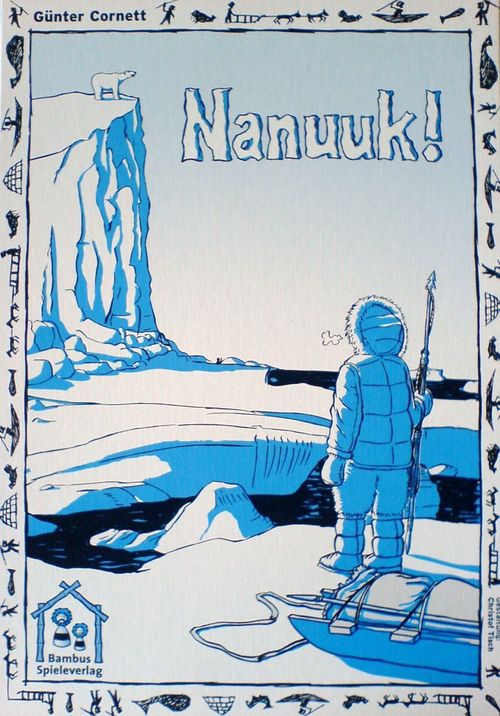
Nanuuk!
Nanuuk! Rulebook
Table of Contents
Table of Contents
Game Material
- 1 game board: showing the mighty ice-floa.
- About 70 wooden sticks to mark the cracks in the ice.
- 4 hunter pieces (in the colours white, yellow, red and blue).
- 3 wooden polar-bears.
- 16 dark pieces as equipment (four at a time of harpoons, huskies, sledges and kayaks).
- 21 light pieces as animals (six at a time of fishes, seals, walrusses and three whales).
- 4 dark pieces "Inuk" – you need to hunt whales.
- 4 game sheets in the colours of the players with all information about bag, equipment and the score.
Part of this game is also a booklet with information about the life of the Inuit (Inuit, the singular Inuk, is how the people living in the arctic call themselves in their own language).
Variants of Nanuuk!
-
If using husky and sledge the player may choose if he likes to let arise one or two cracks (either one crack at the end of the double-move or one crack after each step of the double-move).
-
If you want to avoid that one player has no more moves during the game, upon the following rule can be agreed: A wooden stick must not be laid down blocking a hunters way to every igloo if it is possible. This means the following order has priority (see figure):
a) lay down wooden stick on a free C-line, without blocking any player b) lay down wooden stick on a free C-line, blocking a player c) lay down wooden stick on a free d-line, without blocking any player d) lay down wooden stick on a free d-line, blocking a player.
This rule is some more complicated, not so thrilling, but even more social.
-
If you want a game with less possibilities to move, you can lay down some wooden sticks on the game board during the game preparations.
Game of Introduction
I recommend a short game of introduction without animal, inuk, and equipment pieces and without game sheets to learn that better (it will take about 10 minutes depending on temperament of the players). It is tactical interesting and more than only learning the essential rules.
Information
The cracking of the ice is bound to the movement of the hunter pieces.
Game Preparations
The wooden sticks are placed next to the game board. Each player takes one hunter piece. In a two-player game both players get two hunter pieces.
In a three-player game only a part of the game board is needed: All fields marked with three points don't take part in the game. It makes sense to cover them with animal or equipment pieces turned upside down.
Start of the Game
One after the other each player places his hunter piece on an empty field of the game board. In a two-player game the first player places one of his hunters on an empty field. Then the other player places both his hunters on empty fields. Finally the first player places his second hunter piece.
How to Move
The first player moves his hunter (in a two-player game: one of his hunters) to an empty adjacent field. Entering the new field a crack appears in the ice. Those cracks always divide two fields. As a matter of principle a crack always starts in one corner of the field just entered and ends at a point which is not a corner of that field. The cracks develop star-shaped in any direction away from the just entered field.
A basic rule for every move is: A hunter piece never can be drawn across a crack! On one field there can only be one hunter piece!
Every crack is marked with a wooden stick. However a crack logically can arise only where no other crack already exists, this means where no wooden stick lies. Naturally no crack can appear on the edges of the ice floa, too. If all adjacent fields of the field just entered are divided by cracks all new cracks arise between two corners of the just entered field.
Example: The hunter moves from field A to field B. (A hunter piece standing on field E is not allowed to move to field F because of the crack between E and F (Fig. 1).)
The cracks: As long the least C-line in the drawing is not occupied by a wooden stick, the player has to lay down his wooden stick on one of the vacant C-lines (Fig. 1). If all C-lines are occupied he lets the crack arise at a free d-line (Fig. 2).
The player moving the hunter piece can decide within the bounds of these rules where the crack arises. After one such move the next player gets the turn.
End of the Game
A hunter piece on a field with cracks at all edges or other pieces or the edge of the ice floe on the free sides cannot move. In a three- or four-player game this piece is removed from the game board. The other players play until only one player is left over. This player is the winner.
In a two-player game one of the players looses, if at the beginning of his move both of his hunter pieces cannot move or if one of his pieces cannot move only because of cracks or cracks and the edge of the ice floa.
At the end of these rules you find some variants for this game of introduction.
Game of Introduction Variants
Two Inuit Hunt a Polar Bear (a three-player game)
The game is played on 24 fields. Two player get an Inuk piece, the third one gets a polar bear. The polar bear may move once or twice in each round. A crack only arises at the end of the move. The polar bear wins if one Inuit is enclosed. The Inuit both win together if the polar bear is enclosed.
Variants:
a) When the polar bear moves twice a crack arises after each step. b) The polar bear has always to move twice. c) The polar bear may move once or twice or stay on its field. If it stays on a field a crack arises at the field where it is. d) If the Inuit enclosed the polar bear, they fight for the fur, this means they try to enclose each other.
Two Inuit Hunt a Polar Bear (a two-player game)
Like the three-player game. One player gets both Inuit.
Variants:
a), b), c) as above e) the Inuit player always moves only one of his pieces. The other one stays on a field without arising a new crack. (It makes sense to combine variant e) and b) using both rules together or leaving both rules out. This is for equal chances.)
Two Inuit Fear a Polar Bear (a two-player game)
Each player gets an Inuk piece. A polar bear placed on the game board first is moved each round by every player (and lets arise a crack with every move). One can also take two or three polar bears.
Variants:
a), b), c) as above
Game with a "Partner" (four-player game variant)
The players sitting face to face are "partners". The rules are the same as in the basic game, but the game ends, when the first hunter piece is enclosed.
Goal of the game it is to make the "partner" piece unmoveable. However it makes sense to call this player "partner" even with that goal. At the beginning of the game both players have the same goal, to bring the two own hunter pieces together, so that one "partner" can be captured by the other.
At the same time they try to isolate the opponents hunter pieces from each other and give them as much fields as possible, so that none of them is enclosed.
Neighbourhood Variant
Rules as above. The player wins whose left (right) neighbour is unable to move first.
Helpers Variant (a two-player game)
Each player gets a polar bear and an Inuk piece. The goal is to enclose the opponent's polar bear. If an Inuk piece is enclosed the game is harder to win for the player in question but not lost at all. The Inuk only helps the polar bear.
(You can tell one polar bear from the other if one player uses two polar bears together as a very fat one.)
Nanuuk!
A tactical family game for 2 – 4 players aged 8 years and up.
Game Preparations
The wooden sticks are placed beside the game board. Each player gets:
- one game sheet
- one hunter piece of the same color
- the following pieces: harpoon, husky, sledge, kayak.
All equipment of each player is laid down on his game sheet.
On the left-hand side: the equipment the hunter takes with him and the bag of hunted animals.
On the right-hand side: equipment in the igloo and all bag of hunted animals taken to the igloo during the game.
There are two Inuk-places on the sheet as well. Like for the places of the animals the left place is for the Inuk attending the hunter, the right-hand side place is for the Inuk staying in the igloo after a successful whale hunt.
As a matter of principle on a place on the left-hand side of the game sheet can only lie one animal, equipment or Inuk piece at the same time. On the right-hand side there may lie as many Inuk and animal pieces as possible.
The hunter has got only the harpoon when the game starts. Therefore this equipment piece is laid down on the harpoon place on the left-hand side of the game sheet. Husky, sledge and kayak are placed to the right-hand side at first.
Game Construction
The polar bears, the animal pieces fish, seal, walrus and whale and the Inuk pieces are placed on the game board as shown:
Two-player game
- 2 polar bears, 3 fishes
- 4 seals, 4 walrusses
- 3 whales, 3 Inuit
The two-player game may be played also with two hunter pieces per player. Then the same material as in the four-player game is needed.
Three-player game
- 2 polar bears, 4 fishes
- 4 seals, 4 walrusses
- 3 whales, 4 Inuit
The field marked with [symbol] are not part of the game. They count like water.
Four-player game
- 3 polar bears, 6 fishes
- 6 seals, 6 walrusses
- 3 whales, 4 Inuit (= all)
Basic rules for free-style game construction
Naturally you can use another set up of the pieces at the start of the game. Then you should consider the following rules:
-
Place the whale und Inuk pieces at first. Whale und Inuk pieces should not be placed side by side and not next to an igloo. If it is not possible because of the set up used, it is allowed to place f.e. two whale or two Inuk pieces side by side, but you mustn't place a whale piece beside an Inuk piece.
Why? To catch a whale makes many points and a complete set of equipment, but you can achieve it only with an Inuk piece on the left-hand side of your game sheet. If one player has the possibility to move directly from the igloo to an Inuk, then to a whale and back to the igloo he has got an advantage in only three moves, the other players might not make up for.
-
After placing the whale and the Inuk pieces you place all other animal pieces including the polar bears on the game board.
Using Husky and Sledge
Husky and sledge can only be used together. They allow the hunter to move twice: Before his movement the player places husky and sledge back to the right-hand side of the game sheet. After each step of the double move a crack arises.
Tip: The actions "using the kayak" and "using husky and sledge" can be combined.
Theoretical a triple move is possible: If the first step of a double move ends in an igloo and the player gets husky and sledge there again, they can be used to double the second movement of the first double move. This also applies to the kayak.
In the Igloo: Exchange Animals to Equipment
Whenever a player enters an igloo field, he can exchange the animals in his personal bag for equipment (compare also game sheet):
- a fish for a husky
- a walrus for a sledge and
- a seal for a kayak
- a whale for a complete equipment set consisting of husky, sledge and kayak.
- if the hunter lost his harpoon, fighting against the polar bear, he gets a new one without any return.
The exchanged animal pieces are moved from the left-hand side to the corresponding places on the right-hand side of the game sheet, while the exchanged equipment pieces are moved from right to left.
An exchange naturally is only possible if the hunter doesn't already have the equipment corresponding to the hunted animal. If he has, he nevertheless may lay down one or more animal pieces in the igloo.
An Inuk who helped hunting the whale stays in the igloo only when a whale is layed down in the igloo, too. This means the Inuk piece moves only to the right-hand side of the game sheet if also the whale piece does. In all other cases the Inuk follows the hunter. A hunter can kill only one whale with the same Inuk.
Using the Kayak
Normally a crack in the ice is invincible for the hunter. If he has got a kayak (on the left-hand side of the game sheet) he can cross over a crack once. Then the kayak is placed back to the right-hand side of the game sheet. For the next crossing of a crack another kayak is needed.
End of the Game
The game ends if no animals can be hunted anymore and all hunter pieces, who are able to do so returned to an igloo.
The players count the points for their animals hunted:
- every fish counts 1 point
- every seal counts 2 points
- every walrus counts 3 points
- every whale counts 4 points
It is irrelevant if an animal is on the left-hand side or on the right-hand side of the game sheet.
Each player whose hunter piece is in an igloo at the end of the game gets 2 extra points.
The player with the highest total of points wins. If players have equal points the one with more equipment (on the left-hand side of the game sheet) wins.
Start of the Game
The players one after the other put their hunter piece on an igloo field of their choice. The igloo fields are the only fields in the game where more than one hunter piece can stay at the same time. All igloos belong to all hunters.
In the four-player-game at least two hunters have to start from the same igloo. The player who places his hunter piece as the second one in an igloo should watch out well, that he chooses an igloo which gives a good starting position to both hunters. In the two-player game it makes sense that both hunter pieces start from different igloos.
The Hunting
The player whose turn it is moves his hunter piece to an adjacent field. Obey the basic movement rules from the game of introduction: only move to fields where no other hunter is, never move across a crack (exception: see rules for kayak), mark an arising crack with a wooden stick.
If a hunter cannot move because his way is blocked, he stays on his field (and lays down no new wooden stick).
Depending on the piece lying on the field a hunter enters, he can perform different actions:
Inuk
If no Inuk already accompanies the hunter (this means the Inuk-place on the left-hand side of the game sheet is still empty), this Inuk will follow him (the Inuk piece is placed on the Inuk place on the left-hand side of the game sheet).
Fish, Seal, Walrus
If the hunter has his harpoon and there is an empty place on the left-hand side of the game sheet for that animal, the player can put that animal piece to his personal bag (on the left-hand side of the game sheet).
Whale
Here everything is the same as hunting fish, seal or walrus. But the hunter has to be accompanied by an Inuk, helping him hunting the whale (this means that the Inuk place on the left-hand side of the game sheet must be covered by an Inuk piece).
A basic rule is: A hunter piece can be moved to a field even if the player can't or doesn't like to take the animal piece on it.
Polar Bear
The hunter banishes the polar bear throwing his harpoon. This means the player moves the polar bear to an empty field of his choice on the game board (there mustn't be any hunter piece, any animal piece, nor an igloo).
This way the hunter loses his harpoon: The player places the harpoon piece from the left-hand side to the right-hand side of the game sheet. The hunter cannot hunt as long as he hasn't returned to an igloo. Without harpoon a hunter can't move to a field with a polar bear on it, because he can't banish the polar bear.
Entering the igloo the hunter gets a new harpoon: The player moves the harpoon piece from the right-hand side of the game sheet to the left-hand side.
During the first round it is impossible to move to a field with a polar bear because the polar bear couldn't be moved to an empty field.