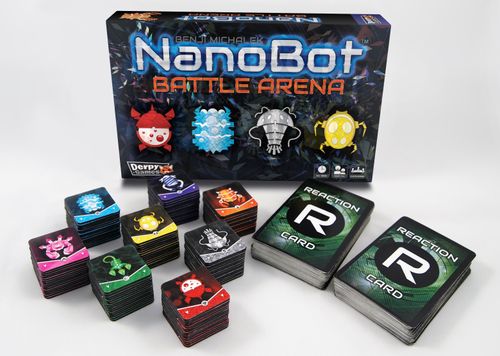
NanoBot Battle Arena
NanoBot Battle Arena Rulebook
Table of Contents
Table of Contents
- Components and Terminology
- Quick Play Setup
- Quick Play Rules
- NanoBot Tiles
- NanoBot Strain Types
- Reaction Cards
- Reaction Card Affinity
- Game Setup
- Making a Chain of NanoBots
- Competing for a Space
- Floating NanoBot Tiles
- Forked Chains and Colonies
- Looping Chains
- Chains of 1 NanoBot Tile
- Placing in a Legal Location
- Reaction Card Phase
- Melding Reaction Card Charges
- Reaction Card Charges
- Not Enough Reaction Cards
- The End Game
- Reaction Card Explanations
- Game Tips
Components and Terminology
Components
- NanoBot Strain Tiles: 15 each of the Blight, Chronos, Inferno, Vex, Ghost, Storm, Relic and Echidna Strains, 120 in total.
- Reaction Cards: 96.
NBBA Terminology
- Scientists are the players in the game.
- NanoBot Tiles are tiny robots used by each player to build a chain.
- Strains are specific types of NanoBots.
- Reaction Cards are powers used by the competing scientists to influence the NanoBots. All Strains have an affinity for specific Reaction Cards.
- The Battle Arena is the petri dish in which scientists compete against each other. It is the central playing area between all of the participating Scientists where NanoBot tiles are placed.
- The Deck is where Scientists draw Reaction Cards at the end of his or her turn.
- The Discard Pile is the area where Reaction Cards are placed once they have been used.
- The Scrapyard is the box lid placed face down to hold all of the scrapped or discarded NanoBot tiles. NanoBot Scientists jokingly call this the "Box of Doom!"
- Phases indicate the flow of a turn, and when a NanoBot tile or Reaction Card should be played. Larger scale games have additional phases to allow for combos. Phases must be played in order.
- Scrap is the term for removing a target NanoBot tile from play, and sending it to the Scrapyard.
- The Cache is where scientists keep their NanoBots before putting them into the petri dish.
Players: 2-8. Ages: 14 and up. Playing time: 30+ minutes.
Quick Play Setup
Players should have a Cache of a single Strain of NanoBots in front of them.
Each player should have a hand of six cards consisting of: three '1' Reaction Cards, two '2' Reaction Cards, and one '3' Reaction Card.
The rest of the Reaction Cards should be shuffled into a communal deck, and placed in a central area that all the players can reach.
A space next to the deck should be reserved for a discard pile.
The Scrapyard is placed outside of the playing area for tiles removed from the Battle Arena.
Reveal Reaction Cards from the top of the deck until a card is revealed with the same Strain Icon as a player. That player goes first. Revealed Reaction Cards are placed faceup in the discard pile.
Sample Playing Area (diagram).
Quick Play Rules
If no tiles are in the playing area, a tile is placed in the center in any orientation.
Tiles are always played dark-side face up. The light side of the tile indicates that it has been petrified.
Tiles can only be placed immediately adjacent to each other, and not diagonally.
A tile's owner is the only player that may play off the tile's Base Edge.
Players always keep a hand of six, and draw at the end of his or her turn.
Phases must be played in order. If a player does not have enough cards for his or her card phases, the card phases are skipped.
15 Tile Game Phases
- Phase 1: Play 1 NanoBot Tile
- Phase 2: Play 1 Reaction Card
- Phase 3: Draw 1 Reaction Card
30, 45, & 60 Tile Game Phases
- Phase 1: Play 1 Reaction Card
- Phase 2: Play 2 NanoBot Tiles
- Phase 3: Play 2 Reaction Cards
- Phase 4: Draw 3 Reaction Cards
If a player plays a Reaction Card with the same Strain Icon as his or her NanoBot, then the card receives a +1 to its charges.
If a player plays a Reaction Card against an opponent with the same Strain Icon, then the Reaction Card receives a -1.
When a player runs out of tiles the game ends immediately.
The player with the longest chain wins.
In event of a tie, the player with the least amount of tiles in his or her Cache wins. If the players are still tied, the player with the most amount of Reaction Card Charges in his or her hand wins.
NanoBot Tiles
Each box of NanoBot Battle Arena contains 120 NanoBot tiles with 8 Strains, and can seat up to 8 players. Tiles are always played dark side face up. A tile is flipped over to its light side when it is targeted by a Petrify Reaction Card.
Petrified (light sided) tiles indicate that they are protected from other Strains' Reaction Cards except the Relic Strain. A NanoBot tile can be flipped back over to its vulnerable dark side if a Petrify Reaction Card is played targeting a petrified tile.
All tiles have five basic parts: the Base Edge, the Standard Edges, the Path Arrows, the Strain Icon, and the NanoBot. The five basic parts are identical on both sides of a tile.
The Base Edge can only be played off of by the tile's owner. The Base Edge is limited to the tile's owner, and other players cannot place a tile adjacent to that Base Edge.
The Standard Edges refers to the other three edges of the tile.
Path Arrows indicate the orientation of a tile, and specify the direction of the line of sight of the NanoBot.
The Strain Icon indicates the Strain type for NanoBots. NanoBots have an affinity for Reaction Cards that share the same Strain Icon.
The NanoBot is the robot in the center of tile. Each NanoBot displays the theme of its Strain's powers.
Diagrams: Regular Tile; Petrified Tile.
NanoBot Strain Types
Each Strain favors a different strategy, and is more suitable for different situations. Choose your Strain wisely.
Blight: An infectious Strain known for its ability to corrupt and convert other NanoBots into allies. Inject noxious fluid into your opponents' NanoBots and watch them fester. There are some things water just can't wash away!
Chronos: This Strain controls the natural order of things by slowing players down with the force of cold and ice. Made an enemy? Watch your foes shiver as you prevent them from using their Reaction Cards for a turn. Smite your opponents with the pain of frostbite.
Relic: Modeled after prehistoric organisms, the Relic Strain is known for its hard shell. Fortify your NanoBots to ward against other players' Reaction Cards, but don't get too comfortable. Opponents can slowly remove petrified defenses and attack.
Ghost: Hauntingly mischievous, this Strain causes chaos by transporting NanoBots to new locations. Now you see it, now you don't! Whisk away your opponents' NanoBots to disrupt their chain or to restore your own.
Echidna: Named after the ancient mother of all monsters, this Strain can grow to mythic proportions. Like a rampant weed, cultivate your chain by placing extra NanoBots in the Battle Arena to overrun your opponents.
Inferno: With blazing claws, snip NanoBots to scraps. Nothing survives the fire! Permanently destroy NanoBots on the beginning or end of an opponent's chain, and send them to the Scrapyard. Level the Battle Arena with ash as the most destructive NanoBot.
Storm: Brace for impact! Bursting with electricity, these turbo-charged NanoBots are intimidating. Blast other NanoBots in your chain's path, and return them to an opponent's Cache. Shock your opponents by preventing them from ending the game too early.
Vex: Through deception and illusion this Strain of NanoBot has become known as the most mysterious of them all. Confuse your opponents' NanoBots to break or block their chain. Beguile your foes by pivoting their NanoBots to a new orientation.
Diagram: sample NanoBot chain, showing a Petrified Tile at the Base Edge end of a chain of 6.
Reaction Cards
Reaction Cards are used to interact with NanoBot tiles. Each Reaction Card has five basic parts: the Name, a Strain Icon, the Number of Charges, a Type, and a Description of the ability.
The Name identifies the Reaction Card.
The Strain Icon indicates the Strain type for Reaction Cards. NanoBots have an affinity for Reaction Cards that share the same Strain Icon.
The Number of Charges identify the number of NanoBot Tiles, Reaction Cards, or players that can be affected by the Reaction Card. Charges can range from 1-3. A player may use the full number of Charges on a card, but may also choose to use less if they so desire. Charges can be split between multiple targets.
The Type indicates how the card is used in game play. In this edition, only 'Power' Reaction Cards are available. This is the most basic type of Reaction Card, and can only be played during a player's turn. Once the card is used, it is placed face up in the discard pile.
The Description is used to explain how a Reaction Card is played. In depth explanations of the Reaction Cards' abilities are included on Page 9.
Sample Reaction Card (diagram): labelled Name, Strain Icon, Charges, Type and Description.
Reaction Card Affinity
Each player has a Strain affinity. The Strain Icon on a player's NanoBot tile determines a player's affinity. When a player plays a Reaction Card that matches the Strain Icon on his or her NanoBot, the card gains a +1 to its Charges. If a Reaction Card is used against a player that has an affinity for it, the card receives -1 to the number of its Charges.
Example: Capt'n Kitteh is playing the Chronos Strain, and has an affinity for Freeze Reaction Cards as indicated by the matching Strain Icon on the cards and on her tiles. If Capt'n Kitteh plays a Freeze '3' Reaction Card she gets a +1 to the card's Charges, making the card a Freeze '4'. If another player uses a Freeze '3' card against Capt'n Kitteh, the card receives a -1 to its Charges making the card a Freeze '2'. The opponent can then use the two remaining Charges on the Freeze Reaction Card against Capt'n Kitteh.
Game Setup
Separate the Reaction Cards from the other cards included in the box, and set the other cards aside. Place NanoBot tiles into individual stacks of the same Strain type.
1. Determine the Division
Determine the division of NanoBot battle that players would like to play by selecting 15, 30, 45, or 60 NanoBot tiles per player. A single box of NanoBot Battle Arena comes with 15 NanoBot tiles per Strain. Add tiles from additional boxes as needed. Depending on the number of tiles used, the rules and style of play can change drastically.
NanoBot Battle Arena Divisions
- BASIC Division: 15 NanoBot tiles per player
- LIGHTweight Division: 30 NanoBot tiles per player
- Middleweight Division: 45 NanoBot tiles per player
- Heavyweight Division: 60 NanoBot tiles per player
Game Phases by Division (phases must be played in order)
- 15 Tile Game Phases: Phase 1: Play 1 NanoBot Tile. Phase 2: Play 1 Reaction Card. Phase 3: Draw 1 Reaction Card.
- 30, 45, & 60 Tile Game Phases: Phase 1: Play 1 Reaction Card. Phase 2: Play 2 NanoBot Tiles. Phase 3: Play 2 Reaction Cards. Phase 4: Draw 3 Reaction Cards.
Suggested Deck Layout by Division (optional)
Larger games sometimes require multiple easy-to-reach decks. For easy cleanup, keep the decks separate by placing additional decks around the table. Players deal from and discard to the closest deck.
- 2-8 players, Basic (15) tiles: 1 deck
- 2-4 players, Lightweight (30) tiles: 1 deck
- 5-8 players, Lightweight (30) tiles: 2 decks
- 2-4 players, Middleweight (45) tiles: 2 decks
- 5-8 players, Middleweight (45) tiles: 3 decks
- 2-4 players, Heavyweight (60) tiles: 3 decks
- 5-8 players, Heavyweight (60) tiles: 4 decks
2. Choose a NanoBot Strain
Players may choose a Strain of NanoBot, or draw randomly from the deck until all have picked a Strain. Players cannot choose the same Strain.
Each player takes the stack of his or her chosen Strain of NanoBot tiles. This stack is called the Cache.
3. Separate Reaction Cards and Deal
Divide Reaction Cards into piles of Charge levels of '1's, '2's, and '3's. Place the three Reaction Card piles face down and shuffle individually. Deal one card from the '3's pile, two cards from the '2's pile, and three cards from the '1's pile to each player. Shuffle the remainder of the Reaction Cards into one deck. Place the deck face down in the central playing area. This deck is used by all of the participating players to draw Reaction Cards.
If a deck runs out of cards, replenish the deck by shuffling the discard pile face down, and use the pile as the new deck.
Sample Starting Hand (diagram).
4. First Turn and Placing NanoBots
Reveal cards from the top of the Reaction Card deck until a card with a player's chosen Strain Icon is revealed. The player with that Strain goes first. Place the revealed cards face up in the discard pile. Play continues to the player to the left (clockwise) of the first player.
The first NanoBot tile is placed dark side face up in the center of the Battle Arena in any orientation. All tiles played from a Cache are always played dark side face up, and can be facing in any direction. Tiles must be placed immediately adjacent to other tiles to form a square grid. Tiles cannot be placed diagonally. Sometimes, through a turn of events, all the NanoBot tiles can be wiped out of the playing area. If there are no NanoBots in the Battle Arena, the next player to place a tile, places it in the center of the Battle Arena in any orientation.
Making a Chain of NanoBots
In order to build a chain of NanoBots, place NanoBots from your Cache with the Base Edge touching a Standard Edge. Chains cannot be made from multiple Strains of NanoBots. Two of the same edges touching do not count towards the final length of the chain. Progressively connect the Base Edges to the Standard Edges forming straight, looping, or zigzagging lines to create a chain. Two Base Edges facing each other count as two separate chains since each has a different direction. The final score of each game is based on the length of a chain that each player builds. The longest continuous chain wins.
Diagrams: Tile facing the wrong way (chain of 9); Chain of 1; Illegal Tile Placement (chain of 3).
Competing for a Space
When two players find their NanoBots trying to overtake the same space, the first player able to take the space can do so (even with Blink or Grow Reaction Cards).
Diagram: two competing chains of 3.
Floating NanoBot Tiles
Due to different Reaction Cards, NanoBot tiles can be left floating in space independent from larger chains. Leave the tile floating, and continue to place tiles in a grid format adjacent to any tile in a legal location. Tiles can be placed adjacent to floating NanoBots.
Diagram: floating chains of 1 and 4.
Forked Chains and Colonies
NanoBots can form forked chains or have colonies of multiple chains independent of each other. Only the longest colony or portion of a forked chain counts towards the final score.
Diagram: forked chains and colonies (chains of 3, 1, 2 and 4).
Looping Chains
If a chain loops without a start or finish where all the tiles feed into each other, that chain cannot be affected by attacks that remove tiles from the beginning or end of the chain (i.e. Burn Reaction Card). If the game ends and a chain is looped, add the total number of NanoBots in the loop for the final score.
Diagram: looping chain of 6.
Chains of 1 NanoBot Tile
Tiles in a chain can have their orientation changed or can be left independently floating. A single NanoBot tile that is facing the opposite direction in a chain or that is independently floating in the Battle Arena counts as a chain of 1 tile.
Placing in a Legal Location
A 'Legal Location' means that tiles are always placed adjacent to other NanoBot tiles anywhere in the playing area except the Base Edge of an opponent's tile. The Base Edge may only be played off of by that tile's owner. The tiles also use the Path Arrows to indicate the progressive direction of the chain, and the line of sight of the individual tile. Tiles do not always need to be placed in a continuous chain or even near the rest of a player's NanoBots. Different situations call for different NanoBot tile placements, and even some Reaction Cards require a tile to be placed a certain way.
Reaction Card Phase
There are two possible actions to take during a Reaction Card Phase:
- Play a Reaction Card: The player can use a Reaction Card from his or her hand. Once the card is played, it is placed face up in the discard pile. Cards are drawn at the end of the turn to replenish a player's hand. Players should always have a hand of six cards at the end of their turn.
- Discard a Reaction Card: Discarding means that the player plays a Reaction Card, does not activate its ability, and places it into the discard pile. The player cannot play an extra Reaction Card after discarding. The player draws back up to six cards at the end of the turn as usual.
Example: In a Lightweight game of 30 tiles, players must play his or her phases in the following order: one Reaction Card, two NanoBot tiles, and two Reaction Cards. Capt'n Kitteh will first discard one of her cards, play two tiles, play two Reaction Cards from her hand, and then draw back up to six cards.
Melding Reaction Card Charges
In the Lightweight Division and higher, it is possible to meld charges of Reaction Cards. Melding allows a player to increase the range of a line of sight attack (i.e. Surge Reaction Cards). When two cards with the same name are played consecutively by the same player, the Charges can be combined for a higher potency.
Example: If a Surge '2' and a Surge '3' are played together, a player can attack up to five tiles in a direct line of sight.
Affinity is treated as normal.
Example: When melding two Reaction Cards, a player playing the Storm Strain has an affinity for Surge Reaction Cards, and would receive a total of +2 Charges when melding two Surge cards. When an opponent melds two Surge cards and attacks a Storm Strain player, the total amount of Charges is reduced by -2 since there are two Reaction Cards being melded.
Reaction Card Charges
It is not required to use the maximum number of Charges on a Reaction Card. Also, the Charges can be broken up among multiple targets (Reaction Cards, NanoBot tiles, or players) unless the Reaction Card states otherwise.
Not Enough Reaction Cards
When a player has too few cards in his or her hand, the player must attempt to play Reaction Card Phases in order to the best of his or her ability. A player cannot skip over a Reaction Card Phase, and must play a card in his or her hand. If the player has no cards or runs out of cards in his or her hand, then the rest of the Reaction Card Phases are skipped for the turn.
Example: In a Lightweight game of 30 tiles, Capt'n Kitteh's opponents have used a Freeze '3' Reaction Card and a Freeze '1' Reaction Card against her. The opponents randomly chose four of Capt'n Kitteh's cards in a hand of 6. The cards are not revealed, and are set aside. Capt'n Kitteh only has two cards left in her hand for this turn. Lightweight Division games require that a player must play his or her phases in the following order: one Reaction Card, two NanoBot tiles, and two Reaction Cards. Capt'n Kitteh will first play one of her Reaction Cards, play two NanoBot tiles, and play the last Reaction Card in her hand. Since she has run out of cards, she will have to skip playing a Reaction Card at the end of her turn. The four cards affected by Freeze return to Capt'n Kitteh's hand before the draw phase, and she draws two cards to have a hand of six.
The End Game
Finishing the Game: When a player runs out of NanoBot Tiles in his or her Cache, the game ends immediately. When the last tile is played from a player's Cache, phases in the turn do not continue and the game simply ends. The longest chain of NanoBots wins. Note: When dealing with forked chains or colonies, the longest portion or independent chain of tiles is the final score for a player.
Ties: In event of a tie for the longest chain, the player with the least amount of NanoBots in his or her Cache wins. If those players are still tied, the players add the total number of Charges on each of the Reaction Cards in his or her hand. The player with the largest sum of Reaction Card Charges in his or her hand wins. If the sum of the Charges in both player's hands are equal, the game is a tie. Cards affected by Freeze are not counted towards the final sum of Reaction Card Charges.
Reaction Card Explanations
Blink (Ghost Strain) can move a NanoBot to a new legal location. When you play a Blink Reaction Card you may move tiles equal to its Charge value. Each tile must be picked up and replayed one at a time. Tiles cannot be swapped. The same tile may be picked up and replayed multiple times. The NanoBot must keep the same orientation. Tiles can be blinked into a competing space. You can voluntarily Blink your opponent's tiles to one of your Base Edges.
Diagram: tiles keep the same orientation when moved.
Burn (Inferno Strain) can destroy a NanoBot from either end of any chain. Multiple chains can be burned in one turn. NanoBots forming a loop cannot be burned.
Diagram: scrap tiles from the beginning or end of a chain.
Freeze (Chronos Strain) can temporarily remove random cards from a player's hand until the beginning of his or her next draw phase. When you play a Freeze Reaction Card, you may choose up to its Charge value in random cards from any of your opponents' hands. These cards are not revealed; they are placed face down on the table, and may not be played. They are returned to their owner's hand before their draw phase.
Diagram: randomly remove a card from a player's hand; don't look and return it before his or her Draw Phase.
Grow (Echidna Strain) can place additional tiles in a player's turn.
Diagram: place an extra tile.
Infect (Blight Strain) can replace up to the Charge value of your opponents' tiles immediately adjacent to any chosen tiles of your own. Any newly placed tiles keep the same orientation as the replaced tiles. Infect cannot travel diagonally, or down a chain. All tiles chosen to be infected from a single Reaction Card are infected simultaneously. Tiles replaced by the Infect Reaction Card are scrapped.
Diagram: convert an opponent's tile (before and after).
Petrify (Relic Strain) can flip over or unflip any tile. When you play a Petrify Reaction Card, you may choose up to its Charge value in friendly or enemy tiles, and flip them over. Other Strains' Reaction Cards may not affect a petrified tile.
Diagram: flip or unflip a tile.
Pivot (Vex Strain) can rotate tiles to any orientation; there is no limit to the amount of rotations.
Diagram: rotate a tile to a new direction.
Surge (Storm Strain) can return tiles in the line of sight of your adjacent NanoBot tiles. The Charge value indicates the possible range of the attack. Targeted tiles are returned to the owner's Cache. All tiles in a single line of sight are returned at the same time. The tiles closest to the attacking NanoBot tile are returned, and tiles cannot be skipped over. Surge cannot be extended past an empty space or a petrified tile. Surge Charges can be broken among multiple attacking NanoBots to Surge from different directions.
Diagram: return tiles to their owner's Cache (before and after).
Game Tips
- Build zigzagging chains.
- Blink tiles into your chain so that you can Infect them later.
- If a player is about to run out of tiles, use a Surge Reaction Card on his or her NanoBot tiles to extend the game.
- Keep the orientation of tiles in a chain in two uniform directions. That way the tiles can easily fit back into a chain if they are moved.
- Save your larger cards for the end of the game (especially Grow '3').
- Great opening moves are to discard a Blink '1', or use a Petrify '1'.
- If you discard a Reaction Card with a '1' Charge level, you have a 50% chance of drawing a higher power Reaction Card.
- Pivot the Base Edges of two tiles to face each other in the middle of an opponent's chain in order to completely break his or her chain.
- Petrified tiles on the beginning and end of a chain will protect a player's chain from Burn Reaction Cards.