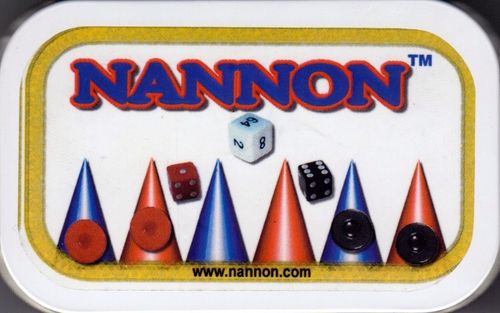
Nannon
Nannon Rulebook
Table of Contents
Table of Contents
Setup
To start, place checkers at HOME and on the first and second spots for each player.
For the opening roll, both players throw their dice, and the winner gets to move a checker the difference between the dice. In case of a tie, roll again.
Movement
Only one checker is allowed on a board spot. A checker may land on an open spot, but may not land on a checker of the same color. If a legal move exists, a player cannot pass and must move a checker.
Hitting
If a checker can land on a single opponent checker, it gets hit and is moved off the board back to HOME.
Primes
When a player's checkers are next to each other on the board, they form a prime and cannot be hit. It is often a good strategy to gain and keep a prime, because it protects checkers and can cause the opponent's next turn to be forfeited.
In this position, the white player who rolls a 3 forfeits a turn because no white checkers can move 3 spots.
Exiting to SAFETY
Any checker on the board may exit to SAFETY with a high enough roll; an exact roll is not needed. Thus the black checker on spot 4 could exit with a 4, 5, or 6.
NANNON
A shutout is called a NANNON, and counts as two games. This rare event, when the loser has no checkers to SAFETY, is marked by the winner banging their fist on the table and shouting "NANNON!"
Match Play
Because the games are short, they are usually played in a match, where the first player to gain e.g. 11, or 21 points is the winner. A single game counts for 1 or 2 points, times the (optional) doubling cube stake value.
Doubling Cube
Doubling is a skill which adds excitement to a match by allowing players to alternatively raise the stake of a single game as luck favors their position. NANNON uses the same doubling rules as Backgammon, you can read a primer at http://bit.ly/doubcube.
The doubling cube is not rolled, but is a marker for the current stake of the game. Initially, the cube is set at 64, which indicates no double has occurred.
When a player thinks they are ahead, they can challenge their opponent to either accept a raise in the stake or forfeit the game at the current stake. (However, a player should be careful of doubling if they have too a strong chance for a NANNON.)
Before rolling the die, a player may offer to raise the stake of the game by turning the cube to the next higher number and handing it to the opponent.
The opponent may take the cube and place it nearby to accept and display the new stake. The player who offered the cube then rolls and takes his turn.
However, if opponent refuses the cube, the game is forfeited and the offerer wins the number of points previously shown on the cube.
Initially either player can double, but then only the player who has the cube can offer the next double.
The cube may be turned when the first roll is a tie.