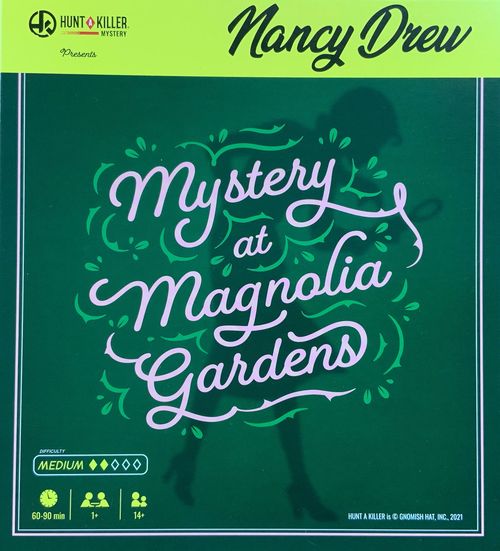
Hunt A Killer: Nancy Drew – Mystery at Magnolia Gardens
Hunt A Killer: Nancy Drew – Mystery at Magnolia Gardens Rulebook
Table of Contents
Table of Contents
Game Overview
Mystery at Magnolia Gardens is a Hunt A Killer all-in-one murder mystery game, solvable in one sitting. For 1–5 players, ages 14+, with a playtime of 60–90 minutes. Difficulty is two out of five.
To solve the mystery, you must unearth which suspect has the means, motive, and opportunity to commit the crime by:
- Sifting through suspect profiles including elaborate backstories, distinctive handwriting, and forensic details.
- Creating timelines and confirming (or unraveling) suspect alibis.
- Unveiling important case details by solving puzzles, ciphers, and more.
- Examining realistic documents to discover clues and evidence.
The case includes red herrings (information meant to muddy the case) and plentiful puzzles (puzzles that require critical reading or creating a timeline).
Welcome, detective. You've got the evidence, the suspects, and a deep-seated desire to see justice served. Every killer, no matter how clever, leaves a trail. To catch them, you just need to follow the three golden rules of murder-solving: Means, Motive, and Opportunity. Only one person will have all three. Your job is to find them.
How to Play
Means
The "HOW"
This is where you figure out the nitty-gritty details of the dirty deed. The means is the weapon, the tool, the method. It's how the killer did the deed. You'll sift through forensic reports, witness statements, and maybe even a suspicious shopping list to figure out what was used. A killer can't get away with murder if they don't have the right equipment.
Motive
The "WHY"
Everyone has a reason. The motive is the reason someone decided to end a life. This is where you play armchair psychologist, digging into private correspondence and backstabbing business deals. Follow the money, the love triangles, and the old family feuds.
Opportunity
The "WHEN"
Timing is everything, even for a murderer. The opportunity is the window of time and the access a suspect had to commit the crime. Were they in the same room? Did they have a key to the victim's secret vault? This is about creating a timeline, tracking alibis, and figuring out who was where and when. A suspect might have the means and the motive, but if they were elsewhere at the time of the crime, they're probably off the hook.
What's in the Box
Inside the evidence box you'll find a trove of documents, objects, and clues designed to get you closer to the truth.
You must start with the cover letter. It sets the scene, introduces the case, and tells you what your first objective is.
After that, the choice is yours. Every case is different; every piece in the box is a breadcrumb on a trail leading to a killer, and you decide which one to follow first.
Conclusion - Case Closed
Put it all together, and you'll have your killer.