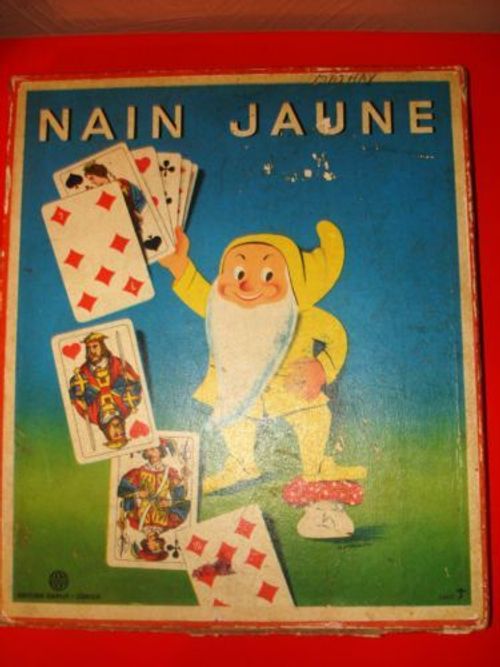
Jeu du Nain Jaune
Jeu du Nain Jaune Rulebook
Table of Contents
Table of Contents
Contents
- 1 game board
- 1 "Nain Jaune" cup
- 52 cards
- 78 tokens: 12 tokens worth 5 points, 12 tokens worth 4 points, 12 tokens worth 3 points, 12 tokens worth 2 points, 30 tokens worth 1 point
Ages 7-99. 2-4 players.
Aim of the Game
Collect the biggest hoard of treasure.
Setup
Each player is given one set of tokens worth a total value of 49 points:
- 3 yellow tokens worth 5 points each
- 3 red tokens worth 4 points each
- 3 blue tokens worth 3 points each
- 3 green tokens worth 2 points each
- 7 brown tokens worth 1 point each
Position the board in the middle of the players, with the "Nain Jaune" cup in the centre of the board.
The game is played over several rounds.
At the Start of Each Round
Each player places a stake in each section of the board:
- one stake worth 1 point on the 10 of Diamonds
- one stake worth 2 points on the Jack of Clubs
- one stake worth 3 points on the Queen of Spades
- one stake worth 4 points on the King of Hearts
- one stake worth 5 points on the Seven of Diamonds or Nain Jaune ("Yellow Dwarf")
The cards are shuffled and the dealer distributes them between the players as follows:
- 22 cards per player in a 2-player game
- 15 cards per player in a 3-player game
- 12 cards per player in a 4-player game
The remaining cards are set aside, face down. They will be reintroduced to the game in the next round.
How to Play
The players take turns discarding cards from their respective hands onto a shared pile in the centre of the table.
Play proceeds in a clockwise direction. The player seated to the left of the dealer goes first.
That player selects a card from their hand and puts it down in the centre of the table, followed by as many cards as they can in sequence in ascending order, without breaking the run and regardless of suit.
The player does not have to start with an Ace.
For example, if a player has a 2, a 4, a 5, a 7 and a 3 in their hand, they can get rid of their 2 and then their 3, followed by their 4 and their 5, but they cannot play their 7, because they are missing a 6.
When the player is unable to play any more cards in the sequence that has been started, the player stops and indicates the value of the missing card by announcing: "No..."
In the example above, the player would announce: "No 6."
Play then passes to the player to their left to continue the sequence. If the player is able and wishes to do so, they can in turn play a sequence of cards (again, without breaking the run), starting with the same value of the card that the previous player was missing.
In our example, the player has to start with a 6.
If the new player is unable to play, play passes to the next player to continue. And so on.
If, after a full round, none of the players has been able to play, the last player to have put down a card may start a new sequence.
Tip: It is in the player's interest to start out with a card that enables them to make the longest sequence possible.
Special Cases
- When a player puts down a King, they announce: "King and I start again!" The player begins a new sequence, starting with the card of their choice.
- When a player plays one of the cards represented on the board (10, Jack, Queen, King or 7), they announce that the card "Takes all!", stating the value of the card. The player takes all the tokens on the section of the board that matches that card.
For example, if a player puts the Queen of Spades down, they announce: "The Queen takes all!" and take all of the tokens on the "Queen of Spades" section of the board.
Please note: If a player forgets to announce their claim, the stake is lost for them and stays in place for the next round.
- If a player manages to get rid of all of their cards on their first turn, this is called a "Grand Opera". The player then collects all of the tokens on the board (regardless of whether they are in possession of the cards represented on the board or not).
End of the Round
The round ends when one of the players has gotten rid of all of their cards.
The other players then give that player 1 token worth 1 point for each of the cards remaining in their respective hands.
The tokens on the board that were not collected during the preceding round stay on the board. All of the cards are shuffled. Then a new round begins.
End of the Game
The game ends when one of the players has insufficient tokens to place stakes at the beginning of the round.
The player with the highest total token value is the winner.