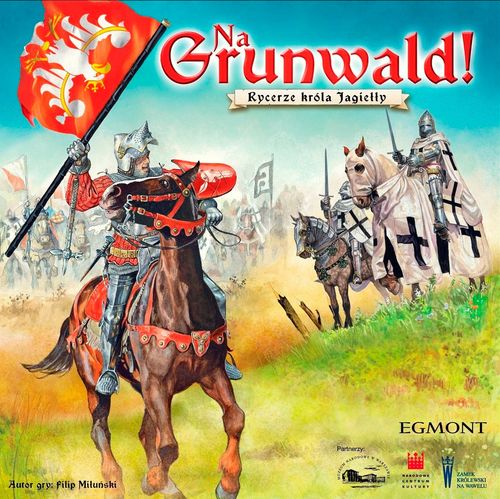
Na Grunwald: Rycerze króla Jagiełły
Na Grunwald: Rycerze króla Jagiełły Rulebook
Table of Contents
Table of Contents
Game Components
- Board
- 24 pawns
- 4 royal officers in four colours (big pawns)
- 20 helpers of the royal officers in four colours (little pawns)
- 16 royal knight cards (Polish-Lithuanian Army knights), strength 1-6
- 16 mercenary knight cards, strength 1-6
- 4 peasant cards in four colours, strength 0
- 12 Teutonic Knight cards, strength 1-4
- 18 provisions tokens, worth 5, 3, 1
- 1st player token
- Round marker
- 8 provisions cards
- 8 ducat cards
- 14 event cards
- 48 ducat tokens
- 3 special tokens: royal army commander, mercenary army commander, royal quartermaster
Object of the Game
The goal of the game is to build up the strongest possible army for King Władysław Jagiełło (Ladislaus Jagiello), setting out for the battle with the Order of the Teutonic Knights as well as to provide the army with provisions. At the end of the game each player sums up the points awarded for:
- drafted royal knights
- drafted mercenary knights
- Teutonic Knights taken captive
- special tokens collected: commanders and quartermaster
- ducats earned
The player who collects the highest number of points is the winner.
CAUTION! The rules below are set out for 4 players. The rules for 2 or 3 players are presented at the end of the booklet.
Setting Up the Game
Place the board in the centre of a table. Each player receives a set of elements in the same colour:
- one royal officer (big pawn)
- two helpers (little pawns)
- a peasant card
- 3 ducats
- a provisions token, worth 1
These elements should be visible for all the players throughout the game.
Fig. 1 shows the elements of the game prepared for the first round: the round marker is placed on the round bar, each player has his elements beside the board, and the ducats bank and provisions bank are placed next to the board.
Place the remaining ducats and provisions tokens next to the board (in this way a ducats bank and a provisions bank will be formed). Place the helper pawns on the Helpers field on the board.
Place the 3 special tokens (royal army commander, mercenary army commander, royal quartermaster) next to the board. You will need them towards the end of the game.
Divide the cards into separate piles according to the reverse and then divide the cards with the reverse coloured red into two groups according to the colour of the frame on their face side (red and blue). Shuffle each pile separately and place the cards face down on the relevant fields of the board:
- place the deck of event cards on the Event cards field,
- divide the deck of Teutonic Knight cards into two equal piles of 6 cards and place them on the Teutonic Knights field,
- divide the deck of royal cards into two equal piles of 8 cards and place them on the Royal Knights field,
- place the deck of provisions cards on the Provisions field,
- place the deck of ducat cards on the Ducats field,
- divide the deck of mercenary knight cards into two equal piles of 8 cards and place them on the Mercenary Knights field.
Before you start the game, put the following cards face up (Fig. 1):
- two royal knight cards, one from each pile,
- a provisions card,
- a ducat card,
- two mercenary knight cards, one from each pile.
Place the round marker on the first field on the board.
The 1st player token is given to the player who most recently visited the Wawel Royal Castle in Kraków, where King Jagiełło (Ladislaus Jagiello) set off for the Battle of Grunwald from. If it is impossible to decide who starts the round in this way, the oldest player gets the token.
Camp
In the further part of the manual the term 'camp' will be used. What is it? During the game the players will send their knights to fight the Teutonic Knights and to perform various tasks shown on some event cards.
EACH ROYAL KNIGHT CARD AND MERCENARY KNIGHT CARD MAY BE USED ONLY ONCE THROUGHOUT THE WHOLE GAME!
Each knight card which has already been used is set aside to the player's camp, which is located on the table next to the player (face up). We assume that the knight who has been sent to fight the Teutonic Knights or to perform another action comes back exhausted and must rest in the camp till the end of the game. Also the Teutonic Knights taken captive by the player will be sent to the player's camp.
The other cards must be held in the player's hands at all times. It is crucial that the two kinds of cards do not get mixed during the game.
The Game
The game is divided into 8 rounds. The rounds represent the time lapse: the game starts in the autumn of 1408 and ends in the summer of 1410, just before the Battle of Grunwald. Each round consists of three phases:
- Event phase
- Royal officer phase
- Resolution phase
1. Event Phase
CAUTION! This phase is not played in the first round.
From the second round on, all rounds start with turning up one event card. These cards show actions that the players must perform either straightaway or later in the round.
If a card sets a task for all the players to perform, the player with the 1st player token takes action first. The other players take action in clockwise order. The event card is left face up till the end of the round.
After the event card has been turned up and the actions have been performed by all players (if relevant), the cards on the other fields of the board are turned up at the end of the phase. You should turn up the first card on top of every pile.
The following rules should be observed:
- In the first round NO event card is turned up. An event card is turned up from the second round on.
- In the first three rounds NO Teutonic Knight cards are turned up, which is shown on reminder icons on the round bar. This is because in rounds 1-3 there is an armistice between the Kingdom of Poland, the Grand Duchy of Lithuania and the Teutonic Knights, which is broken in round four.
- The other cards are turned up from the first round on.
2. Royal Officer Phase
During this phase players send their pawns (royal officers and their helpers) to various fields on the board. The goals are:
- to draft a royal knight
- to draft a mercenary knight
- to earn ducats
- to get provisions
- to hire an additional helper
- to fight against the Teutonic Knights
This phase is divided into turns. In each turn players place their pawns on the oblong fields on the board according to the following principles:
- The player who has the 1st player token starts. The other players place their counters on the board in clockwise order.
- Pawns are placed on the fields starting with the left. (Fig. 2)
- In one turn a player may place his or her pawns only on one field.
- In one turn a player may place only one type of pawn on the board: either a royal officer or a helper(s). In other words, under no circumstances may a royal officer be sent to any field with a helper(s) in one turn. (Fig. 3)
- A player may add his royal officer to a field on which he already has his helper(s) (the officer is placed next to the helper). (Fig. 4a)
- A player may add his helper(s) to a field on which he already has his royal officer (the helper(s) are placed next to the officer). (Fig. 4b)
- A player may not add his helper(s) to a field on which he already has his helper(s). (Fig. 5)
- A player may pass at any moment, deciding not to place further pawns on the board in a given round. If a player does not pass, he or she may place their pawns on the board as long as they have any left (even if other players have already passed).
This phase ends when players have no more pawns to be placed on the board or when all players have passed.
What should be placed on which field
Royal Knights, Ducats and Helpers fields:
- pawns
- at the end of this phase any number of a player's pawns may be placed on these fields. (Fig. 6)
CAUTION! A player may not place his or her pawns on the Helpers field once he/she has collected all helpers in his or her colour. (Fig. 7)
Teutonic Knights field:
- pawns
- at the end of this phase only one pawn of a player may be placed here. (Fig. 7)
CAUTION! Pawns may not be placed here earlier than the fourth round.
Provisions field:
- pawns and ducats
- at the end of this phase any number of a player's pawns and any amount of ducats may be placed here. (Fig. 8)
CAUTION! Every time ducats are being placed on this field, they may only be placed together with a player's pawn(s) (a player is sending his officer or helper(s) with ducats). Ducats without a pawn may not be placed on this field. However, a pawn without ducats may be placed here.
Mercenary knights field:
- pawns and ducats
- at the end of this phase only one pawn of a player may be placed here with at least one obligatory ducat. (Fig. 9)
CAUTION! Ducats may be placed here only together with a pawn. As only one pawn may be placed here, no ducats may be added to this field in the following turns!
This phase ends when players have no more pawns to be placed on the board or when all players have passed.
3. Resolution Phase
In the resolution phase all fields on the board are analysed in order to decide who has won on any of them, therefore earning relevant benefits. The fields are analysed in the order from field 1 to field 6 (the numbers are visible above the fields on the board).
Adding the points the players have earned on particular fields you should remember that:
- royal officer = 2 points,
- each helper = 1 point,
- each ducat = 1 point.
If there is a tie, the winner is always the player who was first to place his or her pawns on the given field (namely, whose pawn is closest to the left). (Fig. 10)
Fig. 10: on this field the winner is the red player, the green one is second and the purple one is third.
There is no field where a player may obtain more than one benefit (one royal knight card, one mercenary knight card, one set of ducats, one set of provisions, one helper or one Teutonic Knight card), even if he or she is the only player on this field.
After analysing a given field the pawns of the officers and helpers return to their players. The ducats used to obtain benefits are placed in the bank. The ducats the player did not use to pay, return to him/her.
Teutonic Knights field
Not earlier than in the fourth round, two Teutonic Knight cards are placed here, worth 1 to 4. They symbolise a battle with Teutonic Knights who have invaded the borderland of the Kingdom of Poland.
The battle:
-
The players check the strength of the Teutonic Knights. They add up the strength value of both cards and the value given at the top of the board:
- with 2 players, add 2
- with 3 players, add 4
- with 4 players, add 6 (Fig. 11)
-
Each player who has placed a pawn on the Teutonic Knights field may now take part in a battle. To do this, players choose one card from the deck held in their hands and place them on the table face down. The card may show both a royal knight and a mercenary knight, as well as a peasant if the player wants to mislead the others and avoid sending his or her knights to fight against the Teutonic Knights.
-
Now all the players turn up their cards together and check if any of them can take Teutonic Knights captive. a. The player who has chosen the card of the strongest knight takes one of the Teutonic Knight cards that take part in the battle. The value of the strength of the Teutonic Knight must be lower than the strength of this player's knight.
- If both cards have a lower value, the player takes the higher one.
- If both cards have the same or higher value, the player does not get any of them. b. The player who was second to place his knight on the field, takes the Teutonic Knight with a lower value of strength (provided that the player's knight is stronger than the Teutonic Knight).
The Teutonic Knight card and knight cards placed on the field by the players are set aside to the camps of the relevant players. Before the battle ends, however, the Teutonic Knight cards stay on the board and the players' cards on the table.
-
After individual fights with the Teutonic Knights it's time to settle the result of the battle (individual fights do not influence the result of the battle!). To do this, you should add the value of all players' knights' strength. a. If the value of all the players' knights' strength is equal or higher than the value of the Teutonic Knights' strength, the players have won the battle and defended the Polish land. The battle is over. b. If the added value of all the players' knights' strength is lower than the value of the Teutonic Knights' strength, the players have lost the battle. As a result, the Teutonic Knights plunder Polish borderland. Therefore, all players (also those who did not fight this battle!) lose their knights or provisions. Each player must discard knight cards (royal or mercenary), provisions tokens, or captive Teutonic Knight cards, of the total value not lower than the difference between the strength of the Teutonic Knights and the players' knights. The players may combine the cards discarded and provisions tokens in any way they want.
EXAMPLE: If the Teutonic Knights' strength is 10 and the players' knights' strength is 8, it means that each player loses 2 points (10-8=2). The player may discard for example:
- a knight whose strength value is 2
- provisions worth 2
- a knight whose strength value is 1 and a Teutonic Knight whose strength value is 1
- a knight whose strength value is 1 and provisions worth 1 etc.
A player may discard cards worth more than the value required. In the example above, a player may discard a knight card worth 3.
Players may discard both the cards they are holding in their hands and the ones set aside to the camp (deposited on the table).
If a player has neither provisions tokens nor cards worth enough, they discard as much as they have.
After the battle has ended, the players set aside the knight cards they have turned up and the Teutonic Knight cards they have taken captive to their camps, putting them near themselves on the table. If a player has turned up a peasant card, it returns to his or her hands.
EXAMPLE: Two cards have been placed on the Teutonic Knights field: worth 3 and 2. Four players fight the battle. They choose one of the cards they are holding in their hands. Each player turns up the card at the same time. Marek has turned up a knight whose strength is worth 5, Jacek has turned up a knight whose strength is worth 2, Kasia's chosen knight has strength worth 1. Ania has decided to keep her knights for further battles and turned up a peasant card worth 0, hoping that the other knights will manage to defeat the Teutonic Knights.
Individual fights are analysed. Marek's knight is the strongest (worth 5), so he takes a Teutonic Knight worth 3 captive. Jacek's knight's strength is 2. He does not take a Teutonic Knight as his card has the same value. Kasia takes no captives either as her knight is weaker than the Teutonic Knight and she was third to act. Ania does not take captives as she has turned up a peasant card.
After the fights, the result of the battle is settled. The Teutonic Knights' strength is worth 11 (3 + 2 + additional 6 points). The players' knights' strength is worth 8 (5+2+1+0). The Teutonic Knights have won the battle. The difference in strength is 3 (11-8). As a result, each of the players loses 3 points. Marek discards provisions tokens worth 3, Jacek discards a knight card worth 4 (he has no knights whose strength is worth 3 and he does not want to discard his provisions). Kasia discards a Teutonic Knight worth 3 and Ania discards a knight worth 2 and a provisions token worth 1. If any of the players had not taken part in the battle, they would also lose 3 points. Avoiding fights with Teutonic Knights does not protect from losses!
After the battle has ended, the players' knights and a captive Teutonic knight are placed in the camps of the relevant players and the peasant card comes back to Ania's hand.
Royal Knights field
In each round of the game two royal knights, worth 1-6, who may be drafted by the players, are placed. In the resolution phase the player who has earned the highest number of points with his or her pawns drafts the stronger knight. The player who was second takes the other knight. The others do not get anything.
Provisions field
On this field in each round you should place a card showing the value of provisions available in this round. In the resolution phase the player whose pawns and ducats sent here are worth the most gets provisions tokens from the bank of the higher value presented on the card. The second player gets provisions tokens from the bank of the lower value (if presented on the card). The others get nothing.
Ducats field
In each round you should place a card showing the value of ducat tokens available on this field in this round. In the resolution phase the player whose pawns sent here are worth the most gets ducat tokens from the bank of the higher value presented on the card. The second (and third, if relevant) player gets ducat tokens from the bank of the lower values presented on the card. The fourth player gets nothing.
Mercenary knights field
In each round you should place two mercenary knights whose strength is worth 1-6 on this field to be drafted.
In the resolution phase the player who has placed here his or her pawn with the ducat of highest value gets the stronger knight card and adds it to the deck in his or her hands. The second player takes the other knight card. The others do not get anything. On this field it doesn't matter if a player has sent an officer or a helper. Mercenary knights get drafted only thanks to ducats.
Helpers field
In each round on this field two players may hire one helper each. In the resolution phase the player who has placed here the pawns worth the most gets a helper in his colour for free and places him or her on the table next to himself or herself. The second player may (but doesn't have to) buy a helper in his or her colour for a number of ducats equal to the number of helpers they already have. From now on these players will be able to place more helpers on the board in the following rounds. Even if the second player does not buy a helper, the third one and the fourth one cannot buy a helper either.
After the last field has been analysed, all cards placed face up on the board are discarded and removed from the game to the box.
At the end of the resolution phase the player who has the 1st player token gives it to the person sitting on his or her left. The round marker is moved to the next field on the round bar.
End of the Game
The game is over with the end of round 8. This means that the preparations for the war with the Order of the Teutonic Knights have finished. King Jagiełło's armies built up by the players are now to set off for Malbork (Marienburg), the capital of the State of the Teutonic Knights. On their way they will fight one of the greatest battles in medieval Europe, the Battle of Grunwald.
-
Each royal knight and each mercenary knight have to be provided with provisions. Each of them needs one provisions set, irrespective of their strength. The players add up the number of knights (royal and mercenary) collected in their hands as well as the ones they have set aside to the camp and add up the value of the provisions tokens they have collected. If the total value of the provisions tokens is lower than the number of the knights collected by the player, he or she loses the ones that cannot be maintained and has to set them aside to the box. The player will not be awarded any points for them. The player may choose the knights they want to set aside to the box. Teutonic Knight cards do not need provisions. (Fig. 12)
-
The players put their cards in front of themselves and divide them into three separate categories: royal knights, mercenary knights and the Teutonic Knights. Provisions tokens are placed on the royal knight and mercenary knight cards to show that they can be maintained.
-
Time to calculate the score (players mark it with one of their pawns on the score bar):
Points earned for the knights
Each player gets a number of points equal to the total value of the strength of all their cards: royal knights, mercenary knights and the captive Teutonic Knights.
Points for the commanders
- The player who has collected the highest number of royal knight cards becomes the royal army commander (he or she takes the royal army commander token) and is awarded a number of points equal to the number of royal knight cards they have collected.
- The player who has collected the highest number of mercenary knight cards becomes the mercenary army commander (he or she takes the mercenary army commander token) and is awarded a number of points equal to the number of mercenary knight cards he or she has collected.
CAUTION! While choosing commanders only the number of cards is taken into account, not their strength value! The strength value matters only in case of a tie. Then the title of the commander is given to the player whose knights' total strength value is higher. If there is a tie both in the number of knights and their strength, both players get the points for the commander.
The player who has collected the highest total number of points becomes King Jagiełło's best officer and wins the game. If there is a tie, the winner is the player who has collected the highest number of knight cards (royal, mercenary and the Teutonic Knights). If there is still a tie, players share the victory.
Example (Fig. 12): The player has collected 2 royal knights, 3 mercenary knights, 1 Teutonic Knight and provisions worth 4. Because a Teutonic Knight does not need provisions, he has 5 knights to maintain. The player must therefore discard one knight card. His decision is to discard the weaker royal knight.
Scoring examples:
- Jacek's score is 36 (knights' strength) + 10 (captive Teutonic Knights' strength) = 46 points.
- Ania's score is 31 (knights' strength) + 4 (captive Teutonic Knights' strength) + 5 (royal quartermaster) = 46 points.
- Marek's score is 28 (knights' strength) + 7 (captive Teutonic Knights' strength) + 6 (Polish-Lithuanian army commander) + 2 (points for ducats) = 43 points.
Jacek and Ania have the same score. They also collected the same number of knight cards, so they share the victory. Marek is second.
With Two Players
Adding up the strength value of the Teutonic Knights during a battle, you should add 2 points to the total value of the two Teutonic Knight cards.
You should turn up two cards on the fields Royal Knights and Mercenary Knights in each round, but only one of them can be taken captive (at the end of the round the other card is removed from the board). The player who is second does not get any cards.
On the Provisions field only one, always the lower value of provisions may be collected. On the Ducats field only two, always the lowest values of ducats may be collected. On the provisions and ducat cards there are special reminder icons.
With Three Players
Adding up the strength value of the Teutonic Knights during a battle, you should add 4 points to the total value of the two Teutonic Knight cards. On the Ducats field only two, always the highest values of ducats may be collected. There are special reminder icons on the ducat cards.
Seasoned Knights' Advice
- At the beginning of the game collecting helpers is worthwhile. Although you may win the game without having all five of them, it is necessary that you have at least two or three of them in order to draft knights effectively.
- Although you do not need provisions during the game, it is among the most important reserves. Remember that at the end of the game the knights that will not be provided with provisions will leave you.
- Special tokens are often decisive and tip the scales of victory. You should decide which of them you would like to get and consistently struggle to get a particular type of knights or a higher value of provisions.
- Do not stay without ducats. Numerous event cards offer an opportunity to obtain or negotiate particular benefits. Without ducats you will also be unable to draft mercenary knights and you will have difficulties with getting provisions.
- Do not neglect fighting against the Teutonic Knights - a failure may be harmful to all players, whereas taking them captive is an easy way to collect points.