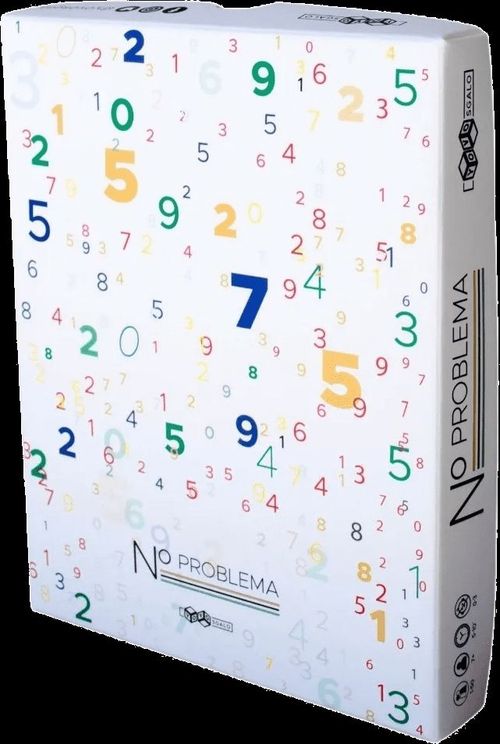
Nº Problema
Nº Problema Rulebook
Table of Contents
Table of Contents
Objective
Complete as many cells as possible, each one time only, with consecutive numbers.
Components
- Block of double-sided game sheets (side 100 – side 64)
- 2 (two) dice of different colours
- 2 (two) pencils
- 1 (one) eraser
Starting the Game
- Take one game sheet and choose which side to play, 100 or 64.
- Write the number 1 in any of the white cells.
Game Flow
The player chooses whether to play the game with one die or with two dice.
- If you play with one die, roll it on every turn. The face shows the reference (sequence) to use to write the N°+1.
References
On the first turn, 1 is the "N°", so the "N°+1" will be 2, and so on, turn after turn.
Example: if the last number written in one of the cells is "25", that is the N°, so the N°+1 is "26". To place it in a next cell, roll the die and obtain one of the possible references (sequences).
Each face of the die shows one possible route, and that route may be rotated in different directions within the grid. Example: if the die shows 4, the route is the four-dot shape described below, and it may be placed in any rotation on the grid.
The rulebook's diagrams give the following route for each die face (the shape runs from N° to N°+1):
- Face 1 (one dot): N°+1 is directly below N° (one cell down).
- Face 2 (two dots, diagonal): N°+1 is one cell right and one cell down from N° (a diagonal step). The route may go right and then down, or down and then right.
- Face 3 (three dots, diagonal): N°+1 is two cells straight down from N° (the route passes through the middle cell).
- Face 4 (four dots, corners): N° → one cell right → two cells down, ending at N°+1 (an L-shaped route with a two-cell lower arm).
- Face 5 (five dots): N° → one cell right → three cells down, ending at N°+1 (an L-shaped route with a three-cell lower arm).
- Face 6 (six dots): N°+1 is three cells straight down from N° (a straight line of four cells).
When you play with two dice, first choose which die gives the reference to represent and which die gives the number of number sequences to write on that turn.
Example:
- Die 1 shows 4 (the reference).
- Die 2 shows 5 (the number of sequences).
In this case, five number sequences must be written, following the reference shown by the die with 4. That is, if the turn starts with N° 1, you must write up to N° 6.
Plus (the "6" option): Under each reference of dice faces 1 to 5 there is a "6". This means that if the die shows 6, and you do not want or cannot follow the reference of face 6, you may change to any of the other references instead. When you use this option, cross out the 6 under the die you chose. Each time this option is used, subtract one point at the end of the game.
Reset (the Reset box): The Reset box is used when you cannot complete writing the N°+1 in one turn. Each player may cross out one Reset box (up to four times) to continue playing. Each time this option is used, subtract one point at the end of the game.
End of the Game
The scoring sheet is divided into the boxes N°, Impar, Par, Reset, 6 and TOTAL, combined as: N° + Impar + Par − Reset − 6 = TOTAL.
- N°: write the last number written in the grid.
- Impar (odd): score 2 points for each odd number written in cells with the colour corresponding to odd.
- Par (even): score 3 points for each even number written in cells with the colour corresponding to even.
- Reset: write the number of times the Reset option was used (subtract 1 point each time).
- 6: write the number of times the Plus (6) option was used (subtract 1 point each time).
- TOTAL: write the final score.
Competitive Modes
To play with more than one person, all participants must first agree on which side of the sheet to use (100 or 64).
Each player writes the N° 1 in any white cell of the sheet of the player to their left.
In all modes the game ends when no player can complete another turn. Players who can still complete their sheet must do so.
The Reset option is available to all participants.
Mode 1
One die is rolled on each turn (the same player may always roll, or players may alternate), and everyone writes the indicated reference. At the end of the game, the player with the most points wins.
Mode 2
Two dice are rolled on each turn (the same player may always roll, or players may alternate). Before play begins, all players must agree which die gives the reference to represent and which die gives the number of times that reference is written. At the end of the game, the player with the most points wins.
Mode 3
Two dice are rolled on each turn, always alternating among all players, starting with the youngest player and passing the turn to the left. The player who rolls the dice chooses one of the dice to write on their sheet (following the reference), and the other die is the reference that all the other players must write. At the end of the game, the player with the most points wins.
Score Ratings
The rulebook lists the following ratings by total score:
| Sheet 100 | Sheet 64 | Rating |
|---|---|---|
| Up to 25 pts | Up to 18 pts | Beginner |
| Up to 40 pts | Up to 25 pts | Counting beans |
| Up to 60 pts | Up to 38 pts | Home abacus |
| Up to 80 pts | Up to 51 pts | Master Mates |
| Up to 99 pts | Up to 63 pts | Artificial intelligence |
| 100 or more | 64 or more | Pythagoras Superstar |