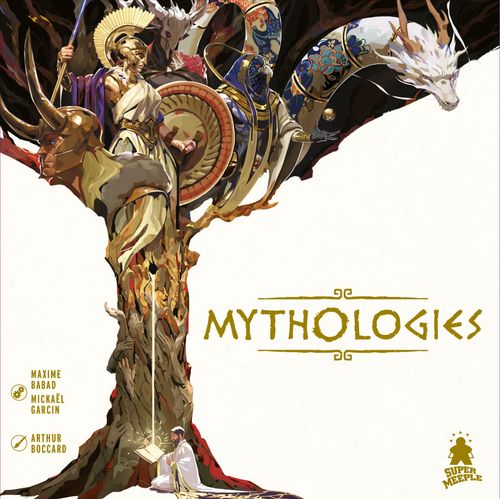
Mythologies
Mythologies Rulebook
Table of Contents
Table of Contents
Components
- 8 double-sided Mythology boards
- 4 Pantheon boards
- 176 cards, split across 8 mythologies of 22 cards each: 6 Creatures (x3) and 4 Deities (x1)
- 4 Destiny cards
- 78 Favor tokens: 65 of value 1 and 13 of value 3
- 55 Gem tokens: 43 of value 1 and 12 of value 3
- 1 Round-tracker board
- 3 Round-tracker markers
- 8 Mythology-choice cards
- 12 selection pawns, 3 for each of the 4 colors
- 4 Game-aid cards
- 8 storage boxes, 1 per mythology
- 1 First-player marker
- 1 Round-tracker marker
Mythologies present in this box: Celtic - Chinese - Egyptian - Greek - Hindu - Inca - Norse - Zulu.
Note: on page 14 you will find a glossary of the different terms used in the game, listed alphabetically.
Overall Setup
-
Take the 8 mythology-choice cards. Shuffle them and draw 4 at random. These are the 4 mythologies you will play with this game (you may of course choose the mythologies instead).
Tip: if this is your first game, it is recommended to play with the following 4 mythologies: Celtic, Egyptian, Greek and Inca.
-
Assemble the 4 Mythology boards matching the chosen mythologies into 2 pairs, one above the other, in any order, so that the texts on each pair form 1 complete sentence, called a Trial. Each board offers the start of a sentence on one side and the end of the sentence on the other side. The set of 4 boards forms the sanctuary.
-
Take the 4 card packs of the chosen mythologies; for each of them, separate the 18 Creature cards (grey back) and the 4 Deity cards (gold back), shuffle each pack separately and place them face down next to the corresponding Mythology board to form the draw piles (the Deity pile is placed next to the top half of the Mythology board, and the Creature pile next to the bottom half).
-
Place a Creature card on each of the 3 bottom slots of each Mythology board, from the corresponding draw pile, face up.
Important: there is no Deity card during setup.
-
Place the round-tracker board near the sanctuary and place the round-tracker marker on space "I".
-
Make a supply of Gems and Favors and place it within reach of the players.
-
Shuffle the 4 Destiny cards and place them face down on the sanctuary's designated slot (straddling the 2 upper Mythology boards).
Course of the Game
A game is played over 4 rounds, each made up of 3 phases:
A - SELECTION PHASE (SIMULTANEOUS) B - PLACEMENT PHASE (IN TURN ORDER) C - UPKEEP
At the end of these 4 rounds, a final scoring is triggered and the game ends.
Note: a player's "turn," as sometimes mentioned, refers to their placement phase.
A - Selection Phase (Simultaneous)
In this phase, players will each select 2 cards from the sanctuary, which they may add to their Pantheon in the next phase.
1) Reveal the top Destiny card of the draw pile and place it on the slot at the center of the 2 lower Mythology boards of the sanctuary.
This card indicates to each player which Mythology board they may select a card from.
Example: This card indicates that the green player may select a card from the Mythology board at the top right of the sanctuary. In the setup example, this means the player will be able to select a card in the purple board (Hindu mythology).
2) Each player secretly chooses one of their selection pawns, which they then place face down in front of them.
3) When all players have placed their pawn, they are revealed. Each player who revealed a pawn places it on a free card (with no pawn already placed) of the Mythology board indicated to them by the Destiny card (for simplicity, we refer to the mythology "assigned to them"). Players who revealed a pawn recover it.
Important: In the case where no Creature is available (due to a card effect or because there is no Creature left available for that mythology), and only in that case, a player may place their pawn on the top hidden card of that mythology's Creature draw pile.
After this step, return to step 1 by revealing a new Destiny card. Continue in this way until all players have chosen exactly 2 cards.
Once each player has placed their 2 pawns (meaning each has chosen 2 cards), the phase ends and each player then recovers their pawns and the cards they cover, and places them next to their Pantheon.
Remarks:
- There can only be one selection pawn per visible card (several players may be led to place their pawn on the same Creature draw pile; those players each draw a Creature from that pile, in turn order, at the end of the phase).
- A player cannot move or take back a pawn already placed.
- Each player may only play one of their pawns per revealed Destiny card.
- If the Selection phase ends before the 4th turn (each player having already placed both their pawns), do not reveal the next Destiny cards. The active Destiny card is the last one revealed.
The 4 Destiny cards allow each player to choose among the 4 mythologies. Since there are only 2 pawns per player, players can therefore only recover 2 cards during this phase, and necessarily from 2 different mythologies.
Important: Players must choose 2 cards during this phase. Each may therefore use their pawn a maximum of 2 times.
Example: The 3rd Destiny card has just been revealed. Maxime has already placed both of their pawns, so they have no more choice to make. Mickaël has already chosen a Creature from the Chinese mythology; on this turn they may choose a Creature or a Deity from the Hindu mythology at the top right of the sanctuary, so they have the choice between a Vetâla and an Asura since the Râkshasa has already been chosen by the blue player. Joé may choose from the Chinese mythology (top left), but they only have one possibility since the other 2 Creatures have already been chosen by Maxime and Mickaël. But both Joé and Mickaël may also decide not to select a card and to choose instead from the next mythology assigned to them by the following Destiny card.
Anatomy of a Card
- Type: Deity or Creature
- Name
- Mythology
- Invocation cost into the Pantheon
- Invocation gains, depending on which plane the card is placed in:
- the celestial plane
- the terrestrial plane
- the abyssal plane
- Effect type
- Effect description
- Unique card number
B - Placement Phase (In Turn Order)
During this phase, players place the 2 cards they previously selected into their Pantheon and activate their effects.
Starting with the first player, then clockwise, each player plays the cards they just acquired and set aside at the end of the Selection phase. Each player plays their 2 cards in the order they wish. They must finish playing their first card completely before playing the next one.
Important: A player may decide not to play a selected card; in that case they place it in their discard pile and gain 2 Gems.
To play a card, follow the steps below in this order:
1) Pay the invocation cost if necessary.
2) Place the card on a slot of your Pantheon. This slot may be empty or already occupied by a Creature; in that case the new card is said to crush the old one, and the old one is said to be crushed by the new one.
Important: It is not possible to crush a Deity!
The infinity-symbol effects of the card are immediately active.
3) Check the completion rule.
COMPLETION RULE: at any time during your turn, if a plane and/or a column is complete, immediately collect the completion gain for that plane and/or that column.
4) Collect the invocation gain indicated on the card according to the plane (the horizontal row) where you place it.
5) Resolve the download-arrow effects of the card.
Card Effects
Download-arrow icon: the effect applies only once, mandatorily and as fully as possible, when the card is played (invoked or called), and only during the active player's turn.
If a card is only moved, or becomes visible after having been covered, this effect does not trigger again.
Infinity icon: the effect is permanent, and is active as soon as the card is placed in the Pantheon. It may be activated, if it has a cost, by the player at any time during their placement phase or in reaction to an effect produced by a card of an opposing player, during another player's turn, or as a passive effect impacting the other players.
The "∞x1" icon indicates how many times the effect may be activated during any player's turn (here, once per turn).
Hourglass icon: the effect applies at the end of the game during the final scoring (see End of Game, page 10).
Examples:
This card's effect triggers on placement in the player's Pantheon; it lets you move a Creature by changing its plane, then gain its invocation gain.
Move a Creature by changing its plane, then gain its gain. (download-arrow effect) — card 070
When the Puma is in a player's Pantheon, each time it crushes a Creature it gains 1 Gem. If the Puma crushes a Creature when it itself enters play, the player also gains 1 Gem (effect active as soon as it is placed).
Gain 1 Gem when you crush a Creature. (infinity effect) — card 045
When the Troll is in a player's Pantheon, if an opponent wishes to place a card on the slot where the Troll is, they must first pay it 1 Favor.
Opponents must give you 1 Favor to be able to invoke a card on this slot. (infinity effect) — card 018
The player is free to activate or not activate their Griffin's effect. They may only activate it once per turn, and must pay 1 Gem each time they do so.
1 Gem: move a Creature/Deity from your Pantheon to another plane. (infinity, once per turn effect) — card 009
Cost of Cards
When a card's effect is presented in the form [cost]: [effect], the player is free to pay the cost or not, but they must do so if they want to apply the effect.
Example (Tian Long – Chinese): when this card is played, the player may, if they wish, pay 1 Gem and thus move a Creature or Deity; the opponents must make the same move.
1 Gem: move a Creature/Deity, the opponents make the same move. (download-arrow effect) — card 055
When a card's effect makes you carry out an effect followed by another effect, the second is not a cost. The following effect is applied even if the previous one could not be achieved.
Example (Condor – Inca): when this card is played, the player chooses an adjacent Creature or Deity, gains its invocation gain, then sacrifices it. If the Creature gives no invocation gain, it is sacrificed anyway.
Gain the invocation gain of an adjacent Creature/Deity, then sacrifice it. (download-arrow effect) — card 048
When a card makes you pay an element to apply an effect, it is a cost, but it is mandatory. If the cost cannot be paid, the effect is then not applied.
Example (Gorgon – Greek): when this card is played in the player's Pantheon, it must sacrifice the Creature or Deity on the slot below to gain 2 Gems. If it did not have a card to sacrifice below it, it does not gain the 2 Gems.
Sacrifice the Creature/Deity from the slot below to gain 2 Gems. (download-arrow effect) — card 007
Important: Effects that have no cost must mandatorily be applied.
Note: only the visible cards of your Pantheon activate their effects. A discarded (sacrificed) or covered (crushed) card is ignored from every point of view, unless an effect specifically targets a sacrificed or crushed card, or a stack of cards.
Worked Examples
Example 1:
- Renaud places a Centaur in their terrestrial plane.
- They immediately gain their invocation gain, namely 1 Gem, as indicated in the box corresponding to the plane where the card was placed. (They would have gained 1 Favor by placing it in their celestial plane, and would have gained nothing by placing it in their abyssal plane.)
- Invoking the Centaur allowed them to complete a column; Renaud therefore recovers the Favor token of that column. If the Centaur had also allowed them to complete their terrestrial plane, Renaud could also have recovered the Gem token of that plane.
- They then apply its placement effect.
Example 2:
- Cyril has a Bénou and an Asura in their celestial plane. They wish to now invoke the Deity Nuwa on the slot where their Bénou already stands. They first pay the invocation cost of the Deity and give 4 Gems to the supply, then place Nuwa on top of the Bénou.
- The infinity effect of the Bénou then triggers in reaction, since the card is crushed; Cyril may then call a Creature or Deity from a discard pile (their own or another player's).
- Once Cyril has finished resolving the Bénou's effect (having called a Creature or Deity from a discard pile), they gain first the invocation gain of Nuwa, namely a Favor. But the card completes neither a plane nor a column, so Cyril does not collect a completion gain.
- Cyril applies the effect of Nuwa, which crushed the Bénou. Each of their table neighbors gives them 1 Gem per Creature in their Pantheon or sacrifices it.
Example 3:
It is Maxime's turn. They wish to place an Unwabu in their Pantheon. But Mickaël has a Troll on the same slot in their own Pantheon, which requires that 1 Favor be paid to them to invoke a card on that slot. Maxime gives 1 Favor to Mickaël and places their Unwabu. They then gain their invocation gain of 1 Favor, and since they complete their terrestrial plane they also gain the completion gain of that plane, namely 1 Gem. But Mickaël also has a Mogwai on the terrestrial plane, and so since Maxime completed Mickaël's terrestrial plane, Mickaël gains 1 more Gem.
When all players have played, or discarded, their 2 cards, it is the end of the round and the transition to the upkeep phase (skipped if it is the 4th and final round).
C - Upkeep
- Advance the round-tracker marker one space to the right.
- The first player passes the first-player marker to the player on their left.
- Complete the sanctuary by adding a face-up card from the corresponding draw pile to every empty slot of each Mythology board.
Important: As soon as round 1 ends, the slot for the Deity card must also be filled in.
- Shuffle the 4 Destiny cards to re-form the draw pile, face down.
Reminder:
- The 3 slots in the bottom half of the Mythology board are reserved for Creatures, and the slot in the top half for the Deity.
- In round 1, there is no Deity in the sanctuary.
Deities
Deities may be selected starting from round 2.
Selecting a Deity from the sanctuary is free, as with Creatures. But at the moment of playing it (invoking or calling) into your Pantheon, you must pay 4 Gems, as reminded at the top right of the card.
You cannot pay this cost with the invocation gains of the Deity itself. But you may use other cards or effects during your turn to obtain the Gems needed.
Reminder: if you cannot, or do not want to, invoke a selected card, you must discard it and you gain 2 Gems.
ATTENTION: Deities cannot be crushed; they therefore block the movement of cards that would otherwise land on their slot.
Trials
A Trial is an objective that every player can reach, and which grants Favors. There are 2 Trials per game, each granting the sum of the Favors indicated on each board that composes it.
The 1st Trial is formed on the boards at the top of the sanctuary. It is active starting from round 3. The 2nd Trial is formed on the boards at the bottom of the sanctuary. It is active only in round 4.
At the end of their own turn during the placement phase, after having placed or discarded their 2 cards, the player checks whether they fulfill the condition of the Trial. If the player fulfills the condition of the 1st Trial in round 3, they gain the number of Favors indicated. The same applies for the condition of the 2nd Trial in round 4. A player may however still fulfill the condition of the 1st Trial in round 4, but gains 1 fewer Favor.
Remarks:
- Each player can only succeed at each Trial once.
- End-of-turn effects of cards apply before checking whether a Trial is fulfilled.
Example: This Trial grants 2+2 = 4 Favors. It is the 1st Trial (from the boards at the top, therefore).
Mickaël has just played their 2 cards for round 3 and has activated their various effects. It is the end of their turn, so they check the 1st Trial, which requires having at least 3 Gems of invocation in their terrestrial plane. Their Troll grants them 1 and their Nâga grants them 2, so they have 3 Gems of invocation in their terrestrial plane; they gain 4 Favors. Mickaël is happy.
After the placement phase of round 4, there is no upkeep phase; it is the end of the game and the final scoring takes place.
End of Game and Final Scoring
At the end of round 4, each player tallies their Favors, adding in this order:
- the Favors accumulated over the course of the game,
- the Favors obtained from the hourglass effects of their cards,
- the Favors obtained from conversion, at a rate of 1 Favor for 3 Gems (converted Gems are returned to the supply).
The player with the most Favors wins the game.
In case of a tie, the tiebreak is decided first by the number of Gems remaining (after conversion), then by the number of Deities in the Pantheon, and finally by the number of Creatures and Deities visible in the Pantheon.
If there is still a tie, victory is shared.
Additional Rule for 2 Players
To adjust the tension during the selection phase, a slight rule modification applies:
When a Destiny card is revealed, identify the 2 Mythology boards that are not used this round and exile from these 2 boards the Creature card whose slot corresponds to the number of Destiny cards revealed so far. If this is not possible, because the card has already been selected by a player, then the Deity must be exiled instead, if it is available.
Thus, the choices narrow over the course of the selection phase.
Note: on the 4th Destiny card revealed, there is therefore no card to exile.
Reminder: When the Creature is already selected, and therefore cannot be exiled, the Deity is exiled instead, unless it is already selected by a player.
EXAMPLE: 2-player game: Green versus Blue.
The 2 mythologies that are not assigned to any player are the Celts and the Incas.
If this is the 1st Destiny card revealed, the 1st Creature is exiled (starting from the left), namely the Leprechaun and the Amaru. Green may choose a Creature from the Chinese mythology. Blue may choose a Creature from the Norse mythology.
If this had been the 2nd Destiny card of the round, the Banshee and the Condor would have been exiled (the 2nd slot).
About the Theme!
Celtic
Celtic mythology, transmitted orally by the druids of Western Europe, is made up of epic tales and heroic legends that celebrate gods such as Dagda (abundance), Morrigan (war) or Cernunnos (nature). The Irish mythological cycles recount the exploits of the Tuatha Dé Danann, a divine people.
The Celts placed great importance on the afterlife and invisible worlds (such as Sidh), closely connected with the seasons and the cycles of the earth.
The Celts are rich in resources, and know how to protect them from outside aggression.
Chinese
Chinese mythology draws on founding stories blending philosophy and popular beliefs. Primordial chaos gave birth to the giant Pangu, creator of the sky and the earth. The pantheon grew considerably with the Taoist immortals, spirits and deified ancestors. This mythology reflects an ordered universe based on yin and yang, and the five elements, where the gods are often protectors of humankind.
The Chinese know how to combine mobility and trade.
Egyptian
Deeply rooted in the Nile, a source of life and prosperity, Egyptian mythology features gods with human and animal forms. Râ crosses the sky daily and sails through the Duat (underworld) each night, fighting against chaos. Osiris presides over the realm of the dead. Seth, for his part, embodies disorder and violence. Based on texts such as the Book of the Dead, it recounts the creation of the world by Atum from Noun, the primordial waters, and places Maât, the principle of truth and balance, at the heart of the judgment of souls and cosmic order.
The Egyptians build monuments in honor of their dead, to make them eternal in the afterlife, and to have them join their gods.
Greek
Greek mythology, abundant and colorful, has shaped the Western imagination. The gods of Olympus, led by Zeus, personified natural forces and human traits: Hera jealousy, Ares war, Athena wisdom. The Greek myths explained the origin of the world, the creation of men and the inescapable destiny imposed by the Fates.
The Greeks combine aggression to pillage neighboring resources and mobility to always adapt their strategy.
Hindu
Hindu mythology is one of the richest and most complex in the world. It rests on a multitude of accounts contained in the Vedas, the epics of the Mahabharata and Ramayana, and the Puranas. Three great deities form the Trimurti: Brahma (the creator), Vishnu (the protector) and Shiva (the destroyer-regenerator). The myths illustrate moral, spiritual and cosmological values, connecting mankind to the eternal cycle of birth, death and reincarnation.
The Hindus frequently refer to the Sanctuary (via the Destiny cards) and also play from the discard pile, thus emphasizing their cycle of reincarnation.
Inca
Inca mythology, born in the heart of the Peruvian Andes, foregrounds deities linked to nature and to the cycle of life. Viracocha is considered the creator god, while Inti, the sun god, was worshipped as the ancestor of the Inca emperors. The Incas believed in a world divided into three levels: Hanan Pacha (sky), Kay Pacha (earth) and Uku Pacha (underworld). Agricultural and astronomical rituals were central, reflecting harmony with nature, while human sacrifices appeased the gods.
The Incas often sacrifice their Pantheon cards in order to appease the gods in exchange for riches.
Norse
Norse mythology, from the Scandinavian peoples, depicts an epic and brutal universe. The gods, divided into Æsir (led by Odin, the "Father of All") and Vanir, reside mainly in Asgard. Nine worlds, including Midgard (land of humans) and Jotunheim (realm of the giants), are interconnected by Yggdrasil, the cosmic tree. The tales of the Eddas recount the creation of the cosmos from the body of the primordial giant Ymir, killed by Odin and his brothers, as well as the prophetic end of the world during Ragnarök, a cataclysmic clash between gods, giants and monsters.
The Norse know how to crush their enemies. True to the tales of epic battles that turn their opponents into a mere march toward reaching Valhalla.
Zulu
Zulu mythology, inherited from Southern Africa, foregrounds the figure of Unkulunkulu, the first ancestor who caused men and animals to emerge from the primordial reed. The world is populated by spirits, invisible forces and deities linked to the sky and to rain. The ancestors, greatly respected, play a central role as intermediaries between humans and the higher powers. The tales, often passed down orally, serve to explain nature, illness or the cycles of communal life.
The Zulus make resources emerge from their bond with the many spirits they invoke.
Publisher's note: The illustrations, while broadly consistent with what is generally accepted, remain an artistic representation and are in no way intended to be educational. The publisher further wishes to stress its deep respect for all the mythologies, and that the mixing of mythologies proposed in the game carries no ideological intent.
Lexicon
GOLDEN RULE: Each player can only apply the effects of cards in their own Pantheon, unless the resolved effect clearly states otherwise. Thus, an effect that says to Invoke/Call/Crush/Move/Sacrifice a card or a stack always resolves in the Pantheon of the player playing the card.
Important: In case of contradiction, the effect of the card always takes precedence over the general rule.
Adjacency A card is said to be "adjacent" to another when it is on an orthogonally neighboring slot.
Call Place a Creature or a Deity (regardless of where it comes from) in your Pantheon by paying its invocation cost and then applying its effect. A called card grants no invocation gain, unlike when it is invoked.
Complete Add a card to the last empty slot of a plane and/or a column. If the slot becomes empty again, the player may complete the plane/column again. If a player crushes a card in a plane/column, they do not re-complete the plane/column.
Discard Every sacrificed card is placed in the player's personal discard pile. The discard pile is placed face up next to the player's Pantheon. If an effect targets a card "from a discard pile," it may target a card from any player's discard pile. Every discard pile may be consulted at any time by all players.
Move Take a card from your Pantheon and reposition it on any other slot (while keeping the crushing rules, cf. Crush), unless the card's effect specifies a movement restriction. A moved card may allow another card to be crushed. If a single effect causes several cards to be moved, all these moves are considered simultaneous. If a move must be made onto an uncrushable card, the move does not take place.
Destined The mythology referred to as "destined" corresponds to the mythology to which the player had access during the last Destiny card revealed during the selection phase (which is not necessarily the last of the 4 Destiny cards, in the case where all players have played both their selection pawns and therefore have selected both their cards before the 4th turn).
Diagonal The Pantheon has 2 diagonals of 3 slots, connecting its opposite corners. When an effect indicates a position "on a diagonal of a card," it refers to the slots that are on the card's diagonal, not the diagonals of the Pantheon.
Crush In a Pantheon, a card crushes another when it is placed or moved onto a slot occupied by another card. There is no limit to the number of cards on the same slot; a card can therefore crush a stack of several cards. It is possible for a crushed card to become visible again, if the card covering it is moved or discarded. In that case, the newly visible card grants no invocation gain and does not trigger its download-arrow effect, but if it has an infinity effect, that effect becomes active again.
If a card with an infinity effect is crushed, the player has the opportunity to trigger that effect (for example, the Puma does indeed grant 1 Gem).
A crushed card is ignored from every point of view, unless an effect specifically targets a crushed card, or a stack of cards. When a card is crushed, it activates its "If crushed" effect. An uncrushable card means it cannot be crushed, so no card may cover it (via placement or movement). Deities are uncrushable by default. When a card is crushed while it has begun activating its effect, the effect is resolved in full.
Exile Remove the card from the game. It is set aside and is part of no discard pile.
Completion gains Completion gains correspond to the Gems or Favors obtained when a plane and/or a column are completed. They are collected immediately as soon as the card is placed. They are never put back in the Pantheon and can therefore each only be collected once.
Invocation gain The invocation gain is the gain obtained immediately when a card is invoked (not called), according to the plane on which the card is placed (celestial/terrestrial/abyssal). This gain may be Gems and/or Favors and is then called the invocation gems or invocation favors. Only the active invocation gain (which corresponds to the plane the card is placed on) is considered an invocation gain.
Invoke Place a Creature or a Deity (regardless of where it comes from) in your Pantheon by paying its invocation cost, gaining its invocation gain, and applying its effect.
Stack When one or more cards occupy the same slot of a Pantheon, they form a stack. Game effects target stacks of cards only when the word "stack" is present in the effect, otherwise only the visible card on top of the stack is affected by the effect. If the card on top of the stack is unaffected by an effect targeting a stack, the rest of the stack is not affected either.
Plane A plane corresponds to a horizontal row of your Pantheon. There is therefore a celestial plane (top row), a terrestrial plane (middle row) and an abyssal plane (bottom row).
Sacrifice Place the card face up in its owner's personal discard pile. A non-sacrificeable card cannot be sacrificed by any effect, regardless of its origin. If an effect sacrifices a stack in which there is a crushed non-sacrificeable card, since that card is not visible its effect is not active, so the card is sacrificed along with its stack. A Deity is sacrificeable.
Neighbor Your neighbors represent, in turn order, the player before you and the player after you.
Icons
- Creature
- Deity
- Pantheon
- Plane (Celestial / Terrestrial / Abyssal)
- Mythology
- Sanctuary (formed by the 4 Mythology boards)
- Completion gain
- Invocation gain
- Gain at final scoring
- Permanent effect
- Permanent effect, usable once per turn
- Effect on placement (Invoke or Call)
Card Glossary
Card-specific rulings, numbered by each card's unique card number.
002 – Poseidon: The effect also applies to Poseidon.
003 – Athena: Several stacks may be moved onto the same slot, stacked in the order of your choice. The effect may apply to Athena's own stack.
004 – Hades: Your opponents do not obtain completion gains; you obtain theirs instead.
005 – Minotaur: Horizontally means on the same plane and on any other slot of the plane.
006 – Centaur: Orthogonally means on an adjacent slot. If you have no other Creature to sacrifice on the plane the Centaur is moved to, opponents must still sacrifice a Creature on the same plane if they can.
007 – Gorgon: If there is a card on the slot below the Gorgon, you are required to sacrifice that card.
008 – Cyclops: If it completes its own plane or column, you may also use its effect by paying 1 Gem. You may use the completion Gem to pay for its effect. If you complete its plane or column because of a card played during an opponent's turn, you may not use the Cyclops's effect.
009 – Griffin: The Creature/Deity moved may change column.
010 – Chimera: The invoked Creature is required to crush the Chimera.
011 – Odin: Draw piles are not part of the Mythology boards, so opponents may always select the Creature on top of the corresponding draw pile. This effect does not prevent your opponents from invoking or calling Creatures/Deities of that board during the placement phase (Impundulu or Râkshasa for example).
012 – Thor: Each opponent chooses for themselves. If they can only do one or the other, they must do so, even if they have only 1 Favor. If they have only 1 Favor and at least 1 Deity, they must choose to sacrifice a Deity.
013 – Loki: The sanctuary is completed with face-down cards as soon as Loki is played during the placement phase. During the following upkeep phases, new cards added to the sanctuary are placed face up, as usual. The draw piles are not part of the sanctuary; having Loki does not let you consult them. Face-down cards are always considered Creatures or Deities.
015 – Draugr: If an opponent has a Creature they cannot sacrifice (protected by Morrigan for example), they must sacrifice another one or give you 2 Gems. If an opponent has fewer than 2 Gems, they must sacrifice a Creature as a priority. If an opponent has fewer than 2 Gems and no Creature they can sacrifice, they must give you 1 Gem if they have one.
019 – Fenrir: If an opponent has only 1 Gem or only 1 Favor, they lose it anyway.
020 – Alf: If it is in a corner of your Pantheon, its effect lets you move another Creature to the opposite corner, which is diagonally opposite the Alf.
021 – Râ: Your opponents do not obtain completion gains; you obtain theirs instead.
022 – Osiris: It can grant up to 6 Favors. To gain 2 Favors, at least 2 Creatures/Deities must be in your Pantheon but on at least 2 different planes.
025 – Scarab: If you must sacrifice several Creatures simultaneously, due to a single effect (Fée or Nuwa for example), you may sacrifice the Scarab instead of another Creature, thus protecting one from sacrifice.
027 – Sphinx: If the crushed card triggers an effect when it is crushed, you choose in which order to resolve the effect of the crushed card and the effect of the Sphinx. The invocation gain is that of the Creature moved.
028 – Cobra: The same mythology as that of the sacrificed card, not that of the Cobra.
030 – Bénou: If it is crushed by a card with an "If crushed" effect, resolve the Bénou's effect first.
032 – Vishnu: Gain the invocation gain of a Deity from the sanctuary and from the plane on which Vishnu is placed.
035 – Asura: The mythology board destined to you is the one indicated by the last Destiny card revealed. This effect can grant up to 4 Gems if no card has been taken.
036 – Nâga: Its effect also blocks the movement of adjacent stacks (Athena).
037 – Râkshasa: It is possible to trigger its effect several times in the same turn.
038 – Garuda: The plane on which the Creatures are sacrificed is indeed the one chosen to gain Gems.
039 – Vetâla: It is possible to move the same card several times; the moves happen in the order chosen by the player.
044 – Inti: Its effect does not convert Gems into Favors; your Gems also grant Favors when converting.
045 – Puma: The effect also triggers when this card is crushed.
047 – Caiman: You cannot choose a mythology that is not present in your Pantheon.
050 – Ukuku: If the Ukuku completes its own plane, its effect activates.
051 – Yanluo Wang: You decide the order in which you make your exchanges with your opponents, and how many exchanges you make with each, within the limit of your Gems and the number of empty slots in their Pantheon.
052 – Sun Wukong: If a neighbor moves several cards simultaneously (Hades for example), you only gain 1 Favor. If a neighbor makes several separate moves during their turn (caused by different effects), you do indeed gain 1 Favor for each of them.
053 – Nuwa: Only visible Creatures in opponents' Pantheons may be sacrificed. Creatures revealed this way do not suffer their own effect in turn.
055 – Tianlong: When the card is played, you may pay 1 Gem to move any Creature/Deity, including Tianlong itself. This move is then made identically by the opponents (same starting slot and same destination slot).
057 – Fenghuang: It is first crushed or sacrificed before you activate its effect, so it triggers reaction effects such as Isis's, for example.
058 – Mogwai: The effect triggers even when a player completes a column or a plane for which they had already obtained the completion gain.
059 – Jiangshi: It may sacrifice its own stack.
062 – Inkosazana: The 2 Creatures/Deities are invoked one after the other; the first must have fully resolved its effect before the second is invoked, including if invoking the first triggers effects from other cards in reaction. If Inkosazana must be sacrificed before the second Creature/Deity is invoked (by invoking a Condor for example), it is invoked all the same (as with Anubis).
065 – Inkanyamba: It can grant several Gems per turn, but this gain is limited to 1 Gem per card triggering its move during a single turn (no infinite loop).
068 – Impundulu: If the crushed Creature triggers an effect when crushed (a Bénou for example), choose which effect to resolve first between that of the Impundulu and that of the crushed card. If you apply the Impundulu's effect first, the invoked Creature also applies its effect before the crushed card.
069 – Hyena-Man: Even if there is no Creature/Deity to call, you must sacrifice a Creature. The Hyena-Man may sacrifice itself.
070 – Idlozi: The Creature moved may change column.
071 – Dagda: If an effect makes you move, crush and/or sacrifice several Creatures/Deities, gain 1 Favor per Creature/Deity involved. The same Creature/Deity only grants you 1 Favor if it is moved and crushed by the same effect.
074 – Morrigan: It does not prevent Creatures from being moved onto its plane.
080 – Dullahan: It grants itself 1 Gem if it is crushed by its own effect.
Summary
Each Round Has 3 Phases
1. Selection Phase (Simultaneous)
a) Reveal a Destiny card: it indicates in which mythology each player may choose a card.
b) Each player secretly chooses a selection pawn.
c) Reveal the pawns and place those chosen on the selected cards, or take back the pawns not chosen.
d) Repeat from step a) until everyone has chosen 2 cards.
ATTENTION: Only one pawn per card. If no Creature is available, the top card of the draw pile may be selected.
2. Placement Phase (Turn Order)
For each chosen card:
1 - Pay its invocation cost if needed. 2 - Invoke it into your Pantheon (a free slot or by crushing a Creature).
ATTENTION: You cannot crush a Deity.
The infinity effects are immediately active.
3 - Check the completion rule. 4 - Gain the invocation gain according to the plane (horizontal row). 5 - Resolve the download-arrow effect of the card.
At any time during your turn, if the plane and/or the column is complete, collect the completion gain of the plane and/or of the column.
Important: The player may decide to discard a card instead of invoking it and gain 2 Gems instead.
3. Upkeep
- Advance the round tracker.
- Pass the first-player marker to the player on the left.
- Complete the sanctuary's missing cards (including Deities from the end of round 1).
- Reshuffle the Destiny cards.
Trials
- Round 3: 1st Trial (top boards).
- Round 4: 2nd Trial (bottom boards) + 1st Trial for 1 fewer Favor if not completed in round 3.
End of Game
At the end of round 4, each player adds up, in this order:
- Favors gained during play,
- Favors gained from hourglass effects,
- Favors gained from conversion: 3 Gems = 1 Favor.
The player with the most Favors wins.
In case of a tie, the tiebreak is decided by the Gems remaining, then by the number of Deities, and finally by the total number of cards visible in the Pantheon.
Mythology Complexity and Interaction Reference
The rulebook includes a reference table rating each mythology's relative complexity and player-interaction level (Celtic, Chinese, Egyptian, Greek, Hindu, Inca, Norse, Zulu), shown as a scale of icons rather than numeric values.