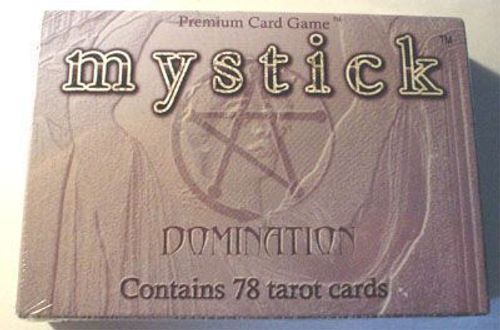
Mystick Domination
Mystick Domination Rulebook
Table of Contents
Table of Contents
What is Tarot?
For centuries, tarot cards have been used for inspiration, instruction, and fortune telling. Tarot decks have two different kinds of cards: Minor Arcana and Major Arcana. A traditional 78-card deck has 56 Minors and 22 Majors.
If you’ve ever used standard playing cards, the Minor Arcana should look familiar to you; playing cards evolved from them. Minors are divided into four suits and ranked from Ace through King, just like standard playing cards. There are two important distinctions, however. Firstly, the suits are different. Instead of clubs, hearts, spades and diamonds, there are Wands, Cups, Swords and Pentacles. Secondly, instead of three “face cards” (Jack, Queen, King) there are four “court cards” (Page, Knight, Queen, King).
The 22 Major Arcana cards are another matter altogether. These are the really famous tarot cards you may have seen in movies, like The Fool, Death, The Lovers, The Tower, and so on. They have no suit or rank, and are all considered to be above the Minors. Major Arcana are numbered from zero to 21 (or rather, from O to XXI, since they use Roman Numerals).
Suits
In Mystick: Domination, all Minor Arcana cards have a tarot suit and a tarot rank printed in the upper-left corner. Each of the four suits excels in controlling one particular aspect of the game.
WANDS (red symbol) represent primal forces: creativity, spirituality, and the element of Fire. A deck that uses Wands will be able to control Power by moving it, creating it and destroying it.
CUPS (green symbol) represent binding forces: sympathy, contagion, and the element of Water. A deck that uses Cups will be able to control the Mystick Cross by manipulating the cards within.
SWORDS (blue symbol) represent moving forces: intellect, wit, and the element of Air. A deck that uses Swords will be able to subtly control the flow of the game by altering the Draw Count and players’ moves.
PENTACLES (yellow symbol) represent static forces: knowledge, worldly resources, and the element of Earth. A deck that uses Pentacles will be able to control cards in players’ hands, decks, and discard piles.
Traits
The Pawns from each suit have a tendency to possess certain special abilities called traits.
Aggression is common to Pawns from the suit of Wands. It gives a Pawn the ability to kill other Pawns. If a Pawn with Aggression challenges another Pawn, and gets a number of successes equal to or greater than the target’s influence, the target is discarded from play.
Presence is sometimes possessed by Pawns from the suit of Cups. At the end of each round, when bonus victory points are scored, Pawns with Presence score double points.
Immunity belongs to the suit of Swords. It is difficult to take Power away from a Pawn with Immunity, because whenever it is challenged by another Pawn, one success scored against it is cancelled.
Resources are the province of the suit of Pentacles. Whenever you use your move to draw, you also have the option to draw an additional card for each Pawn you control who has Resources.
Game Setup
To begin a game, each player needs a deck and a playmat. You will also need tokens to represent Power, and to help you keep score. Your playmat represents your Mystick Cross; beside it are your play area, your deck, and your discard pile.
Use the chart on the back of this rulebook to find out how much Power goes in the pool at the start of the game. Place that many tokens in the center of the table to create the pool.
Now shuffle your deck and draw the top six cards. If you draw any Major Arcana, you must discard them and draw new cards from your deck to replace them. Continue until you have six cards and no Major Arcana. Place a token on your playmat’s score tracker on the number zero. All players do this at once. Optionally, players may be permitted to shuffle discarded Major Arcana back into their decks at this point.
Finally, place one Draw Count tracker card (one was provided with your deck) in the center of the table, next to the pool. Place a token on the number zero. Now you are ready to begin the first round of play.
Drawing for Initiative
Each player draws the top card of his or her deck and shows it to everyone. If anyone draws a Major Arcana card, they must discard it and try again until they get a Minor Arcana card. Whichever player draws the card with the highest tarot rank wins the initiative and will go first. All players put their initiative draws into their hands before continuing.
In case of a tie, all players put their initiative draws into their hands, and then the tied players draw again, following exactly the same procedure. Keep on doing this until the tie is broken.
Making Moves
Beginning with the player who won the initiative, each player in turn will make one move at a time. When a player finishes his or her move, it is the next player to the right’s turn to make a move. This continues until the end of the round.
When it is your move, you generally have three choices: you can play, draw, or challenge.
Play
There are four different kinds of cards you can play from your hand, and each functions slightly differently. No matter what type of card it is though, to play it, you simply take it from your hand and place it face-up on the table next to your playmat. The card is now “in play” (unless it is an Action card; see below).
Environments (pale green cards ranked Ace-2)
When you put an Environment into play, it usually creates some kind of overall effect on the game. Environments, once played, stay in play for the rest of the game unless something specifically makes them go away.
Pawns (pale yellow cards ranked 3-7)
When you put a Pawn card into play, it joins your cause, whether it wants to or not. Unlike any other card type, Pawns have an influence rating (shown in the lower-left corner of the card illustration) in addition to a tarot suit and a tarot rank. The higher a Pawn’s influence, the more Power it can take and hold. Once played, a Pawn remains in your play area until something specifically gets rid of it.
Attachments (pale blue cards ranked 8-10)
Attachments are unusual in that they do not stand alone; they must attach to a Pawn in order to exist in play. When you play an Attachment card, you must choose a Pawn (yours or an opponent’s) somewhere in play to receive it. Place your Attachment card together with the Pawn you have chosen, so everyone can see that the cards are attached.
Obviously, you may not play an Attachment if no one has any Pawns in play. A Pawn may have any number of Attachments, and the suits of the Pawn and its Attachments don’t have to match.
If a Pawn leaves play for any reason, all of its Attachments go immediately to their respective owners’ discard piles; Attachments cannot exist in play on their own.
Actions (pale red-bordered ranked Page-King)
Actions are the disposable cards. Unlike the other card types, you do not put Action cards into play. Instead, when you play one, simply follow the directions on the card. As soon as the card has finished taking effect, put it in your discard pile.
Draw
Drawing is perhaps the simplest move you can make, but it can have a few complications. To draw, take the top card from your deck and add it to your hand. Whenever any player does this, the Draw Count goes up by one (move the token on the Draw Count tracker to indicate this). When the Draw Count reaches 3, the round will end.
If you ever have a Major Arcana card in your hand, you must immediately discard it and draw the next card from your deck to replace it. You may have to repeat this a number of times before you get a Minor Arcana.
If you happen to have any Pawns in play with the Resources trait, you also have the option to draw extra cards. Whenever you use your move to draw, you may draw a number of additional cards equal to the number of Pawns you have in play with Resources.
Regardless of the number of additional cards you take from your deck as a result of needing to replace Major Arcana or using Resources, the Draw Count still only goes up by one each time a player uses a move to draw.
Challenge
When a Pawn challenges, it tries to take some Power, either from the pool or from an enemy Pawn. To challenge, follow these steps:
Declare the challenge
In order to begin a challenge, you must make two choices: which of your Pawns will attempt the challenge, and who or what will be the target of the challenge?
Obviously, you must have at least one Pawn in play to make a challenge. But not just any Pawn will do. For instance, each Pawn has an influence rating in the lower-left corner of its illustration. A Pawn’s influence is also its maximum capacity for Power; no Pawn may ever hold more Power than it has influence. For example, if a Pawn with 2 influence also has 2 Power, it is at its full capacity and may not make a challenge until either something takes that Power away, or until its influence is increased somehow. A Pawn with zero influence cannot challenge at all.
But even if a Pawn has influence to spare, it might not always be able to make a challenge. Specifically, there has to be a target out somewhere in play that it can go after. Which brings us to the question of who or what can be challenged?
You can challenge the pool, or you can challenge an opponent’s Pawn, but whoever or whatever the target is, it must have at least one Power. So you can’t challenge the pool if it is empty, and you can’t challenge a Pawn that has no Power.
There is one more restriction: no Pawn may ever challenge a Pawn with higher tarot rank. For example, the six of Pentacles could challenge the three of Pentacles or the six of Swords, but not the seven of Cups.
At this point, any card effects that occur “when a Pawn challenges / is challenged” are activated.
The Fate Draw
The number of cards you will use in your Fate Draw depends on the influence of the Pawn who is making the challenge. If your Pawn has one influence, draw one Fate. If it has 2 influence, draw 2 Fate, and so on. Take the cards one at a time from the top of your deck and place each one in turn onto the first available open space in your Mystick Cross (that is, whichever numbered rectangle on your playmat has the lowest number, and doesn’t already have a card sitting on it). If you don’t have enough open spaces on your playmat to fit all of your Fate cards, the extra cards go straight to your discard pile and have no effect. If your Mystick Cross is completely filled up, you cannot challenge again until some space is cleared.
Each card in the Fate Draw that matches the suit of the Pawn who is challenging represents one success, and a Major Arcana is always a success. A Minor Arcana that doesn’t match the challenging Pawn’s suit is a failure. So for example, if the five of Wands has 2 influence and makes a challenge, and its Fate Draw produces the Knight of Wands and the four of Swords, that would be one success and one failure.
Redraws
Once you have drawn your Fate, you have one chance to redraw any cards you don’t like. You can choose any card or cards just drawn in the previous step, throw them in your discard pile, and try them all again. You may only do this once per Fate Draw.
Resolve Majors
Major Arcana usually have some special effect, in addition to providing an automatic success. At this point, all of the Major Arcana cards that you drew in this Fate Draw take effect, in the order of their position (that is, the one sitting on the lowest number on your playmat resolves first). Simply follow the instructions on the Major Arcana cards to resolve them.
Count successes
Next, count up the number of successes your Pawn has achieved. If any special effect adds or subtracts from your Pawn’s successes, it takes effect at this point. For example, If the target has Immunity, you must subtract one success from your total.
Transfer Power
Now, for each success you achieved, move one Power from the target of the challenge to the Pawn who made the challenge.
There can be limitations to this. Firstly, if you get more successes than the target has Power, your extra successes will have no effect. For example, if your Pawn challenges the pool and gets 3 successes, but there is only 2 Power in the pool, one of those successes will be wasted.
Secondly, if your Pawn doesn’t have enough influence to hold all of the Power that it is about to take, the excess Power stays where it was. For example, if you have a Pawn with 2 influence and one Power, and it challenges another Pawn and gets two successes, then one of those successes is wasted, because your Pawn only has room for one more Power than it already has.
If a Pawn with Aggression challenges another Pawn, and the number of successes equals or exceeds the target’s influence, the target is discarded after the Power is transferred.
Score victory points
For each Power you transferred to your Pawn during the previous step, add one victory point to your score (move the score tracker on your playmat to show this).
If you gain at least one victory point this way, your challenge is considered to have been successful. If not, it is considered unsuccessful.
Using Special Moves
Sometimes you will come to control a special card that will give you the ability to do something other than play, draw, or challenge as your move. Usually, such cards are worded like this: “You may use a move to…” If you have such a card in your play area, you may follow the directions on that card instead of making a normal move.
End of a Round
If the Draw Count ever reaches 3, the round ends immediately. At the end of each round, all players follow these steps in order:
Score bonus points
For each Power you have on your Pawns, score one bonus victory point. Pawns with Presence give you 2 points for each Power they have at this point instead of one.
Check for a winner
Look at the pool. If there is no Power left in it, the game is over and the player with the highest score wins! But if there still is at least one Power left in the pool, then it’s not over yet. Prepare for the next round by continuing with the next step.
Remove Power
Remove all Power on the Pawns from the game. Power remaining in the pool stays, but don’t replenish the pool; it usually gets smaller and smaller each round until the game ends.
Clear Mystick Crosses
Discard all the cards from your Mystick Cross.
Reset Draw Count
The Draw Count goes back to zero.
Now you are ready to begin another round. Draw for initiative to see who goes first, and play away.
Elimination
There is one other way to win: eliminate all the other players. A player is out of the game if their deck has no cards remaining in it. As soon as their last card is played, drawn, or discarded, they’re eliminated.
Tiebreakers
If a game ends and the top scores are tied, the tied players count the number of cards remaining in their decks. Whoever has the most cards left wins the tiebreaker. If they have the same number of cards, the game is a draw.
Deck Construction
One of the most enjoyable aspects of Mystick is the challenge of constructing a custom deck, designed around a particular theme or strategy. When you play with custom decks, you’ll never know which suits or cards your opponents are going to use, so your games will continually surprise you. There are two ways to customize your deck.
Basic Deck Construction Rules
Choose two suits. Take 14 cards from each of those suits, and add 11 Major Arcana. You may not use any duplicates in your deck.
Two or more Minor Arcana cards are considered to be duplicates of one another if they have both the same tarot suit and the same tarot rank (even if they have different names). Two or more Major Arcana cards are considered to be duplicates if they have the same Roman Numeral.
Advanced Deck Construction Rules
As in the basic rules, choose two suits and take fourteen cards from each, then add eleven Majors. The difference is that in the advanced rules, you may use up to three duplicates of any card or cards you wish.
Tournaments
A Mystick tournament can be held in either the basic or advanced formats described above.
Tournament matches are usually one-on-one, best two games out of three. At the start of the tournament, you must have the complete contents of your 39-card deck written down in a list for judges to check with. At the beginning of each match, your deck must match the contents of your deck list exactly as written.
At the end of each game, the loser may choose to either play the next game with the same deck, or to remove exactly 3 cards from their deck and replace them with 3 different cards from their collection. All cards removed and added must be shown to the other player. The modified deck may not contain more than 3 duplicates, just as in the advanced deck construction rules.
Questions and Answers
Q: Can there be two copies of the same Pawn in play at once?
A: Oh, yes. Clones, evil twins, impostors and things like that happen all the time in Mystick.
Q: When a card says “you” or “your”, is it referring to the person the card belongs to, or to all the players?
A: Just the person who played the card.
Q: If I use a card effect to pick up and look at cards from my opponent’s deck, and I pick up the last card in that deck, is my opponent eliminated?
A: No. If you’re just looking at the cards, and the effect tells you to put the cards back right away, the player is not eliminated.
Q: I’m at the “redraw” step of a Fate Draw. If I discard a Major Arcana and redraw something else, will the Major still take effect?
A: No.
Q: Can my score go above 29 or below zero?
A: There is no maximum score, but zero is the minimum. Any effect that would reduce your score below zero puts your score at zero.
Q: I challenge a Pawn, and a Major Arcana in the Fate Draw kills the target of my challenge. Do I still get to take its Power and get victory points?
A: No. When the time comes to transfer the Power, that Power has already returned to the pool, and you weren’t challenging the pool.
Q: If a Pawn’s influence drops, and it winds up with more Power than it can hold, what happens?
A: The excess Power goes back to the pool.
Q: If a Pawn has some Power and gets removed from play, what happens to the Power?
A: The Power returns to the pool.
Q: Can I look through the discard piles?
A: Yes.
Q: When two effects happen at the same time in the middle of a move, which resolves first?
A: The player whose move it is resolves all his/her effects in any order they choose, followed by the player to his/her right, and so on.
Q: If several card effects happen “after the next initiative draw”, in what order do they resolve?
A: The player who wins initiative resolves all of his/her “after initiative” effects in any order he/she wishes, followed by the next player to his/her right, until they have all resolved.
Q: If a Pawn with Immunity gets an Attachment that grants Immunity, is the trait “doubled”?
A: No. A Pawn either has a trait or it doesn’t.
Q: Why the old artwork on the cards?
A: The Secret Masters are very old, and they don’t believe that anything really changes. They see the modern world like the images on the cards.
Glossary / Index
Ace : A rank for a Minor Arcana card. Lower than a 2.
Action : Card type. Actions are played, take their effect, and are then discarded.
Aggression : Trait possessed by some Pawns, particularly in the suit of Wands.
Attachment : Card type. An Attachment sticks to a Pawn and bestows its effect, good or bad, upon that Pawn.
challenge : One of the three main options you have when you make a move. It is an attempt made by a Pawn to get Power, accomplished by means of a Fate Draw.
Cup card(s) : Any card or cards that are of the suit of Cups, as indicated by a green symbol in the upper left corner of the card.
deck : The pile of cards that a particular player draws from. Kept face-down.
discard pile : Each player has a discard pile, where their used cards are placed face-up.
draw : One of the three main options you have when you make a move.
Draw Count : A tally of the number of times players have chosen to draw as their move so far this round. When it reaches 3, the current round ends.
draw Fate : Draw one or more cards and put them in the unoccupied spaces of your Mystick Cross.
drawn as Fate : A card that goes directly to your Mystick Cross from the top of your deck is considered to have been drawn as Fate.
Environment : Card type. Environments are put into play, and thereafter have some kind of global effect on play, until something gets rid of them.
failure : A card in a Fate Draw which does not produce a success.
Fate Draw : The process of determining how successful a challenge is.
Immunity : Trait possessed by some Pawns, particularly in the suit of Swords.
in play : Any card in anyone’s play area is considered to be “in play”.
influence : Amount of control a Pawn has over worldly affairs. The number of cards that Pawn pulls for its Fate Draws. Also the Pawn’s maximum capacity for Power.
initiative : The process of determining which player will make the first move of a new round.
King : The highest rank possible for a Minor Arcana card.
Knight : A rank for a Minor Arcana card. Higher than a Page, but lower than a Queen.
Major Arcana : Any of the set of 22 high cards with no suit and no rank. Each is represented by a Roman Numeral from zero to 21, and is considered above all the Minor Arcana.
Minor Arcana : Any card with a suit and a tarot rank.
move : A single move can be used to either play, or draw, or challenge.
Mystick Cross : The eight numbered rectangular spaces on your playmat, used during Fate Draws.
Page : A rank for a Minor Arcana card. Higher than a 10, but lower than a Knight.
Pawn : Card type. Pawns are the most important type of card, because they are the only ones with the influence necessary to obtain Power.
Pentacle card(s) : Any card or cards that are of the suit of Pentacles, as indicated by a yellow symbol in the upper left corner of the card.
play : One of the three main options you have when you make a move.
play area : A large area next to your playmat, your play area is where you place your Pawns and Environments.
pool : The central repository of Power, which all players have access to during the game.
Power : Used to control the world. Represented by tokens.
Presence : Trait possessed by some Pawns, particularly in the suit of Cups.
printed trait : A trait possessed by a card naturally, ie. without the aid of an Attachment or other card effect.
Queen : A rank for a Minor Arcana card. Higher than a Knight, but lower than a King.
redraw : Once each time you make a Fate Draw, if you get cards you don’t like, you can redraw them in hopes of getting something better.
Resources : Trait possessed by some Pawns, particularly in the suit of Pentacles.
round : Each game progresses over a series of rounds, which begin with a draw for initiative, and end when the Draw Count reaches 3.
success : In a Fate Draw, a Minor Arcana card that matches the suit of the challenging Pawn, or a Major Arcana.
successful challenge : If you gain at least one victory point at the end of a challenge, it is considered to have been successful.
suit : A quality possessed by all Minor Arcana, indicated by a colored icon in the upper left corner of the card, just below the rank. The four suits are: Wands, Cups, Swords, and Pentacles.
Sword card(s) : Any card or cards that are of the suit of Swords, as indicated by a blue symbol in the upper left corner of the card.
tarot rank : A quality possessed by all Minor Arcana, indicated by a word or number in the upper left corner of the card, just above the suit. The ranks are, in ascending order: Ace, 2, 3, 4, 5, 6, 7, 8, 9, 10, Page, Knight, Queen, King.
trait : One of the four special abilities a Pawn can possess. The traits are: Aggression, Immunity, Presence, and Resources.
use a move : If a card you have in play states that “You may use a move to” do something, you may do that instead of a standard play, draw, or challenge. You cannot use such an effect unless the card is already in your playing area.
victory point : Obtained by getting Power for your Pawns, or as a result of having Power at the end of a round, or from special card effects. When a game ends, the player with the most victory points wins.
Wand card(s) : Any card or cards that are of the suit of Wands, as indicated by a red symbol in the upper left corner of the card.
Charts and Reference
| Number of players | 2 | 3 | 4 | 5 |
|---|---|---|---|---|
| Power in pool at start of game | 11 | 15 | 19 | 23 |
| Suit | Controls | Trait |
|---|---|---|
| Wands | Power | Aggression |
| Cups | Mystick Cross | Presence |
| Swords | Moves | Immunity |
| Pentacles | Cards | Resources |