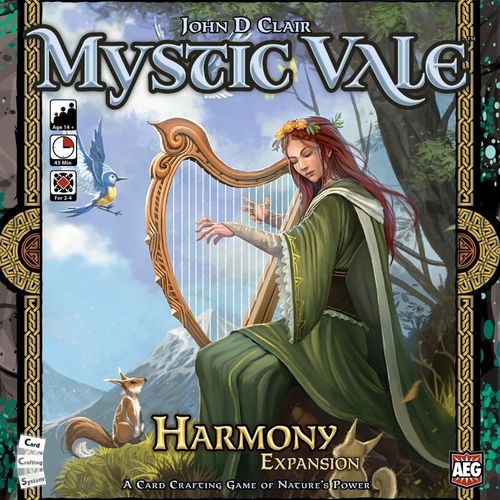
Mystic Vale: Harmony
Mystic Vale: Harmony Rulebook
Table of Contents
Table of Contents
Components
Your game of Harmony should include the following. If it does not, contact [email protected] for assistance.
- 105 Advancements consisting of:
- 36 Level 1
- 36 Level 2
- 33 Level 3
- 36 Vale cards consisting of:
- 18 Level 1
- 18 Level 2
- 8 Leader cards
- 8 Amulets
- Rulebook
Setup
The new advancements and vales in Harmony can be used as an expansion or as a replacement base game, as described below.
Expansion
Simply shuffle the new advancements and vale cards into their corresponding decks. Then follow the standard setup rules for the base game.
Base Game Replacement
If players want an entirely new experience of Mystic Vale, the new advancements and vales in Harmony can replace the base game's advancements and vales (but use the Fertile Soil advancements as normal). In other words, you can replace the base game with Harmony to play with entirely new cards. Setup follows standard rules for the base game.
After a few games when players become familiar with the new content, you can mix in the base game and expansions to add more variety.
Eclipse Symbol
Eclipse advancements feature an eclipse symbol, represented by a card overlaying another card.
Eclipse advancements work like regular advancements with the exception that they may be covered by another advancement.
Example: You may sleeve an advancement so it covers an eclipse advancement.
Example: You may sleeve an eclipse advancement under another advancement, so the eclipse advancement is covered.
Important: You cannot sleeve an eclipse advancement so that it covers another advancement, even another eclipse advancement.
If an advancement is sleeved over an eclipse advancement, the VP symbol on the covered eclipse advancement is not worth any points at the end of the game.
Legendary Advancements
Legendary advancements use multiple slots instead of just a top, middle, or bottom slot. Otherwise, sleeving a legendary advancement follows all of the standard rules:
- You may not sleeve the advancement if it will cover another advancement already on the card (including advancements on starting cards). However, you may sleeve a legendary advancement over an eclipse advancement.
- You are not allowed to buy an advancement if you do not have a legal place to sleeve it on a card in your field.
- Advancements that you buy are not sleeved until your Discard Phase. Abilities and symbols on advancements that are not sleeved cannot be used.
Note: Each Legendary advancement also has two single slot advancements associated with it. These advancements have only one copy instead of a full set for each of the top, middle, and bottom slots.
Leader Cards
Leaders grant players abilities that can be used throughout the game, which can also be upgraded to become even more powerful!
Playing with leaders is optional and players should agree upon whether or not to use them at the start of the game.
Leader Card Anatomy
The leader card shows the following parts, as labelled in the source diagram:
- Upgrade Cost (top right corner)
- Title
- Ability
- Victory Points (during end of game)
Amulets
Amulets grant players a unique (mana) token with an Evoke ability that replaces the ability of gaining 1 from a regular token. Amulets are considered a token for abilities and effects that refer to tokens. Turning an amulet or a regular token from its active side to its used side is called "Evoking" the token's power.
Amulets with a VP symbol are worth points at the end of the game.
Amulet and Leader Setup
Regular tokens are still used during setup to determine the starting player. The starting player keeps their regular token only as a reminder that they started the game and the other tokens are returned to the box.
There are several ways players can choose an amulet and leader to use. Players can choose which ones they want to use, or deal them randomly, or deal 2 amulets and 2 leaders to each player and they may choose which one of the two they want to use.
For official play using both amulets and leaders, we suggest the following:
- Randomly select a number of leaders and amulets, equal to 1 plus the number of players (e.g. in a 3-player game, randomly select 4 leaders and 4 amulets). Place the selected amulets and leaders on the table.
- Beginning with the starting player and continuing clockwise, each player chooses and takes either 1 amulet or 1 leader from the options on the table. Then, beginning with the last player and continuing counter-clockwise, each player chooses either 1 amulet (if they chose a leader in the first round) or 1 leader (if they chose an amulet in the first round).
- Each player should now have 1 amulet and 1 leader. Any player who is not happy with his or her amulet may exchange it for a regular token.
Amulets start the game on the "used" side, i.e. the side that shows the Spoil symbol face up.
Each player sleeves their leader into one of their 8 blank cards. Be sure that the leader's starting side is showing face up, so that its upgrade cost is shown in the top right corner. Each player must place their leader into their deck facedown, then shuffle it in their deck. Players are now ready to begin the game!
Expansion Note: If players are using totems from the Conclave release, select totems before proceeding with the amulet and leader setup.
Using Your Amulet
Amulets work like regular tokens. When you Spoil, you turn over your amulet to its active side that shows the Evoke symbol face up. You may "Evoke" your amulet to use its ability, as described on its active side. You must then turn your amulet over to its used side.
If you choose not to Evoke your active amulet, it will remain active for your next turns until you Evoke it. If your amulet is already active and you Spoil, the amulet remains active but you don't receive any other reward.
Using Your Leader
Abilities and symbols on your leader work the same as all other effects.
You cannot sleeve advancements on a leader.
Leaders are a new type of card, and are not considered an advancement for abilities and effects. They are still considered a "card" for abilities and effects that refer to a card.
During the Harvest Phase of any of your turns when your leader is in your field, you may pay the upgrade cost in the top right corner of the leader to turn the card over to its upgraded side.
Upgrading Your Leader
Each leader has two sides; a starting side (indicated by the upgrade cost in the top right corner and a silver border) and an upgraded side (indicated by a gold border).
Upgrading your leader counts as one of your two advancement buys during your Harvest Phase. In other words, if you upgrade your leader you may only buy one advancement during that turn. You cannot use the leader's upgraded ability and symbols during the Harvest Phase that you upgrade it. However, you may use the leader's starting ability and symbols during the Harvest Phase that you upgrade it.
Card Clarifications
This section covers additional explanations for advancements, vales, leaders, and amulets that may be referenced during play.
Advancements
Auroral Aviary
This is a "When Played" ability, meaning it resolves when it goes from being your on-deck card to being placed in your field. Look at the card from the top of your deck. You may discard it or leave it on top of your deck. You do not need to reveal the card that you looked at to your opponents. If you do not have any cards remaining in your deck, shuffle your discard pile to create a new deck, then continue. When you are done, turn over a new on-deck card and proceed with your Planting Phase.
Banished Clan
This is a "When Played" ability, meaning it resolves when it goes from being your on-deck card to being placed in your field. Count the number of cards in your field (including this card) and gain 2 VP for every 3 cards (rounding down). Note, these VP tokens come from the box and are not taken from the pool of VP that make up the game clock. For example, if you had 8 cards in your field at the time you played Banished Clan, you would gain 4 VP.
Cauldron of Bones
When you are adding this advancement to a card, it may be sleeved so that it covers a Cursed Land printed on the card. That Cursed Land is no longer considered to be on the card and you ignore the decay and mana you would normally receive from it. This effect is an exception to the general rule that you are not able to cover advancements with new effects.
Clan Council
This is a "Harvest" ability, meaning if it is in your field, it resolves during your Harvest Phase. You cannot resolve this ability if you Spoil. Using this ability is optional. Clan Council cannot be used to remove its own card, so when you use its ability you must choose another card in your field. When you remove a card from the game, it is no longer considered part of your deck or in your discard pile. This also means that you will have fewer cards in your deck for the remainder of the game. You do not gain any benefit from the removed card, including end of game VP or end of game abilities.
Note that you may use a card's ability and resources as normal before it is removed from the game. For example, you may gain a card's mana and spirit symbols before it is removed with Clan Council's ability.
Cold Snap
This is a "Harvest" ability, meaning if it is in your field, it resolves during your Harvest Phase. You cannot resolve this ability if you Spoil. Swap your on-deck card with any other card in your field. Any "When Played" effects on the card moving from on-deck to your field do not trigger. Remember, you may resolve effects during your Harvest Phase in any order you wish, so you may use a card in your field, then swap it with your on-deck card using Cold Snap's ability, then use the new card you just added to your field, all in the same Harvest Phase.
Consecrated Boscage
If Consecrated Boscage is in your field, its ability is available for use during your Planting Phase (or more rarely your Prep Phase). During your Planting Phase, if you push and the new on-deck card you reveal would result in you Spoiling, instead of Spoiling, you may use Consecrated Boscage's ability and discard your current on-deck card. Then reveal a new on-deck card.
You may not use this ability more than once during your turn. In the rare case of Spoiling during your Prep Phase, if Consecrated Boscage is in your field, you may use its ability once, but then you cannot use the ability again during your next Planting Phase.
Deepwood Steward
This is a "Discard" ability, meaning it triggers during your Discard Phase. However, this ability does not trigger the turn it is bought. When you place Deepwood Steward at the bottom of your deck, the card must be placed face down. If there are no cards left in your deck, place Deepwood Steward under your on-deck card. If you manage to get two or more cards with this effect in your field at the same time, you may choose what order to resolve them in.
Dragon Eggs
This is a "Harvest" ability, meaning if it is in your field, it resolves during your Harvest Phase. You cannot resolve this ability if you Spoil. Reveal the bottom card of your deck to all players. You may then place it back at the bottom of your deck or place it at the end (rightmost card) of your field.
If added to your field, you may use any effects on that card that would help during the Harvest Phase. Since you are in your Harvest Phase, meaning you have already passed and are done with your Planting Phase, you cannot push, nor can you Spoil, so growth and decay on the card can be ignored. Moreover, this card is not being "played", it is being "placed", so no "When Played" effects are triggered.
If you don't have any cards in your deck (meaning you only have an on-deck card), then shuffle your discard pile to make a new deck, and then take the bottom card. Your on-deck card never counts as the bottom card of your deck.
Elder Dragon
This is a "Harvest" ability, meaning if it is in your field, it resolves during your Harvest Phase. You cannot resolve this ability if you Spoil. All other players must reveal the bottom card of their deck. If there are no cards in an opponent's deck when you resolve this effect, they must immediately shuffle their discard pile to create their deck, and then reveal their bottom card.
You may choose any one of the revealed cards and place it at the bottom of your deck. This card is now in your deck. You use it as any regular card and you score it at the end of the game if it is still in your deck. When you shuffle this card into your deck, it will have a different colored back than the rest of your cards. You should still make sure that you are randomizing your cards, so having another player cut your deck after shuffling is recommended.
The other revealed cards are removed from the game permanently and are no longer considered part of any deck or discard pile. Place the cards back in the box along with any advancements on them. They no longer have any impact on the game including end of game VP or end of game abilities.
Gatewatch Defenders
This ability triggers when Gatewatch Defenders is revealed in the commons. Place this advancement as a fourth level 3 advancement and then add a new third level 3 advancement. For the rest of the game, replenish advancements during the Discard Phase so there are four level 3 advancements available to buy.
Greenvale Descendant
This is a "When Played" ability, meaning it resolves when it goes from being your on-deck card to being placed in your field. If there are 1 or more cards in your discard pile with a Cursed Land on them (not counting Cursed Lands that have been covered by effects like Gaia's Blessing), then you must choose any 1 of those cards and place it as your on-deck card.
Hall of Elders
This is a "When Played" ability, meaning it resolves when it goes from being your on-deck card to being placed in your field. For each guardian on this card you may choose a card in your discard pile and shuffle it into your deck. If there are no cards in your deck when you resolve this effect, the cards you would choose to "shuffle into your deck" just go in a random order to create your deck.
Gaia's Blessing
When you are adding this advancement to a card, it may be sleeved so that it covers a Cursed Land printed on the card. That Cursed Land is no longer considered to be on the card and you ignore the decay and mana you would normally receive from it. This effect is an exception to the general rule that you are not able to cover advancements with new effects.
Ley Line Apex
This is an "End of Game" ability, meaning it only matters when counting total points at the end of the game. At the end of the game, this advancement is worth VP equal to the total cost of advancements on this card divided by 3 (rounding down). This includes the cost of Ley Line Apex and other eclipse advancements, even if they are covered. For example, if the total cost of advancements on this card was 20 mana, Ley Line Apex would be worth 6 VP.
Sacred Pledge
This is a "When Bought" ability, meaning it triggers the moment the card is bought and then can be ignored for the rest of the game. You must add 5 VP tokens to the pool of tokens that make up the game clock. This will make the game clock possibly take longer to run out. Note that if the VP pool has already run out when this When Bought effect triggers, the game will still end that round so this effect essentially does nothing.
Pollination
This is a "Discard" ability, meaning you may only resolve this ability during your Discard Phase. You may simply place this card face down at the bottom of the deck of the player sitting to your left. This card is now in their deck. They use it as they would any regular card and they score it at the end of the game if it is still in their deck. When another player shuffles this card in their deck, it will have a different colored back than the rest of their cards. The player should still make sure that they are randomizing their cards, so having another player cut their deck after shuffling is recommended.
Shadowspawn Cavern
This is a "While in Field" ability, meaning it is active while this card is in your field. If you Spoil and Shadowspawn Cavern is in your field, then you will take another turn after completing your current turn. This means you will do all the normal things you do during a turn in which you Spoil, (i.e. discard all the cards in your field, turn your mana token to the active side, then complete a Prep Phase for your next turn), however, rather than the next player beginning their turn, you then immediately proceed to take a new turn beginning with your Planting Phase.
Tribal Horn
This is a "Harvest" ability, meaning if it is in your field, it resolves during your Harvest Phase. You cannot resolve this ability if you Spoil. Rather than the normal limit of only buying up to 2 advancements per turn, you may buy 2 additional advancements this turn (for a total of 4 advancements) and each advancement you buy cost you 1 less mana (to a minimum of zero). However, Fertile Soils still count towards your buy limit and you cannot use the discount when buying Fertile Soils.
Writhing Bramble
If Writhing Bramble is on-deck during your Planting Phase, you must push rather than pass even if you don't want to. If another ability does not allow you to push, like Legend of the Elder Dragon, Writhing Bramble takes precedence and forces you to push. If Writhing Bramble is in your field, its ability has no effect.
Vales
Mud Geyser
This is an "End of Game" ability, meaning it only matters when counting total points at the end of the game. If you and one or more players are tied for the most total points, you win the game instead of using tiebreakers to determine the winner. If you are not tied for the most total points then this ability has no effect.
Oubliette
Vale cards placed under Oubliette are no longer considered to be in play but you are still considered to own them. These vales no longer have any impact on the game including end of game VP or end of game abilities. The vales simply make the Harvest ability of Oubliette better. Vales placed under Oubliette still count toward your normal limit of only buying up to two vales cards per turn.
Sacred Scroll Copse
This is a "Discard" ability, meaning you may only resolve this ability during your Discard Phase. If you did not buy any vale cards during your Harvest Phase this turn, the player to your left chooses any level 1 vale available to buy and you gain it for free. Note that any "When Bought" abilities on that vale do not trigger.
Serene Savanna
This is a "Planting" ability, meaning you may only resolve this ability during your Planting Phase. If no resource or ability is giving you any growth, then you gain 1 growth. If you push later in the same Planting Phase and gain a growth, you do not lose the growth you gained from Serene Savanna.
Spectral Tree
This is a "Harvest" ability, meaning if it is in your field, it resolves during your Harvest Phase. Advancements placed under the Spectral Tree no longer have any impact on the game including end of game VP or end of game abilities unless they are re-sleeved using the Discard ability.
Leaders
Aureal - The Mind Weaver
This is a "When Played" ability, meaning it resolves when it goes from being your on-deck card to being placed in your field. Discard cards one at a time until either there is only 1 card left in your deck or you have discarded 2 cards with a Cursed Land. Then reveal the top card of your deck as your new on-deck card.
Danomar - The Frostcaster (upgraded side)
This is a "Harvest" ability, meaning if it is in your field, it resolves during your Harvest Phase. You cannot resolve this ability if you Spoil. Reveal the top card of the level 2 advancement deck. If possible, you may sleeve it onto any card in your field, otherwise return it back on top of the level 2 advancement deck. This does not count towards your buy limit that turn. This does not trigger any "When Bought" effects on the advancement.
Sad Grumple and His Garden Patch (starting side)
Sad Grumple has a "Start of Game" ability. This effect resolves after setup is complete but before the first player takes their turn. Take the top seven level 1 vale cards from their deck. Your opponents, as a group, must choose 1 vale and return it to the bottom of its deck. You claim the other 6 vales for free (this does not trigger any "When Bought" effects on the vales). You may use these vales during your first turn of the game.
If you are playing a 1-player solitaire game, simply claim the top six level 1 vale cards from their deck since there are no opponents to choose which vale to return to its deck.
Sad Grumple also has a "Discard" ability, which resolves during your Discard Phase. This ability is mandatory. You must lose one of your level 1 vale cards at random. To do this, shuffle all of your level 1 vale cards face down and have an opponent randomly select one. The selected vale is placed face down at the bottom of the level 1 vale deck. Then the remaining vale cards are returned face up to your play area.
Amulets
Blackwood Root Shard
You may Evoke this effect during your Planting Phase (or more rarely, your Prep Phase). During your Planting Phase, if you push, and the new on-deck card you reveal would result in you Spoiling, you may Evoke (turn to the grey used side) the Blackwood Root Shard. If you do, flip the amulet in the air like you would flip a coin. If the amulet lands on the active side, keep it on the active side and nothing else happens, meaning you would Spoil as normal. If the amulet lands on the used side, you gain 1 growth and therefore do not Spoil (in most cases). Note, if you use the Blackwood Root Shard to gain a growth during the Prep Phase the gained growth still counts during your subsequent Planting Phase.
Dreamer's Orb
You may Evoke this effect during your Discard Phase. When you Evoke the Dreamer's Orb, choose any 1 card in your field that has a Cursed Land on it (do not count covered Cursed Lands) and it becomes the first card (i.e. the leftmost card) in your field. Then during your Planting Phase, play cards to the right as the second card, third card, fourth card, etc. This effect essentially allows you, under most circumstances, to keep a card in your field for an extra turn.
Seer Stone
Look at two cards from the top of your deck. You may discard any of them or place them back on top of your deck in the same order. You do not need to reveal the card that you looked at to your opponents. If you do not have enough cards remaining in your deck, shuffle your discard pile to create a new deck, then continue.
Warden's Tome
You may Evoke this effect during your Discard Phase. When you Evoke the Warden's Tome, place it on any advancement in the commons. During other players' Harvest Phase, they must spend 2 additional mana to buy that advancement. During your Harvest Phase, you may pay 2 less mana to buy that advancement. Regardless, once the advancement is bought or discarded, place your amulet back in front of you with the same side showing.
If you Spoil or use an ability that allows you to turn your mana token to the active side while the Warden's Tome is on an advancement, simply leave it on the advancement and then turn Warden's Tome to its active side. If you Evoke Warden's Tome while it is on an advancement, you may move it to a different advancement.