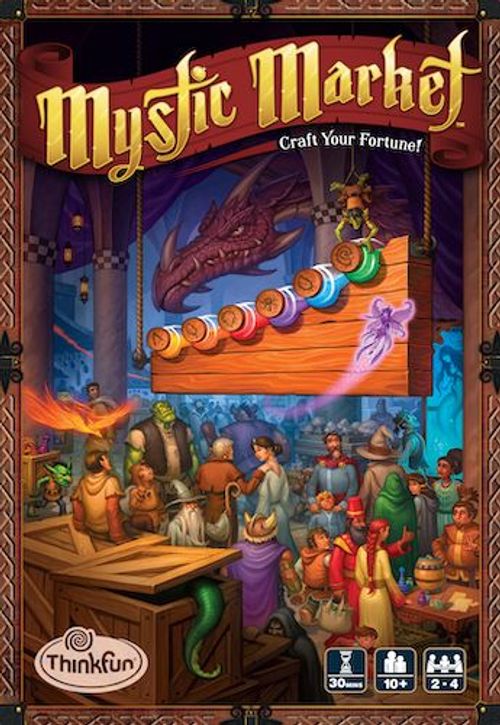
Mystic Market
Mystic Market Rulebook
Table of Contents
Table of Contents
Objective
BUY Ingredients from the Market and then SELL complete sets for Coins. Pay attention! The cost to buy Ingredients and the value of complete sets will change over the course of the game. If the cost is too high to buy, SWAP Ingredients in your hand with those in the Market, or Craft them into powerful Potions!
At the end of the game, the player with the most Coins from selling Sets of Ingredients and crafting Potions—WINS!
Includes
-
6 Ingredient Vials: Red Dragon Scales, Orange Phoenix Feathers, Yellow Orc Teeth, Green Kraken Tentacles, Blue Mermaid Tears, Purple Pixie Powder.
-
1 Value Track.
-
66 Ingredient Cards: 16 Dragon Scales, 16 Phoenix Feathers, 10 Orc Teeth, 10 Kraken Tentacles, 7 Mermaid Tears, 7 Pixie Powder.
-
20 Potion Cards: 3 Elixir of Luck, 3 Fortune Serum, 3 Tonic of Borrowing, 3 Tonic of Mystery, 2 Exchange Elixir, 2 Serum of Forfeit, 1 Duplication Tonic, 1 Elixir of Wealth, 1 Plunder Tonic, 1 Reduction Serum.
-
6 Supply Shift Cards.
-
4 Reference Cards:
On each turn, do only one of the following:
- Buy 1 or 2 Ingredient Cards — from Ingredient Market or Deck
- Swap 1 or 2 Ingredient Cards — from Ingredient Market only
- Sell Ingredient Cards — full sets for profit or singles for no profit — move vial of Ingredient to 5-mark on Value Track to complete sale
You may also Craft Potions.
-
Coins: 45 One-value Coins, 20 Five-value Coins, 10 Ten-value Coins.
Ingredient Set Sizes
The number of Ingredient Cards needed to sell a complete set (shown on the cards):
- Dragon Scales: 4 of a kind
- Phoenix Feathers: 4 of a kind
- Orc Teeth: 3 of a kind
- Kraken Tentacles: 3 of a kind
- Mermaid Tears: 2 of a kind
- Pixie Powder: 2 of a kind
Setup
-
Select a dealer to shuffle the Ingredient and Potion Decks, then:
- Deal each player 4 Ingredient Cards, face-down.
- Give each player 5 One-value Coins, and one Reference Card.
-
Form the Ingredient Market by dealing 5 Ingredient Cards in a row, face-up.
Tip for New Players: Try a practice game, leaving out steps 3 and 4 (Supply Shift and Potions) to get the hang of basic game play. Then proceed to a full game including Supply Shift and Potion Cards.
-
Place the 6 Supply Shift Cards face-down and mix them up. Then, distribute 3 of the 6 Supply Shift Cards randomly throughout the remaining Ingredient Deck, and re-shuffle the entire deck. Return the remaining 3 Supply Shift Cards to the box—you will not need them. Place the Ingredient Deck face-down beside the Ingredient Market.
-
Form the Potion Market by dealing 5 Potion Cards in a row, face-up, opposite the Ingredient Market. Place the remaining Potion Deck face-down beside the Potion Market.
-
Leave room near the Ingredient and Potion Markets for two discard piles and a Bank of Coins.
-
Assemble the Value Track by placing the 6 Vials of Ingredients on the Track with the Vial of Purple Pixie Powder at the 15 mark, Blue Mermaid Tears at 12, Green Kraken Tentacles at 10, Yellow Orc Teeth at 8, Orange Phoenix Feathers at 6, and the Red Dragon Scales at 5, as shown.
The setup area is arranged with the Bank, Potion Discard, Potion Market, and Potion Deck along one side, and the Ingredient Deck, Ingredient Market, Ingredient Discard, and Value Track along the other.
The Value Track
How it Works
- The positions of the Ingredient Vials on the Value Track represent the current value of each type of Ingredient Card in the deck.
- The cost to buy individual Ingredient Cards and the value of complete sets change based on the position of the Vials on the Track.
- Over the course of the game, Ingredient Vials will be moved to the top of the Track, causing other Vials to roll into new positions, changing costs and values.
The Track runs from the top position (Value of Set of Ingredient Cards, e.g. 8) down through positions such as 10, 12, and 15 (Cost to buy an Ingredient Card at the bottom of the Track).
How to Play
- Players take turns in a clockwise direction from the dealer.
- Each turn, the active player must choose only one of the following actions: BUY, SWAP, or SELL Ingredient Cards. They may NOT combine these actions.
- Players may also Craft Potions during their turn in addition to Buying, Swapping, or Selling. (You can learn more about Potions below.)
- A player may not pass on their turn.
- A player's hand can never have more than 8 Ingredient Cards at the end of their turn. Cards must be discarded to limit the hand to 8 Ingredient Cards. Potion Cards do not count toward this hand limit.
Buy
BUY 1 or 2 Ingredient Cards per turn from the Ingredient Market or off the top of the Ingredient Deck. (A player may buy one card from each.) Replenish the Ingredient Market immediately after buying an Ingredient Card by drawing the top card from the Ingredient Deck and replacing the purchased card.
- When buying cards from the Market, pay the current cost based on the position of the matching Ingredient Vial on the Value Track.
- When buying cards from the Ingredient Deck, pay a standard cost of 2 Coins per card.
Swap
SWAP 1 or 2 Ingredient Cards from your hand and replace them with the same number of Cards from the Ingredient Market. Cards may NOT be swapped with cards from the Ingredient Deck.
- No Coins are exchanged during a SWAP.
Sell
SELL Ingredient Cards as complete sets to earn Coins or sell single cards to shift Ingredient values.
Note: The number of cards required to make a set is shown on the cards.
- Complete sets – collect the number of Coins equal to the current value of the Ingredient on the Value Track AND perform a Value Shift.
- Value Shift – Move the Ingredient Vial for the Ingredient being sold from its current position on the Track to the top of the Track at the 5 mark. Other Ingredient Vials will roll down the Track, shifting their values, as well.
- Single cards – collect NO Coins BUT STILL perform a Value Shift for the Ingredient being sold.
- Players may SELL as many times as they choose per turn.
Supply Shift
When a Supply Shift Card is drawn, move an Ingredient Vial determined by the Supply Shift Card to the 15 mark on the Track by cycling any Vials below that colored Ingredient Vial. Vials are cycled, one at a time, beginning with the lowest on the Track, up to the 5 mark, until the color of the Vial on the Supply Shift Card is in the 15 mark position.
When a Supply Shift Card is drawn from the Ingredient Deck, whether to replenish a card bought from the Ingredient Market or when a player has bought a card from the Ingredient Deck for their hand, the effect of the Supply Shift Card is resolved immediately. The player should still draw from the Ingredient Deck after completing the Supply Shift on the Value Track. In the event that two Supply Shift Cards are drawn in a row from the Ingredient Deck, resolve the effect of the cards in the order that they were drawn. Supply Shift cards do NOT count toward cards purchased.
Potions
Potions can be crafted at any time during a player's turn. To Craft a potion, choose one of the Potion cards from the Potion Market and discard from your hand the two Ingredient Cards shown under Cost on the top of the Potion Card. The Potion Card is now yours to play whenever you wish. Replenish the Potion Market immediately after crafting a Potion by drawing the top card from the Potion Deck and replacing the crafted Potion.
Example: the Elixir of Luck Potion Card shows a Cost of 1 Dragon Scales card and 1 Orc Teeth card, and a Profit of 4 Coins. The card text reads: "Use this Potion Card in place of any 1 Ingredient Card."
- Players can Craft as many Potions as they like during their turn.
- Players collect the number of Coins shown under Profit when Potions are played, not when they are Crafted.
- Potion Cards can be played at any point in the game, even during another player's turn. Once played, the effect of the Potion is resolved immediately, the Profit marked on the card is collected, and the Potion Card is discarded.
- If the Potion Deck is ever depleted during play, it is NOT replenished.
Potion Card Reference
| Potion | Qty | Cost | Profit | Effect |
|---|---|---|---|---|
| Elixir of Luck | 3 | Dragon Scales + Orc Teeth | 4 | Use this Potion Card in place of any 1 Ingredient Card. |
| Fortune Serum | 3 | Phoenix Feathers + Phoenix Feathers | 2 | Draw 1 card from the top of the Ingredient Deck. |
| Tonic of Borrowing | 3 | Dragon Scales + Dragon Scales | 2 | Take 1 card from the Ingredient Market. |
| Tonic of Mystery | 3 | Phoenix Feathers + Kraken Tentacles | 4 | Steal 1 random card from an opponent's hand. |
| Exchange Elixir | 2 | Phoenix Feathers + Orc Teeth |
End of Game
When the last Card from the Ingredient Deck is drawn, the current player completes their turn. All players then take one final turn to SELL Cards, CRAFT Potions, or play Potions. The player with the highest value in Coins at the end of the game—WINS!
For a shortened game, the first player to collect 30 Coins—WINS!
Note: For a shortened game, you do not need to play though the entire Ingredient Deck.
About the Inventor
Ken Gruhl is a game designer living in Chicago, with a love of making games that are fun for all ages. His fond memories of playing games growing up gave him the desire to provide that same experience for others. During a brainstorm, he had the idea of using gravity to help track the pricing of a market, and this game popped into his head. Aside from making games, he enjoys cheering on the Michigan State Spartan teams and making pizza with his wife.