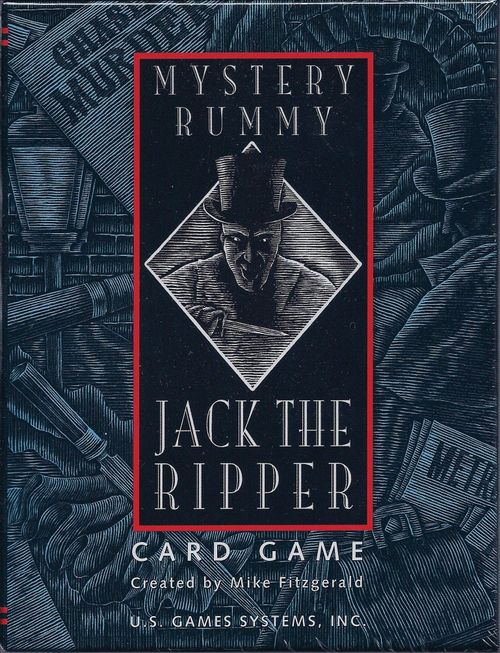
Mystery Rummy: Jack the Ripper
Mystery Rummy: Jack the Ripper Rulebook
Table of Contents
Table of Contents
About the Case
For three months in 1888 a killer known as Jack the Ripper terrorized the district of Whitechapel in East London, England. Scotland Yard was not able to solve the case, and to this day the identity of Jack the Ripper is still a mystery.
Can you succeed where Scotland Yard failed? Each hand of Mystery Rummy will reveal one of six suspects to be Jack the Ripper—or the Ripper will escape! Who will it be: Montague Druitt, Prince Eddy, Sir Gull, Dr. Pedachenko, George Chapman, or Jill the Ripper?
Object of the Game
The object of this rummy card game is to score the most points. The game ends when at least one player has scored 100 points or more. This will usually take between 3 and 5 hands.
Summary of Play
There are two main types of cards used in this game: "Evidence cards" and "Gavel cards". Most of the time you will be trying to catch "Jack the Ripper" by making melds (three or more of a kind) of Evidence cards. The Gavel cards will help players trying to catch Jack as well as the player who may be trying to escape. They provide a strong strategic element to the game not found in traditional rummy.
There is also one special "Ripper Escapes" card. With this card, you may decide to try to win the hand by helping Jack the Ripper escape. Playing the Ripper Escapes card ends the hand immediately with lots of points for the person playing it.
Points can be scored in several ways:
- Playing melds of Evidence cards
- Playing layoffs of Evidence cards on other melds
- Playing Gavel cards with point values
- Voting correctly
- Playing the Ripper Escapes card
The 62-Card Deck Consists Of
Gavel Cards (25)
Suspect Cards
- 1 Montague Druitt
- 1 Prince Eddy
- 1 Sir Gull
- 1 Dr. Pedachenko
- 1 George Chapman
- 1 Jill the Ripper
Alibi Cards
- 1 Montague Druitt
- 1 Prince Eddy/Sir Gull
- 1 Dr. Pedachenko
- 1 George Chapman
- 1 Jill the Ripper
Victim Cards
- 1 Mary Nichols
- 1 "Long Liz" Stride
- 1 Kate Eddowes
- 1 Annie Chapman
- 1 Mary Jane Kelly
Scene Cards
-
1 Buck's Row
-
1 Mitre Square
-
1 Hanbury Street
-
1 13 Miller's Court
-
1 Berner Street
-
2 Commissioner Resigns
-
2 Ripper Strikes
Evidence Cards (36)
- 5 Montague Druitt
- 5 Prince Eddy
- 5 Sir Gull
- 5 Dr. Pedachenko
- 5 George Chapman
- 5 Jill the Ripper
- 4 Letters
- 2 Wild Cards
Additional Card
- 1 Ripper Escapes card
Game Overview & Strategy
Mystery Rummy Case No. 1: Jack the Ripper can be thought of as two games in one: a Rummy card game and a Ripper Escapes game. Compartmentalizing the strategies of each game may help you when learning how to play.
Rummy Game
The cards that will aid you in playing your Rummy game are the Evidence cards, Wild Evidence cards, Letters Evidence cards, Suspect Gavel cards, and Alibi Gavel cards. The Evidence cards are played as melds and layoffs, which gain points for your score. The Suspect and Alibi cards will add to your points, supplementing your meld points. The interesting part of this dual game strategy is that all the cards in the game will help your Rummy game, while some of them also help the Ripper Escapes game.
Evidence Cards Summary
Evidence cards have a magnifying glass in the upper left corner of the card. You may play as many Evidence cards as you want per turn as long as you play them in melds (three or more identical cards), or play them as a layoff to a meld already in play. All Evidence cards you play go in your play area, even when played as layoffs on other players' melds. Their points may be doubled if that Suspect is identified as the Ripper when the hand ends. They may end up scoring no points if the Ripper Escapes.
Wild Cards
These two Evidence cards can be used as any other Evidence card except Letters. You may use a Wild Card to make a new meld of three or more evidence cards or you may use it to duplicate another evidence card already in play in front of you as a layoff. You can never play a Wild Card without matching to another card in play in your area. The Wild Card acts as an evidence card for all purposes including scoring.
Letters
These are special Evidence cards that do not apply to any suspect. They are their own meld. Each Letter is worth three points because with only four cards available, it is a more challenging meld to achieve. The points for Letters never double.
Gavel Cards Summary
Only one of these cards may be played per turn. (Although sometimes the playing of a gavel will lead to the playing of more gavels during your turn as with Ripper Strikes and Scene cards.) There are two types of Gavel cards; ones that link to Evidence (Suspect & Alibi) and ones that help the Ripper Escape. The latter provide the game with more action and strategy. Gavel cards are played alone, not in melds. Some Gavels are played onto the table and some are played into Scotland Yard. Read each card for an explanation on how to play that card.
Suspect Cards
You play these Gavel cards on the table in your play area. They may only be played when there is a meld of Evidence cards of the same color already in play. For example, you cannot play the Druitt Suspect card until there is a Druitt Evidence meld already in play.
(Note: A Suspect card cannot be included or used to make an Evidence meld.)
The points on a Suspect card are added to the Evidence cards to determine who the Ripper is at the end of a hand. These points also get doubled if the Suspect turns out to be the Ripper. There does not need to be a Suspect card in play for that Suspect to be the Ripper.
Alibi Cards
These Gavel cards can only be played when there is a meld of Evidence cards of the same color already in play. For example, you cannot play the Pedachenko Alibi card until there is a Pedachenko Evidence meld in play. The Alibi card is played on the table in your play area and stays there until another Alibi card gets played. There can only be one Alibi card in play at a time. When one is played, any previously played Alibi card is put into Scotland Yard (the discard pile). The Alibi card keeps that suspect from being the Ripper even if they have the most points on the table. There is one special Alibi card that can apply to either Prince Eddy or Sir Gull. When it is put into play, the player announces which suspect it is being applied to and points the matching color toward the center of the table.
Ripper Escapes Game
This is the more intricate part of the game. But once you master the strategy behind this aspect of game play, your enjoyment of the game will increase immensely.
The cards that will assist the Ripper Escapes Game are Victim Gavel cards, Ripper Escapes card, Ripper Strikes Gavel card, Commissioner Resigns Gavel card, and the Scene Gavel card. These cards all help bring Victim cards to the table, which allows the Ripper to escape. This is a very difficult thing to accomplish, which is why there are so many different cards that can help.
A Victim card must be in play in order for players to begin playing Evidence melds. Anyone can play Evidence on another player's Victim card. When playing a Victim card, place it on the table in your play area. Check to see if the Scene card of the same color is in play. If it is, take that card and place it in front of you as well. These points now count toward your score. Draw the top two cards from the Case File and put them in your hand. This also benefits your Rummy game. When all five Victim cards are in play, this allows play of the Ripper Escapes card.
Ripper Strikes
This is a Gavel card. When you play it, put it on top of Scotland Yard (Discard Pile) and announce that the Ripper Strikes. While making sure that all players can see, start turning over five cards from the Case File into Scotland Yard until you get a Victim card. If you get to a Victim card before you reach the fifth card, stop turning cards over immediately. Play the Victim card in your play area and then draw two cards from the Case File just as if you were playing the Victim card from your hand. Also, check to see if the Scene card of the same color is in play and if so, add it to your play area as well. This ends the play of the Ripper Strikes card. If you don't get a Victim card, you stop after turning over the fifth card and play continues as normal.
Commissioner Resigns
This is a Gavel card. When you play it, place it on top of Scotland Yard (Discard Pile) and announce that the Commissioner has resigned. All players (including you) must immediately put any victim cards they have in their hands on the table in front of them. You do not get to draw cards when you are forced to play Victim cards by a Commissioner Resigns card. Matching Scenes are taken as normal. (See Scene Cards for more details.) If this causes a player to put their last card into play, the hand ends at the end of the current player's turn. If all five Victim cards are in play after a Commissioner Resigns card forces you to play your last card, you must pause to see if someone will play the Ripper Escapes card before declaring the end of the hand.
Scene Cards
These are Gavel cards. Place the Scene card on the table in your play area when you play it. Check to see if the Victim card of the same color is in play. If it is, you take that card and place it in front of you in your play area as well. Pick up Scotland Yard and look through it without showing it to the other players. You must choose one card and show that card to all players. (The only cards you cannot take are other Scene cards.) If you take a Gavel card you may play it immediately or put it in your hand; once you put it in your hand you must wait until your next turn to play it. If you take an Evidence card from Scotland Yard, you can play it at any time during that turn (if it is playable). If you don't want to (or can't) play the card you get, simply put it in your hand after showing it to all players, and finish your turn.
Ripper Escapes
If played, this card is worth 35 points. It's not a Gavel card or an Evidence card. You may play this card immediately as soon as the fifth Victim card comes in to play. It does not need to be your turn to play it. As soon as the Ripper Escapes card is played, the hand ends. As described under Commissioner Resigns, even if a player has to place his last card in play (because it is a Victim card) and all five Victims are now in play, you have a chance to play the Ripper Escapes card before the hand ends.
If not played and a player is left holding the Ripper Escapes card at the end of a hand, he must deduct two points for each Victim card in play. (This is the one case when you do not deduct the card's point value from your score, using this special scoring instead. It is NOT -35 points.)
The Cards
Each card is laid out consistently to help you read it at a glance:
- A gavel in the upper left corner indicates a Gavel card. A magnifying glass in the upper left corner indicates an Evidence card.
- The number in the upper right corner is the card's point value.
- The name of the card is listed directly under the picture frame.
- The words on the left spine of the card indicate the type of card it is, and in some cases the name of the card.
- Game text is below the name of the card. This information describes how the card is played.
- Text in italics gives background on the real facts of the case. This information is meant for "flavor" and has no bearing on gameplay.
- The number in the lower left corner is the Suspect Order Number. This represents the likelihood of that person being the Ripper—with Number 1 being the most likely and Number 6, the least. (These numbers are used to break ties in determining the identity of the Ripper at the end of a hand.)
Playing the Game
Players will need a pencil and paper to keep track of the score and votes during game play.
The Deal
Randomly determine who will deal the first hand. The dealer shuffles the deck and allows the player on his or her right to cut the deck.
- For 2 players: 10 cards are dealt one at a time, face down, to each player
- For 3 players: 9 cards are dealt in clockwise order, face down, to each player
- For 4 players: 8 cards are dealt in clockwise order, face down, to each player
The remainder of the deck is placed face down in the center of the table, and the top card is revealed and placed face up next to the deck. This forms the discard pile. The draw deck is called the "Case File" and the discard pile is called "Scotland Yard". This game uses a closed discard pile. The top card is the only card that should be visible in the discard pile. Players are not allowed to look through the discard pile unless a card they are playing instructs them to do so.
The Turn
Play proceeds clockwise around the table starting with the player to the dealer's left (or opposite him if two are playing). Each player completes the following steps before the next player's turn begins:
Vote (optional) → Draw (mandatory) → Play (optional) → Discard (mandatory)
The following is an explanation of each step of the turn in detail:
Vote (Optional, once per hand and includes all players)
Voting is an optional action. There does not have to be a vote.
- A vote may only be done once per hand.
- If you want to call a vote, it must be done at the start of your turn before you draw.
- To call a vote you must have at least one meld in play.
- Every player votes simultaneously when it is called.
When a vote is called, all players secretly write down the name of one of the six suspects who they think will be the Ripper at the end of the hand. (Whether they have Evidence cards on the table at that time or not.)
- Letters Evidence cards satisfy the requirement for having a meld in play, but you cannot vote for Letters as a suspect and Letters cannot be the Ripper.
- You cannot vote for the Ripper escaping.
Votes are revealed at the end of a hand during Scoring.
- A Suspect card does not need to be in play for that person to be the Ripper.
- If you vote correctly, you will add ten points to your score.
- If you vote incorrectly, there is no penalty.
Draw (Mandatory)
Draw one card from the top of the Case File or take the top card from Scotland Yard (discard pile). Add this card to your hand.
Play (Optional)
Gavel cards: You may only play one Gavel card per turn. If the Gavel card has positive points in the upper right hand corner you play it into your play area. If it has a 0 point value, you discard it into Scotland Yard. When playing a Scene Gavel card you are allowed to take a Gavel card out of Scotland Yard and play it right away as long as it is playable. You may only play one Gavel card per turn.
Refer to Game Overview & Strategy for detailed instructions on how to play each type of Gavel card. Note the exceptions to one Gavel Card a turn under Ripper Strikes and Scene card explanations. Abbreviated prompts are also given on each Gavel card. Gavel cards are played alone, not in melds.
Evidence cards: No one can play any Evidence cards until there is a Victim card in play. Evidence cards are played in melds. A meld is three or more Evidence cards of the same color. You can also play Evidence cards by themselves if they go with a meld that is already on the table. For example, if a player has a Jill the Ripper meld in play, you can play a Jill the Ripper Evidence card in your play area. This is called a "layoff."
Discard (Mandatory)
After you have played all the cards you want to, you must discard one card face up to the top of Scotland Yard. You may discard any card. Play continues in a clockwise direction around the table until the hand ends.
Ending a Hand
There are four ways a hand can end:
- A player discards his last card, known as going out.
- A player plays the Ripper Escapes Card.
- The last card in the Case File is drawn. That player completes his turn and then the hand is over.
- A player is forced to discard his last card when someone plays the "Commissioner Resigns" card. The player who played the "Commissioner Resigns" card finishes their turn and the hand is over. NOTE: This can result in the fifth Victim Card being played in which case a player with the Ripper Escapes card can play it immediately ending the hand there.
Sample Turn
You are playing in a two-player game of Mystery Rummy. You look at your hand of ten cards and group them by color. You have two blue Evidence cards for Druitt, as well as the blue Druitt Suspect card. You decide to pick up the top card from Scotland Yard, which happens to be another Druitt Evidence card.
You would like to play a meld of Evidence cards for Druitt since you have three of them. However, there is no Victim card in play yet, so you cannot. Looking at your hand, you notice that you have the Victim card for Mary Nichols, which has the gavel in the upper left corner of the card. You are allowed to play one Gavel card per turn, so you play the Victim card in front of you and follow the instructions on the card.
Now that there is a Victim card in play, you may begin to play Evidence cards. You play your Druitt meld in your play area.
The Druitt Suspect card can be played now that there is a meld of Druitt Evidence cards in play. However, since it is a Gavel card and you already played a Gavel (Victim Mary Nichols) this turn, you must wait until your next turn to play it.
You discard a Letters Evidence card into Scotland Yard to end your turn and it is now the next player's turn.
Scoring
The scoring method will depend on the outcome of the hand and whether the Ripper is caught, escapes, or is still at large.
Ripper Is Caught—Scoring
- The Ripper is caught when the hand ends without the Ripper Escapes card being played and the Case File is not empty. To find out who the Ripper is, add up all the points for cards played for each suspect. The suspect (or color) with the most points on the table is the Ripper. A Suspect card does not need to be in play for that person to be the Ripper. Important: When there is an Alibi card in play, that suspect cannot be the Ripper—even if he or she has the most points. You must then take the next highest point total to determine the identity of the Ripper. If there is a tie, refer to the suspect order number on the lower left corner of each card relating to a suspect. The lowest number is the Ripper. All points in play for the Suspect determined to be the Ripper will be doubled.
- Add up all your points on the table. Remember to double all points on Evidence cards and Suspect cards you have in play for whoever the Ripper is this hand. Points for other suspects count at their face value. Be sure to add cards like Victims, Scenes, and Alibis, as they have a point value on them as well.
- If you are not the one who went out and have cards remaining in your hand, you must look at your hand and subtract from your point total any cards that could not be played. Any cards that could have been played are set aside and do not figure in scoring. Scenes and Victims in your hand are always subtracted from your score when the Ripper is caught. (This rule allows you to strategically hold cards that could be played to help the suspect you want to be the Ripper.)
- Ripper Escapes Card Special Scoring: If a player is holding the Ripper Escapes card when the hand ends, it counts as minus 2 points per Victim Card in play. It is not -35 points.
- If a vote was called, check the results. If a player voted correctly, add 10 points to that player's score for the hand. There is no penalty for voting incorrectly.
Ripper Escapes—Scoring
When the Ripper Escapes, the only points scored are for Victims and Scenes in play and the Ripper Escapes card. The player who plays the Ripper Escapes card receives 35 points for playing that card. All players score for Victims and Scenes in their play area. No points are deducted for cards remaining in a player's hand.
Ripper Still at Large—Scoring
This is exactly like the Ripper Caught Scoring except you do not figure out who the Ripper is and Vote results are ignored. No points are doubled. Players only score face value for cards in their play area.
Winning the Game
After scoring the hand, total all scores for the game. The game ends when at least one player has scored 100 or more points. The player with the highest score wins. If there is a tie, play another hand.
Sample Scoring
Part A: The following is in play when the hand ends:
5 Evidence cards for Druitt at 2 points each, so there are 10 points that say Druitt is the Ripper.
- 3 Evidence cards for Jill the Ripper at 2 points each, which makes 6 points that say Jill is the Ripper.
- Jill's Suspect card is also in play, worth 4 points, bringing Jill as the Ripper to 10 points.
There is a tie, so the suspect order number must be referred to. Druitt is the number 1 suspect and Jill is number 6. Thus, Druitt wins the tiebreaker and is declared the Ripper for this hand. This means that all Druitt card points are doubled. Jill's card points score as normal.
Part B: When counting points for each player at the table, anyone with Druitt or Jill the Ripper cards left in their hand would set them aside. They do not count against you since they could have been played on the table (but they don't gain you any points either). However, if you had 3 Dr. Pedachenko Evidence cards and a Dr. Pedachenko Alibi card left in your hand, you would have to subtract 9 points from your score since there were no Dr. Pedachenko melds on the table in our example.
Strategy Tips
- Pay attention to which Alibi cards have been discarded. Having a Scene card toward the end of the game (which allows you to retrieve the right Alibi card) can be key.
- Pay attention to how many Victim cards are in play. When the fifth one goes into play, any player can play the Ripper Escapes card and win instantly!
- Be aware that it is fairly common for there to be a tie for who the Ripper is. Pay attention to the Suspect order number (in the lower left-hand corner of the card). The lowest number wins a tie.
- Try to call a vote when you know you will be able to change the situation during a turn so that you might be the only player to vote correctly.
Thanks to Play-Testers: Nick Sauer, Ralph Anderson, Zvi Moshowitz, Bob Morss, Doug Bissonnette, Jeff Kramer, Dan Louie, Richard Borg, escape artists Donald Lim and Sam Lai, Jim Maher, Steve Rugh, Thomas Scull, Doug Morse, George Michaels, Gary Miller, Ed Lasso, Joanne White, Jack Everett, and Lisa Fitzgerald.
U.S. GAMES SYSTEMS, INC. 179 Ludlow Street Stamford, CT 06902 USA 800-544-2637 www.usgamesinc.com www.eagle-gryphon.com www.eaglegames.net
©1998, 2003, 2010, 2014 U.S. GAMES SYSTEMS, INC.