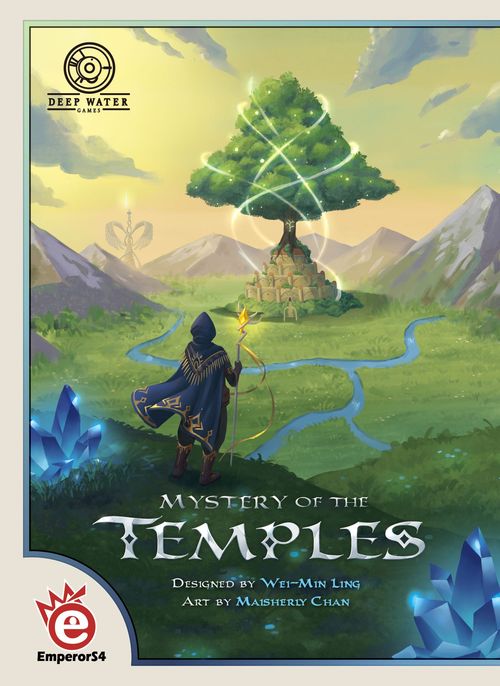
Mystery of the Temples
Mystery of the Temples Rulebook
Table of Contents
Table of Contents
Goal of the Game
In Mystery of the Temples, players will take on the role of Curse Breakers, traveling between the wilderness and the temples in order to collect crystals of various colors.
Fusing the colorful crystals on the Crystal Grid in the correct order will break the curse of the temple, and you will earn the runes and victory points in the process.
Once a player has broken 5 curses, the game will end. Whoever has the highest amount of victory points will be the winner.
Components
- 5 Temple Cards (double-sided)
- 10 Wilderness Cards
- 20 Rune Cards
- 6 Objective Cards
- 4 Reference Cards
- 4 Crystal Grids (double-sided)
- 60 Crystals (24 in colorless, 8 in red, 8 in yellow, 8 in blue, 6 in green, 6 in purple)
- 4 Curse Breaker Figures (1 for each color)
- 24 Broken Curse Markers (6 for each color)
- 1 Scoring Board (box inlay)
Reference Card
Move 1-3 Spaces
| Spaces | +1 | +2 | +3 | … |
|---|---|---|---|---|
| Colorless crystals paid | -1 | -3 | -6 | … |
Collect Crystals or Break the Curse
- Pay 1 Colorless: switch the location of 2 crystals on your Crystal Grid.
- Pay 4 Colorless: take 1 crystal of any color from the supply.
- Colorless Crystals: any crystal may be used as colorless crystals instead.
- Supply Limit: when any particular color has run out, takes it from another player who owns the most number of that crystal.
Game Elements
Temple Card
- Curse Box: Once a curse has been successfully broken, take a Lifted Marker and place it in the Curse Box with the corresponding victory points (see Break the Curse).
- Arch: When a player stops at a temple, he or she will need to spend crystals of a certain color depending on the left end or the right end of the Arch in order to break the curse (see Break the Curse).
- Rune Tablet: If the symbol of the Rune Tablet matches the Rune Card possessed by a player, a Rune Resonance is triggered (see Rune Resonance).
- Collect Crystals: When a player stops at a temple, he or she may choose to either break the curse, or take the matching crystal from the supply (see Collect Crystals).
Wilderness Card
- Collect Crystals: When a player stops on the wilderness, he or she collects crystals as indicated on the Wilderness Card (see Collect Crystals).
- Rune Tablet: If the symbol of the Rune Tablet matches the Rune Card possessed by a player, a Rune Resonance is triggered (see Rune Resonance).
- Number: At the beginning of the game, set up the Wilderness Cards in increasing order of the number shown here (see Setup).
Crystal Grid
- Storage Space: When a player gains a crystal, he or she must immediately put them in one of the empty storage spaces on the Crystal Grid. Each space may hold only 1 crystal. Each crystal may not be moved after placing it.
- Special Effect: In the advanced game, each Crystal Grid will also provide an unique and powerful continuous effect throughout the game (see Crystal Grid Effects).
- Number: For your first game, the person with the 1A Crystal Grid is the starting player. In the advanced game, the A side and B side will provide different effects.
Rune Card
- Rune Type: The rune type may trigger Rune Resonance as well as affect the final scoring (see End of the Game).
- Number: The total number of Rune Cards of this type in the deck.
- Rune Resonance Effect: Types of effect. For more information, please refer to Rune Resonance.
Symbols
| Symbol | Meaning |
|---|---|
| Blue arrow | Place … in / Move |
| Dark red arrow | Remove … back to the supply |
| Red arrow | Pay … to obtain |
| Multicolored crystal | Any color of crystals |
| Plus | Additionally, gain … |
| Brace | Whenever… |
Setup (A 4 Player Game Example)
- Randomly place the 5 Temple Cards face up on the center of the table, forming a pentagon.
- Place 2 Wilderness Cards between each temple. Starting between any 2 temples, going clockwise in increasing order according to the number on the bottom of the cards.
- Place the 60 Crystals in the center of the table and separate them by colors. Place them under the temples with the corresponding colors, forming a supply.
- Shuffle the 20 Rune Cards face down, and place 4 of them on the top of each Temple Card, forming a Rune Pile. Reveal the top card of each Rune Pile.
- Shuffle the 5 Temple Objective Cards face down, and randomly reveal 3 of them face up. Place the revealed cards along with the single Rune Objective Card besides the Scoring Board, and put the remaining Temple Objective Cards back in the box. They will not be used this game.
A. Each player chooses a color and takes the corresponding Curse Breaker Figure and 6 Broken Curse Markers. Place 1 Broken Curse Marker on the "50/0" spot on the scoring board.
B. Randomly determine a starting player, who will take the 1A Crystal Grid. In clockwise order from that player, each player takes the next Crystal Grid in order (2A > 3A > 4A). Everyone will then take 2 colorless crystals from the supply and place them on their Crystal Grids in any empty spaces.
Note: For your first game, please use the Crystal Grids in the designated order. In the advanced game, players will take turn drafting their Crystal Grids (see Crystal Grid Effects for their effects).
Setup Changes for 3 and 2 Players
- Use the back side of the Temple Cards for 3 and 2 players as indicated.
- After the Wilderness Cards are set up, put Wilderness Card number 4 and number 7 back into the box as indicated.
- Reveal only 2 Temple Objective Cards.
The rest of the rules remain unchanged, except for the 2 player variant rules (see Variants for 2 Players).
Gameplay
Games will last several rounds, with the starting player taking the first turn, and play proceeds clockwise.
During a turn, the player must perform the following actions in order:
- Move the Curse Breaker
- Collect crystals or attempt to break the curse (choose 1)
Move the Curse Breaker
During each player's first turn, instead of moving, the player places his or her Curse Breakers on any unoccupied Wilderness or Temple Cards, and proceed directly to the next step.
During the following turns, the player must move his or her Curse Breaker 1~3 spaces clockwise, following the rules below:
- Each movement must be on wilderness or on temples. If choosing to move on wilderness, the player "skip" any temple cards in between, and vice versa.
- If there are any Curse Breakers in between, the player must skip over the spaces they are on.
- Each Wilderness or Temple Cards may only have 1 Curse Breaker on them.
Example: Wei is standing on the Wilderness Card 6. He may move to Wilderness Card 7, 8, 9 or to the purple, yellow, or green temples. But he may not move to Wilderness Card 10.
Dexterity Charm: The player may spend extra colorless crystals to move further. For each colorless crystal spent this way, he or she may move 1 additional space clockwise.
| Spaces | +1 | +2 | +3 | … |
|---|---|---|---|---|
| Colorless crystals | -1 | -3 | -6 | … |
Collect Crystals
Depending on the destination, take the indicated crystals from the supply and place them on the spaces in the Crystal Grid.
There are 3 ways to collect crystals:
-
Direct Collection (Wilderness Cards number 1, 3, 5, 7, and 9 and the 5 Temple Cards): Take the indicated crystals as shown on the cards.
-
Mana Conversion (Wilderness Cards number 6 and 10): Remove 3 colorless crystals from the Crystal Grid, and take 2 crystals of different colors from the supply.
Example: Mai wants 2 red crystals. However, she can only convert 3 colorless crystals into 1 red and 1 yellow crystal.
-
Mana Upgrade (Wilderness Cards number 2, 4, and 8): Take 1 to 2 colorless crystals from the Crystal Grid and place them on the empty spots on the card to gain the indicated crystals on the covered spots from the supply. Then, if the number of empty spots is less than or equal to 2, return all crystals on the card back to the supply.
Example: Wei chooses to cover up the blue and green crystal spots, and takes them from the supply. Now there are only 2 empty spaces, all the colorless crystals are returned to the supply.
Colorless Crystals: Any crystal may be used as colorless crystals instead.
Crystal Grid Storage Limit: The Crystal Grid can hold at most 12 crystals at a time. If a player ever has more than that, he or she has to return the excess back to the supply.
Supply Limit: When a player has to take a crystal, but that particular color has run out, he or she takes it from the Mana Upgrade Wilderness Card. If none available, then the player takes the crystal from another player who owns the most number of that crystal (he or she may choose which player to take from in the event of a tie).
Break the Curse
If a player stops on a Temple Card, he or she may choose to break the curse instead of collecting crystals.
To break the curse, the player returns a chain of 3 to 5 (max) crystals from his or her Crystal Grid back to the supply. A chain is defined as a continuous path of crystals that is connected via the lines on the Crystal Grid. This chain must match both the color and the order on the Arch shown, starting from either end, on the Temple Card.
Note: The chain may not contain any empty spaces.
Example: Mai wants to break the curse. She can choose to start from the right end of the Arch by breaking the "blue-red-red" curse and gain 3 points; she may also start from the left end of the Arch by breaking the "red-yellow-yellow" curse, which is also 3 points; however, she may not break the 5-point curse as the green crystal is not connected with the other chain of crystals.
Switcheroo Charm: On your turn, you may switch the location of 2 crystals on the Crystal Grid by spending 1 colorless crystal. This may be done any number of times.
Exchange Charm: On your turn, you may take 1 crystal of any color from the supply by spending 4 colorless crystals. This may be done any number of times.
After the player returns the chain of crystals back to the supply, he or she takes a Broken Curse Marker and places it on the corresponding Curse Box, gaining the indicated victory points and advancing his or her Marker on the Scoring Board accordingly.
Note: Each Curse Box may only contain 1 Marker.
The player then takes the revealed Rune Card from that Temple Card and places it in front of him or her, revealing the next card of the Rune Pile. The player may be able to trigger Rune Resonance next time he or she collects crystals.
Rune Resonance
When collecting crystals (see Collect Crystals), if the Rune Tablet of the card (indicated on the bottom right corner) where the player's Curse Breaker is located matches his or her Rune Cards, a Rune Resonance is triggered.
Note 1: If the Rune Tablet matches several of the Rune Cards, the effects will all be triggered simultaneously.
Note 2: A Rune Resonance is only triggered when collecting crystals, not when breaking curse.
The 20 Rune Cards are divided into 5 types, matching the 5 Rune Tablet symbols:
- Cube rune type (6 cards): Take the indicated crystal from the supply. (The six cards indicate red, yellow, blue, green, purple and colorless crystals.)
- Star rune type (5 cards): Take the indicated crystal from the supply. (Red, yellow, blue, and two colorless.)
- Horn rune type (4 cards): Take the indicated crystal from the supply, and clear all the crystals from the Wilderness Card before you perform Mana Upgrade. (The fourth card of this type simply takes the indicated colorless crystal from the supply.)
- Triangle rune type (3 cards): When you perform Mana Conversion, you may take 1 extra crystal, and it may be the same color as the other 2; if you have 2 of this card you may take 4 crystals total. (The third card of this type takes the indicated colorless crystal from the supply.)
- Cross rune type (2 cards): Continuous Effect: When you perform Exchange Charm, you only need to pay 3 colorless crystals.
End of the Game
When a player uses all 5 of his or her Broken Curse Markers, play continues until the end of the round, and the game will end (each player will have the same number of turns).
All players check the Objective Cards and record any amount of victory points they gain on the Scoring Board:
1. Rune Objective Card: Players will earn extra points according to the chart below by collecting runes of different types (The maximum is 11 points for 5 different types).
| Different rune types | 1 | 2 | 3 | 4 | 5 |
|---|---|---|---|---|---|
| Victory points | 1 | 2 | 4 | 7 | 11 |
Example: Wei collected 3 different runes, gains 4 points.
2. Temple Objective Card: Check each Temple Card that matches the Temple Objective Card. The player who has the most Broken Curse Markers on it will earn 4 points; the player who has the second most will earn 2 points. In case of a tie for most Broken Curse Markers, 4+2 points will be distributed evenly among the tied players (rounded down) and the 2 points for second most are not rewarded. In case of a tie for second most, 2 points will be distributed evenly among the tied players (rounded down).
Scoring examples: with a clear first and second place the split is 4 VP / 1 VP / 1 VP where three players tie for second (rounded down); a two-way tie for most gives 3 VP / 3 VP / 0 VP; and a sole leader with no second place gives 4 VP / 0 VP / 0 VP / 0 VP.
After the Objective Cards are scored, the player who has the highest amount of victory points is the winner.
Note: The remaining crystals on the Crystal Grid are not worth any points.
In case of a tie, the player with the most number of colored crystals remaining among the tied players is the winner; in case of another tie, the player with the most number of colorless crystals among the tied players is the winner. If still tied, the player among the tied players whose turn order is later is the winner.
Variants for 2 Players
Take the 5 Broken Curse Markers of an unchosen color and place them on the indicated 5 points Curse Box on each of the Temple Card.
Note: Throughout the game, these spots will continue to be occupied. When scoring points for the Temple Objective Cards, scores normally as if these markers belong to a virtual player.
Example: on a Temple Objective Card the two real players and the NPC score 4 VP / 1 VP / NPC, or 2 VP / 2 VP / NPC where the two players tie.
Take a Curse Breaker of an unchosen color and place it on a random Temple Card. Throughout the game, treat this Curse Breaker as if it belongs to a virtual player, and the other players may not enter its location. If a player encounters the neutral Curse Breaker, he or she must skip that spot and completes the movement.
After a player moving, move the neutral Curse Breaker 1 space counterclockwise, skipping any players' Curse Breakers in between until it is located on an empty space once again.
Example: Wei is standing on the Wilderness Card 5 and wishes to move onto Wilderness Card 8; however, it is occupied by the neutral Curse Breaker, so Wei has to (1) skips it and moves into Wilderness Card 9 instead. The neutral Curse Breaker is then (2) moved 1 space counterclockwise onto a purple Temple Card.
The rest of the rules remain unchanged.
Advanced Rule
After the players are familiar with the basic game, we recommend implementing these advanced rules.
Picking Order
- During Game Setup (see Setup), after step A, players may freely choose to use the A side, the B side, or a mix of both sides for the Crystal Grids.
- The Crystal Grids are then laid out face up in the center of the table. Starting with the player going last in turn order, and going counterclockwise, each player chooses a Crystal Grid until all players have one in front of him or her.
- The rest of the rules remain unchanged.
Crystal Grid Effects
Crystal Grids provide unique and powerful continuous effects throughout the game.
These special effects often change part of the game rules. Should contradictions ever arise, the special effects take precedence.
1A
- Each time you gain a colorless crystal, gain 1 more.
- When performing Exchange Charm, only pay 3 colorless crystals (effect does not add on to runes) (see Rune Resonance).
2A
- After taking this card, immediately takes 3 colorless crystals and place them on the empty spots.
- On your turn, you may remove any number of colorless crystals from the spots to gain 1 crystal of any color from the supply for each removed colorless crystal.
3A
- After taking this card, immediately takes 1 of the 5 revealed Rune Cards and place it under this card.
- You start the game with that Rune Card, this card and any cards you own of the same TYPE does not score points at the end of the game.
4A
Each time you place a Broken Curse Marker, gain the corresponding rewards depending on how many times you have placed the Broken Curse Markers.
| Broken Curse Marker placed | 1st | 2nd | 3rd | 4th | 5th |
|---|---|---|---|---|---|
| Reward | 1 colorless crystal | 1 crystal of any color | 1 crystal of any color | 1 victory point | 2 victory points |
1B
When stopping on a Temple Card, you may collect crystals and break the curse during the same turn, choosing which action to do first.
2B
When placing Broken Curse Markers, additionally you may spend 2/3 colorless crystals to break a curse that is 1/2 level higher.
Note: You must spend at least 3 crystals to break the curse to use this effect.
3B
During movement, you may move your Curse Breaker to any unoccupied Wilderness or Temple Card instead of your regular movement.
Note: You may not choose to make the Curse Breaker stay on the same card it started on.
4B
- When you gain a Rune Card, you may choose to take the Rune Card from the top of the Rune Piles of the adjacent Temple Cards instead.
- At the end of the game, you are treated as if you have an additional type of runes during Objective scoring. If you collect 6 different types of runes, you will earn 16 points.