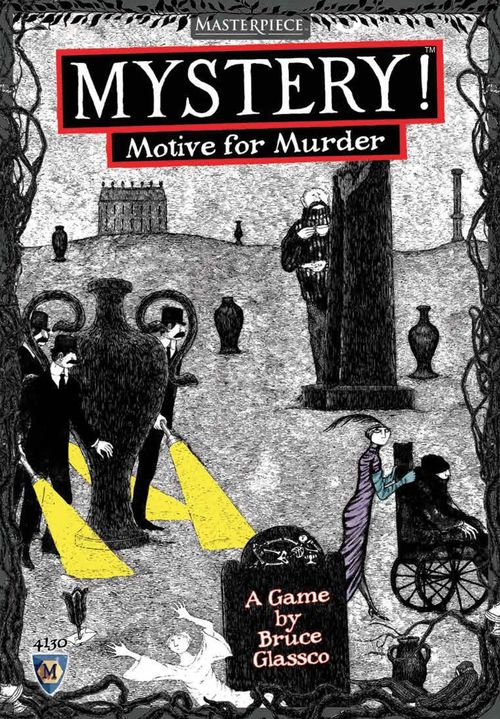
Mystery! Motive for Murder
Mystery! Motive for Murder Rulebook
Table of Contents
Table of Contents
- Getting Started
- Components
- Game 1: The Body in the Courtyard
- Relationships & Motives
- Example
- Game 2: Ten Little Houseguests
- Game 3: Tangled Motives
- Game 4: The Usual Suspects
- Motive Cards and Markers
- Sequence of Play
- End of a Case
- Game 5: Prime Suspect
- 2nd Interviews
- One More Thing
- 3-Player Games
- 2-Player Games
- End of Round 1
- End of Round 2
- Final Case
- Solo Game: You Are the Murderer!
- Suspect Tile Reference
Getting Started
For your 1st game use the separate, 4 page rules. You should carefully read the material on relationships & motives on that sheet. That information is crucial and is used in every version of the game.
More experienced players may want to proceed directly to game 4, the full game. If so, you need only read the relationships & motives material on the 4 page rules sheet before starting the game 4 rules.
There are also rules for 2-player, 3-player, and solitaire games for Games 4 & 5.
Game 1: The Body in the Courtyard — The players take turns playing suspect tiles next to the body or suspects—interviewing suspects. You mark each tile you play with one of your interview cubes. You score motive points at the end of the case for each suspect that you interviewed. The player with the most motive points wins. Introduces—Playing tiles & motive points.
Game 2: Ten Little Houseguests — As Game 1, except that there is a 2nd body. You score motive points for each body. Introduces—2nd body.
Game 3: Tangled Motives — As Game 2, except that you may play motive cards that affect play in a number of ways. Introduces—Motive Cards.
Game 4: Usual Suspects (full game) — As Game 3, except each case only has 3 rounds of tile/card play. Also, points are only scored each round for prime suspect, secondary suspect, and a few other special bonuses. Winning is now based on interviewing the most likely suspect. Introduces—Limited suspect scoring & limited tile/card play.
Game 5: Prime Suspect (Advanced game) — As Game 4, except you can take on the role of a famous detective who has a special ability. You can also score points for interviewing suspects a second time. This allows you score points by joining another player in finding the prime suspect. Introduces—Detectives & 2nd interviews.
Components
- 75+ Motive & Status Markers
- 30 Motive & Summary Cards
- 22 Suspect Tiles
- 10 Detective Cards
- 30 Interview Cubes
- 15 Status Disks
- 12 Second Interview markers
- The Body marker and the Start Player marker
- The Status Board (with the Scoring Track and the Turn Order track)
Game 1: The Body in the Courtyard
"Heart failure, it explains nothing! I have yet to meet a body whose heart it still beats." — Hercule Poirot, Agatha Christie
When a body is discovered stabbed in the courtyard of the crumbling English mansion, there is no question of weapon or location: the only questions the investigators need to answer are Who and Why. Almost every guest seems to have a motive, though, and all of them have secrets they're trying to hide!
Your reputation as a detective will be assured if you're the one who makes the final arrest. One by one, you interview suspects and establish their relationships with the victim. Which of them had the greatest motive to commit murder?
Overview
This sheet of rules will get you started playing Mystery! You can refer to the main rules for more explanations, more examples, and more detailed versions of the game.
The game consists of multiple cases. At the beginning of each case, a randomly-chosen suspect tile is placed at the center of the play area. This represents a body discovered at a stately country manor. As detectives, the players interview the victim's family, friends, and neighbors by playing suspect tiles to establish who has the greatest motive to kill the victim.
Setup
For each case:
- Shuffle the suspect tiles and deal 3 tiles to each player. Place the rest in a stack.
- Draw one suspect tile and put it face-up in the center of the table, then place the body marker on it.
- Each player takes the interview cubes of one color. Put a status disk for each player next to the scoring track.
- The youngest player is the starting player, and takes the start player marker.
How to Play
On your turn:
- Play a Tile – You must play a tile from your hand adjacent to any tile already on the board (for the first turn, that will be the body). You may not play a tile more than two spaces away from the body. (See the diagram at the right.)
- Interview the Suspect – Place one of your interview cubes on the tile you just played.
- Finish Your Turn – If the tile stack is not empty, draw a tile. The player to your left takes a turn.
Once suspects have been played in all twelve spaces one or two spaces away from the body, the case is over. Score points for your interviews. Pass the start player marker to the left and start another case. Play a number of cases equal to the number of players. The player with the highest combined score is the winner.
Play Area Layout
The layout diagram shows the body in the center, surrounded by twelve spaces that are one or two spaces from the body. Four spaces are one space from the body (directly above, below, left and right of it, sharing an edge). The other eight spaces are two spaces from the body, forming the outer ring; the corner positions of the 5 x 5 grid are not used. Each player's tiles and cubes are kept at the side of the table, and the tile stack and the Status Board are at the top.
Scoring
Remove the interview cubes one at a time. When one of your cubes is removed, determine how much motive, if any, the suspect that you played had for the murder. (See the section on the back of these rules.) Then advance your status marker on the scoring track by that amount.
The turn order track on the Status Board is marked "Ignore in Game 1" (see the Turn Order rules in Game 4 and later).
Relationships & Motives
IMPORTANT! This material applies to all versions of Mystery!
As you play suspect tiles in Mystery!, you create a web of relationships among the victim's family, friends, and associates. Some have with relationships to each other and some do not. Each suspect's potential relationships are indicated by red and blue motive arrows on his/her tile. See page 3 in the main rules for an example.
Playing a Suspect Tile
When you play a suspect tile:
- At least one of its edges must be fully adjacent to a suspect tile already in play.
- Its orientation (text and tombstone) must be the same as the victim.
The printed rulebook shows legal and illegal placements of tiles next to one another as diagrams.
A Relationship
Whenever two adjacent suspects have motive arrows that point at each other, those two suspects have a relationship.
The 2 red arrows show a relationship: Miss Ursula "Fears being abandoned by" her lover, Count Chester, who fears that she "threatens to tell all."
Note: There are only 2 arrow positions on each edge of a tile. Thus, 2 arrows point at each other if both are in the same half-edge.
Arrow Direction
For each relationship, the active motive arrow points inward (toward the victim) and is used to determine the suspect's motive for murder. The outward pointing arrow (inactive) is only used to indicate that a relationship exists.
Marking Motives
Each active arrow on a suspect tile should be marked with a motive marker. The marker and the arrow must match (color, direction, and points).
The printed rulebook circles the arrows that affect motive in its diagrams.
Blue & Red (love & hate)
If a suspect has a relationship with an active blue arrow, that suspect loves/likes the other suspect in the relationship. A red arrow indicates hate.
Note: If an arrow is pointing away from the victim, its color and number are ignored.
Note: A suspect has motive if he/she hates the victim OR if he/she loves a suspect who hates the victim OR if he/she hates a suspect who loves the victim.
Variable Arrows
A one-point arrow can be red or blue. You must decide when you play the tile. Also some arrows can be red or blue as determined by other relationships as stated on the tiles.
Double Motive Paths
A suspect can have two indirect relationships—each using a different suspect adjacent to the victim. In this case the motive points are equal to the sum of the 4 arrows involved.
Note: If two tiles have arrows that do not touch, then no relationship exists. It's legal to play a tile this way.
Motive Points
You determine a suspect's motive to murder the victim (motive points) in 1 of 3 ways:
- A suspect adjacent to the victim with an active arrow has a direct relationship with the victim. That suspect has motive points equal to the red arrow's number.
- A – 4 points of motive (see below).
- B – 0 points of motive (see below).
- A suspect two tiles away from the victim, must have a relationship with a suspect that has a direct relationship to the victim. AND one of the two inward pointing arrows involved must be blue and the other must be red. The suspect has motive points equal to the sum of the numbers on those two arrows. This is an indirect relationship.
- B B – 8 points of motive (see below).
- A A – 8 points of motive (see below).
- Otherwise the motive is 0.
See page 3 in the main rules for a detailed example of relationships and motives.
Example
This example details the motive points and story for 7 suspects. See the 4-page sheet for the rules for motive.
Direct Relationships:
- Dr. Xavier is the indifferent father of the victim. He has 1 motive point = 1.
- Karl is the victim's former lover who refused to move on or to return gifts. He has 4 motive points = 4.
- Percy and the victim were blackmailing each other. Percy has 5 motive points = 5.
- Lord Ivan was the victim's jealous husband. Since she had a lover (Karl), Lord Ivan hated (7) her. Lord Ivan has 7 motive points = 7.
Indirect Relationships:
- Miss Ursula doted (5) on her favorite former student, Karl, who had grown to hate (4) his lover, the victim. Miss Ursula has 9 motive points = 5 + 4.
- Felix was caught stealing (4) by his mysterious neighbor, Lord Ivan. So Felix hates Lord Ivan who hates his wife, the victim. So Felix has no reason to kill the victim. Felix has 0 motive points = 7 + 4.
Editor's note: the 0 is as printed. Both arrows on Felix's chain are red (hate), and an indirect motive needs one blue and one red arrow (see Motive Points, rule 2), so the chain gives no motive.
Double Relationships:
Baroness Eugenia was unwed when she had her beloved (4) son, Karl. Karl had grown to hate (4) his lover, the victim. So the Baroness had an 8 point indirect motive through Karl.
But wait! Dr. Xavier, the Baroness' beloved (4) husband was fed up (1) dealing with his daughter, the victim. So the Baroness also had a 5 point indirect motive through Dr. Xavier. She has 13 motive points = 4 + 4 + 1 + 4.
Note: Feel free to embellish the story line. In the example above, you could add that Dr. Xavier and the Baroness were each in their 2nd marriages. And that Agnes and Karl are the fruit of those previous marriages.
Game 2: Ten Little Houseguests
Setup
As Game 1, except you add the 2nd body marker.
Second Body
When the fourth tile directly adjacent to the original victim is played, then another dastardly crime is committed! The player who places the tile may immediately take a "2nd Body" marker and put it on a suspect tile in play (regardless of the color of any cube on it). The suspect tile chosen may not be adjacent to the original victim and must have at least one edge without an adjacent suspect tile.
End of a Case
A case ends when the tile deck is exhausted and all players have placed all of their tiles or have used all of their interview markers. Note: Keep playing tiles after there are none left to draw.
Scoring
When you remove a cube, score for the original body. Then score for the 2nd body.
Example: Suppose Miss Ursula became the 2nd victim in the example on the next page. All of the existing motives to kill Agnes remain. There are only 4 suspects within 2 spaces of the 2nd victim. Karl, who was bankrupted by the victim, has a direct motive of 2 points. Baroness Eugenia, who loves her son, Karl, has an indirect motive of 6 points (4 + 2). Percy has no relationship with her, for 0 points. Agnes hated Karl who hated Miss Ursula, and so has 0 points.
Game 3: Tangled Motives
Setup
Use the Game 2 components & setup, except:
- Shuffle the 10 motive cards with ID numbers between 23 & 32 (colored red in the upper right corner). Deal 2 cards to each player.
- Start the scoring markers at 10 points.
How to Play
The game plays the same as Game 2, except:
- You may play one of your cards rather that playing a tile. When you do so, discard your other card.
- The 2nd body only appears when the 2nd body card is played.
- The case ends when all tiles and cards have been played, OR when a player has played all of his/her interview cubes, OR there are no spaces left within 2 spaces of the body.
The Motive Cards
When you play a card, follow its instructions. The cards are:
- Secret Loyalty (1) — Creates a 6-motive blue relationship on 2 adjacent suspect tiles without a relationship, OR replaces the relationships on two 1 point arrows pointing at each other with a 6-motive blue relationship.
- Secret Enemies (1) — As secret loyalty, except that the new relationship is red.
- Hobnob With Aristocracy (3) — During the first case, you receive 3 points when you play this card. During cases 2 & 3, you receive points as stated on the card.
- Brilliant Deduction (3) — Normally, during your turn, you play 1 card or 1 tile. When you play the brilliant deduction card, you get to play two tiles in your turn.
- 2nd Body (1) — This allows you to place the "2nd Body" marker on any tile (including one that does not have a free edge). Ignore the round restriction, instead discard this card if it has not been played before the tile stack is exhausted.
- Concealed Motive (1) — This allows you to change a relationship's arrow to the opposite color. You must have a cube on the tile with the relationship.
Editor's note: the printed rulebook calls the red secret relationship card "Secret Enemies" on the card and in Game 3, but "Secret Hatred" in the Motive Cards and Markers section. Both names are transcribed as printed.
Game 4: The Usual Suspects
"No innocent person ever has an alibi." – Agatha Christie
Each game consists of three cases. Each case has three rounds, and you score at the end of each round. However, you only score points for the two suspect tiles with the most motive points.
After three rounds, the prime suspect for the murder is identified and taken away. Then a new body is discovered and a new case begins. After three cases have been investigated, whoever has scored the most points is the winner.
Setup (For a Case)
Do not use the Disguise card, the 3 "One More Thing" cards (numbered 50-52), the detective cards, and the 2nd interview markers.
- Shuffle the suspect tiles & deal 3 to each player. The rest form the tile stack.
- Shuffle the motive cards & deal 3 to each player. The rest form the card deck.
- Draw one suspect tile and put it face-up in the center of the table, then place the body marker on it.
- Each player takes the interview cubes of one color. Put a status disk for each player next to the scoring track.
- In round 1 of the 1st case, randomly place 1 status marker for each player on the turn order track (from left to right).
Motive Cards and Markers
Game 3 introduced 6 motive cards. More cards are added in this game. Most of the motive cards are self explanatory or detailed on the card itself.
Round Restrictions — Some cards may only be played on rounds 1 & 2, while others may only be played in rounds 2 & 3.
Motive Change Cards — Motive change cards include: Destitute (+2), Obsession (+3), Psychopath (+4), Sympathetic (-4), Reformed (-5), Alibi (-6). Each such card has a matching motive marker that is played on a suspect tile when the card is played. The modifier on a motive marker is added to that tile's total motive and does not affect any other tile's total motive.
A maximum of 2 motive markers may be on a tile. If a tile has 2 markers and one is removed, then another one may be added.
Note: A motive change may be played on a suspect with no motive, in anticipation of the suspect becoming a suspect later.
Secret Relationship Cards — There are 3 of these cards: Secret Loyalty, Secret Hatred, and Secret Marriage. When a relationship card is played, the matching marker may be placed between two tiles if there is no relationship between the two tiles or if there is only a 1-point relationship between them.
- Secret Loyalty — Creates a relationship. If there is no relationship between 2 adjacent suspect tiles, place the secret loyalty marker between them; OR place the secret loyalty marker between two 1 point arrows (replacing any relationship marker already there).
- Secret Enemies / Secret Hatred — Creates a relationship. If there is no relationship between 2 adjacent suspect tiles, place the secret enemies marker between them; OR place the secret enemies marker between two 1 point arrows (replacing any relationship marker already there).
- Secret Marriage — Creates a marriage relationship. If there is no relationship between a female suspect tile and an adjacent male suspect tile, place the secret marriage marker between them.
The Secret Marriage marker may only be played between a male and a female suspect. It can trigger an attitude change in suspects like Lord Ivan. If he's angry about his wife having an affair, there's no question he'll be upset if he learns she's married to someone else!
Second Body — During each scoring round with two bodies, there are potentially 2 prime suspects and 2 runner-up suspects. Each prime suspect scores for having the greatest motive for its body.
In a five-player game with two bodies, only discard the two victims at the end of the case—the murderers lurk to kill or be killed again!
Sequence of Play
A game consists of three cases. A case consists of three rounds. A round consists of each player taking a turn—and then scoring.
Each round has the following sequence of play:
- Take Turns. In the order shown on the turn order track, each player takes an action.
- Score. You score points based on who has interviewed the most two most likely suspects.
- Choose Turn Order. At the end of each round, determine a new turn order.
1. Take Turns
Going from left to right on the Turn Order track, each player takes a turn. You can do one of the following actions on your turn:
- A. Play a motive card or suspect tile. Mark each suspect card you play with an interview cube.
- B. Draw and play. You may draw and play a card from the motive deck OR a tile from the tile stack. If you draw a tile from the tile stack, you must play it, following the normal rules for playing suspects. If you draw a card from the motive deck, you may play it or discard it with no effect.
- C. Draw 2. You may draw 1 card and 1 tile, but may not play anything.
Note: If you draw a card that is not legal to play due to restrictions on the round (e.g., play only round 1 or 2), discard it and redraw.
2. Score
At the end of each round, you score interview points based on the motive points of suspects you interviewed (that have your interview cubes). The prime suspect is the suspect that has the most motive points. The runner-up suspect has the second most motive points.
| Interview Points | Prime | Runner-up |
|---|---|---|
| Round 1 | 3 points | 1 point |
| Round 2 | 5 points | 2 points |
| Round 3 | 7 points | 3 points |
A player who interviewed a suspect between the prime suspect and the body scores 1 point if the relationships involved are love-hate or hate-love (see 4-page sheet).
Note: Ties are broken in favor of the suspect with the lower id-number.
Note: A prime or runner-up suspect must have at least 1 motive point.
3. Choose Turn Order
At the end of each round, the new turn order track is the empty row of 5 boxes on the status board. (Only boxes with numbers up to the number of players are used.) In ascending order on the score track, each player moves his/her turn order disk from the previous turn order track to any open space on the new turn order track. If tied, the player with the marker further to the left on the previous turn order track chooses first.
Example: All 4 of the players have taken their turns in round 2 of the 1st case.
- Lisa (green) went first and has 8 points.
- Elinor (purple) 2nd, 11 points.
- Armory (brown) 3rd, 11 points.
- Bruce (yellow) 4th, 13 points.
Lisa has the fewest points and chooses first: she takes last. Elinor and Armory are tied so Elinor chooses next (she went earlier last turn). Elinor takes first, Armory takes 3rd—leaving 2nd for Bruce.
Strategy Tip: In early turns, if you want to play a suspect before someone else plays a suspect in the space you need, it may be advantageous to act early in the turn. In later turns, when players tend to play more motive cards, it may be advantageous to go later. Choosing to go earlier or later in a turn is an important area of strategy.
End of a Case
At the end of the third round of a case, the tile for the prime suspect and any victims are removed from the game (as one is buried and the other goes to trial).
Return all remaining suspect and motive cards to the appropriate deck/stack and shuffle them. Then return to the instructions for setup, selecting a new victim, dealing out new hands of 3 motive cards and 3 suspects, and playing a second case. At the end of the third case, whoever has the most points is promoted to chief detective!
Game 5: Prime Suspect
This game introduces several new elements to the game. You can play one of ten Mystery! detectives—each with a special ability. In addition, 2nd interviews are included. They allow you to jump on the bandwagon if you feel a suspect is a lock for prime suspect.
Setup
Setup is identical to Game 4, with the following exceptions:
- You receive a detective card.
- You receive a set of 2nd interview markers.
- Use all of the motive cards.
- Deal each player 4 cards instead of 3. At the end of the initial setup of the 1st case, place one of your tiles or cards face down in front of yourself. Then reveal these cards/tiles. Proceeding from low to high card/tile number, each player marks his/her chosen position in the turn order (e.g., 1st, 2nd, 3rd, or 4th for 4 players). Discard the cards/tiles used.
Detective Cards
You draw and reveal a detective card at the beginning of the game. You may use its special ability as specified on the card.
Option: Draw 2 detective cards and choose 1 to play.
Disguise Motive Card
You may only play this card on the second or third round. When you play this card, play a tile normally; and place the "Disguised" marker on it. At the end of the case, before scoring, you may replace the disguised suspect tile with any suspect tile not in play. (See back page of these rules.)
The replacement tile can be in a player's hand. It can be in the discard stack. It can be a suspect who was removed from the game (dead or on trial). Escapes and mistaken identity have been known to happen!
If there was a relationship marker on an edge of the disguised suspect, and the replacement suspect has a regular relationship on that edge, the relationship marker is discarded. Concealed Motive may not be played on a suspect with the Disguised marker.
2nd Interviews
Sometimes in a case, every single lead that a detective follows turns out to be a dead end. On those occasions, the temptation becomes great to haul a suspect that has already been interviewed back down to the station for another round of questions. If you drop a few well-timed opinions into the captain's ear, who knows? Maybe you'll be able to claim some of the credit for yourself when the arrest is made.
During the 1st and 2nd rounds of each case, you have an additional choice of actions. You may play a 2nd Interview marker face down on a suspect. You may only play such a marker on a suspect who was originally interviewed by another player (i.e., has another player's interview cube). The 3 interview markers are:
- Prime. 4 points. You receive 4 points if the suspect with your prime interview marker is the prime suspect at the end of the case.
- Prime or 2nd. 3 points. You receive 2 points if the suspect with your prime interview marker is the prime or runner-up suspect at the end of the case.
- Not 2nd or Prime. 2 points. You receive 1 point if the suspect with your prime interview marker is neither the prime nor the runner-up suspect at the end of the case.
One More Thing
This motive card may only be played in the first and second rounds. When you play this card, you may also play a 2nd interview marker (but you do not have to). In either case, you may place the motive card's corresponding motive marker on a 2nd interview marker in play. You have told the captain you are very, very sure of your hunch.
If the One More Thing marker is on a 2nd interview marker that scores, double that score. But if it does not score, you lose as many points as you would normally gain (4, 2, or 1).
3-Player Games
In a game 4 or game 5 with three players, each player gets an extra action. Round 1 is played normally. Round 2 is played normally until the last player has completed his/her turn. At this point, before scoring, the players each take another turn in the same order already established. Then round 2 is scored and round 3 is resolved.
2-Player Games
In a game 4 or game 5 with two players, there are quite a few changes to play.
Setup
Use the setup for the game being used; with the following exceptions.
- Each player takes two turn order markers.
- Deal each player one suspect card and three motive cards.
- Chose the 1st player for the beginning of the game as outlined in the type of game (4 or 5). Place the 4 turn order markers (2 for each player) from left to right as follows (1 indicates 1st player, 2 indicates 2nd player): (the printed rulebook shows this placement as a diagram of turn order tokens)
- Deal two tiles and place them face up in a row next to the stack.
- Deal two cards and place them face up in a row next to the deck.
- If a card/tile is placed that is not be playable due to any restrictions, discard it and deal another one.
- Draw a suspect card to be the victim, as usual.
Your Turn
In addition to the normal actions available, there is another action available:
- Play one of the face-up card/tiles in one of the rows next to the deck/stack. You lose 1 point for playing the 1st card/tile in a row (i.e., the card closest to the deck or the tile closest to the stack). You lose 2 points for playing the 2nd card/tile in a row.
- After playing a face-up card, move any remaining face up cards/tiles to fill the gap.
End of Round 1
After each player has had two turns, round 1 ends and the following must be resolved.
- Record scores normally.
- Discard the face-up cards/tiles next to the deck/stack (if any are left). Then add 2 more cards and 2 more tiles to the rows of face up cards/tiles.
- Place all four turn order markers on the turn order track (swapping positions). (Shown as a diagram in the printed rulebook.)
End of Round 2
After each player has had four turns, round 2 ends and the following must be resolved.
- Record scores normally.
- Discard the 2 closest cards and the 2 closest tiles. Then add 3 cards to the card row and 3 tiles to the tile row.
- Place all four turn order markers on the turn order track (swapping positions). (Shown as a diagram in the printed rulebook.)
Final Case
At the start of the final case, the player with the smaller score may decide whether the turn order will be (the printed sentence ends here; the turn order options are shown as an "OR" set of diagrams, not reproduced in text).
Solo Game: You Are the Murderer!
For months now you've laid out your plans, and at last you've finally done it—committed the perfect murder! It doesn't matter why this unfortunate act was necessary. Your motive was perfectly adequate as far as you were concerned—the important thing is that you don't relish the thought of being hung for your crime.
The local constabulary may not employ the brightest detectives in the land, but they may stumble upon you by pure blind luck if you aren't careful. You'll need to keep them properly distracted by false trails, or it's the hangman's noose for you!
Solo Setup
- You use all twenty two suspect tiles in the solitaire game. Only a few of the motive cards will be involved, however. Separate out the following ten cards to create the card deck:
- 2 Destitute card
- 3 Secrets cards
- 2 Obsessed card
- 1 Psychopath card
- 1 2nd Body card
- 1 Concealed Motive card
- Card/tiles in the solitaire game occupy four different areas:
- The reserve and active deck/stack. Shuffle the suspect stack and divide it into 2 stacks: one with 10 tiles and one with 12. Then divide the 10 motive cards into two 5 card decks. Place the 12 tile stack and one of decks aside, as the reserve deck/tiles. Place the other deck and stack in the center of the table, as the active deck/stack.
- The draw area. Draw three cards and 3 tiles from each active deck/stack and place them face up below their respective deck/stacks. These are the cards available for play. Whenever a card is drawn from this area, it is immediately replaced from its active deck/stacks. If there are no card or tile left in its active deck/stack to replace a card that has just been played, then the game is over and the police have concluded their investigation!
- Turn over a 4th tile from the suspect stack and place it face-up, with the body marker upon it. This is the victim, and the start of the play area.
Solo Play
-
For your first turn, play any of the three starting suspects from the play area in any of the four positions around the victim. Then replace the tile from the active stack.
-
For your second turn, you may again play any of the three available suspect tiles. However, this time you must place the suspect in the next space adjacent to the victim, going either clockwise or counterclockwise. After this turn, you will be committed to going around the victim clockwise or counterclockwise for the rest of the game. Again, replace the played tile from the active stack.
-
Play suspect tiles in the final two spaces next to the victim, continuing in a clockwise or counterclockwise direction, and still replacing the tiles played from the active stack.
-
After all four positions around the victim have been filled, place a marker on the first suspect played. From now on, you must either
- play a suspect adjacent to the marked suspect, or
- play a motive card on the marked suspect, or
- play a motive card on a suspect adjacent to the marked suspect.
The suspect you play on need not have any relationship arrows connecting him/her to other suspects.
After you have played a card and replaced it with another card from the appropriate active deck, move the marker to the next suspect adjacent to the victim, continuing clockwise or counterclockwise as chosen in step 2, and then repeat step 4.
-
The "Destitute" and "Obsessed" cards, in the normal game, allow an extra turn. When you play one in this game, you may draw a card from either reserve deck/stack and place it face down on top of the appropriate active deck/stack, before replacing the Destitute or Obsessed card you just played. You may only play cards that enhance motives on a suspect who already has at least some motive.
Solo Scoring
If you play a card or tile from the draw area and there is no card in the active deck/stack to replace it, the game is over. To keep the police busy enough for them to overlook your role as the murderer, your display must have:
- one suspect with at least 20 motive, or
- two suspects with at least 15 motive apiece, or
- three suspects with at least 10 motive apiece.
After figuring out whether you have managed to elude capture or not, you may add up all the motive on all suspects in the play area to see if you have a personal record:
- Under 40: Lucky Rascal
- 0-49: Cad
- 50-59: Rotter
- 60-69: Plotter
- 76-80: Arch villain
- 81+: Evil Mastermind
Editor's note: the printed record table has no entry for totals of 70-75. It is transcribed as printed.
Harder Version
While the version of the game described above works well for learning the game, it may not be sufficiently challenging for a skilled player. For a real challenge, try the following:
- Add the four False Evidence cards to the ten motive cards available. The active Motive deck consists of six cards instead of five.
- Take the Alibi, Sympathetic, and Reformed cards and place them in a separate Exculpatory Evidence deck.
- Every time a suspect is placed in the play area who possesses a motive, draw a card from the Exculpatory deck, and place the appropriate marker on the suspect. Do not draw a tile for suspects that gain motive, but were already in the play area.
The victory conditions are the same as before, but now you will have additional evidence of the other suspects' innocence to be overcome!
Suspect Tile Reference
The printed rulebook's last page shows all 22 suspect tiles. Each entry gives the tile number and name, then the relationship label and arrow value on each edge (top, right, bottom, left, as the tile sits when played). Arrow colours are shown in the printed artwork (red = hate, blue = love). Where a colour depends on the story, the printed rule is given in the entry.
- Horace, Dishonest Butler — top: Partners in crime 3; right: Marriage of Convenience 1; bottom: Wants to rob 4; left: Secretly desires 4.
- Count Chester, Respectable Peer — top: Comrade in Arms 1; right: Husband of 4; bottom: Child disgracing family name 3; left: Lover threatens to tell all 5.
- Sheldon, Desperate Heir — top: Soon to be disinherited by 5; right: Marriage of Convenience 1; bottom: Owes gambling debts to 3; left: Wants to pay lover's debts 4.
- Herr Otto, Imperious Foreigner — top: Caught spying by 5; right: Husband of 3; bottom: Father of 3; left: Lover of 3.
- Sir Gerard, Dashing Archaeologist — top: Stealing buried treasure from 5; right: Marriage of Convenience 1; bottom: Overprotective father 4; left: Dates 1.
- Felix, Opium Fiend — top: Wants to regain favor of 4; right: Seeks forgiveness of 4; bottom: Caught stealing by 4; left: Supplier 2.
- Lord Ivan, Hot-tempered Cossack — top: Mysterious Neighbor of 1; right: 5 (upper arrow) and Jealous husband 7 (lower arrow; red if wife has lover, blue otherwise); bottom: Father of 3; left: Lukewarm Affair 1.
- Karl, Panicky Businessman — top: Son of 4; right: Husband of 4; bottom: Bankrupted by 2; left: Refuses to return gifts 4.
- Dr. Xavier, Handsome Specialist — top: Childhood friend 1; right: Wants to remarry 5; bottom: Indifferent father of 1; left: Lover of 4.
- Percy, Perpetual Bachelor — top: Blackmailed by 5; right: Love that does not speak its name 6; bottom: Social Lion 1; left: "Girlfriend" 1.