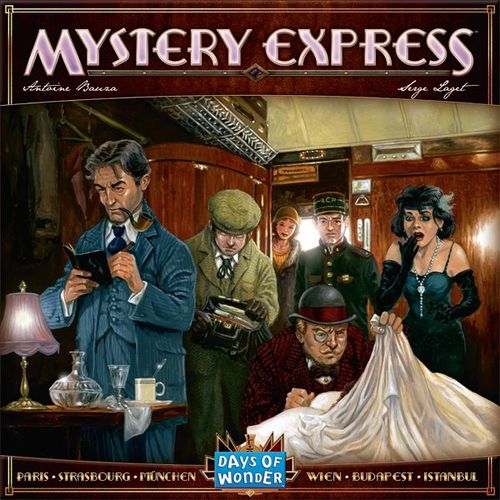
Mystery Express
Mystery Express Rulebook
Table of Contents
Table of Contents
- Components
- Setting Up the Game
- Object of the Game
- Starting the Game
- Game Turn
- The Hour of the Crime: Strasbourg, Wien, Budapest
- New Passengers Climb Aboard: Strasbourg, Wien
- A Long Tunnel: München
- An Important Wire: Budapest
- A Sudden Revelation: Budapest
- End Game
- The Cars of the Mystery Express
- Useful Tips for First-Time Travelers
- Useful Investigative Practices
- Days of Wonder Online
Components
Aboard the Mystery Express™, you will discover:
- 1 Board map of the Mystery Express and its itinerary from Paris to Istanbul.
- 5 Player character figures and 5 large round character tokens of matching colors (1 each per player).
- 5 Ticket wallets (1 per Character) each containing the background story of the Player's character, a description of his or her Special Power, and a summary of the game turn.
- 100 Deduction sheets that players will use to keep track of their deductions.
- 72 Crime cards, divided into 5 distinct Crime categories, each with its own distinct back.
- 1 Telegram notepad for players to wire their suspicions in from Budapest.
- 1 Mystery Express miniature train to keep track of the Mystery Express's journey on the map.
- 1 (gray) Conductor figure and 6 small Conductor tokens, to help determine the Conductor's position aboard the Mystery Express.
- 2 Small Passenger tokens, representing the passengers that climb aboard during the trip.
- 1 Miniature travel bag, used to determine whether a player is able to successfully rummage through another's effects.
- 1 Miniature whistle, to identify the 1st player at the start of each turn.
- 1 Rules booklet with 1 Days of Wonder Registration Code.
Setting Up the Game
- Place the Mystery Express board map in the center of the table.
- Each player chooses a character and takes its corresponding figure, Ticket wallet ❶ and character token of matching color. Each player then takes a deduction sheet from the notepad and places it inside his Ticket wallet, enabling him to keep his deductions hidden from the other players. The players place their character figure in the train car of their choice ❷ and the character token in front of them ❸. This token will be used to identify the players and their discard pile during the game. Each player also receives 1 blank Telegram from the Telegram notepad, which he will use to wire his suspicions from Budapest later in the game ❹.
- Now, separately shuffle each set of Crime cards to form a deck of Modus Operandi cards, a deck of Suspect cards, a deck of Motive cards, a deck of Location cards and a deck of Time cards.
- Without looking at them, take 1 card from each deck and place it face down under the Mystery Express board map ❺. These 5 cards (1 of each category) define the Who, What, When, Where, and Why of the murder just committed.
- Place the deck of Time cards face down next to the board map ❻.
- Thoroughly shuffle all four remaining decks (Modus Operandi, Suspect, Motive and Location) together into a single deck. Deal 7 of these cards face down, one at a time to each of the players, without paying attention to the cards' back colors (which type of cards each players receive will thus likely differ) ❼.
- The players may now take a peek at their cards, without revealing them to others. Players lucky enough to receive 2 identical Crime cards can already safely (but discreetly!) rule out the corresponding Crime element from their deduction sheet.
- The remaining Crime cards are placed face down on their three designated spots (1st passengers, 2nd passengers and Conductor) on the Mystery Express board map ❽.
The number of cards placed on each spot will vary according to the number of players in the game and is indicated on each spot on the board. The Conductor always receives 3 cards (one card per spot), the two passengers 2 or 3 each depending on the number of players.
- The Mystery Express begins in Paris. Place the miniature train there ❾. Shuffle all 6 Conductor tokens, and place them with their destinations face down, one on each of the 6 Stations that the Mystery Express will stop in during its journey. Reveal the 1st token (in Paris) and place the Conductor in the train Car indicated by this token ❿. Place the 2 Passenger tokens in their respective cities of Strasbourg and Wien.
- The player who has most recently boarded a real train starts the game and takes the miniature whistle to identify himself as the first player for this turn.
The game will now proceed in successive turns, going clockwise around the table. At the end of each turn, the player who played last this turn will receive the 1st Player miniature whistle and begin the new turn.
The Mystery Express is now ready to begin its ill-fated journey. All aboard!
3 and 4 Player Adjustments
- When playing with 4 players, remove the 2 "Stabbed" Modus Operandi cards, the 2 "Dr. Rajiv" Suspect cards, the 2 "Unknown" Motive cards and the 2 "Smoking Car" Location cards from the game.
- With 3 players, remove the same cards as for 4 players, plus the 2 "Shot" Modus Operandi cards, the 2 "Sra. Pérez" Suspect cards, the 2 "Rivalry" Motive cards and the 2 "Sleeping Car" Location cards from the game.
Object of the Game
The players' characters attempt to win the game by correctly deducing all 5 elements of the crime just committed. There is always a risk that no one manages to accomplish this by the time the Mystery Express rolls into Istanbul, however. In this case, the player with the highest number of Crime elements correctly identified on his deduction sheet is declared the winner of the game.
Should several players be tied for the highest number of Crime elements correctly identified, the telegrams each player sent from Budapest will be used to break the tie (see An Important Telegram and End Game on p. 5).
By visiting different cars during the train's travel from Paris to Istanbul, the players have a chance to accomplish a number of actions each turn that may help them deduce the various elements of the Crime: the Modus Operandi, Suspect, Motive and Location. The Time of the Crime is deduced differently from the other Crime elements.
There are exactly 2 identical copies of each Crime card (except the Time cards) present in the game. Therefore, the moment a player sees the same Crime element twice (in the hand of 2 different players or the same one) during the same turn, he or she can safely rule out that Crime element from his deduction sheet.
Beware though - if you see a Crime element twice but in 2 different turns, there is a risk you might have seen the exact same card as it may have changed hands between 2 turns. Be careful not to draw too hasty a conclusion in this case.
The Players' Discard Piles
Since there are identical copies of each Crime card in the game, it is critical that the players be able to keep track of the cards' whereabouts during any given game turn. As such, all players must remember this basic rule: Any card that you show or receive during the course of a turn must immediately be placed face down in front of you, atop your discard pile. Make sure to then place your Character token back on top, so that it always sits on the top card of your discard pile.
This will help you identify your discard pile to the other players and will ensure that you don't mix it up with the cards in your hand (which some players sometimes set aside, when taking notes).
The different categories of Crime cards each have their own distinctive back color. Throughout the course of the game, you may ask any of your fellow players to show you the back of the cards in their hand and discard pile, to see how many cards of a given Crime category they have in each.
Starting the Game
As is visible on the itinerary laid out on the board map, the Mystery Express will pass through 4 stations (Strasbourg, München, Wien, Budapest) as it makes its journey to Istanbul. At the start of the game, the train - represented by its miniature on the board map - is in Paris. At the end of its journey, it will have reached Istanbul.
Each leg of this journey represents one game turn, during which all the players will, in clockwise order, starting with the player who holds the miniature whistle, get a chance to take some actions and pursue their investigation. As the duration of each leg varies, so will the actions each player may attempt to undertake: A short leg might prohibit some lengthy investigations, while a longer one might offer a trove of possible actions to pursue, each tempting and tantalizing...
Example: The Paris - Strasbourg leg takes 4 hours. Colonel MacDouglas may choose to try to clear the smoke in the Smoking Car (3 hours), and then retire to the Passenger Car (1 hour). Going in the Smoking Car (3 hours) prevents him from visiting the Lounge Car (2 hours) this same turn however, as this leg of the journey only lasts 4 hours.
As a result, different characters are likely to use their time onboard differently, to pursue their own deductions.
During each leg of the journey, the players' characters will attempt to gather as many clues as they possibly can - taking various actions to peek at their fellow player's cards in the hope of discovering pairs of identical cards that will let them rule out certain Crime elements.
To ensure a smooth game, each time a Crime card is shown to, or exchanged with, a player, this card is then immediately placed face down in a stack in front of its current owner: The player's discard pile. Doing so will also greatly facilitate the players' deductions.
The owner's Character token is placed atop the discard pile, to identify this stack as belonging to that player's character. This helps ensure that whenever you see the same Crime element for the second time during a single game turn, it is indeed the second copy of that Crime card you are seeing, not the first one - thus allowing you to safely rule out that element of the Crime.
Once all players have taken their actions at the end of each leg of the trip, but before the train miniature is moved onto its next destination, all players simultaneously take back in hand any cards in their discard pile.
Game Turn
1. The Mystery Express Travels: Characters & Their Actions
> Enter one of the Mystery Express Cars
Move your character figure to the train Car of your choice. You do not have to move your Character, and may stay in the same Car you finished your previous turn in, as well as move to the same Car multiple times during a turn. However, you may only perform each action associated with a train Car a maximum of once per turn, no matter how many hours you may have left at your disposal. Moving from one Car to the next, and moving through Cars, does not cost any time. You may move back and forth as much as you wish, regardless of the positions of the other players' characters or the Conductor aboard the train. Only the Actions (see Take an Action) you choose to undertake when you stop in a Car are deducted from the total amount of hours you are allotted for any given leg of the journey (i.e. for any game turn).
> Take an Action
Once stopped in a Car of your choice, you may attempt the corresponding Action to try and gather some clues. Doing so takes time however, which must immediately be deducted from the time you have at your disposal for this leg of the trip (the amount of time varies from one leg to the next, as indicated on the Mystery Express itinerary). If there is still time left after taking this action, you may move to another train Car during this same turn (or stay in that same Car, in the case of the Club Car - see p. 6) to take another different action. If you do not use all of the time available to you during this leg of the journey, it is permanently lost - You may not carry it over onto another leg of the trip.
> And Chat with the Conductor
If you choose to stop in - not just pass through - the Car where the Conductor currently is to take the corresponding Action, you MUST discuss with the Conductor and do the corresponding bonus Conductor action AFTER completing your regular Action in this Car (see Chatting with the Conductor p. 7).
For a complete list of the action(s) available in each Car, please refer to The Cars of the Mystery Express on p. 6.
2. The Mystery Express Arrives in Town: Local Events
Once all players have completed their action(s) for this leg of the journey, the Mystery Express arrives at its local destination. The players all take the cards from their discard pile back in hand and the miniature train moves to the next City station on the board map's itinerary. If the City is one in which the Hour of the Crime is investigated (as indicated by the Time card symbols that appear on that section of the board), this event must be handled first (see The Hour of the Crime next). All other event(s) associated with this city, if any, are then performed in the order they appear on the board, going from left to right. Also remember to reveal the Conductor's token placed in that city and move the Conductor accordingly to the new Car indicated on its token, in preparation for the next leg of the trip.
The Hour of the Crime: Strasbourg, Wien, Budapest
There are 3 events that may help you figure out the Hour of the crime. You may have noticed that the Time cards, unlike all other Crime cards, were not distributed to the players at the start of the game. This is because these cards will be shown briefly to all of you, each time in a slightly different manner, in the 3 cities the Mystery Express travels through that are marked with a Time cards symbol on the itinerary.
There are 3 identical copies of each Time card, for a total of 24 Time cards featuring 8 different possible Hours of the Crime. You will have to observe the clock carefully and apply your deductive powers as the Time cards are only revealed briefly. You must figure out which Hour of the Crime card has gone missing and is thus 1 card short (i.e. which precise position of the hour and minute hands on the clock appear only twice, and not thrice as it normally would if the third card wasn't hidden below the board).
In each City marked with a Time cards symbol, the player who currently holds the Whistle (i.e. the first player in the turn) is the one charged with the passing of time. Remember that the Hour of the Crime event must always be done first, before all other Local event(s) in the City, if any. The method he uses to – briefly, at his own judgment – display the Time cards in the deck varies depending on the City the train is in:
> In Strasbourg
Take the deck of Time cards in hand, and flip them, one at a time, face up, visible to all players, into a single stack in front of you so that each card revealed is covered by the next one as you go through the deck. Once done, place that deck back, face down next to the board map.
> In Wien
Deal the deck of Time cards face down, clockwise to all of the players, you included. Upon your signal, each player must pick the Time cards in front of her, take a look at them, and upon your next signal (say the word "Pass") pass them to the player on his left. Repeat your signal as many times as there are players in the game, so that each player gets a chance to look at each deck of Time cards thus formed. Then gather all the cards back into a single deck and place it back, face down next to the board map.
> In Budapest
Take the deck of Time cards in hand and flip them face up, one at a time, into three separate stacks, so that the 4th card revealed covers the 1st one, the 5th one covers the card on the 2nd deck, etc... Once all cards have been flipped into 3 face-up decks, gather all the cards back into a single deck and place it back, face down next to the board map.
Out of fairness to the player who reveals the Time cards, none of the players should take notes as the cards are revealed. You may of course still write down your conclusion(s) on your deduction sheet once the player is done revealing all cards.
New Passengers Climb Aboard: Strasbourg, Wien
In those two cities, after the Hour of the Crime has passed, some new passengers climb aboard, each time enabling one of the following corresponding actions. In Strasbourg, and any Station thereafter, any players' character that chooses to visit the Club Car (see Madam, please let me help you! p. 6) may draw 1 card of his choice from the 1st passengers deck (i.e. the player can look at the cards' back color before deciding which one to pick). In Wien, the same becomes true for the cards in the 2nd passengers deck.
A Long Tunnel: München
The players' characters take advantage of the prolonged darkness of the tunnel to take a peek into their fellow passengers' affairs. Each player lays all his cards face down, next to each other, then takes a peek at 1 card in each of his neighboring players' decks without revealing their content to the other players. Each player thus sees 2 cards in München, 1 from the player on his left, and another from the player to his right. The players then take all their cards back in hand (the train hasn't left the station yet!).
An Important Wire: Budapest
When they arrive in Budapest, the Players' characters all rush out to wire their suspicions via telegram. Using a sheet from the Telegram notepad, each player is invited to secretly write down the Crime elements he has already identified for certain, as well as those for which he may have a strong suspicion. These suspicions will be used as a tiebreaker at game's end. Each Crime element wired in from Budapest that turns out to be correct will be worth 1 point, and each wrong one will subtract 1 point. This is the only instance in which you may lose some points. Some (or all) fields of the telegram can be voluntarily left blank. In this case they do not add or subtract any points to the tiebreak (and may actually help win the tiebreak, see End game next). Once all players have completed their telegrams, they are collected and placed face down under the board, next to the hidden Crime cards. Make sure to write in your name on your telegram and be careful not to look at your fellow players' telegrams when gathering them to place them under the board.
A Sudden Revelation: Budapest
After the players have wired their telegram, each player chooses one card from his hand. All the players then reveal this card to all. Those cards are set aside, face up, next to the board for the rest of the game. Don't forget to take these newly revealed clues into account to advance your investigation!
End Game
When the Mystery Express pulls into Istanbul, this concludes the characters' journey. The players must now write down the conclusions of their investigation in their deduction sheet. Once all players are finished, the 5 Crime cards hidden below the board at the start of the game are revealed!
To make the end game fun and exciting, we suggest revealing the cards that were under the board one at a time, with each player announcing his or her own suspicion for that card type just before the card is revealed. The tension around the table will be palpable and reach a climax as each new card type is revealed!
The player with the most Crime elements correctly identified on his deduction sheet is declared the winner. Elements of the crime incorrectly guessed on your deduction sheet (but not your telegram!) cost you no points, so do not hesitate to take a guess or two, if you're not sure of certain crime elements. If two or more players are tied for first, look at the telegrams sent from Budapest to break the tie using the methodology described above.
If the points earned from the telegrams are equal, break the tie in favor of the player with the least number of incorrect suspicions (i.e. 1 correct suspicion and no false one trumps 2 correct suspicions and 1 false one, despite both scores being equal to 1). If players are still tied, then both are declared co-winners.
The Cars of the Mystery Express
Each Car aboard this fabulous train has its own distinctive atmosphere and lends itself to a unique, specific action that the characters that stop in this Car between two cities can perform. The only exception is the Club Car, which offers 2 different Actions once the Passengers waiting in Strasbourg and Wien have climbed aboard (see below).
Each action takes a certain number of hours to complete, so the characters have to choose wisely which Car(s) to visit during each leg of their journey to Istanbul. They cannot stop in a Car unless they have enough time left on their turn to accomplish the corresponding action. And they may never accomplish the same action twice during one turn.
A player who chooses to have his character stop in a given Car must also always ensure that he has enough Crime cards left in hand to legitimately initiate and complete the corresponding Action.
Here is the composition of the train:
Club Car
There are 2 different possible actions in the Club car. If you have enough time (at least 4 hours) you may choose to pursue both courses of action, once each, either during the same stop or by stopping twice in this car during this turn.
> Get a grip, young man!
- Duration: 1 hour
This action allows you to force one other player (or yourself, if you prefer) to immediately take back in hand, from his (or your) discard pile, all the cards of 1 Crime category of your choice.
> Madam, please let me help you!
After helping this new passenger climb aboard, you strike up an interesting conversation...
- Duration: 3 hours
This action may only be selected once new passengers have climbed aboard in Strasbourg or Wien. Pick a Crime card with the back color of your choice, from among those in the corresponding Passengers' stack on the board map. If both sets of passengers are aboard, you may pick 1 card from either of the 2 stacks, but not both. The card you picked and looked at must then be placed face down on top of your own discard pile.
Dining Car
For many, nothing beats trading gossip over a good meal...
- Duration: Variable (see next)
This action takes a number of hours equal to the number of players' characters you decide to share your meal with. If you invite 2 players to your lunch, this action will thus take 2 hours. Ask the players of your choice (up to 4 in a 5 player game) to each show you one Crime card from their hand. For each player, specify the Crime category you want him to show you a card from. This category must be different for each player you designate, and you cannot designate the same player twice in a row to try and see 2 different cards from his hand. Once you have looked at these cards, they go atop their respective owners' discard pile.
Lounge Car
A snifter of brandy or a glass of fine claret may loosen a few tongues...
- Duration: 2 hours
Every player (except you) must simultaneously reveal 1 card of the Crime category of your choice to all players. This category is the same for all the players. If a player has no card of that category, he reveals nothing (but still gets the benefit of seeing the other revelations). The revealed cards go atop their respective owners' discard pile.
Passenger Car
You begin chatting with fellow passengers in the hope of getting to know them a bit more...
- Duration: 1 hour
Name a Crime category (Modus Operandi, Suspect, Motive or Location) and designate the player seated to your immediate left or right. That player chooses a card of the named Crime category from his hand, and passes it on to you. Once you have looked at that card, place it face down on top of your discard pile. Then choose another card of the same Crime category from your hand and pass it onto the player seated on the other side of you. That player now repeats the same process (i.e. looks at your card, places it face down atop her discard, and passes another card of the same category from her hand to the player seated on her other side, etc…) until all players have passed one card.
Note: If a player (including yourself) has no cards of the chosen Crime category in hand to pass on, he MUST pass the card he just received (after having looked at it), instead of placing it atop his own discard pile.
Sleeping Car
You enter into one of your fellow passengers' sleeping compartment, looking for important clues...
- Duration: 1 or 2 hours (see next)
This dangerous action carries a risk, in that it may fail to yield any new clue. Designate a player of your choice. This player takes the Miniature travel bag in hand and hides it in one of his two closed fists. You must now try to find which hand the bag is in.
If you guess correctly, you spend 2 hours rummaging through his affairs and gain one card of the Crime category of your choice, picked at random from among those available in his hand. Once you have looked at this card, place it face down on top of your discard pile.
If you fail to pick the hand that contains the bag however, you have lost 1 hour and must return empty-handed to your seat (or another Car of your choice, if you still have enough time left for another action)!
Smoking Car
When the smoke clears all the pieces start to fall into place...
- Duration: 3 hours
Ask any 2 other players to give you a Crime element card of your choice (the category must be the same for both players) from their hand. Look at these cards, then place them face down atop your own discard pile. In return, give 1 card of your choice from your hand, back to each of these 2 players. After looking at it, they place the card they received atop their own discard pile.
Note: You must have at least 2 cards in hand to select this action. Otherwise you must choose a different action.
Chatting with the Conductor
- Duration: Free action
In addition to the above actions, the players must chat with the Conductor any time they visit the Car he happens to be checking on.
The Conductor moves throughout the train during the course of the game, as determined by the Conductor tokens revealed each time the Mystery Express reaches a new city. There is one Conductor token associated with each Car and only 5 tokens that will be revealed during each game (from Paris to Budapest; once the Mystery Express enters into Istanbul, the Conductor gets off the train, regardless of the token present in Istanbul). This means that the Conductor will visit 5 different Cars throughout the course of the game.
Chatting with the Conductor is a free bonus action that takes no time. However, the chat must occur after you take the action in this Car. If you don't have enough time left to perform the Car's action, you won't get to chat with the Conductor. Select one of the 3 cards visible on the Conductor's spots. Look at it, and then place it atop your discard pile. Next, take a card from your hand and place it face down on the empty Conductor's spot. This card must come directly from your hand, not from your discards.
Note that even though you may stop in the Club car twice during a turn (once to perform each of the Club car's two possible actions, once the Mystery Express has passed Strasbourg), you will only be able to chat with the Conductor after your first Club car action, not after both.
Useful Tips for First-Time Travelers
Undertaking the trip of a lifetime aboard such a luxurious carriage might be intimidating at first. Hopefully the tips that follow will help you navigate through the often arrogant and occasionally disdainful atmosphere of the Mystery Express and its extraordinary cast of characters!
The Player Characters' Special Power
Until players feel they truly belong to the small clique of old-timers aboard the Mystery Express, it is recommended that they take advantage of the Special Power associated with each of the five characters offered with the game. Each has a distinctive personality and corresponding unique Special Power, giving him/her an edge over fellow passengers.
Before beginning your journey, make sure you familiarize yourself with the layout of the train by looking at the summary of each of the Cars' action(s) provided on the inside cover of your Ticket wallet.
Now look at your Character token, and make sure you place its power face up in front of you. Once per turn you will have a chance to use the unique Special Power available to your character, as indicated on the cover of your deduction notebook.
To make sure you do not use your Special Power more than once during the same turn, turn your Character token over as soon as you have used its Special Power.
When the train arrives in a new city simply flip the token back to enable your Character's Special Power again.
Four of the five Characters (Colonel MacDouglas, Contessa De Mirabella, Doctor Strauss and Archibald Mansard) have a Special Power that is directly associated with the Crime cards whose back matches the color of the Character's miniature. Once per turn the Character may peek at a Crime card of that category that another player just placed atop his discard pile.
The action takes place immediately when the player places the card atop his discard pile, so your Special Power is put in use during that player's turn, not during your own. Once you have taken a peek at the card, place it back onto its owner's discard pile.
This Special Power usually allows you, even if you happen to be a relatively inexperienced beginner, to quickly identify the missing Crime card for the category associated with your own Special Power - even if you haven't seen that many cards of this type during the course of the game.
The fifth Character, Miss Pransky, has a Special Power of a different sort: Every turn, she has 1 more hour than indicated on the itinerary (and thus, 1 more hour than any of the other characters) to take actions with. This allows Miss Pransky to take some of the most time-consuming actions, such as conversing with one of the new passengers in the Club Car, and usually goes a long way toward helping her narrow down her suspicions.
Useful Investigative Practices
Keeping Track of What You See
How you will encode the information you see and gather on your deduction sheet has a major impact in moving your investigation forward.
As such it is critical that you pick a way to clearly differentiate a Crime element you have seen twice during the same turn (such as the 2 Hanged cards) versus seeing it only once. A checkmark for when you see the first card, transformed into a cross check when you see the second identical card this same turn, is a possible solution. Of course, you must be careful to correctly make note of the leg of your journey during which you saw each card; otherwise you risk coming to the wrong conclusions…
It may also prove useful to keep track of who owns a card in a given turn. Unless that player has both identical cards in hand (unlikely), there is a great chance that if he shows you the same Crime element again during the next leg of your trip it may be the exact same card he showed you the previous time.
Increasing the Odds
Since the simplest way to rule out a Crime element with certainty is to see both copies of that Crime card during the same game turn, try to focus on a certain category of Crime card/color during a turn. This way you will maximize your chances of seeing all the pairs of identical cards in this category in one turn.
The Hour of the Crime
There are a lot (24!) of Time cards, so you will need a strategy to try and memorize them. Unless you are fortunate enough to be blessed with a photographic memory, it is usually hopeless to try and memorize them all in a single pass. Instead, we recommend you focus on a different aspect of each card (such as the position of the hour hand) during each different showing of the Time cards. Remember that there are 3 identical copies of each Time card. You are trying to find the one that is present only twice in the deck.
Days of Wonder Online
Here is your train ticket to Days of Wonder Online – The online board game community where ALL your friends play!
Register your game at www.daysofwonder.com to receive online discounts and discover a web site full of game variants, discussions of effective investigation strategies and more. Simply click on the New Player button and follow the instructions.