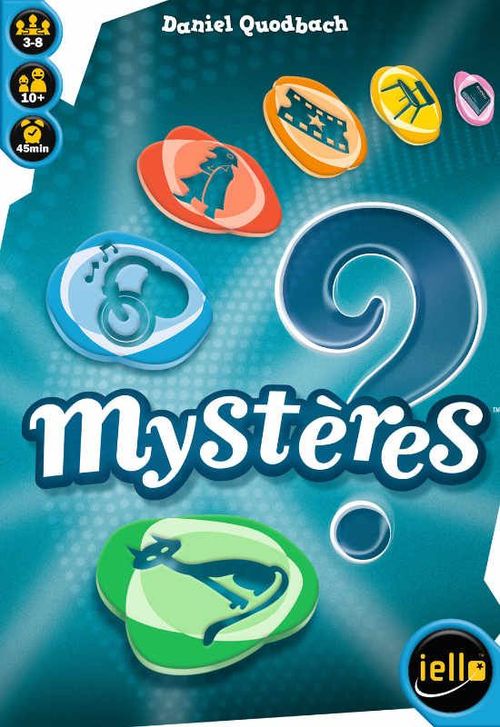
Mystères?
Mystères? Rulebook
Table of Contents
Table of Contents
Components
- 1 opaque bag
- 14 Clue tiles
- 6 Special Clue tiles
- 71 Mystery cards
- 9 Key cards
- 1 pad of score sheets
Overview and Goal of the Game
Throughout the game, players guess or make others guess a secret word in the form of a "twenty questions"-style portrait. In turn, one of them will be Maestro and will have the task of giving clues to the other players. Each of them tries to be the first to find this word, called the "Mystery word".
If the Mystery word is discovered, the Maestro and the player who found the Mystery word earn as many points as Clues used. But if, by the end of the 9th Clue, no player has the solution, no one scores any points! The player with the most points at the end of the game is declared the winner.
Game Elements
Clue Tiles
The Clue tiles represent the categories of Clues that can be given during the game. They are double-sided: one Text side and one Blank side.
When a Clue tile is on its Text side, the players may use the Clue category shown on this tile to try to guess the Mystery word. When a Clue tile is on its Blank side, the players have already used the Clue category represented by this tile and can no longer use it for the round.
Mystery Cards
The Mystery cards are made up of 14 words spread across 14 different Clue categories, each represented by a color and a symbol.
Each of these Clue categories is represented by a Clue tile of the same color. The categories are: Shape or Color, Movie or TV, Object, Place, Book, Material, Animal, Famous Character, Song or Music, Number or Date, Common Character, Hobby, Concept, and Verb.
Key Cards
The Key cards are made up of a grid indicating to the Maestro which Clue, among the 9 Clue tiles present on the table, is the Key Clue for that round. This card is read with the arrow pointing up.
The Key Clue indicates the category of the Mystery word for the round. The Mystery word represents the word that the players must guess during this round, among those offered on the Mystery card in play.
Example: You draw a Key card designating as Key Clue the tile at the center of the grid. The Mystery word you must make the others guess is therefore the one indicated by that tile's category on your Mystery card.
Draw Bag
The bag is used only during the setup of each round.
Setup
- Shuffle the Mystery cards to form a face-down deck.
- Shuffle the Key cards to form a second face-down deck.
- Place the 14 Clue tiles in the opaque bag.
- Place the score pad near the players.
- The last player to have revealed a secret becomes the first Maestro.
How the Game Unfolds
A game is played over a certain number of rounds, noted on the score pad.
Number of rounds by number of players
- 2 players: 10 rounds (each player is Maestro 5 times)
- 3 players: 9 rounds (each player is Maestro 3 times)
- 4 players: 8 rounds (each player is Maestro 2 times)
- 5 players: 5 rounds (each player is Maestro 1 time)
- 6 players: 6 rounds (each player is Maestro 1 time)
- 7 players: 7 rounds (each player is Maestro 1 time)
- 8 players: 8 rounds (each player is Maestro 1 time)
Setting Up a Round
The bag is used during the setup of each round.
-
The Maestro draws 9 Clue tiles at random from the opaque bag and places them at the center of the table, forming a 3-by-3 grid, Text side visible.
Note: To play with beginners, it is advised not to draw the tiles at random, but to select the tiles listed below.
-
Out of sight of the other players, the Maestro draws a Key card and a Mystery card. The Key card indicates which is the Key Clue for this round. The Key Clue indicates on the Mystery card which is the Mystery word for this round.
Example (above): You draw 9 Clue tiles at random and place them on the table. You then draw a Key card, which indicates that the Key Clue for this round will be "Material". You also draw a Mystery card and read the word that corresponds to your Key Clue. The Mystery you must make the others guess is the word "GLUE".
If the Maestro does not wish to make a Mystery word guessed, because they feel no one knows what it is or because that word has already been used in a previous game, they may draw a new Mystery card.
Playing a Round
Once setup is complete, the Maestro does nothing but answer the other players' questions; they play in turn, clockwise. The player to the Maestro's left becomes the first active player.
Each round proceeds as a succession of turns made up as follows, until the Mystery word is discovered:
- Choice — The active player chooses a Clue category.
- Clue — The Maestro answers.
- Answer — All players may propose an answer.
How a Turn Unfolds
1. Choice
The active player designates a Clue tile of their choice among those on the table, Text side visible.
Example: You designate the Material Clue tile and say "What if it were a material?"
2. Clue (two possibilities)
The designated tile is the Key Clue
The Maestro tells the players that this is indeed the type of Clue they are looking for. They turn over and set aside this Clue tile so that all players keep it in mind. They say nothing more.
Example: Continuing the example above, the Maestro then says "It is indeed a Material!" and sets aside the Material tile from the other 8. You now know that the Mystery word you are looking for is a material.
The designated tile is not the Key Clue
The Maestro turns the Clue tile over to its Blank side, then gives the players a clue, respecting the three main rules.
Example: You designate the Place tile, and say "What if it were a place?" The Maestro turns this tile over, and then gives you a clue. They say "It would be a classroom."
The Three Rules for Giving a Clue
Examples of clues — the Mystery word is "glue".
- The Clue must correspond to the designated tile.
- Famous Character: "Helmut Kohl" (in French, "Kohl" sounds like "colle", glue)
- Number: "5" (the word "colle" contains 5 letters)
- The Clue must allow the other players to discover the Mystery word.
- Common Character: "A hall monitor" (they "stick"/glue students in detention)
- Movie or TV: "L'École des fans" (you hear "colle" in "école", school)
- The Clue may include the Mystery word, but not exclusively.
- Animal: "A leech" (it sticks/glues to its prey)
Lacking inspiration...
If the Maestro is lacking inspiration and feels that the best Clue they could give would let the players find the right answer too quickly, they are allowed to pass their turn and put the designated tile back in the bag. Move directly to the Answer phase.
By doing this, the Maestro will be penalized when scoring points. Putting the Key Clue tile back in the bag is not allowed.
3. Answer
In this phase, all players have the opportunity to give an answer.
Between the Clue and the active player's Answer, all other players who think they have found the Mystery word may speak up by declaring "I've found it!"
Two possibilities
-
If no player speaks up: The active player may propose an answer, but is not obliged to. If it is wrong, they are not eliminated.
Example: Continuing the previous situation, you designate the Common Character tile. The Maestro says "Hall monitor." No other player speaks up, so you then propose "Chalk". This is not the right answer, but you are not eliminated from this round.
-
If at least one player speaks up: The active player may propose an answer, but is not obliged to. If the answer is wrong, the active player is eliminated. Then, the players who declared "I've found it!" give their answer in the order in which they spoke up. Any player, even the active player, who gives a wrong answer on this turn is eliminated from the round, and can only play again starting with the next round.
Example: Continuing the previous example, you designate the Common Character tile. The Maestro says "Hall monitor." Another player thinks they have found it and says "I've found it!" You have no idea what the Mystery word is and prefer to pass without proposing an answer, for fear of being eliminated. This other player then proposes "Chalk". They were wrong, and are eliminated until the next round.
If no one finds the right answer, the player to the left of the active player becomes the active player and begins their turn.
As soon as a player finds the right answer, move directly to the end of the round.
Special situations
- Last player remaining — When only one player remains in play (the others having been eliminated), that player plays one more turn and proposes one last answer. If the answer is wrong, the round ends without anyone scoring points.
- Last Clue tile — When a player designates the last Clue tile in play, all other players still in play are considered to announce "I've found it!" clockwise. The active player may give an answer, then the other players still in play may each in turn give an answer.
End of the Round
The round can end in two different ways:
The Mystery is discovered!
A player has discovered the Mystery word. That player, as well as the Maestro, each earn a number of points equal to the number of Clue tiles used (Blank side visible). Note the points on the score sheet.
Note: The tiles that the Maestro put back in the opaque bag when they passed their turn earn no points.
Stay fair-play! Be flexible in accepting answers. For example, if a player answers "January 1st" instead of "New Year's Day", grant them the win for this round.
The Mystery remains a total mystery...
If no one found the Mystery word, the round ends. No one scores any points.
The player to the left of the Maestro becomes the Maestro of the next round. They put all the tiles back in the bag and begin the setup of the round as Maestro.
End of the Game
At the end of the last round, add up the points from all the rounds for each player. The player with the most cumulative points is declared the winner.
Two-Player Game
The two-player game is a cooperative mode whose objective is to solve the Mysteries as quickly as possible. The pair's goal is to achieve the best possible score over the course of 10 rounds.
Setup and play proceed the same as described previously. The active player designates a tile, the Maestro gives a Clue, then the active player may give an answer, and so on. When the active player discovers the Mystery word, the pair earns a number of points equal to the number of Clue tiles showing their Text side. If the active player discovers the Mystery word after having designated the last tile, the pair still earns 1 point.
At the end of the round, swap roles: the Maestro becomes the active player, and the active player becomes the Maestro.
Advanced Variant and Special Clue Tiles
The following rules are optional and can be added to enrich your games. This variant introduces new Clue tiles for special actions.
Setup
When setting up the game, the Maestro adds the 6 Special Clue tiles to the 14 Clue tiles in the bag before starting to draw. The Key Clue cannot be a Special Clue: if the Maestro draws a Key card that indicates a Special Clue tile, they draw a new Key card until it indicates a (non-Special) Clue tile.
Playing a Special Clue Tile
On their turn, a player may designate a Clue tile or a Special Clue tile. If they choose a Special Clue tile, it is turned to its Blank side as normal and the Maestro gives their clue while respecting the action of that tile.
The Different Special Clue Tiles
No Clue — The Maestro does not give a Clue on this turn. The player who chose No Clue may propose two answers. At each proposal, the other players may speak up as normal, as during a regular Answer phase.
Example: You choose No Clue. No one speaks up. You are wrong, but are not eliminated. Before your second proposal, another player speaks up. You try to answer anyway. You are wrong, and are therefore eliminated. The other player must therefore answer, at the risk of being eliminated too.
Adjective — The Maestro must reveal an adjective that describes the Mystery word.
Example: "The Mystery is marvelous."
Number of Words — The Maestro must reveal the number of words that describe the Mystery word.
Note: Compound words count as a single word.
Example: 3 for "Light the fire", 1 for "Thirty-three".
First Letter — The Maestro must reveal the first letter of the Mystery word. If the Mystery word is a number, they reveal the first letter of the number written out in full.
Example: "F" for fifty.
Direct Question — The player who chooses Direct Question asks the Maestro a closed (yes/no) question, which the Maestro must answer honestly with yes or no. If the Maestro does not know the answer, they must answer that they don't know.
Example: "Is he still alive?"
Verification — The player who chooses Verification designates another Clue tile (or Special Clue tile) to be shown Blank side during this round. The Maestro must give a new Clue concerning the Mystery word.
Note: Using Verification on First Letter or Number of Words is pointless. The Maestro cannot give a new Clue.
The Clue Tiles
Animal — The Maestro must reveal the common name of an animal, real or fictional (e.g., a salmon, a bird, a dragon...).
Song or Music — The Maestro must reveal the title of a musical work, song, piece, opera, album, or style of music... (e.g., Comme d'habitude, Starmania, rap...).
Movie or TV — The Maestro must reveal the title of a movie, a saga, a series, or a TV show (e.g., Le Pianiste, Le Hobbit, Le Juste Prix...).
Shape or Color — The Maestro must reveal the name of a geometric shape or the name of a color. The shape can be as simple or as complex as needed (e.g., a rectangle, a prism, a dodecahedron...). The color can be a color in itself or a color derived from a material (e.g., red, emerald, mustard...).
Place — The Maestro must reveal the name of a place, proper or common, real or fictional (e.g., Nancy, a marsh, a warehouse...), or the name of a famous monument (e.g., the Arc de Triomphe...).
Book — The Maestro must reveal a type of work or the title of a written document: a novel, a short story, a magazine, a work, a manual, a collection, a comic book, a dictionary, a rulebook... (e.g., The Diary of Anne Frank, On the Road, the Code Civil...).
Material — The Maestro must reveal a common noun that names a material, a substance, or an element. Generally, its name can be preceded by "some" or "a" (e.g., limestone, velvet, bread...).
Number or Date — The Maestro must reveal a digit, a number (e.g., 8, 42, 1993, 10,000...), or a date (e.g., July 14th, New Year's Day...).
Object — The Maestro must reveal the generic name of an object, real or fictional (e.g., a vacuum cleaner, a glove, a magic wand...).
Famous Character — The Maestro must reveal the proper name of a famous character, real or fictional (e.g., Mickey Mouse, Joan of Arc, a well-known game show host...).
Common Character — The Maestro must reveal the name of an archetype, a common character, real or fictional (e.g., a farmer, an Indian, a fool, a rich person...).
Verb — The Maestro must reveal a verb in the infinitive (e.g., to hit, to mow, to hatch...).
Hobby — The Maestro must reveal an activity, an occupation, a sport, a hobby... (e.g., aikido, macramé, pottery...).
Concept — The Maestro must reveal a quality, an emotion, an idea (e.g., freedom, contempt...).