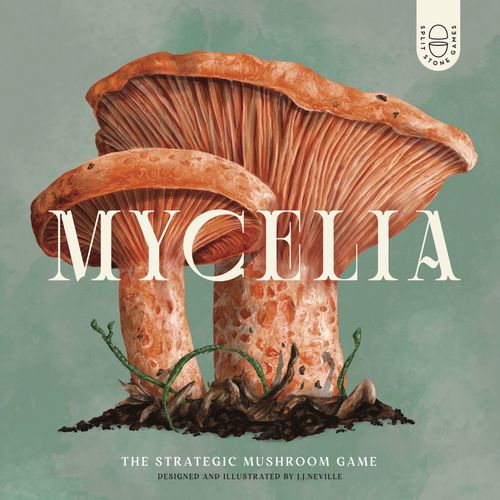
Mycelia (2024)
Mycelia Rulebook
Table of Contents
Table of Contents
Overview
Ways You'll Score Points
Gain the highest points through growing mushrooms, collecting insect tokens and gaining the end game token.
- Gold diamond (points value): Each time you grow a mushroom, you gain the points displayed in the gold diamond displayed on the mushroom card.
- Insect tokens: For every 2 insect tokens you have at the end of the game, you score 1 point.
- End game token (Ex Morte Vita): The player who triggers the end of the game receives the end game token worth 5 points.
What Is Mycelia?
Mycelia (plural of mycelium) are the hidden root systems of Fungi. Mycelia are composed of dense masses of fine, thread-like filaments called hyphae. These threads naturally extend into the soil, plant matter, wood and other materials to pick up water and nutrients for their food. The mushrooms you see are only the fruiting bodies of mycelia and are only a small part of the fungi hidden under the earth. When spores are released from these mushrooms and dispersed by air they germinate in new locations and create new mycelia.
Game Components
- 69 Mushroom Cards
- 20 Mushroom Tokens (5 per player)
- 120 Spore Tokens (30 per player)
- 20 Spore Counters (5 per player)
- 4 Mother Mushrooms (1 per player)
- 20 Player Mats (5 per player)
- 50 Triangle Tiles
- 20 Insect Tokens
- 1 Wind Direction Die
- 10 Automata Cards
- 2 Automata Ref Cards
- 4 Player Aids
- End Game Token
Set Up
Triangle Tiles
Shuffle the triangle tiles and place in two piles face down. Then select the top 6 from each pile and set up in a star shape as shown. The board will grow and adapt as the game goes on, so be sure to leave plenty of room around the initial star shape.
Insect Tokens
If the tile has the insect symbol, immediately place an insect token on this tile. Then give one token to each player and leave the rest to one side.
Mushroom Cards
Shuffle all the mushroom cards, deal 3 cards to each player and leave them face down.
Player Mats
Each player should place 5 of their colour player mats in front of them, ordering them from 1 to 5 pips. Then place your mushroom tokens on the spaces that match the number of pips. Place your spore counter for each mushroom in the farthest slot to the left (the colour slot). Keep your spores handy next to your player mats. Keep any insect tokens you gain next to your player mats. Your player mats should always have a mushroom token or a mushroom card on top. It should never be empty!
First Player
The first player is determined by whoever saw a mushroom in the wild last, or you can put a spore from each player into a hat and see whose is drawn first, or argue about it for 15 minutes.
Mother Mushroom
In reverse order, each player places their Mother mushroom on one of the 6 centre triangle tiles (not a black tile, if present*). Mother mushrooms can never be on the same tile as another player's. If the player places their Mother mushroom on a tile that has an insect token, they immediately gain the token.
End Game Marker
Place the end game marker to one side - this will be claimed at the end of the game by the player that triggers the end game conditions. This marker is worth 5 points, which is added to their total score. See page 14 to learn how the end of the game is triggered.
Card Reveal
Finally, reveal the top three cards from the deck and place next to the deck. Players can now look at their cards and begin play.
Variations
Shorter Game Option
To make the game shorter set up just 3 or 4 player mats for each player. The end of game token is worth the same amount of points as there are player mats.
2 Player Set Up
Exactly the same set up apart from the second player gets one extra card to their starting hand.
* If a situation arises where there are too many black tiles in the centre and players can't place their Mother mushrooms, reshuffle all tiles and draw again.
Taking Turns
On a turn, a player has 2 actions. There are 6 actions to choose from: move, spore, explore, fruit, discover and decay. A player must choose 2 different actions on their turn. Once the player has finished performing their actions the next player moving clockwise performs their 2 actions and so forth until the end of the game. There is a handy player aid that reminds the player of what each action does.
MOVE | EXPLORE | SPORE | FRUIT | DECAY | DISCOVER
Move
The only piece that you can move in the game is your Mother mushroom (M). You can move your M up to two spaces* (triangle tiles). Movement is only over a flat edge of a tile. You can never move onto a tile that already has another player's M on it. The M is a useful tool in the game to access different colour triangle tiles that you need to spore on. It can be used to strategically block areas of the board, claim other players' spores and stop other players from sporing. It's also the only way to collect insect tokens.
Blocking
You can block other players from sporing or decaying by moving your M on top of another players mushroom token. The main way to move an opponent's M is by spending your insect tokens (see page 13), but certain decay actions may also allow you to do this.
Example: Showing the available moves for red player's M.
* It is also possible to move one space and then back to the original position
Explore
Placing a New Triangle Tile on the Board
Flip over the top triangle tile of one of the face down piles and add it anywhere on the board, as long as one flat edge is touching another. If the tile has the insect symbol on it you then immediately place an insect token on the tile. This will stay there until a player's M lands on or moves through the tile and claims the insect token.
The board can grow in any direction and, because the tiles are random, no two games are exactly the same.
Types of Tile
There are 5 types of tiles. Four coloured tiles (red, green, brown & yellow) that represent different nutrients and minerals that mushrooms need to grow. The special black tile can be used as any colour when growing mushrooms.
Symbols on the cards correspond with the symbols shown on the tiles to help anyone with colour vision deficiency (colour blindness) to differentiate between them.
- Standard Tiles (x44 - 11 of each colour)
- Special Tile (x6)
Spore
Create and spread spores across the board.
Mushroom Selection
Before you spore, you have to say out loud which mushroom you are choosing (select a fruited mushroom or your Mother mushroom). This selection is where your spores will disperse from.
Spore Counter
Mother mushrooms can spore forever. Fruited mushrooms only have the capacity to spore twice. You keep track of this by using the spore counter above each mushroom slot on your player mat. Move the counter up each time you spore (once your counter is in the last slot you can decay that mushroom). Remember: When sporing a fruited mushroom, it's best practice to move your spore counter up before placing your spores on the board.
Wind Direction
Next, you roll the wind die. Just like in nature, you never know which way the wind is going to blow, so you have to roll the wind die to determine which direction your spores will spread. These symbols are abstract symbols but an easy way to remember is to see them as O, U and A.
Number of Spores
The number of spore cubes you place is determined on the card. Each mushroom has a different spore count and is shown within this symbol. Your Mother mushroom (M) will always spore two as standard.
Spore Distribution
Once you have determined the wind direction, you add the appropriate number of your spore cubes to the board. The first spore is always placed on the same triangle tile as the mushroom you've chosen. The following spores spread in the direction determined by the wind die, flowing off the edge that shows the matching wind direction symbol. Remember that only the symbols on the tile where you are sporing from matter, you can ignore the rest.
The first spore is always placed on the same tile as your fruited mushroom or Mother mushroom. The spread of the spores always follows the flat edge of the tile.
Example A: The player has rolled the U symbol. They have 4 spores to spread. The spores must be placed following the larger triangle shape (red area).
Example B: The player has rolled the A symbol. They have 3 spores to spread. The first spore is on the mushroom then the next on the tile directly next to it. With the third spore the player has a choice whether to pick the tile to it's right or left.
Example C: The player has rolled the O symbol. They have 4 spores to spread but the board doesn't exactly fit the triangle spreading area. In this case you fill up the available tiles.
Example D: The player has rolled the U symbol. This is pointing away to the edge of the board. Even if the player has more than 2 spores to spread there are only 2 available tiles to place them so the others are not placed.
Spore Ownership
Larger pieces, such as a Mother mushroom or a mushroom token, always have control over any spores on the tile they occupy. The player with the larger piece can spend all spores on that tile as their own.
In this example, the blue player has spored 5 spores, but one of the spores (A) is no longer connected to the rest of the blue player's network. This is because the red player's M splits up the network. Now, the red player can spend the blue spore on the same tile as their M if they wish because they have control over that tile (B). The blue player now technically has two separate mycelium networks (C) and (A). If the red player's Mother mushroom was removed, the networks would be reconnected and create a single network of 5 blue spores.
Fruit
Grow a new mushroom.
To fruit a mushroom card from your hand you must have the correct number of spores located on the correct coloured tiles. However, they must be connected! Your coloured pieces represent your network, so your M or a fruited mushroom can connect spores if needed. If a spore you need is on the other side of the board or cut off by another player's mushroom or M, then these spores aren't connected and can't be used together (see example A).
Card example: Shaggy Inkcap — a mushroom token is drawn from the player mat's numbered slot onto the board.
If you do have the correct spores to spend, you remove them from the board and add them back to your spore supply. You then pick up any available mushroom token from your player mat and place the card just fruited on that slot. Then place your mushroom token on any free triangle from where you spent spores to grow it. You can't grow two mushrooms on one tile. You can grow a mushroom on the same tile that your Mother mushroom currently occupies. If you have spent another player's spores, their spores go back to their supply.
Example A: Blue player wants to fruit a mushroom that requires 3 green spores and 1 brown spore, but red player has split up their network by having their 1 pip mushroom on the brown tile.
- A - The one blue spore can still be used (for a mushroom card that would require a single brown spore) but not with any other spores as it's not connected.
- B - Red player can use the blue spore as their own as long as their mushroom token is there. So currently they have 3 browns.
- C - Blue's current spore network doesn't have any brown spores. If red player moved their M or removed their mushroom token then the blue player would have access to brown spores.
- D - If red player had a card requiring 2 green spores and 1 brown spore they could spend the blue player's spores as well as their own and fruit the new mushroom. But they would have to place it on the green tile because the brown tile already has a mushroom on it.
Decay
Removing mushrooms from the board and gaining bonuses.
When one of your mushrooms has spored twice you now have the option to go into decay for that mushroom. You do this in the following order.
- Remove the card from the top of the player mat and slide it underneath the player mat.
- Select the mushroom token that is going into decay and remove it from the main board, placing it back on your corresponding player mat.
- Reset your spore counter by moving the counter to the left most slot.
- Resolve the mushroom's decay action.
There is no limit to how many mushrooms you can decay under one slot.
You cannot double up on decay upgrade card actions. For instance if you decayed 2 cards that both had the "Mother mushroom now moves 3" upgrade, you cannot now move 6.
Decay Action Types
There are 3 main decay actions:
- Instant Action — Instant decay actions must be performed as soon as you decay your chosen mushroom.
- Game Upgrade — Pink decay actions are immediately applied to you and continue for the rest of the game.
- Mushroom Upgrade — These upgrades only apply to future mushrooms that are grown on the same player mat. Any mushroom that is placed on top of the player mat with this decay upgrade card slipped underneath will gain the displayed bonus.
Discover
Pick up a new card.
Pick up one of the 3 mushroom cards on display or pick up a face down card from the top of the pile. There is no card limit to your hand. After your turn replenish the market if any cards were taken.
Card Anatomy
- Mushroom name
- Mushroom Latin name
- Points gained when grown
- Spores required to fruit mushroom
- Reference for fungi facts found on pg. 17
- Spore count
- Decay action
Example card — "The Prince" (Agaricus augustus): points gained when grown 6, spores required 3 (bracket + 2 mushroom-cap symbols shown in colour), fungi-fact reference "P.", spore count 4, decay action (Instant): Move an opponent's Mother mushroom to an empty triangle.
You can spend one insect token to refresh the market at any point on your turn.
Insect Tokens
Placement & Collection
Whenever a new triangle tile with the insect symbol is added to the board an insect token must be placed on the tile. You can only gain insect tokens from the board with your Mother mushroom. You can pick up insect tokens by landing on or moving through a tile with your Mother mushroom. You can also trade in three cards from your hand at any point on your turn to gain one insect token.
Spending Insect Tokens
You can spend your tokens at any point on your turn, which will not count as one of your two actions. Give your insect tokens back to the supply and perform one of these actions:
Two insect tokens: Move another player's M to any other triangle tile on the board, as long as it does not contain another player's M.
One insect token: Refreshes the market. Discard the 3 cards on display and place another 3 face up.
Insects as Points
When scoring points, you score 1 point for every 2 insect tokens you have at the end of the game. There are no half points in the game, so if you have 3 insect tokens you still only gain one extra point. There are a total of 20 insect tokens, so there are an extra 10 points up for grabs if they're all revealed.
Why Insects?
Insects are friends of fungi because they crawl across mushrooms and pick up spores on their feet and bodies helping to disperse the fungi spores in a different way.
Game End
The end of the game is triggered by a player having at least one decayed mushroom in all 5 slots on their player mats. The game immediately ends and no other turns are taken. If the player decayed as their first action, they do not get a second. The player who ends the game gains the end of game token (EGT) which is worth 5 points. All of the players add up their scores, including all fruited and decayed mushrooms plus any insect tokens.
The player with the highest number of points wins and is crowned victor over the fungi kingdom.
In the event of a tie, the player who grew the most mushrooms overall wins. If still tied, the player with the most insect tokens wins. In the unlikely event of another tie, the tied players share the victory.
If you played with 3 player mats the EGT is worth 3 points and with 4 player mats it's worth 4 points.
Automata
This Automata (A) can be played solo or be added in as an extra player in a 2/3 player game.
Board Set Up
Follow the same set up for a 2-4 player game (Pg.5). For solo variant remove all the black triangle tiles and only set up the player mats for yourself.
Automata Set Up
- Shuffle the Automata cards and place face down.
- Place the larger Automata ref cards face up and side by side as shown.
- Choose a colour for the A. Then, on the second ref card (spore-tomata), place the spore counters in the circles with the numbered pips.
- Place the A mushroom tokens and spores close by.
- Shuffle the main mushroom deck and give the A 5 cards face down plus 2 insect tokens.
How to Play
You will take your turn first. Place your M and then the A's M directly opposite. Then take your first turn by performing two (different) main actions.
The A turn is determined by the cards. Flip over one of the cards from the deck and place on top of the first ref card. Then the A performs two actions in the order shown on the card. If the A cannot perform an action move down and perform the next action on the list until two actions have been performed. The order is as follows: Fruit > Decay > Spore > Move.
After all the cards have been played, shuffle them, place them face down, and begin drawing again.
Fruit — The spores needed to fruit are displayed on the card. The empty boxes are wild spores, they can be used from any coloured tile. When fruiting a mushroom place the mushroom token on a tile where a spore was used. Place on a tile whose colour matches one of those shown on the card; if that's not possible, place on the tile closest to the opponent. If a number of potential spores are available then, one at a time, take the next spore the A needs from the tile that is most populated. All spores still have to be part of the same network to be used.
Decay — The A is eligible to decay if any spore counter on the 'spore-tomata' card is on number two slot. Move the spore token on top of the 'D' symbol, remove the mushroom token from the board and place on the mushroom slot on the ref card. Then perform the decay action shown on the card.
Spore — Spore a fruited mushroom or M if there are no fruited mushrooms on the board. The amount of spores is indicated on the card. A blocked mushroom still counts as a fruited mushroom on the board and therefore the M cannot spore.
Move the spore counter along each time a fruited mushroom spores. If multiple mushrooms have been fruited make sure they have all spored once before sporing for a second time. So if the 1st and 2nd mushroom have spored once, but there's a 3rd mushroom on the board. The 3rd mushroom must spore before the other two.
If the fruited mushroom or M is on an outer tile (only one flat edge touching) then perform the EXPLORE action first, placing tile next to said mushroom/M. This counts as one of the A actions. If EXPLORE is the first action performed by the A then SPORE will automatically be the second.
Automata ref card — MOVE, move to/towards closest, in priority order: coloured tile; opponent's fruited mushroom; Automata's fruited mushroom; opponent's spores (most populated tile); opponent's Mother mushroom; insect tile/s.
Move — All the actions move (two spaces) to/towards the closest piece/tile/token shown on the card. The action taken is determined by the wind die, roll the die and match the symbol on card for the action. If the action is completed over one space* - no more moves are needed. See the ref card for the symbol actions key.
If the move action on the card is not applicable, roll the wind die to determine the direction and follow the symbols on the tiles (as you would with sporing). Do this twice to move two spaces. In the event that the die is rolled twice and the M still does not move, then the A performs EXPLORE as its action.
In the event of the A only being able to perform the MOVE action due to a fruited mushroom being blocked by the opponent's M then the A spends just ONE insect token to move the opponent's M to the furthest tile on the board. It then performs EXPLORE as its second action.
Difficulty Level
The cards are split down the middle. The GREEN side is Medium difficulty and the YELLOW side is Hard difficulty. It is recommended that you start on the green side.
An option to make the game slightly easier is to shuffle back in all the black triangle tiles that were removed at the start.
* The only exception to this rule is if the move action is for insect tokens and there are two insect tokens located next to each other. The Mother mushroom would move two spaces to pick up both insect tokens.
Rule of Thumb: When performing any of the Automata's actions and there is a choice, like placing a spore or moving a token, then always go for the option that will help the Automata. Not yourself.
2/3 Player
When two or three players are in a game with the Automata and there is a decision to affect one of the human players, and it's unclear who it should be, then simply let fate decide. Put a spore from each player (who might be affected) into a hat and see whose is drawn first!
Example A: The A is on their MOVE action and has rolled the "move to or towards an opponent's fruited mushroom" symbol. Usually the A would move to the closest mushroom but both players are the same distance apart. A red spore is pulled from the hat so the A moves two spaces towards the red player's mushroom.
Initial Mother mushroom placement: The Automata always goes last in a game. When players place their M the A should be placed equidistant between the players.
Example B: The red and blue players' have placed their M opposite each other. This means the A can't be placed equidistant. A blue spore is pulled from the hat meaning that the A will be placed next to the blue player. Blue player will decide on which side the A will sit.
Example C: Three players are placed equidistant. When a situation might apply to all three players two colours are chosen. In this case yellow and blue were pulled from the hat, so the A is placed between them.
End Game and Scoring
The end of the game is triggered when either the Automata or real player decays in all 5 slots.
Automata scoring: Each mushroom the A fruits is worth 5 points plus any bonus points earned through insect tokens. The standard score for the A is usually 26. The A does not gain the end of game token.
Fun Fungi Facts
Facts helped gathered by @the.fungi.guy
A. Beefsteak Fungus - Fistulina hepatica: Aptly named due to it's marbled red flesh resembling that of a fresh slice of meat (with dripping 'blood' to boot), this fungus infects the heartwood of Oak trees. The discolouration caused can create handsome streaking known as 'Brown Oak' timber, and is highly prized in the woodworking industry.
B. Death Cap - Amanita Phalloides: The world's most famous toxic toadstool, not only responsible for 90% of mushroom related deaths, but potentially also the premature departures of an Emperor, a Pope and a King! Their toxins shut down your liver and kidneys. The whole process can last a few days. Not a nice way to go!
C. Devil's Tooth - Hydnellum peckii: The common name derives from the fact its underside is covered in tiny spine like teeth. When the fruitbodies are young, they are known to 'ooze' a blood like red liquid in a process known as guttation.
D. Fly Agaric - Amanita muscaria: Apparently, the Sámi people would gather and consume the urine of reindeer that had consumed the fly agaric mushroom. This is because the reindeer's kidneys filter out many of the toxins that cause sickness leaving behind the psychoactive compound that was used for religious and recreational purposes.
E. Green Elfcup - Chlorociboria aeruginascens: The turquoise stained wood resulting from this fungus has been highly prized by traditional woodworkers. The famous marquetry work of Tumbridge wells would use this coloured wood in their intricate designs.
F. Grey Oyster - Pleurotus ostreatus: These silver grey shells of the trees have a dark secret up their sleeves - they are a carnivorous fungus! In order to supplement their nitrogen intake, oyster mushrooms have the ability to paralyse tiny nematode worms that share the same feeding ground. Once paralysed, the fungal hyphae then enter the worm, dissolving its insides and sucking out the desired nutrients.
G. Honey Fungus - Armillaria mellea: The rizomorphs of this often parasitic fungus can be seen in the form of black 'bootlaces' revealing themselves where bark has fallen away from the dead/dying tree. These root like structures restrict the flow of nutrient to the host and are incredibly resilient, known to survive for up to 100 years.
H. Inky Cap - Coprinopsis atramentaria: Also known as 'tippler's bane' because it is poisonous if alcohol is consumed up to three days before and up to three days after eating it, causing nausea and hot flushes.
I. Jubilee Waxcap - Gliophorus reginae: This rare waxcap made its first appearance in the British Isles in the early 2000's, and was so named to celebrate the 60th anniversary (diamond jubilee) of the late Queen Elizabeth II.
J. Mousseron - Marasmius oreades: The growing habits of this grassland specialist present us with its other common name - the Fairy Ring Champignon. Before scientists were able to attribute mushrooms to these mysterious appearances of dark circles in the grass, folklore tells of slugs, snails, moles, fairies, lightning bolts and even UFOs all being held accountable at one time or other. Some of the more substantial fairy rings of the UK are estimated to be hundreds of years old.
K. Penny Bun - Boletus edulis: One of the most revered edible mushrooms on the planet, and therefore not surprisingly holding the title for mushroom with the most common names: Penny Bun, Cep, Porcino and King Bolete. In the Netherlands, it goes by the moniker of Eekhoorntjesbrood, which translates as 'squirrel's bread'. A phenomenal amount of mycelial energy is required to make a mushroom, and with its bulk and size, the Penny Bun is a real heavyweight. It takes an estimated 1,800 km of fungal hyphae to create a single fruitbody!
L. Satan's Bolete - Rubroboletus satanas: This dangerously poisonous bolete causes severe sweating, vomiting, possible liver damage and heart issues. Not only resembling the Devil with its crimson stipe, they also share a putrid smell - compared to that of decaying meat.
M. Scarlet Elfcup - Sarcoscypha austriaca: If you were to find a cluster of these cute little cups sheltered and undisturbed, they hold a lovely little surprise. Treat them to a long, firm blow, and after a short pause, the fungus will expel a beautiful wisp of visible spores into the air.
N. Shaggy Inkcap - Coprinus comatus: The shaggy white scales of this mushroom resemble that of the Lawyer's wig, another common name this self digesting mushroom goes by. It has the ability to push up through tarmac and even lift paving stones.
O. Stinkhorn - Phallus impudicus: Apparently, Charles Darwin's daughter Etty would destroy these phallic shapes whenever they appeared in the garden, as she was worried they would be a corruptive influence on their servants!
P. The Prince - Agaricus augustus: This sought after and very tasty mushroom and grow incredibly large, with developed caps measuring up to 30cm in diameter.
Q. Yellow Brain Fungus - Tremella mesenterica: Also known as Witches' butter, folklore tells of this unusual fungus appearing as a result of mischievous Nordic trolls that would carelessly splash the butter they were churning from milk taken from farmer's cows.
Decay Action Glossary
- Decay (Instant Action): Move one outer edge (one edge touching) including all contents. An 'outer edge' tile means that only one edge is touching another tile and 'all contents' means anything on that tile is coming with it.
- Decay (Instant Action): Move an opponent's mushroom to an empty triangle. An empty triangle tile should mean a tile with nothing on it. But if this is not possible then use a tile with an insect token on and if not, a tile with the least amount of spores.
- Decay (Instant Action): Randomly steal one opponent's card. Randomly steal an opponent's card from their hand. Once cards have been fruited or decayed they cannot be affected by another player.
- Decay (Instant Action): Pick up two new cards. Refill the market after both cards have been taken from either the market or the deck.
- Decay (Mushroom Upgrade): Mushroom now releases one extra spore. Any mushrooms fruited with this mushroom upgrade decayed under the same player mat get one additional spore added to their spore count.
- Decay (Mushroom Upgrade): Spore both your mushroom and Mother mushroom as one action. You only roll the wind die once and apply the direction of the spores to both the mushroom token and Mother mushroom.
- Decay (Game Upgrade): You can now perform the same action twice. You still only have two actions to perform but they can be the same action if you choose. For example, you could SPORE twice on your turn.
- Decay (Game Upgrade): If you pick up a card from the deck - pick two and discard one. The discarded card is placed either back in the box or at the bottom of the deck. This upgrade only affects the "Discover" action and not any instant decay actions.
You cannot double up on the same decay upgrade actions. For instance if you decayed 2 cards that both had the "Mother mushroom now moves 3" upgrade, you cannot now move 6.
Common Questions
Can I block another Mother mushroom? No, Mother mushrooms cannot be on the same tile or move through a tile containing another Mother mushroom.
Can I move my Mother mushroom one space and then back to it's original position? Yes!
Can I fruit a mushroom on the same tile as my Mother mushroom? Yes, as long as you're spending a spore from that tile. But you can only have one fruited mushroom per triangle tile.
Are my mushrooms worth points at the end if they haven't gone into decay? Yes, as soon as you have fruited your mushroom you gain the points.
If another players Mother mushroom is on one of my fruited mushrooms can I still spore and decay? No, another players Mother mushroom blocks you from doing anything with that mushroom. But you can spend two insect tokens to remove their Mother mushroom.
Can I spend insect tokens to move my own Mother mushroom? No, you can only move another players Mother mushroom. You can place them anywhere on the board apart from on another Mother mushroom.
Do my mushroom tokens have domain over other players spores? Yes! When ever there is a larger piece (Mother Mushroom or Mushroom token) on a tile they have domain over any spores on that tile.
Can I connect my network with my Mother Mushroom? Yes! Any of your pieces on your board make up your network.
Is one insect token worth 1/2 a point? No, there are no half points in the game.
Do you have to perform a decay action? No you don't. But you probably will!
How many spore cubes does my Mother mushroom spore? The standard is 2 spores. Although there are some decay game upgrades to raise it to 3.
Is there a limit to how many times you can spore your Mother mushroom? No, you can spore your Mother mushroom as many times as you like. Your fruited mushrooms can only be spored twice though. Be sure to keep track with your spore counter on your player mats.
Is there a limit to how many cards I can have in my hand? No, you can have as many as you like.
Can I decay multiple mushrooms under one player mat slot? Yes, you can decay as many as you like under one player mat slot. Once a player has decayed in all 5 slots the end of the game is triggered.
What happens if I run out of spores? Once you run out, the only way to get them back from the board is to spend them to fruit mushrooms!
Can I double up on my decay upgrade card actions? No. For instance if you decayed 2 cards that both had the "Mother mushroom now moves 3" upgrade, you cannot now move 6.
Does spending insect tokens count as one of my main actions? No, you can spend your insect tokens as a bonus action at any point on your turn.
Can I refresh the market? Yes! You can spend 1 insect token to refresh the market at any point on your turn.
Can I pick up an insect token with my fruited mushroom? No, you can only pick up an insect token from the board with your Mother mushroom.
Do the different insect tokens mean anything? No, they are purely aesthetic and all have the same value.