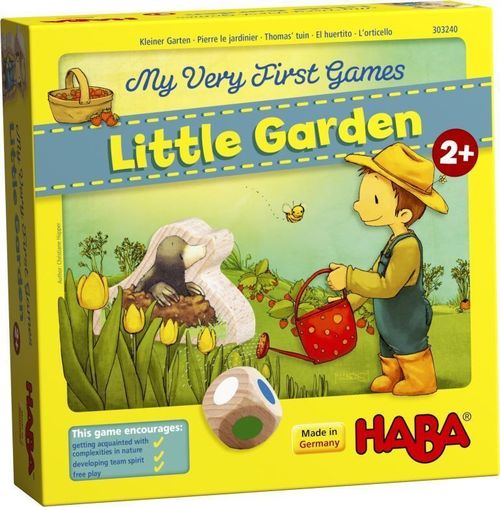
My Very First Games: Little Garden
My Very First Games: Little Garden Rulebook
Table of Contents
Table of Contents
Contents
1 game board, 1 Gardener Gabriel, 3 x 3 patch cards (strawberries, carrots and tulips), 1 Molly Mole, 1 molehill (= 3 tiles), 1 color die, 1 watering can, 1 wheelbarrow, 1 bucket of carrots, 1 basket of strawberries, 1 bouquet of tulips, 1 set of game instructions
Dear Parents
Thank you for choosing this game from the My Very First Games series. You've made an excellent choice, providing your child an opportunity to develop important skills by playing. These instructions provide you with many ideas on how you and your child can explore the game contents together, enjoying a variety of indoor gardening fun. At www.haba.de in the area 'Magazin', you will find further suggestions for outdoor gardening together. This game encourages your child's development in several areas, including fine motor skills, concentration, language skills and color recognition. But most importantly, your child will simply have a lot of fun playing while automatically learning at the same time.
Before playing, please take all cardboard pieces out of the plastic bag and dispose of the bag immediately.
Discovering details in free play
Before playing the game, you and your child can explore the game contents. Discover the delightful illustrations on the figures, the little patch cards and the game board. Talk together about Gardener Gabriel's garden, how the plants on the patch cards grow, and all the other details you'll 'unearth' while assembling the game.
Game board: In the springtime, you cannot see anything growing, yet. The earth is just brown. Gardener Gabriel has recently turned over two patches. He has put strawberry and carrot seeds into the fresh earth and watered them well. Last autumn, Gabriel had already planted tulips in the third patch. So now all he has to do is water the patch.
Big patch card (= dark brown backside): Gabriel spots the first plant shoots pushing out of the earth; they all look very much alike. The weeds also like to grow in the spring so gradually he will have to begin pulling up weeds here and there if he wants the plants to grow well.
Layer 2 (= medium brown backside gray): Now, Gabriel can clearly see the differences between the plants. The strawberries are flowering and the tulips have their first big buds. The carrots are quite bushy and green.
Layer 3 (= light brown backside): Red strawberries are hanging from the plants. The tulips have bright yellow blossoms, and you can clearly see the orange carrots peeking out of the earth. Hurray, it's time to harvest the garden!
The wooden figures invite your child to play out the various garden activities, for example: tending the patches with Gardener Gabriel, sowing seeds, watering, and harvesting. Or you can also invent a fun little Molly Mole story together.
For older children who are already familiar with the game, you can be more specific with your questions. For example: Can you find the striped cat? Have you spotted the spade? Where do the dandelions grow? Can you see the teddy? Where is the strawberry/ tulip/ carrot patch?
The Gardener Gabriel's Garden
A co-operative gardening game.
Before Starting to Play
Spread the game board in the center of the table and place Gardener Gabriel on any mole square. Molly Mole, the molehill tiles and patch cards are placed next to the game board, along with the die.
Let the game begin
The children proceed clockwise. The child who has been gardening most recently starts, rolling the die.
Ask the child: Which color do you see on the die?
- White/blue/green? Proceeding clockwise, move Gardener Gabriel to the next square of the same color.
Hint: The tip of Molly's nose always points in the direction Gardener Gabriel should move. She can help the children recognize which way to move.
Ask the child: Can you see Molly Mole on this square?
- Yes, there is Molly Mole! Molly Mole pays the garden a visit. Take the biggest of the molehill tiles lying next to the game board and place it in the center of the game board (earth face up). When all molehill tiles have been placed in the center, place Molly on top of the hill.
- No. Super! Gabriel now looks after his patches; take a good look at the patch cards. Choose any of the patches on the game board and place a corresponding big patch card there. If a patch card is already on the chosen patch, the child takes the next smaller patch card corresponding to the plant marker, and places it on top. And so, bit by bit, the plants grow.
Now, it is the next player's turn to roll the die.
The patches are laid beginning with the largest and working up to the smallest. The plant markers indicate which patch card belongs to which patch. You can integrate the little story you invented prior to beginning the game, drawing your child's attention to the different growth stages, how the plants look, and so on. This way you stimulate his/her vocabulary and language skills. The game playfully familiarizes children with the life cycle of garden plants (sowing, sprouting, blossoming, harvesting).
End of game
As soon as all tulips are flowering and all fruits have grown in the patches, i.e. all patch cards have been placed on the game board, the children have collectively won the game.
If, however, Molly Mole is sitting on top of her molehill before the carrots and strawberries are ripe and the tulips in flower, the children have unfortunately lost. This time Molly Mole was quicker than the little gardeners. So it's time to turn over the earth and sow some new seeds!
Variation for nimble gardeners
The game is a little more difficult if one or more tiles remain in the game box, making the molehill lower.
Variation for professional gardeners
This competitive variation is played according to basic game rules with the following changes:
- When setting up the game, also put the playing figures of the tulip bouquet, strawberry basket and carrot bucket next to the game board.
- When a player places the last patch card on a patch, as a reward he receives the corresponding figure.
- The one who collects the most figures, wins the game. In the case of a draw, there are several winners.
After the harvest
In Gabriel's garden everything is ripe and ready to be harvested. Talk with your child about what can be done with the harvest.
- Strawberries: A delicious strawberry cake for grandma? A pudding or simply savoring them fresh from the garden? How do you like to eat your strawberries?
- Carrots: A delicious vegetable soup with a dollop of cream? A colorful vegetable risotto with, for example, pieces of orange carrots, green peas and yellow pepper? A carrot cake? Do you know someone with rabbits or a pony that would just love to munch on a juicy carrot?
- Tulips: A nice springtime table decoration? Maybe your child likes to fold paper tulips or draw tulips.