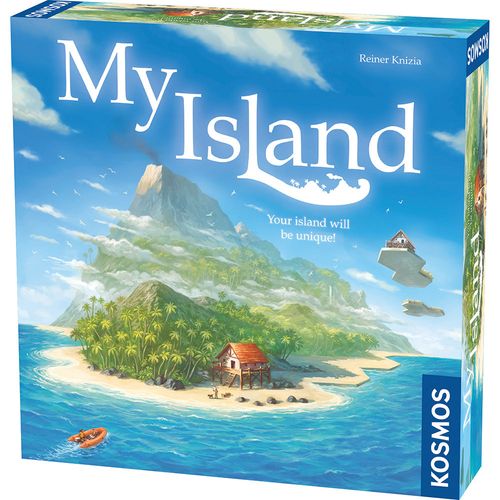
My Island
My Island Rulebook
Table of Contents
Table of Contents
Game Materials
- 4 Double-sided gameboards (each with progress circles, a scoring track, and rainforest, palm, heather, and beach spaces)
- 112 Tiles (4 sets of 28 tiles each)
- 8 Envelopes with game materials
- 4 Scoring tokens
- 28 Cards
During the game you will also need something to write with, such as a ball-point pen, for writing and drawing on your gameboards.
My Island is most appealing if the same group of players play and experience all the chapters together.
If you want to continue the game with different players, the new players will have to pick up where their predecessors left off and continue accordingly.
After each episode, note where you have stopped. That way, you can easily continue the next episode when you resume.
Each of the 24 episodes can be played on its own. However, the game was designed so that three episodes combine to form a thematic chapter. Gameplay for each chapter is about 90 minutes and is best enjoyed when played in a single sitting.
Important: No matter how curious you may be, do not open the sealed envelopes until you are playing the corresponding chapter.
Game Setup
- Before starting the first episode, carefully remove all die-cut pieces from their frames.
- Each player gets a gameboard and places it with the front side, which has an animal symbol at the upper left, face up in front of themselves. That will be the player's personal gameboard for all 24 episodes. At the start, all gameboards are identical. But during the course of the game, each player will be changing the gameboard. You will be applying stickers, developing new playing areas, and writing on the board. Don't worry: That's how it is meant to be played. After all, it's your board. Right at the beginning, you will want to give your island a name. Write it in the space at the top left next to the animal symbol.
- Each player gets a scoring token and sets it on the number 10 of their board's scoring track. This scoring token is used to indicate your points during the episode and, most importantly, at the end of the episode.
- Each player gets the 28 tiles showing their animal's color on the back sides. Just like the gameboards, each player's set of tiles is otherwise identical. Place your tiles face up next to your gameboard so they are all easily visible. There are various shapes of tiles which can be used to cover two, three, or four spaces. They show the following symbols: Field (yellow), House (brown), Wall (blue), and Path (green).
- Shuffle the 28 cards and place them in a single stack face down in the middle of the table. For each tile, there is one corresponding card. In each episode, you will place the tiles on your gameboard in the order in which you turn over the corresponding cards.
General Rules of the Game
There are some rules that — with a few exceptions — apply to all 24 episodes:
Each episode consists of a number of rounds. In each round, you turn over the top card from the face-down stack and place it face up in a discard pile. Each player takes the tile that matches the one depicted on the card and places it on their gameboard. All players place their tiles simultaneously. During and at the end of each episode, you get points, which you mark on your scoring track.
The player with the most or second-most points in the episode colors in two or one progress circles respectively. These are the circles at the top edge of your gameboard. These progress points will help determine the overall winner of My Island at the end of all 24 episodes.
The Placement Rules
- Each player must place the first tile in such a way that it covers at least one beach space.
- All the remaining tiles must be placed in such a way that they have at least one side adjacent to a matching symbol — house next to house, field next to field, and so on.
- In episode 1, tiles may be placed only on beach or heath spaces.
- At first, tiles may not be placed on palm and rainforest spaces. These spaces will only come into play in later episodes.
- Tiles may not be placed on top of other tiles that have already been placed.
- Once a tile is placed, it may not be moved.
Passing: If you cannot or do not wish to place a tile, you may pass. If you want to do this, place the tile in front of you with its back side facing up. You must also move your scoring token one step backward on the scoring track. In other words, you lose one point.
Important: If your scoring token is already on 0, you may not pass. If you still cannot or do not want to place the tile, you must end your participation in the episode. In that case, you will not be able to place any more tiles during the episode.
Ending participation in an episode: Each round, after a card has been revealed, each player always may decide whether to end their participation in the episode. If you wish to end participation, you announce this out loud. When you do this, you do not lose any points on the scoring track. You only lose a point if you pass but stay in the episode.
End of an Episode
An episode ends when all the players have ended their participation in it.
If this does not happen, an episode will end after all the cards have been turned over and the corresponding tiles have been placed.
Scoring
Then, each player's points are calculated and marked on the scoring track.
- During the episode, you will always immediately get one point when you place a house on a beach space.
- At the end of the episode, you will lose one point for each beach space that is still visible on your board.
- If your scoring token reaches 55 during scoring, immediately color in one progress circle. The scoring token remains standing at 55, even if extra points are added or deducted.
- If it happens that a scoring token drops under 0, the negative points are not excused. They are deducted from the next positive points earned.
Assessment of an Episode
After the points have been calculated, the episode is assessed. Depending on your ranking, color in progress circles on your gameboard as follows:
Assessment with three or four players:
- The player with the most points on their scoring track comes in first and colors in two progress circles.
- The player with the second-most points on their scoring track comes in second and colors in one progress circle.
- All other players are ranked as others and do not color in any progress circles.
Assessment with two players:
- The player with the most points on their scoring track comes in first and colors in two progress circles.
- The player with the second-most points on their scoring track is ranked as other and does not color in any progress circles. So in a two-player game, only the player with the most points colors in progress circles.
A special two-player symbol on the overview tables means that an instruction does not apply in a two-player game. In general, it is used to indicate that nobody gets second place. Instead, the player with the second-most points counts as "other."
Tie: If two or more players have attained the same point total at the end of an episode, the winner is the one who has the fewest open spaces in the top row (below the mountains) on their gameboard. If the result in the top row is also a tie, look at the next row, and so on.
The progress circles are found along the top edge of the gameboard. There are eight sections with ten circles each. Always color in the circles in one section before moving to the next. That way, you can easily see how many progress points each of you has.
Also, in accordance with your ranking (first, second, other), you will get various stickers that you will permanently affix to your gameboard or tiles. These stickers can be found in the sealed envelopes along with other game materials. Each envelope also contains one overview table, which summarizes the point allocation and assessment for each chapter.
After each episode, the gameboards are cleared and the scoring tokens are set again on the number 10. In the next episode, you will once again place the tiles on your island.
Example: Tina has placed seven houses on beach spaces. For that, she received seven points during the episode. She passed once, for which she had to move her scoring token back one step on the scoring track. Because she was unable to play the triple tile shown at the bottom of the illustration, she ended her participation in this episode without having to lose any points. At the end of the episode, she has to move her token two steps back on the scoring track because there are still two beach spaces visible on her gameboard (outlined in red). She does not lose any points for the visible heather spaces (outlined in white).
If Tina had passed instead of ending her participation in this episode, she would have had to move back one step on the scoring track, but she would have continued to participate in the episode. On the other hand, she would have risked losing even more points due to additional passes.
The Sealed Envelopes
The eight sealed envelopes are a special feature of My Island. Inside each envelope, you will find a rule sheet containing a few new rules for the three episodes in that chapter.
You will also find an overview table. The left side of the sheet summarizes how points may be won or lost. Some points are won immediately during an episode. Other points (and, later on, other rewards) apply at the end of an episode.
Example from the overview table for episode 1:
| Episode | Rule | Points |
|---|---|---|
| 1 — Only place on beach and heather spaces | Immediately: Tile not placed | −1 |
| Immediately: House placed on beach space | +1 | |
| End: Visible beach space | −1 |
On the right side of the overview table, you will see the assessment for the relevant episode. This indicates who colors in progress circles at the end of the episode. In addition, you will see who receives the stickers that are also found in the envelope. Some of the stickers are allocated at the beginning of an episode, but most are assigned at the end.
To apply the stickers to your gameboard at the end of an episode, you will first have to clear away all the tiles from the gameboard. The game will tell you where to affix the stickers.
In addition to stickers, some of the envelopes will have other materials that will be used in the game.
The First Chapter
Now that you know all the important rules, you can begin your My Island adventure.
You already know that there is one sealed envelope for each chapter. You may now open the first envelope: Chapter 1: Arrival — Episodes 1 to 3.
The envelope contains one rule sheet, one overview table, and one small sheet of stickers. Display the overview table so that all players can see it easily and keep the sheet of stickers handy. If there are stickers or other materials that you have not used at the end of a chapter, keep them in the box. Read the rule sheet for Chapter 1 and place it in this rulebook after you have read it. Now you can begin your first episode.
Legends
Space legend: Rainforest space, Palm space, Heather space, Beach space. (A rainforest space marked with a small square has special significance in later episodes.)
Tile legend: Field (yellow), House (red), Wall (blue), Road (green).
The Eternal Game
Have you played all 24 episodes? If so, you have enjoyed a unique gaming experience. You have guided the development of your very own island and uncovered its mysterious secrets through eight chapters.
But My Island is not over. If you want to keep exploring your island in competition with other players, you will find a version of the game on the back of your gameboard that you can play again and again. It more or less corresponds to episode 9 of the legacy game.
You can also play it with friends who are not playing the legacy game with you. In that case, however, at least one of you must have played episodes 1 – 9.
Game Setup
-
Each player takes a gameboard and places it in front of them with the side without the animal symbol facing up.
-
Each player takes a scoring token and places it on the number 10 of the scoring track. This token will be used to mark your points during the game, and most importantly, at the end of it.
-
Each player takes a set of 28 tiles all showing the same color on their back side. Lay your tiles face up next to your gameboard so they are all easy to see. There are tiles that will cover two, three, or four spaces.
Important: If you have already completed the legacy game, you will have four additional tiles with your color on the back. Separate those ones out, because they will not be used in the Eternal Game. You will only use the 28 tiles shown on page 2 of this rulebook. You may also ignore the stickers that are on some of the tiles. That means, for example, that each space with two wall symbols counts as one wall symbol.
-
Shuffle the 28 cards and place them in a single stack face down in the middle of the table. For each tile, there is one corresponding card. In each game, you will place your tiles in the order in which you turn over the corresponding cards.
Important: If you have already completed the legacy game, you will have four additional cards in the deck. Take them out; these are not used in the Eternal Game.
-
Place the following cubes in the center of the table: 12 yellow cubes, 12 brown cubes, 12 blue cubes, and 16 green cubes.
Course of Play
Each game consists of a number of rounds. In each round, you will turn over the top card of the face-down deck and place it face up in a discard pile. Each player takes the tile matching the one depicted on the card and places it on their gameboard. All players place their tiles at the same time. During and at the end of each game, you receive points, which you mark on your scoring track.
The Placement Rules
- For each player, the first tile must be placed in such a way that it occupies at least one beach space.
- All other tiles must be placed in such a way that at least one side is adjacent to a matching symbol — house next to house or field next to field, for example.
- Tiles may be placed only on beach spaces, heather spaces, and palm spaces.
- Tiles may not be placed on rainforest spaces.
- Tiles may not be placed on other tiles that have already been placed.
- Once a tile has been placed, it may not be moved.
Passing: If you cannot or do not wish to place a tile, you may pass. If you want to do that, place the tile in front of you with its back side facing up. You must also move your scoring token one step backward on the scoring track. In other words, you lose one point.
Important: If your scoring token is already on 0, you may not pass. If you still cannot or do not want to place the tile, you must end your participation in the game. In that case, you will not be able to place any more tiles during this game.
Ending participation in a game: Each round, after a card has been revealed, each player always may decide whether to end their participation in the game. If you wish to end participation, you announce this out loud. When you do this, you do not lose any points on the scoring track. You only lose a point if you pass but stay in the game.
Farm / Village / Fortification
Try to form groups of adjacent spaces with five or more of the same symbols:
- Farm = 5 or more field symbols
- Village = 5 or more house symbols
- Fortification = 5 or more wall symbols
When a player places a tile to complete a farm, village, or fortification, they immediately get three points and advance their scoring token accordingly. Then, they place a cube of the corresponding color (farm = yellow, village = brown, fortification = blue) on this group of symbols to indicate that it has already been scored.
If an already-scored group is later enlarged with other symbols of the same type, it remains one single group. That is even the case if it attains or exceeds an overall size of two groups (ten or more symbols of the same type). Even in that case, no additional points will be allocated, and no additional cube is placed.
If there are two separate groups of symbols (that have already been scored and marked with cubes) and they are later joined to become one single large group, nothing happens. The previously-awarded points are not retracted.
Note: The number of farms, villages, and fortifications is not limited by the number of cubes. If there are more than 12 of any one of them, you may use any suitable substitute material from around your home to mark that they have been scored.
Road from Statue to Sea
There are four statues at the edge of the rainforest. Building roads from these statues to the sea will earn you points. To do that, you will have to create a continuous line of adjacent path symbols connecting a statue with the sea. The road must connect a path symbol that is adjacent to a statue to a path symbol covering a beach space. The rainforest space with the statue itself must not be covered.
When a player places a tile to complete a road from a statue to the sea, they immediately get five points. Only one road to the sea may be scored for each statue. Place a green cube on the statue to indicate that it has been scored.
A road from a statue to the sea does not need to be in a straight line.
A road may branch and connect more than one statue with the sea. In that case, each statue earns you five points.
End of the Eternal Game
The game ends when all the players have ended their participation in the game. If this has not happened, the game will end after all cards have been turned over and the corresponding tiles have been placed.
Then, each player's points are calculated and marked with the scoring token on the scoring track. The player with the largest group of adjacent symbols of a given type gets five points. In case of a tie, each of the players involved will get the full five points.
- Largest farm: + 5 points
- Largest village: + 5 points
- Largest fortification: + 5 points
- Largest path system: + 5 points
At the end of the game, you will lose one point for each beach space still visible on your gameboard.
The player with the most points is the winner.
Tie: If two or more players have attained the same point total at the end of the game, the winner is the one who has the fewest open spaces in the top row (below the mountains) on their gameboard. If the result in the top row is also the same for both players, look at the next row, and so on.
End-of-game example: During the game, Tony completed two villages, two farms, and one fortification. He got three points for each (= 15 points). He also built roads connecting four statues to the sea. That earned him another five points per road (= 20 points). He passed once, thus losing one point. At the end of the game, he gets another ten points for having the largest village and farm (his seven houses give him the largest village and seven fields give him the largest farm). The points for the largest fortification and largest path system go to the other players. Ultimately, Tony loses three points for the three visible beach spaces on his gameboard. In total, he gets 41 points.