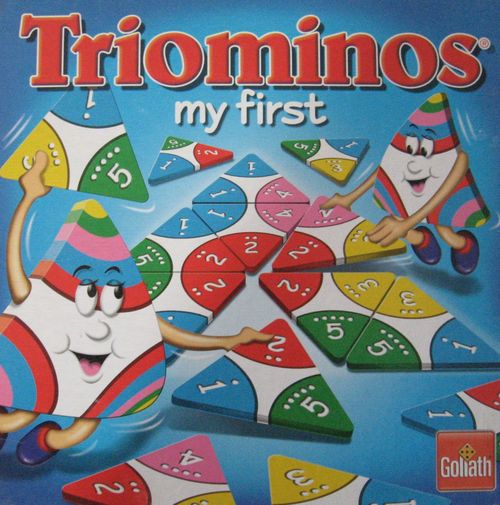
My First Triominos
My First Triominos Rulebook
Table of Contents
Table of Contents
Components
- 36 Triominos, including one joker
- 60 coins
- 4 coloured racks (one per player)
- This rules sheet
Level 1: Discovering the Triominos (from 4 years)
Goal
Be the first player to place all of your Triominos.
Setup
Give each player a rack. Set aside the joker and the coins. Spread all the remaining Triominos face down on the table to form the draw pile.
Each player draws 5 Triominos and places them on their rack.
Draw one Triomino to serve as the starting point and place it in the centre of the table, face up. (Example: the first Triomino is fig. A.)
Playing the Game
The oldest player begins.
On your turn, try to place one Triomino. It must share at least one side with a Triomino already on the table, and all numbers, colours and symbols that touch each other must be identical (fig. B). The positions shown in examples C and D are not allowed.
Attention: all numbers, colours and symbols meeting at the same point must be identical (fig. F).
Play then passes clockwise to the next player.
If you cannot place a Triomino, you must draw a Triomino and place it on your rack. Then play passes to the next player.
End of the Game
The winner is the first player to place their last Triomino.
The game also ends if the last Triomino of the draw pile is drawn. The player or players with the fewest Triominos on their racks win.
Level 2: Managing Points with Reward Coins (from 5 years)
Goal
Earn as many coins as possible by placing your Triominos.
Setup
Give each player a rack. Spread all the Triominos, including the joker, face down on the table to form the draw pile.
Each player draws 5 Triominos and places them on their rack. Each player also takes 4 coins from the bank.
Draw one Triomino to serve as the starting point and place it in the centre of the table, face up. (If it is the joker, return it to the draw pile and draw a different Triomino.) Example: the first Triomino is fig. A.
Playing the Game
The oldest player begins.
On your turn, try to place one Triomino. It must share at least one side with a Triomino already on the table, and all numbers, colours and symbols that touch each other must be identical (fig. B). The positions shown in examples C and D are not allowed.
- If you placed a Triomino, you receive one coin. Play then passes clockwise to the next player.
- If you could not place a Triomino, you must draw a Triomino and place it on your rack, and pay one coin to the bank. Then play passes to the next player.
End of the Game
The game ends when a player plays the last Triomino from their rack. Finish the round of play before counting coins. The player with the most coins wins.
The game also ends if the last Triomino of the draw pile is drawn. Each player counts their coins, and the player with the most coins wins.
The Joker
The joker replaces any number, colour or symbol.
The joker is the only Triomino that may be taken back from the table and returned to your rack. To take a joker that is on the table, replace it with one of your own Triominos that matches exactly the place where the joker was (fig. E). This exchange does not earn a coin.
You may use the joker on a later turn.
Note: the French source reads "ffVous pourrez utiliser le Joker", which contains a typo; it is transcribed here as "You may use the joker on a later turn."
Figure Key
The rules sheet refers to six figures, A to F. The illustrations are not reproduced in this text; the key below describes what each one is referred to for in the rules.
- Fig. A: an example of a starting Triomino, used for the first Triomino of the draw in both levels.
- Fig. B: an example of a legal placement, where the Triominos share a side and every touching number, colour and symbol is identical.
- Fig. C and Fig. D: examples of placements that are not allowed (crossed out).
- Fig. E: the joker exchange, where a player replaces a joker on the table with their own matching Triomino (Level 2 only).
- Fig. F: the rule for matching at a shared point, where all the numbers, colours and symbols meeting at the same point must be identical.