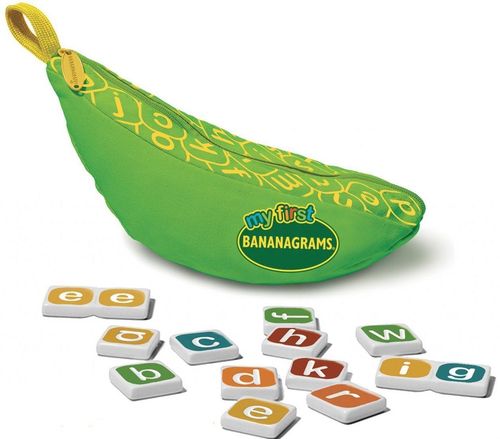
My First Bananagrams
My First Bananagrams Rulebook
Table of Contents
Table of Contents
Special Features
- Lowercase letters: help reinforce early reading skills.
- Baseline: elevated bottom indicates letter orientation.
- Combo-letter tiles: make word-building easier!
- Vowels are yellow! a, e, i, o, u and y (sometimes).
- Letters have personalities! Some letters are reversed by children. Colors and differently shaped letters give each tile a distinct identity so they're easier to tell apart. Examples: b and d, p and q, m and w.
What's Inside?
80 single-letter tiles. Number of each letter:
- a 6, b 2, c 2, d 3, e 8, f 2
- g 2, h 2, i 5, j 2, k 2, l 4
- m 2, n 4, o 5, p 2, q 2, r 5
- s 4, t 4, u 2, v 2, w 2, x 2
- y 1, y 1, z 2
The letter "y" can be used as either a vowel or consonant.
Combo-letter tiles:
- Vowel teams: ai, ea, ee, oo
- Word families: an, at, et, un
- Digraphs: ch, sh, th, wh
- qu
How to Play
Setup (1 to 4 players)
- Place all 80 single-letter tiles facedown in the center of the table. These form the BUNCH.
- All players take 15 single-letter tiles.
Note: There will be leftover tiles at the end of the game.
Game Time
Object: Be the first to use all your letters in a connected word grid without a spelling mistake, proper noun, or abbreviation.
Example grid (words shown): four, who, ax, zoom, with q and i connecting.
- To start, any player calls out, "SPLIT!" Everyone simultaneously turns their tiles faceup and races to arrange them in their own intersecting word grid. Words must read left to right horizontally, or top to bottom vertically. IMPORTANT: You may rearrange your grid at any time, and as often as you like.
- At any time during the game, you can say, "SWAP!" and put one of your tiles back, facedown in the BUNCH. Then, you MUST take a tile to replace the old one. This has no effect on other players, and there's no limit to the number of times you can SWAP out tiles.
Advanced Play (1 to 4 players)
All players take 2 combo-letter tiles and 15 single-letter tiles. Mix in the combo-letter tiles facedown with the single-letter tiles. Combo-letters can only be used horizontally, but can be built upon vertically. When SWAPPING, you MUST take a single-letter tile for a single-letter tile, or a combo-letter tile for a combo-letter tile in exchange.
Winning!
When you use ALL your letters in a connected word grid, call out, "BANANAS!" Play stops, and everyone inspects your completed grid.
If someone spots a misspelled word, proper noun, or abbreviation, they may call out, "SPOTTED BANANA!" Don't worry, you can fix your grid, because the game now resumes for ALL players.
Play continues until someone again calls out, "BANANAS!" The first player to complete a grid correctly wins, and is declared TOP BANANA!
Too easy? You're ready for our original Bananagrams! Too hard? Try our mini-games.
Mini-Games
Here's where we focus on tools to build word grids. Caution: There's silliness in the mix!
- Preschooler - goal: recognize letters
- Early reader - goal: build words
- Reader - goal: intersect words with other words to make simple grids
All mini-games can be played as group games by adding a "race to the finish."
Preschooler
Spell your name. Find all the letters to spell out your name in tiles. Also try spelling names of friends and family members.
ABC's in order (1 to 2 players or teams). Create the alphabet with the single-letter tiles. For an extra challenge, pick 3 random tiles and put them in alphabetical order.
Letter match. Place single-letter tiles faceup to start. Pick a letter, find its match.
Race time! Place all 80 single-letter tiles facedown in the center of the table. Now race to find all of the yellow letters by flipping them over as quickly as possible. Whoever has the most wins! Try this with all of the colors!
Early Reader
Sound it out. Pick a single-letter tile. Think of words that start with that sound. Try to spell some of the words using tiles. (Example: for "s": sand, sun, sea, saw, seek, seal, soul, sum, safe, sag, sub, sail, suds, smile, sad, seat, say, socks, seven, seed, sign, set, sew, sit, salt, soap, silly, so, size.)
Word families. Combine consonants with combo-letter tiles. Then, pair vowels with combo-letter tiles. (Examples: c + at; sh + e.)
Rhyme time. Pick a combo-letter tile. Then, try a bunch of consonants to make rhyming words. (Examples: j, m, w, l, g + et.)
Matching game! Place all single-letter tiles facedown. On your turn, flip over two of them. If none of the letters match, leave them faceup. Players take turns flipping over tiles. Keep any matches. The player with the most tiles, wins! Note: There may be leftover tiles at the end of the game.
Reader
Vowel power. Use the ai, ea, ee, oo tiles. Add beginning and ending tiles to make four-letter words. (Example: y + ea + r.)
Diggity digraph. A digraph is a single sound, which is represented by two letters. Here are 4 examples: sh, wh, ch, th. Try adding a letter at the beginning or end. (Examples: a + sh, m + o + th, wh + o, ch + a + t.)
Criss-cross. Try making a simple word grid. When creating words vertically, spell them out from top to bottom.
- Create a simple word. It's easier to start with a three-letter word, preferably with a vowel in the middle (e.g. top).
- Make the word again, reading from top to bottom.
- Find more letters, and form a word cross (e.g. dog crossing the "t"/"o" column).
Online
Check out bananagrams.com for fun printable activities, including reader activities. Contact [email protected] if you have more game ideas. If you post online, include #myfirstbananagrams.